Inspiring Leaders to Innovate Together | Thomas Anglero
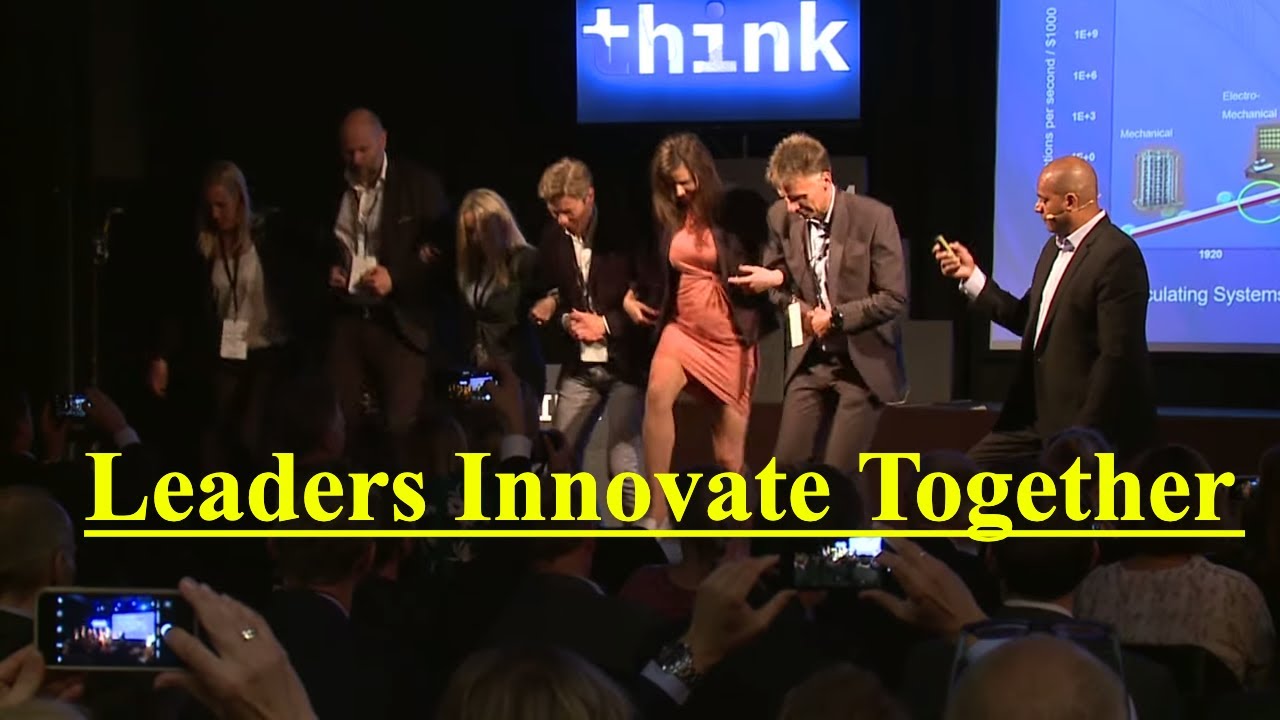
This content was created by Thomas Anglero. This content was uploaded by Thomas Anglero. This is a YouTube video titled "Inspiring Leaders to Innovate Together | Thomas Anglero" (uploaded/recorded 2019-08-09). The excerpt is from a live keynote/presentation featuring Thomas Anglero with exchanges involving Anna Wessenthaler, an unnamed English-speaking presenter (labeled Speaker C), and audience members (e.g., Antti, Doug). The talk is an energetic, multilingual (primarily English with some German/Norwegian phrases) presentation about innovation — telling stories like Kodak and Corning, describing IBM's strategy of repeatedly "jumping" to new technologies, urging leaders to take risks and partner, and ending with an audience participation "jump" moment and award references.
Chapters
Gratuliere alles zusammen, Englin liegt uns noch ein bisschen vor, deshalb werden wir den IBM Award voran— IBM's "Durch den Nerd", den würde ich mal nennen, vorher dann, nächste Woche, weil wahr. Meine Männer, ihr seid alle zusammen Herr EO-Englin-Winner. Sehr schön, Sie können einen Applaus vor allen auslösen zusammen.
Aubie, meinah hört, ich trule wirklich auf mein volles Hirn und like le zusammen, freu udah man skoppa in wa schoon. Oi i bam so haw wi over 3000 Foschera zum Sitte, o ja, eijat li like kose war dag for o skoppni technologie zum biedrateni in wa schoon. Kuschen klaart wi, for example, of litwo atoom? Jo, de wa nahtop jan um like.
Oida achtlan, wi werd e gu po o law gelekke o go lekke sur e Usah.
Ore haiokum valimi e bravrajasa, ve haioblan tana?
The hamburger.
The light bulb.
The pickup truck.
Brad Pitt.
The movies.
The computer.
Coca-Cola.
Hollywood.
The Kardashians.
The Intel processor.
IBM, of course.
Hooters.
The credit card. Super Bowl. McDonald's, McDonald's, Kentucky Fried Chicken and a pizza. Øya, og det var alle vetka he for dei, un amle Star Wars.
Ich heiße Anna Wessenthaler.
For the man of the full glee, Iba Ams, er gen Director of Innovation. Live from Oslo, straight in from New York City, tech founder and one of Norway's most sought-after presenters.
O kannte er na damnsom er ser alla mast up till.
No pun intended there, forse du var.
Please welcome Thomas Anglero on stage.
Thank you.
All right, I am the last thing before all you get to eat. So I'm gonna try to do my best job so you have something to talk about other than everything that's happened. Is that good? Yeah? So there's some really interesting things that I've heard today. Today was an amazing day because I saw the Probably the most attractive Darth Vader I've ever seen in my life. Yes? Yeah? I saw a Dane actually admit that Danes are the ugliest people in the Nordic countries. I wasn't the only one that thought that was weird? But I disagree with one big one. Some things were said about the Finns today. And I think Finns are amazing. So I'm dedicating this entire presentation to Finns because many years ago when I first came to Norway, I worked with Eriksson, and we had these Finns in Finland. No matter what, these people innovated like mad. Eriksson would say, "Don't do it." They would do it, and they would prove the world wrong. They actually were a huge inspiration for me to be innovative. So that's why I was innovation director at Skaptitan, now I'm an innovation director at IBM. And so everything you see here is inspired by these massively phenomenal Finns. So any Finns out there? One Finn. What's your name? I can't pronounce that. Antti. This is for you, Antti. What did he say? I can't understand a word they say, but I love you anyway. God bless Finland. But I'm serious, I met these Finns, and they pushed me out of my comfort zone. They made me think, you know, I thought I was good, I thought I was an executive, I thought I knew what I was talking about, but to be innovative, to be innovative, you know you're innovative when everybody hates you. Think about that. And all of you being Norwegian, Norwegians don't want to be hated at all. Vi mobbi hägglimme salmon? You get that? "Otta gay, otta bra, freida koken tu, vi got the hitter, jatta da." But nobody wants to be hated, but innovation costs. Innovation costs massive amounts, and you have to really— you know, they say step out your comfort zone, but to be innovative, you have to be willing to stand there by yourself, you're the only person in the world. You have a picture in your head, you have an idea, you wake up in the morning, you go, "This idea has to be born." Do any of you wake up in the morning and go, you know, you wake up and your wife or your husband or whoever sees you jump out of bed and you go, "Yeah!" Anybody?
You do?
Seriously? How does she handle it? Or he handle it? I don't know which way you go. Does it work? Does she pull you, he pull you back in bed? No, no. Doesn't work. Nah, just kidding. That is what it takes. You know, that's what it takes. So let's talk about the Kodak story. All of you know the Kodak story? Y'all and I. This side of the room says something, this side of the room— Y'all and I. Y'all. What? Y'all and I. Y'all.
Y'all. Y'all.
You guys need food. The Kodak story, what you think about the Kodak story is actually not the true Kodak story. Do you guys know who that guy is? Other than his name is Steve Sassoon. Does anybody know who he is? He's the inventor of the world's first digital camera. And there it is. It's 7.5 kilos heavy. Now you have to understand, when this happened back in 1975, when this picture was taken and he invented that camera, Kodak was number one in every single market in the world, every single town, every single city, every single store. They sold Kodak cameras, film, everything. Everything was Kodak. And this guy— I'm using the Darth Vader mask as a prop, it's OK? So this guy came out with this really ugly thing. See how hideous that thing is? And he went down through the halls of Kodak, and he went to every vice president's door. He said, "Will you invest in my idea?" "Ja or nein?" "Nein." "Nein." Schick wie ein Ohrsk. "Will you invest in my idea?" Say "nein." "Nein." She enjoyed that. "Will you invest in my idea?" "Nein." With attitude. "Will you invest?" "Will you invest?" You see how everybody's worried that I'm coming to them? Imagine what Steve felt when he went down the halls of Kodak from vice president to vice president with his dream, that idea, just like you had when you woke up in the morning, this idea has to exist. Because Steve did not quit, because Steve said, "You know what? This ugly thing, this ugly thing is going to change the world." Because of that, every single one of you— you got a digital camera, you got a mobile phone, right? You have pictures in there of people that mean everything to you, yes? Yes? When you take a picture of your granddaughter or your daughter, she's doing something wonderful, and you capture that moment of that person you love. Do you guys think of saying, "Thank you, Steve"? Yah elonay. Why not? How come he's not famous? How come when we think of innovation, we think of Elon Musk? We think of Steve Jobs. How come the guy He's the reason why every moment that I have in my phone of capturing the people I love, I was at the top of this mountain Kilimanjaro, all these things I've done in my life, because of him, because he was all alone, because he was willing to take that journey by himself and he heard, "Nai, nai, nai, nai." He persisted and did not quit. Because of him, all of those amazing moments that in your personal life have been captured, is because of a guy like him. That's innovation. It's not just a cool word, it cost. He's not rich. He didn't make any money. Kodak went concurs. But all those moments in your mobile phone have been captured because he didn't stop. He thought this ugly thing was worth it. How many of you wake up in the morning and go, "It's ugly, but it's going to change the world." That guy changed your world. Next time you take a picture, instead of thanking your little pretty little daughter or whatever like that, "Takskarawa, Steve." Do you guys know the Kodak story now? That's the true Kodak story. Innovation costs. Anybody seen these before? Anybody been to Mumu's house lately? Besta Moore's house? Anybody even visit them anymore? It's funny now, right? 20 years ago it was an embarrassing question. Today it's like, let me send her an SMS or see if she's on Tinder. But I guess, now Mumu wouldn't be on Tinder, would she? Anybody's Mumu on Tinder? No. Is that a politically correct question? I don't know. This is Dow Corning. Dow Corning, back again in the '70s, they were the number one pots and pans company in the world. They're 160 years old. They know their pots and pans. Does that look very innovative, anybody? It's boring as hell, right? It's a pots and pans. The CEO of the company, again, they were number one in every kitchen in the world, the same thing. The CEO of the company woke up one day and said, "We have more money than God." We are making billions of dollars in the 1970s. That's a hell of a lot of money. He goes, "We're number one in every market, this is not good." So what he did was he took 3 of his engineers, 3 people, he says, "I'm giving you 1 year, go outside of the company, you have unlimited budget, come back in 1 year right here and tell me where's the future of our company." Will any of you ever do that to your employees? Any of you? Who's that innovative? Who's willing to risk the entire company, you're number one in every market, Are you willing to give your entire future to 3 people, 1 year? Anybody, raise your hand. The lights are in my eyes, I must be blind, I don't see any hands up. No one? Uff, oh my. Here we go. 1 year later. 1 year later. The 3 engineers came back, and they said, "Sir, we're not a pots and pans company, sir. We're a glass company. We know glass. And the entire future, sir, the entire future is going to go into this thing called the Internet, sir. And because we know glass, we've created, sir, the world's first fiber optic cable." and in the future all communication shall go through is about a 10-centimeter piece of glass. So this is about it. That's what they had. They went away and they came back after 1 year and that's all they took out of their pocket. Would you have freaked out? Uncomfortable laughter. And they said in the future this thing called the internet, all communication will go through this piece of glass, sir. A glass company. The CEO said, "I believe you." He then went into his board of directors, presented it, they told him two things are going to happen: number one, you're fired; number two, we're committing you to a mental institution. You're crazy. But because the CEO did not quit, today, every time you use the internet, did you know that that fiber optic glass, that optical fiber, Came from Mumu's kitchen. Did you guys see the internet in that? Do you understand what innovation is? Innovation is the ability to look at something that you may see every single day of your life that doesn't get you excited, and you're able to see the future, a future that hasn't happened yet. Do you get it? That's innovation. By the way, those are the guys. Look at the top right corner, the black and white picture, that's really important. They look like normal people, right? They look like your nabu, the person you hang out with when you see in the hitta, right? They're nothing special. You don't have to be a guy in a turtleneck sweater, be really cool, have a lot of money, you know, to be innovative. They're not the most handsome people in the world. Anybody think they're handsome? Raise your hand.
Seriously?
She's just kidding. Gotta talk to you later. And here they are today. I think this is really, really important. When you are thinking about the future, when you have a new project and you're saying, you know, we have to be innovative, you have to get rid of all the pictures that you have in your head that the media's been giving you, and you gotta put this picture in your head of those guys, balding, horribly dressed, blah blah blah blah blah, that's the future. They created the Internet! What will you and your employees create? Do you get it? That's where the Internet was born, in the kitchen. That's who gave birth to it. Within you, within your people, are the future. You just have to be able to trust in them. By the way, the CEO wasn't done. Corning got really happy, they said, "Wow, we're a really innovative company, we gotta do more." Everybody have a mobile phone? What's the name of the glass on the mobile phone? Gorilla Glass, made by Corning. Corning Gorilla Glass is on every mobile phone in the world, Huawei, Apple, blah blah blah blah blah. Is corning Gorilla Glass. It's corning. Did you see the world's largest mobile phone when you saw Farrah Buck the Cable? Did you see the world's largest mobile phone when you saw that? From that picture, from that kitchenware that's so boring, when I first put it up, a lot of people were like, "What the hell is this?" Gave birth to the internet, and it gave birth to a huge movement in mobile phone telecom. Did anybody see that when they saw that picture. Innovation costs. You have to look beyond what you see in front of you, and you have to dream. If you have crazy people in your company, you go, "Hana lig gaal, was hem haan?" Or I'll be very Norwegian. Can I do the Norwegian joke? Right? What do Norwegians do 2 minutes before they go to lunch? "Skalvis fiskes salmon, skalvis fiskes salmon, skalvis fiskes salmon." Do you guys not do this before your lunch? You guys don't laugh at yourself? You should watch yourselves, it's really funny. My point is this, when you guys go like a herd, you know, it's like 2, 3, 5 people all going to the cantina at the same time, and there's one person sitting all by themselves, that one person is like this guy, what's your name by the way?
Doug.
Doug, it's just like Doug. That one person sitting by themselves in the cantina is just like Doug. He woke up in the morning and he says, I have an idea that has to give birth, that has to give birth. Do you get it? Innovation ain't pretty. Innovation is doing something that no one else has ever thought before. Of course people don't get it. They're not supposed to. They're not supposed to. Does everybody get what I'm saying? Does everybody want to do something stupid now? Nein. You guys are being too Norwegian. That's okay. This is the problem and this is the challenge that we are having and that all you are feeling right now. The left side, this is where all the companies are today. We're based on profit, not purpose. The right side is where society is not going, it is today. This is the whole Airbnb, the whole Uber, the whole crowd sharing, all these technologies. What's going on? Why are these people doing this? Things for free. What's happening with the dynamic of business? It's all here. This side here, we had hierarchies, we have bosses that says, "OK, I have an innovation project." Do any of you have— the innovation is a box. Anybody have that in their company? If you have an innovative idea, put a card in a box. Would we have seen innovation and all that other stuff if you had a card in a box? This world here of hierarchy, controlling, planning, privacy, it is dying. This is the thing, to transition from this side to this side, from hierarchies where I am your boss, you must report to me, all ideas must go through me, to this new world, to this world of networks where we share everything. Open source. I'm not doing this for money, I'm doing this because it moves me, because it gets me excited. This side of the world is exploding. I know a kid in Vidigona School, he's 17 years old, he makes a million dollars. Did any of you make a million dollars when you were 17? Raise your hand, other than Dog, you don't have to raise your hand. By the way, Dog, you married? Damn, okay. Trying to get you a date, Dog, you should have said no. This kid's 17 years old, he goes to video going to school, and his teacher, he told me his teacher was writing on the board, and you know, he was bored, falling asleep in class, it was so boring, and the teacher turned around, she says, "You're not gonna get to your," sorry, Teacher said, "You're never gonna be anything. You're never gonna turn out to be anything." The kid is 17 years old, he's making $1 million a year selling stuff from China and then dropshipping it all over the world. What is the goal of everybody in this room? One of your goals, to make a lot of money. If you were Vinnie going to school and you made $1 million a year, what's your goal now? This side here is huge. You got kids, teenagers who are already achieving all the things we try to achieve over here, they're achieving it at 17. They're working in a different world. This is why these things— crowd sharing, all this stuff is exploding. They work in a different way. They made a huge jump to this new world. So I want to end this presentation by just explaining to you one thing: the IBM story. And I like to explain it in one simple way. It's about jumping. IBM. It's been around for over 100 years, long, long time. And how do you stay such a large IT company for so long? Real simple. You create a technology, when you create the technology, you have high margins. Over time, the margins shrink, and when you get to the end saying, "God, you know what, our margins are not so good, we have to create a new technology," and then you gotta jump. Boom, you have a new technology, nice high margins, and you keep on repeating the cycle. When you get to that precipice at the end saying, "What are we going to do?" Everything is change. You have to jump. IBM jumps every time. It risks the entire company. Today we're cloud, today we're cognitive. We've jumped again. And the most important thing I got to tell you from today, and the whole purpose, the whole purpose of today, is that IBM cannot jump alone, and nor neither can you. IBM and partners jump together. We've been jumping for 100 years. We know how to jump. But one thing we know is we jump best when we jump with our partners. Those are partner jumps. Those aren't IBM jumping by themselves. So my last thing I want to say is, does anybody want to jump with me? Anybody want to come on stage and jump? Show some— please, come on up, come on, come on, come on. We're going to jump together. Come on. See, look, anybody else? Anybody who won an award want to jump? Come on up. There we go. Good. Come on, come on, come on. I need some more women. Any more women left in the crowd? Too many men up here. Yeah, please, come on. There we go. There we go. Men, girl, boy, girl, boy, girl. Oh my God, a lot of women. Fantastic. Okay, stand at the edge, stand at the edge. Put your toes at the edge. Fantastic. Okay, toes at the edge. Okay, good. Now I want you to look down. Think about the challenges you have in your company, right? Don't look at me, look down! What the hell? Okay? Everything is changing, technology is changing, your boss is yelling at you, he needs innovation or she needs innovation. What am I going to do? How far down does it look? Looks pretty far down. You're not alone. Everybody, put your arms together, put your arms together, put your arms together. In life, when you need somebody, you pick up the phone and you call your best friend, you say, "I have a problem," and your best friend talks to you. All of a sudden it's so kuschelig, isn't it? Isn't that wonderful? Jump! Jump together! Un, two, tre! Thank you very much!
More from Thomas






IBM Watson AI Lab for Cancer presentation to Ullern HIgh School / Thomas Anglero

Will You Lose Your Job to AI / Oslo Business Forum / Thomas Anglero & Richard Qwest



