Thomas Anglero Keynote Speech for IBM (Bødo, Norway)
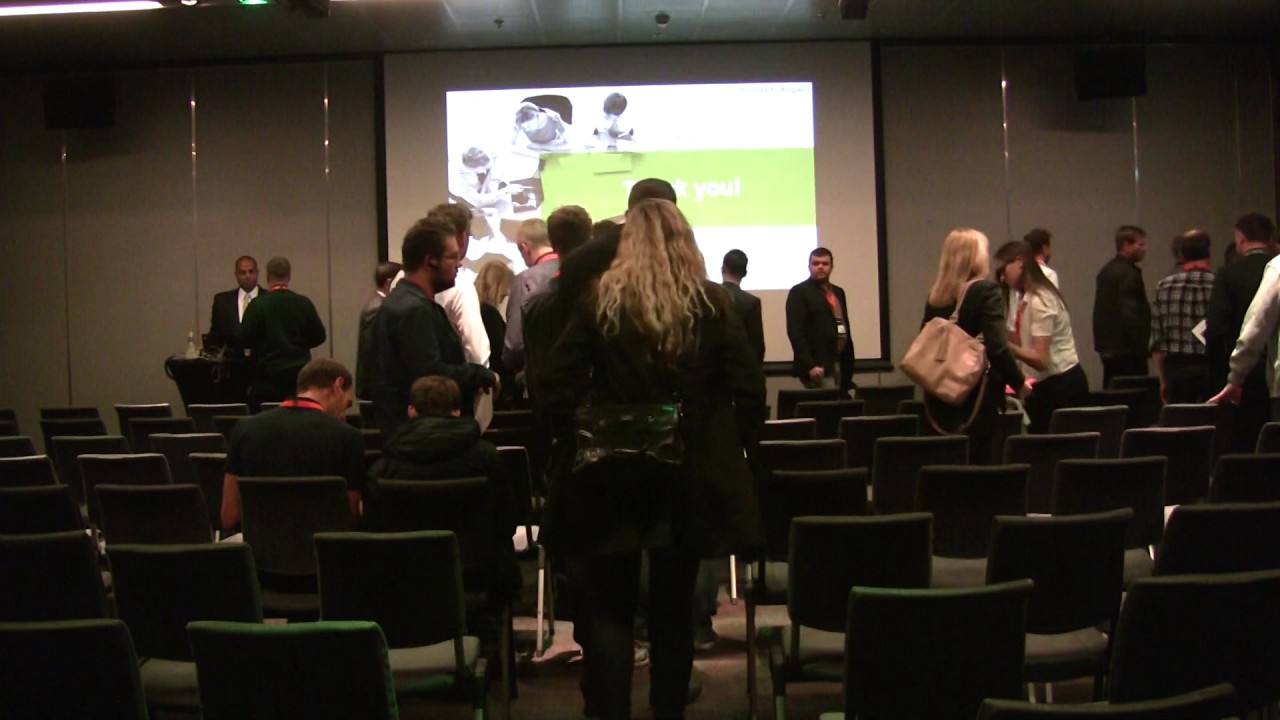
This content was created by Thomas Anglero. This content was uploaded by Thomas Anglero. This is a YouTube video titled "Thomas Anglero Keynote Speech for IBM (Bødo, Norway)" (uploaded/created 2016-12-22). The excerpt is from a live keynote/presentation by Thomas Anglero delivered to an audience in Bodø, Norway on the topic of IBM Watson, big data and analytics. Anglero describes multiple Watson use cases (predictive policing, U.S. Postal Service logistics, automobile recall detection, university call-centers, tax authorities, community innovation centers), explains Watson's handling of structured and unstructured data and languages, and mixes examples, personal anecdotes (a bicycle crash/helmet story) and audience interaction/Q&A throughout. Metadata: YouTube content, thumbnail provided, created_time 2016-12-22T12:21:21+00:00.
Chapters
Watson. And in the morning, the sergeant comes out in the morning at 8 o'clock and gives— you know how these police shows when all the policemen are there and the sergeant stands up there and he gives this big speech and says, "Go get 'em"? Everybody saw the same TV shows I did? Right? If anybody knows what I'm talking about, you're old. Alright? So what this police station now does, he gives a report, a Watson report, in the morning. And in that report, Watson Abe says, "At 10:42 in the morning, on the northeast corner of the school, a crime will be committed. This is real. Now Watson is not 100% certain, but Watson takes into account all the historical data of crime, of people living in the neighborhood, things that are happening in the neighborhood, have happened in the past, the weather, data that you can't even possibly think is relevant, and then predicts what's going to happen in the future. When you start layering data, you not only understand who your company is today, where you start to do the most impossible thing that we thought was impossible before. What is the business my company should be in tomorrow? We're there now. Are you having a profound moment? Like this wonderful woman said, "He's hotter." I am not picking on you. That was very cool. Really. I have a lot of respect for you, especially in this religious crowd. Can somebody tell me what's wrong with this picture? This is about the U.S. Postal Service. You win a prize. I have a prize, but you win something. Real quick, the picture. Something wrong with the picture. Huh? No. No, it's a U.S. Postal slide. FedEx. FedEx. There you go. Very good. I ran out of time. I threw up a FedEx picture. I want to see if anybody caught it. But FedEx has the same problem as the U.S. Postal Service. But the U.S. Postal Service has a— had, past tense, a huge problem. In 2009, the U.S. Postal Service delivered 177 billion pieces of mail. Let's put that in Norwegian perspective. That means every single day, every single Norwegian is going to posten with 3,000 pieces of mail. 100,000 konvoluts to deliver. You know how much mail that is? You have an idea? Insane amount of mail. The U.S. Postal Service said, you know what, we are just barely keeping up, and let's be honest, they weren't doing a good job of keeping up, with 177 billion— now we're not just talking about envelopes, we're talking about boxes, we're talking about that mess, right? So then they utilized Watson and now the U.S. Postal Service said, you know what, we're a logistics company, we know who we are in the future. Interesting. Anybody know the car? Very good, Koenigsegg, very good. The National Highway and Transit Safety Agency in the United States, they're the people that— everybody know what a car recall is, when you recall a car? Anybody heard what happened with Volkswagen? You heard of recalls, yeah? So the National Highway and Transit Safety Agency, they were very frustrated because it took them 5 to 7 years to figure out, wow, this car needs to be recalled because maybe the brakes have killed a couple of people. Is it acceptable that it takes 7 years to figure out this car needs to be recalled because people are dying? No, no, of course not. So they utilized Watson and they reduced 7 years down to 3 months. People weren't dying. Pretty important. This is a school, Deakin University in Australia. When you call a school, if you guys remember going back to college, you call a school, you ask a question, they really didn't give you the answer, it took them forever to give you the answer. They put all their information into Watson and now when you call the school, the person just takes the question, types it into a computer and Watson gives the answer and they increased their customer satisfaction 98%, just by utilizing Watson. Taking huge amounts of data and getting an easy answer. The SCOTATA of Singapore. Do we like SCOTATA now? Yes? No. The Tax Authority of Singapore? Well, they weren't like, much like the one we've been talking about today. I'll be nice. They took all their information and now when you call the tax authorities in Singapore, You say, "Okay, I'm in this situation. I have a store. What tax refund do I get? What form do I have to fill out?" They put all that information in, within 2 minutes the operator is able to tell you, "Here's the form. I'll email it to you right now." Watson. IRS in the US, my favorite tax authorities. I'm very happy that they found Watson. They also improved their service. And this is probably one of the best slides I've ever seen. And that is the following. This town in the United Kingdom, the local commune said, you know what, Watson's so exciting, we're gonna give it to everybody in the community. So everybody, they created an innovation center, they installed Watson there, so moms and dads could go there, take all their data. If you want to do a startup and you don't have any money, take your data, go to the community center, and put it into Watson, and Watson will tell you what to do. Watson could start layering the data, where am I going? Isn't that a fantastic commune to live in? Do you want to move there now? I think this is great. I think this is where more places should go, right? Take care of one another. What is the future? The future and the answer of where— one of the answers of what is big data and big oil, what happens to Norway without oil? You. You is the answer. Your creativity is the answer. So a lot of people ask me, where do we go to do all this? So the next time your boss goes to lunch, You can download, not download, you actually run some of the data on Watson. And it's free. Everybody see the left column? See the zeros? Gratis? Ja? You guys like gratis? So you could go to IBM.com/marketplace, log in username password, costs you nothing, and while your boss is eating lunch, you revolutionize your company. The data stays in your place. We don't take the data. All right? So don't worry about that. But I'm trying to help all of you. I'm trying to help your business. And I'm being very, very serious. Remember, what is Watson? Silos of data turned sideways. Simple? Thank you very much. Hey, did the police ever catch the guy? Or was there one there? Did the guy show up at 10:42? Would you show up? Their success rate went up, I believe, 25%. Oh, cool. And the biggest result they got from that was that because they were much more efficient in finding the bad guys, they spent more time in the community educating, going to schools, and talking to people, and actually building relationships with the community versus reacting to crime. Because they were there beforehand, they were able to actually talk to people and say, "How's your day?" and things like that. So, the whole community went like that, and they started liking cops. They obviously was not New York City. We have a whole different— Thank you. They're looking at all their different— yes, absolutely right. So the answer to your question is all their data and the way they're doing it is just one silo of data, right? And within that one silo of data, the data is sort of like— what they could do then is take, um, let's use existing examples, take the food. What happens when food is this community No, so what I'm saying is that you can take external data, other data, and lay it to your existing data because they are doing it. But now do it with another one and then do it to a third one. Yes, everybody today, everybody is doing something with their data, everybody. But now you can do something with somebody else's there and see what the fact is. That's the difference. Yeah, good. Thank you very much. Hi. Hi. Thank you for a fun presentation. Thank you. Thank you. Some interesting thoughts about open source later. Okay. —methods. You won't be uploading because privacy rules. So you're going to access it, and then you point to your databases, and then you can play like crazy. Yeah. Have fun. Yeah. Do it. And then tweet me. Let me know. And if you end up with a billion dollars, definitely tweet me. Okay. Chief? Hi. Let's go, Arnold. Um. Just so you know, you know American football, right? Yeah. Same statistic, and I know this because I worked in the industry. Halftime of the Super Bowl is the the worst moment, half that, half hour, half hour in the United States for all sewer systems. Because everybody is waiting and they all flush and all of a sudden mains and streets start blowing up. So they always try to tell everybody months at a time, please, you know, go before, because it's like a tsunami in the sewer systems, really. And throughout America. And so people call in overtime and nobody goes because everyone wants to football team. Nobody wants to stand at the truck ready. So what you're saying is at least when it comes to football, the whole US budgets that little gap hour. Yeah, yeah, yeah. We always say it's soccer. Yeah, soccer. We call it real football because we kill each other. But then rugby, there is no equipment. That's real. That's real. That's crazy. Injuries. Brain damage is hopeless. I know, but this— yeah, I know, somebody did something. Why is that, right, when you got a helmet? I don't know, it's a good question. So the helmet actually, if you look at actual research on bicycle cycling, people wearing helmets, it's like you just get different kind of, you know, like, you can't get damage to your head, but to your neck. I had a crash a few years ago and I landed on my head and my elbow. Have you ever crashed on a bike? Yeah, right? So I was going down this, you know how things slow in slow-mo? And I was about to do this, but because of slow-mo I had time to go, right? Because I didn't want to break them. I knew they would break, so I hot. So my elbow went in and I broke 4 ribs here. Got home and I'm sitting there on my steps and my son comes to me and he has my helmet and he goes, Papa, how's your head? I'm okay. And the sun was out and he turned it at an angle and it had cracked. So maybe this bicycle thing is true. That, that, that saved my life because it just— I, I started he goes, you okay? I go, no, because if I did not have that on, my head would have been completely split open. Yeah, so it was like a wake-up moment for me. And now our whole family, everybody goes with helmets because we all got shocked that it actually is, you know, a lifesaver. I wrecked the whole Granada in this place. What the hell? Yeah, I went straight out with my bike, straight in the front of the port, straight door on. With my hand into the front screen, the window screen. You okay? Yeah, I'm okay. I walked home, took my helmet off, and the helmet split that way. It took the bullet. Entire bullet. Nothing. I'm actually so thankful for it, because I survived. Yeah, but you're alive. Cars are cars, but you're alive. That's what's important. Wow, good story. Yeah. But it— because lots of data that's around is like documents. Yeah. So we also with Watson can take in unstructured data. So the answer to that is we take in unstructured data too. And that's the most unique part of Watson is that Watson can take in unstructured data. That's why Twitter. Twitter's unstructured data. So Watson takes in unstructured data. No one else in the market takes in unstructured data. So we can't take in— but unstructured data is still lazy data. It's just sort of no relationship or whatever. But Watson will find relationships. Because one of the parts I didn't get into is that Watson can read. And Watson can read English, Spanish, Portuguese, and soon Japanese and Korean. And not read like Google Translate. But if I said the Big Apple, Watson actually understands it's a city. While Google Translate says, "Spoo deh." Yeah, we have— we're doing things. Yeah, but for the examples I gave you, Watson in different industries, but I can give you an example of Watson in healthcare as well. Yeah, don't show that to Elon Musk. I'm sorry, I promise you I won't talk. But it's interesting how you can compare It's amazing. I'm glad you like it. Yeah, it's fun having you. I try to make it more fun. This is, you know, I've been here long enough to, as you can see, I play the jokes and I try to have a sense of appropriate and inappropriate. And I think I have a formula. But Americans, we're not rude. New Yorkers, we're not rude. We're just honest. Yeah, that's what I say as well. That's what Americans really want to know and some of the suggestions. That's actually good. Which is— Interesting. Yeah, take care. All right, nice meeting you. Nice meeting you.
More from Thomas






IBM Watson AI Lab for Cancer presentation to Ullern HIgh School / Thomas Anglero

Will You Lose Your Job to AI / Oslo Business Forum / Thomas Anglero & Richard Qwest



