WiHood NYC 2013: Day 4 at Hackley School
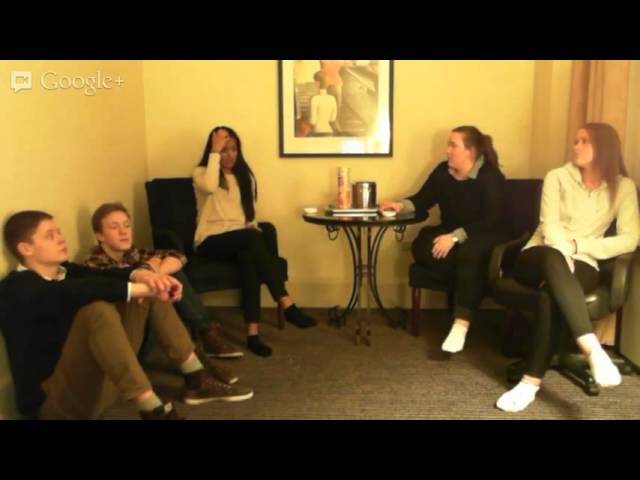
This content was created by Thomas Anglero. This content was uploaded by Thomas Anglero. This is a YouTube video titled "WiHood NYC 2013: Day 4 at Hackley School" (created 2013-03-15). The excerpt is a recorded group conversation/talk featuring Thomas Anglero speaking with students/participants (labelled SPEAKER A) during a visit to Hackley School as part of a WiHood NYC trip. Thomas reflects on the school’s culture, teachers, food and student spirit, shares personal anecdotes (including thanking a former teacher, Mr. Van Leer), and encourages the visiting Norwegian students to bring Hackley’s values back home.
Chapters
Today on the show we have our guest, Divinator and Mask. Welcome.
Alright, let's get serious.
Oh, after—
forget the camera again, just look at me. I guess it's hard to do that when there's a screen there.
Yeah, it's so distracting. Make it black.
Just close it down.
Just go in front of the camera. Minimize. Lay it down. Yeah. There you go. Okay. Cool. Oh, I almost— Yeah.
All right. We did a lot of— we did some reflections after— well, we had that break-in before the lacrosse game, so we can keep this short, but I just want to make sure we talk about what we need to talk about. Today was— today is day 4, Thursday the 15th, right? If you count. And we still got Friday, Saturday, and then Sunday we're in Jersey. I'm sorry? Today's the 14th?
Yeah. Yeah, it is.
Okay, today's the 14th. Sorry. And so today was a special day, right? Very, very different day. And I told you that it was going to be a different type of experience. And today we went up to where?
Tarrytown. Ackley.
Ackley. Proud school.
Underline.
Underline. Could there have been any way I could have described it to you from your experience at Björnholm? No.
Not at all.
When we were in the car and Adrian picked us up from the train station and we drove up and we turned into Hackler. Yeah, all those cars. And you saw all those cars. So that was your first impression. What's your first impression? All the cars. What about the cars?
Luxury car show.
Like Porsche, BMW, Mercedes, Jeeps, all Jeep, Range Rovers.
Yeah, all of them.
And then when we pulled up, uh, in the parking lot and walked out, what was your next impression when you saw the buildings?
Which one is the right building?
Which one's the right building?
Was it really?
There was so many buildings, right? Yeah, I was confused. I didn't know where the hell I was going when I was walking through that place. It was vintage, like, it was vintage, vintage, old. Yeah, yeah, over 100, that's 110 years, 120 years now or something. I don't know, there's something like that.
And then when you got inside, what was the first thing you did? We went up the stairs. Yeah.
My point is, when we were inside the school, did it look like a school?
No, no, it looks like hotel. Yeah, it could have been a hotel.
Really? I never thought of Hackley like a hotel. Why?
Like a big house.
A big house.
Yeah, a big, big house.
And each one of you got, uh, A person for the day?
Yeah.
And Katrina, your person abandoned you?
But she was really cool. Yeah, she was really— she had a test.
Oh, she had to go study for a test?
Yeah, professional.
Okay.
And she told us all about Hackley and yeah.
Did everybody speak positive about Hackley? Yeah. Did anybody ever say anything negative though?
No.
And the teachers, did they impress you? Any bad teachers?
Yeah. No. They were all great.
They're all great.
Were there any bad teachers? No, no bad teachers.
Wait a minute, seriously, when we talk about Buren Hall, when we first met and asked you guys about your teachers, remember I said, let's go around the room, who likes your teachers, who hates your teachers? And I think each one of you had a teacher you could not stand. Remember that?
Yeah.
And now today at Hackley, you said all the teachers were good?
Yeah.
What happened? That's weird. That's weird. You didn't find one teacher that didn't— really? That's interesting. That's just the police coming after me, taking you.
No, we should take the guy in the window.
The guy in the window.
Tom, they're after you. Your girls, they can't find it.
I know my past catches up to me when I'm in that place. I forget all about my past. I think the lesson, what I was— what I wanted to show you at Hackley, the big lesson, and there's a thousand little lessons, but the big lesson was Your first impression was the cars, BMWs, Porsches, blah, blah, blah, blah, blah. Big building, big campus. Wow, wow, wow, wow, wow. Cool-ass people. Even after 29 years is when I graduated. God, that's a long time ago. That's an oof-a-mai, right?
That's a really long time ago.
29 years ago I graduated, and still the culture of that place and the students of that place are still the same. That's amazing. A lot of things should change, but that hasn't changed. The people going there, the families going there, they're still wealthy, and yet they're there teaching their kids values. The faculty is about values, right? Food is not an option. Food should not be a hindrance for a child. No one should go hungry, and we've seen hungry at the soup kitchens. We see hungry. You don't see hungry at Hackley, right? It was too much food. It was always food. And then we were about to go to lacrosse game, they made the squid. What's the—
Black squid?
No, no, no. What is squid in—
uh, seafood type of food.
Anyway, it was squid. Calamari.
Calamari.
And then when we were done and they put away all the food, then they came and made some freshly baked calamari. And I remember I took the last of the calamari and the guy who was serving, like, hey, no, he smiled, no problem. He brought out a whole other one. Yeah, that's why I had 3 plates and you have 4. Yeah, right. Always food, always food. Raising a child, food shouldn't be an issue. You shouldn't have to worry about that. Everybody was nice. The teachers were nice. They even didn't act— did they act like teachers, really?
No, no.
That's the whole thing. I called one of the teachers, you're not a teacher. That you're not a teacher according to the way teachers are labeled. They're more like friends. Did you see any teachers disrespecting?
No.
The teachers' eye contact?
Yes. They were more like friends than teachers, I think.
How would it be if Bjørnholm was like that? Back home in Norway? You like that?
Yeah. But they didn't disrespect the teacher or talk in their classes. They were all silent and they listened to the teacher. Everyone was participating, and I think they participated because the teacher was like a friend.
Yeah. Did not one person crack a joke or try to be funny in the classroom?
They did, but that was like relevant with the subject.
With the subject. But nobody was trying to be like the goofy one? No. Interesting. I went to an 8th grade English class, 7th grade, sorry, English class, and they read a book on a family that was in the Auschwitz, the concentration camps. And she says, just be prepared that these 7th graders feel honored to have been given a book so mature about people dying. And these 7th graders came in and I was wondering where she's going to go with this thing. How do you handle this with 7th graders who when somebody gets hurt, they take it seriously? And she goes, what questions do you have? I go, how the hell are you going to ask a 7th grader what questions do they have? First you say, did anybody read the book? It wasn't even that. Everybody raised their hand. And she started going around the room. And these kids were going, everybody turn to page 43, paragraph number 3. In the third sentence he says blah blah blah blah blah. I don't understand because two pages earlier he says blah blah blah blah blah. These two things don't make sense. It wasn't about did you read the book or not. It was more like can you compare this sentence or this paragraph to this chapter when the mother did this and then she had a child and the child did that. What are the— 7th graders? On a book on Nazi concentration camps. I was completely blown away. This is a whole different experience. What would it be like if that was like in Bergen-Bjørgo back in Norway? Are the teachers, the students that dedicated?
No.
And then the question is, why not? And then, why are you that dedicated? And then the question is, why not? Nobody's telling you not to be. Wouldn't you think your teachers appreciated it if you were that dedicated and that into it? Does it have to be the great teacher to motivate you, or should you motivate yourself?
Both.
Maybe if you motivated— you were that type of teacher, maybe that would help to motivate the teacher. You were that type of student, and that would help to motivate the teacher. Right? Sometimes teachers look out and they see this, you know, group of nobody gives a crap, so then the teacher doesn't give a crap. Sometimes it has to start with you. Today was lessons, thousands and thousands of lessons. The big lesson is it ain't about money. You cannot in the future say, I'm going to get paid, I want to make money. All of those parents make tons of money and they spend, how much, $38,000 a year? 220,000 kronor a year. They pay so that their child is raised not based on money. They spend a fortune, that's a lot of freaking money, to make sure their child is not raised with the principle of I'm gonna make money. What is the principle of those students? What do they talk about? What are their goals? Ain't about money. And the dress code, they took away the collar dress code. Everybody was dressed in whatever they want, and they didn't dress up. Did you? I didn't see— now I was looking for my Canadian Goose, I was looking for the Uggs. Maybe they have one Ugg. I was looking— yeah, you saw some Uggs?
Yeah.
Uh, I was looking for all the marca, the brands that we— I couldn't see it. Nobody was dressing up. One teacher had on like a New York Knicks shirt. It was all downplayed. And we know that they have more than enough to— and the yenta weren't dressed up. You know how there's a yenta competition about I put on more makeup, I'm gonna look really—
nobody's makeup.
Yeah, it was very natural. Yeah. So if you have all the money You have all the possibilities in the future. Why are these teenagers who are the exact same age as you completely not interested in that? And then the question goes, why are the people in your age and back in Norway are?
Culture.
The culture is saying in Norway, spend time on materialism, materialism, materialism. Here in Hackley, they got all this money. They have all the money to buy all the materialism possible, and what do they do? Put on the regular clothes. That's a massive lesson I wanted you to take back today. It's not about the money. There were some great kids you met today. Great teachers, faculty, the people serving lunch were nice and polite. You met the administration, Holly, And Adriana, they were extremely sweet. I mean, right? Call me, I'll drive you back. And they didn't want us to freeze. They gave us gifts.
Yes.
Right? Giving, giving, love, love all the time. They went out of their way and set up the whole day. Do you get that kind of treatment in Norway? From complete strangers? You learned a lot today. Hold on to that, and then not all of it, but parts of it, adapt it to who you are when you get back home. It exists. If I would have told you these stories, you guys would have thought about it like a movie, like somebody telling you about something they saw. You lived it. No one else in Norway has lived it other than the first group I took them there, and they were blown away too. So there is 13 people of 5 million people in Norway who have experienced what you experienced today. You 5 plus 8 others, and that's it for the 5 million in Norway. And good luck trying to explain to people what you experienced today. But take pieces of it and make it part of you. Wouldn't you love to make— be a little bit— have that culture with you all the time? No one's stopping you. What did you learn at Hackley? Nothing stops you, right? The future is completely yours. Completely yours. Guys, girls, young, old. The future is yours. And these kids were nailing it. Smart, driven, a different type of driven than that little guy who gets up at 4 AM, right? Yeah, that was a different type of drive. But Hackley, there was still the drive, but they don't have to get up at 4 AM because mom's gonna drive in the Porsche. But the homework is done, they're articulate as hell in class. You guys went to math class, you saw some amazing stuff.
Yeah, Chinese class.
Chinese class. You, you have video audio tape. That was awesome.
That was— I went to the English class. It was really good. Yeah, and they have like a really good spirit. I'm going to miss that a lot back in Norway. Yeah, um, like school spirit and Everyone feels like they belong. They do. Yeah, they just want to do good at school.
You can take it with you. You can, when you want to, build that up within your own small little group of friends.
Yeah.
Nothing's stopping you. When Hackley started, when Miss Hackley, who you guys were very impressed with the picture of her, and her best friend when they started Hack Club.
Yeah.
They started with nothing, scratch. There was no culture.
I think it's important to have good friends. Yes.
But it started with those two.
Yeah.
Those two started, and the culture was passed on and on and on. And over 120 years later, the culture is still there. It's incredible.
It's holy. You can't ruin that spirit.
It's an amazing place and it's now yours. Did they not bring you into the Ackley family?
They did.
No hesitation?
No.
Love, love, love, love, love, giving, giving, giving, giving, giving, food, food, food, food, food. A lot of food in that place.
I like that everyone say hi.
Yeah, yeah, yeah. Everybody said hi, hi, hi.
That's what I want to do when I come back. I just said hi to people.
Was it annoying? Did you find it annoying that everybody said hi? Did you like it?
Yes.
Would you like every day to be that way?
Yeah. It feels really good.
Would you look forward to going to school every day, every morning? Hi, hi.
Yeah.
It's cool as hell, isn't it?
Yeah.
Why don't we do it when we go back to Norway? Why don't other people not do it? I don't know. Wouldn't it be nice though to do it to your friends? And don't you think your friends might like it?
Yeah, I'll try when I get back. Yeah, I'll try. And see how it goes. I hope it goes well. Yeah. So we can continue doing it.
First week back to school.
Yeah.
The whole week, all of you, commit yourself to all day, every day for the first week, go, "Hi," all the time. "Hi," all the time for the first week.
Hi.
I guarantee you the following.
Hi.
The following Monday, If you don't continue, I guarantee you one of your friends will go, why aren't you saying hi? Because what you got today was the effect of people saying hi to you all the time. It started spoiling you. You started liking it, right? Well, when you go back to Björnholm, you tell all your friends hi all week long, and then you stop the following week. Same thing. They'll be like, wait, I like that. Why are you stopping? Nobody told you to. Why aren't you doing it now? These little things change people. Mix Hakley just had an idea, a passion, and I want to create a school that's good, good culture kids, and it's changing the world. You could change Norway. No one's telling you not to. Matter of fact, people are waiting for the young people to do something. You now have some good examples. And Hackley of what happens when you give young people all the love and support and let them grow. You have tons of love and support.
Grow.
Do.
Yeah.
See the lessons? They're not explicit. It's not written down on paper, but it's built into the culture of the school. Or the— I don't know, it's not a school. I can't— I don't know what you call the place.
Home sweet home.
Home sweet home.
Yeah.
So let me share with you one more story, my own personal story, which I have to open up because you guys weren't around. It's been 29 years, like I said, since I graduated. And one of my teachers who was not just a teacher, but when I lived there, he was in charge of all of us boarders, you know, people who lived at boarders.
The one that hugged you?
Yes, Mr. Van Leer. Yeah, well, I had my moment. For 29 years, I've been waiting to tell him how much I feel about him. And he invited me to his class. And he said, would you mind speaking with Billy Giddy to the class? I go, nah, no problem. The class comes in and he introduces me, says, well, Thomas is going to talk a little bit. He is a graduate from '84. And he says, he's going to tell you about these kids, Norwegian kids, and why they're here. And I told them about you guys and why we're here and stuff. And I just told the class, but the important thing I'm going to talk about is how special Mr. Van Leer is. I have been waiting 29 years to thank him because he was my virtual father. During the week, I had no father figure. I still have a father who I respect and love, but that man taught me what was right and wrong. I was a kid from the projects. You seen the projects, you'll see more. And then I took the train ride you took, and then I went there. How much was my little head spinning at 13 years old? Your heads are spinning, you're 16, 18, 19, your heads are spinning. Imagine 13, and the only thing you've ever seen and known are the projects And then I went up there and I thanked him and I told stories and I explained how everything I do, the person I am, is because of him. And then we both started crying in front of the whole class. That school and Mr. Van Leer made me. That's why it was important that you guys up there and you That's why I was upset last night with you. Because these things are so important. These— what I'm showing you, what I'm trying to show you and share with you are insanely intense. That these are opportunities that you as 16, 18, 19, you're not going to get anyplace else, especially not in Norway. And I thought you were not trying. You were missing out. Just before the big punchline, you're leaving. If we'd have went home last night and you'd have missed Hackley today, would you have regretted it after you've been there? I mean, if you'd have known you'd have missed today, after you've been there today, would it have sucked? Yeah.
Really?
Do you understand what I'm trying to teach you? Or at least what I'm trying to expose to you and you have to learn yourselves. You met the man that shaped me. How much work is it to shape a kid from the projects to Hackman? It's a hell of a lot of work. I couldn't write, I could— I was a mess. And they stuck with me. They didn't give up. And I was trying to give up.
I was—
it was too much. I came from that crappy education that they talked about at KIPP, but not KIPP, but the school, the guy with the kids in the hallway, remember? That was me. And then I went straight up to athlete. And Mr. Van Leer believed in me. A lot of love. That's a hell of a lot of love. Understand the message, how special? No one can stop you from what you want to be. They opened the door that I could be anything I wanted to be. Coming from the projects, I didn't think I had a chance. Hackley said, "Go. Be." Enter here to be and find a friend. Powerful, isn't it? Always, always, always remember what you experienced. Not what you saw, but what you experienced and what you felt today. Take it with you. It's a part of you now. You're part of the family. In the future, you guys can always call on them and they will Answer the phone and take care of it.
Yeah, they said that.
How many schools say that? And they mean it. They got together 2 cars to take us back to the train. Shit, when I was upstairs and it took me a while, she was calling everybody. She had tons of cars for us. Like, this person's gonna take this person, this person's gonna take this person. Everybody jumped up and stopped what they were doing. They're like, they called their kids, I'm gonna be 10 minutes late, you gotta drive some people.
Hakwet.
It's wonderful. Love, love, love, love, love, love, love. What more can we do to love you? What more can we do to love you? What more can we do to love you? You do the same when you go back home. What more can I do to love you? Because when I do that, the end result is Hakwet. It's all these amazing people. And when society doesn't allow you to love Look what happens. But look what happens when you do love. Don't forget what you experienced today. And in the future, if you have a shutdown, if you don't do something, think about today and look at the effects. Ah, what did you lose? What opportunity did you lose? Do you think those kids are going to go on and do quite well? Yeah, so will you. No one's stopping you. Remember what you felt today and experienced today. Got it?
Yes.
Capiche?
Capiche.
Let's get dinner.
Um, on the bread with the pear.
More from Thomas






IBM Watson AI Lab for Cancer presentation to Ullern HIgh School / Thomas Anglero

Will You Lose Your Job to AI / Oslo Business Forum / Thomas Anglero & Richard Qwest



