World Government Summit - Disrupted Business Models and AI
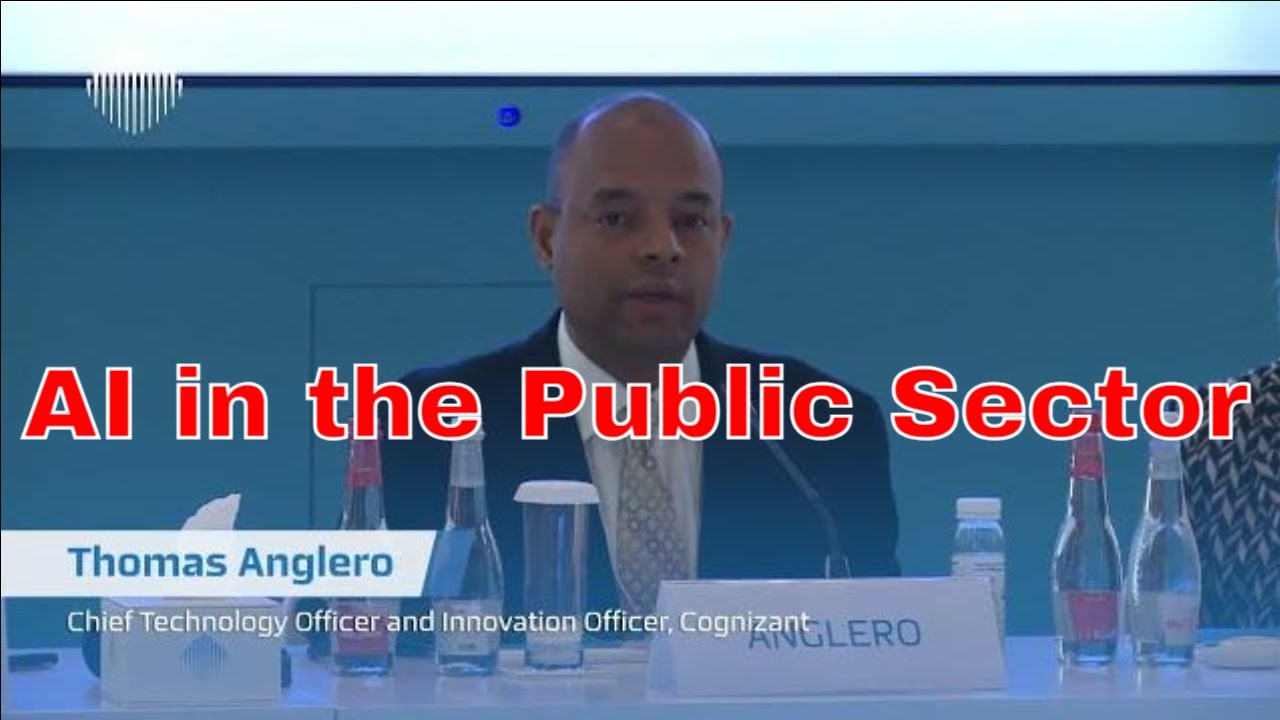
Thomas Anglero, Sophie Hackford, and Ulvi Madiev discuss how AI and digital transformation reshape government and business. They debate whether physical service centers like Azerbaijan's ASAN Service can coexist with metaverse alternatives, and examine AI's risks to trust and human empathy in automated decisions.
Chapters
So good afternoon, ladies and gentlemen. It has been an amazing day here in Dubai, which is no wonder some of the brightest people on the planet are here with us today and in the next two days. And we are going to speak today about value-driven organizations according to ChatGPT, and I believe you've heard used this word on this conference 100 times so far, but according to ChatGPT, value-driven organization is the one that values its customers and stakeholders above all. So two things we have here: we have a customer which has become the center of our galaxy, and then the products and services are only circulating around, gravitating around that. It's not the other way around like it used to be in the past. And then we have the technology, which is a tool to challenge the status quo and to make the services more, uh, better for the customer. So we will start for the— from the value-driven organization, and I don't know where we are going to end, because I have extraordinary people here on the panel. We have here His Excellency Ulvi Madiev, and he is the Chairman of the State Agency for Public Institutions and Social Innovations of the Republic of Azerbaijan, and he is the mastermind of the Awesome Centers, which are basically redefining or taking the public service notion on the next level. We have Sophie here, Sophie Hackford. She is a global, and if I can add, fantastic woman, tech futurist. So, and of course, I have here Thomas Anglero. Besides many titles and positions he has, the one I like the most is digital disruptor. So I will start with Thomas. Please tell me, what is harder to disrupt? Is it a government or a corporation? Because you have been working both for governments and different corporations. Yes, please. Thank you.
Thank you. Good afternoon, everyone, and I hope you've had a wonderful day. And I'm sorry we're the last ones to speak, but we hopefully will entertain you and enlighten you. So I know your pain. It's an interesting question. So I've worked as the head of innovation for— in the public sector for 5 years with an innovation group. And the word innovation and public sector are two very strange words that usually don't go together. And I'm now the head of innovation for the Nordic countries, or cognizant, which is private sector. The answer to the question of which is more difficult to disrupt, a corporation or a government, the answer to that would be a corporation. But let me explain why. A government, and I have to filter my stories because after 5 years of fighting for innovation inside the public sector, I could talk for weeks about how frustrating it is to innovate inside of the public sector. But a government is like a multi-headed dragon. You know the expression, if there's a three-headed dragon, if you chop off one head, you still have to battle the other two. The public sector has 10,000 heads. So if you chop off one head, one leader, you still have to deal with the other 9,999 heads. It is very complex. It is not a entity and it doesn't have one purpose. There are many purposes. A corporation in the private sector is typically— main purpose is to make money and it has one business model. And so you can disrupt that one head. Public sector, governments, much more complicated. But then there's a question of do they need disruption? Both of them need to be disrupted. But you have to be extremely careful. And it's very different. It's a long answer, but that's my short answer.
Thank you so much. Sophie, do you have to add something on the governments and private sector? Or you, maybe as a futurist, you can tell us more about why is that important? Why disruption and technology will matter for the government?
Yes, thank you. Well, I think the only thing that is important when it comes to disruption is actually thinking about the future. And of course, I'm a futurist, so I'm horribly biased. But I've sort of become obsessed with this question I read the other day by a guy called Benjamin Bratton, who said, "What future makes the past worth it?" And that is a question I think we don't ask enough. What are we actually building towards? What do we actually want? Let's not sleepwalk into something that we don't. And that's something that I think we need to ask much more about. I remember at the beginning of the pandemic, Reed Hastings, who was the founder and CEO of Netflix, said that it could very easily have been a computer virus and that instead of us all being indoors watching Netflix, we would have been outdoors hanging out with our family and friends and no one would have watched Netflix. And his, you know, his stock price would have fallen off a cliff. And of course, that is one of many big challenges that we face, whether it's climate change or cybersecurity, whether it's pandemics, nuclear war, the whole lot. And it's not just those that don't fit within very specific government departments, but it's also the solutions to those, whether it's fusion, whether it's quantum computing, carbon sequestration. There are no specific government departments for those technology areas. Those are things that span everything. We all need to sit down and imagine what kind of future we're looking for. It's a creative exercise which makes it sound like a luxury, but actually I would argue that it's completely the opposite. That we will sleepwalk into something we don't want unless we dream about the kind of world we do. So this question, as I said, about what future makes the past worth it, uh, is something we all need to ask, I think, um, when we're thinking about disruption.
Can I just comment on that? That was— I'm sorry, a perfect example of sleepwalking into something we don't want is social media for our kids, right? When, when social media came out None of us, we all thought, oh, okay, the kid's on the phone, I'm sure it's safe and everything. But social media, the kids are exposed to everything. We just sleptwalk into that technology. Now every child in the world is affected by social media. But as a parent, I'm a parent, we thought it was okay. So I think your comment is excellent and we have to be very careful.
I'm not on social media.
I'm sorry?
I'm not on social media for that reason. Haven't been for decades. But I'm— that is exactly right. And that is one, as you said, example of, you know, thousands and thousands of things. So we've got to spend a lot of time invested in that.
Exactly. And you don't have to be a technologist. You can be just a caring parent, you know, be ahead of the curve. If your kid says, hey, Mama, Papa, I'm doing this in school, take a moment, take some time, try to understand it. You know, don't be afraid of technology. It's getting easier and easier. You know how to open an app, you're going to know how to use any technology for the next 50 years. Is just spend some more time. Like you said, don't walk into it.
Yes, but you know, when you mention social media and all the Amazons of the world, and that kind of services pushed the citizens, pushed the government to kind of provide services which are similar to the ones that corporations are providing, and Everything is online, social media is all over, all around. So having in mind that, having in mind that basically government need to disrupt to provide, you know, social public services that are very similar to one the corporates are providing, there is one thing which is very interesting and I would like to emphasize for Azerbaijan, for example. So in this world of of artificial things. We have this artificial intelligence. We also have artificial meat, you know. There's one thing that you did well and you preserve kind of the Azerbaijan authenticity, that you still have physical spaces with real people on physical counters providing public services. So If you can tell us what is the importance of a physical space in the world that is becoming more and more digital.
Thank you. Good afternoon. It's a pleasure and honor to be part of today's discussion, and I would like to thank the government of the United Arab Emirates for their efforts organizing in this summit. And thank you, Ms. Martha, for your interesting question. You see, 10 years ago when our government established Asan Service Center, Asan Service concept, this question was in front of us— digitalization or physically to provide services by the principle of one-stop shop. You see, I think the first step of digitalization is standardization. In our case, when the President of the Republic of Azerbaijan established ASAN service concept, established the State Agency of the Public Service and Social Innovations, Our— we have two main directions. One of them, to provide all public service by the principle of one-stop shop. And now more than 300 services we provided in one place by the base of principles of transparency, effectiveness, accountability, and it's etc. And we— our second direction to research, or the research, high-tech modern technologies, high technologies and innovations, how to implement in the field of public service. In that case, first of all, we create— created the basic unique standards. For public service. Because first step, it's to optimize the business process of service, then automate this. You know, as you know, if you automate mess, you will get more mess. That's why first step to standardization, to optimize service process,. And second step to digitalize this. And our main goal is the government and citizen relationship. You know, we cannot see state, we cannot touch the state, we only can feel state. But how and when? Then as citizen, I need service, public service. I feel how my government care, treat me. You, you see our buildings, our centers, they are modern and beautiful design. Why? Because it shows the power of the state. And inside these buildings, we provide services as non-bureaucracy, transparency, for everyone accessibility. It means the treatment of state for citizens. Power and treatment, it's a two key in our concept. Second reason, I think, you see, the governments have a lot of resources to digitalize all services very quickly, but is your citizen, is your society ready to use digital services, to use high technologies? Do they have digital skills? In our case, Assan Center is a platform which we use technologies and innovations and we help the citizens to use and to create or to develop their digital skills through the— get services. And third, I, I think digitalization is the most important key, most important tool for governments to implement their projects. But new technologies, innovations, and digitalization take new challenges, new problems. I don't mean about cybersecurity, it's, you know, but some of invisible challenges. It's asocialization. Asocialization. If we digitalize all services, we cut relationship between government and citizen. Okay, we can't feel that. And in this— in that case, Assam Centers is one of the platform to community communication of society. And it's very important for governments. And I think every government have to think about it, which of level they have to digitalize their strategy, their projects, and etc. And you know, I, uh, once I talk about it, in our case, our old mothers, grandmothers come to our centers and they choose for their sons blind. You know, many of our employers are women and they choose for their— it's the communication, new communication for society. That's why I think to provide services by the physically now and now is actually, actually, actually. And that's why I think physical center not— is not alternative digitalization. Complementary.
Complementary.
Yes, first step for digitalization.
Thank you. Thank you so much. You have anecdotes Plenty of anecdotes happening in the centers. But Thomas, we've heard we have these physical spaces. On the other side of the spectrum, there are several governments that are moving their government services on the metaverse. I know about Korean government, they're moving Seoul as a city of Seoul to, to the metaverse. And here in UAE also, I've seen the Ministry of Economy, some of the services, Ministry of Healthcare. So do you think that this new virtual space, spaces, can assist the government to improve the way the government is engaging with the citizens?
The short answer is yes, but that's a dangerous answer just to take my answer of yes and run away with that because it's—
Elaborate, please.
It's not a simple yes. I'm so impressed by your story. And I think the way— not I think, I know the way you've done it is the right way. And I'll elaborate. What we saw during COVID in the lockdown where everyone was forced to be digital, when we came out of that, Do any of you, when you meet with people, do you see how people are a bit awkward now when you interact with people because they've been locked up for so long? Human beings must have inter-exchange. We must see each other. So your wonderful emphasis on having a place for people to go is correct today in 2023 and is correct probably in 2123. We must have physical spaces. Government must supply those physical spaces. The metaverse is coming and we cannot stop it because it's already here. There are tens of billions of dollars being spent every day, and we— it's what you said before, don't just walk into it, that we already walked into it. You're not going to stop it. But even though we enter the metaverse, this virtual world where people interact and all that, we saw with COVID which was a great test, even though you're online all day, you feel like something's wrong. You're not getting enough out of life. You're missing something, and that's people. So I think what you're doing is beautiful, is a wonderful example. Don't change at all. And if I could give you one more example, if we look back on the last 20, 30 years of the internet and companies have done very well, There was a shoe company called Zappos. They obsessed. And, you know, just want to buy shoes online, you do that. People would buy the shoes, come to an event like this. They have wonderful, very expensive shoes to show off to everybody. And as soon as the event went over, they would mail it back. And Zappos had a policy where they would refund you the full amount of money. They were obsessed with customer service. They were obsessed with taking care of people, taking care of people. Is always the best business model. It is always the one that is best. Investing in people, focusing on people is always best. And governments, that's their job. Obsess on that and you will always do well and your people will always love you. Do not move from where you're talking about. Even though everybody goes to the metaverse, they will come back down and they're going to want to have social interaction. They're going to want to be with people. They want to smile and see somebody smile back. So yes, the metaverse is huge, but love is bigger and stronger.
This was very inspiring. Sophie, Sophie, is technology entrenching the inequality, or we can see it as a positive engine of progress?
Well, yes, these are all questions that we need to ask, and we need to ask them all the time and a lot. I mean, the number one thing that we're all thinking about at the moment, I think, is the sort of monopolistic behavior of big tech. And is it actually a solution of tech to solve the monopolistic behavior of big tech? I like what Tim Berners-Lee, the founder of the internet, how he describes Web 3.0. So that's the next one on from where we are today. He said the internet needs to earn our trust back. And I like that. I think technology's got a long way to go to earn our trust. Trust back, because I think we all feel, and if we don't feel, we probably should, that we are IP when we're online, when we're in the metaverse, whatever that means. We're actually someone else's intellectual property. And that's a fairly uncomfortable feeling for me anyway. And a lot of this sort of new tech frontier is promising, and I bold and underlined promising, that it's going to help solve some of that stuff. A friend of mine the other day said something quite fascinating, which has sort of troubled me ever since. He said that since 2020, he's a tech person. Since 2020, a lot of the information that we've been reading online has actually been already infiltrated by these AI platforms. He calls them AI isotopes that are in our— and he said if we've been ingesting that as training data, like if all of us have been reading this training data for the last couple of years, this is going to end in a very strange way. And I like that. It made me maybe think quite profoundly about what these technologies are actually doing to us. And you talk about social media as a perfect example of that. And I like— Pete Warden talks about how governments and others should treat our data like toxic waste. They should treat it like the effluent from a nuclear power station or whatever it might be. It's very dangerous if it leaks. It's dangerous to the individual, but it's also dangerous to the company that does it. And that engineers should take responsibility for that, engineer systems to be leakproof. The same way that hopefully they do that in the nuclear industry. But you said at the beginning also there are plenty of positives that come out of this as well, whether it's using online metaverse-type worlds to trial new forms of government, to trial new ways of doing things, to trial new services. There's a tremendous potential for us to, to, to war game, for want of a better word, in virtual environments so we can test whether things work before they get released into the real world. So I think the short answer, of course, is both. But I think the most important thing to remember, certainly from a technologist's perspective, is that technology is not a force of nature. It's not like the weather where you can't do anything about it. You just got to let it come and hope for the best. It is something we still control. The internet, just about. Humans still design the internet. It's not something that's been taken away from us just yet. So we've got to remember we have agency in all of this. And let's not recreate the problems that we have in the real world online. Let's not entrench that financial inequality. Let's not entrench all these things that we have in the real world in our new virtual worlds.
Yeah, yeah.
Can I add some doom and gloom to her statement? So ChatGPT, which we all probably I've heard way too much about. It's actually beginning to bother me because it's talking about replacing search engines. And you're talking about we still have control, right?
Just about.
Just put your nails into the table, right? So the thing that scares me with ChatGPT is you ask a question and it takes its time and then it gives you an answer, sort of like it's the definitive answer. When is life anything a definitive answer? It's never a definitive answer. The beauty of the old search engine was you had the first link, second link, and you checked a few of them and you decided on your own, maybe this one, maybe that one, little this one, little that one. ChatGPT says, no, this is the answer. That's not life. That's not right. Then also, who's controlling that answer that's provided to the world? That could be manipulated because it's an algorithm and it's very easy to manipulate and control and blah, blah, blah. So we go down a very dark, deep rabbit hole very fast. So don't be obsessed with ChatGPT. I think what it does is wonderful, but that's not the answer, right? If you're a lawyer, is there one answer? No, right? One lawyer says this, another lawyer says this. You know, it's the most interesting intellectual game. So ChatGPT, interesting, but that's not where we're going. It's interesting. That's about it, because life doesn't work that way. All right. So, I was trying not to be too dark.
No, no, no. I mean, yeah. I was thinking about, in Serbia, we have a case where we are using a pilot to use machine learning for bringing the decisions. I mean, to support judges' decision on traffic misdemeanors. So, and it proved to have like 97% accuracy. So what the machine learning said, judges confirmed in 97%. But we stopped that because judges don't want to have this kind of support. And they are thinking the same way we are talking here, like AI isotopes. It's kind of AI is radioactive. It might be, but there are a lot of positive cases. So AI can automate tasks, can improve decision-making process, can optimize operations. So it's reducing cost, improving service delivery, and enhancing the positive performance of the government. So have you— do you have any, like, really positive, positive cases of usage of AI in the government? Wow.
Positive use of AI in the government. Yeah, well, there are probably— there are thousands in terms of time savings, cost savings, and looking at analytics and projects. There's increasing or decreasing traffic signals so that traffic can go by. There's all that. So the obvious answer is, yeah, of course. Where I'm concerned is that we talk about AI as if it's just one thing. AI, there is not just one AI. You know, AI, AI is like a child. Your AI is very different than my AI. Whatever she feeds her child. So for breakfast, if you feed your child, I'll be nice to you. For breakfast, you give your child carrots and apples and things like that. Your child's going to grow up to be a wonderful child.
Yes.
Yes.
I'm scared of what you're going to say. I feed my child cakes and brownies and ice cream and stuff like that for breakfast. What type of child am I going to have?
Hyperactive one.
A hyperactive, right. And that's the way you have to see AI. Everyone, every government that has an AI, the data you feed it, the training that you do to it, you will raise your own child and it will be unique to you. So just be very careful when we use this general statement about AI. There is no one AI. Everyone's or every government's AI will be unique to that government because that government will train it, feed it, warp it, massage it, you know, raise it, take it to the pool or whatever. And so just be very careful of that. And so some governments, and I'm sure yours will do very well because I love the way you're at where your head is. Will raise a beautiful AI that will be healthy and fantastic, where mines will probably, you know, ruin the world or something like that.
Going back to you and your human intelligence in the Asan Center versus the artificial intelligence we have all around the world. I was there a few months ago walking around the Asan Center. It was in the late in the evening. Everybody was working, they're very polite. It looks like, if I may say it, it's modern design with immaculate attention to details. Look like a high-end bank in London, for example. And you have also a café, you have also a playground for kids. But the thing that impressed me the most was a space, a place where you have your employees with startups, with citizens working together on designing services. My question is— I'm not going to ask, is it important for your government, this co-creation and collaboration and working together— but why is it important for your government?
Thank you. I think today The governments need the relationship with the— this, you say, the private sector, need to collaborate with private sector. Why? Because you see today the data is the most power for government, for companies, for everybody. And I, I can call our era a new era, maybe dataism. You know, in history, federalism, socialism, capitalism. Now we are transforming from capitalism to dataism. Why? Because data is a key role, the key tool which the government, if correctly use the data The government can implement the— its strategies very successfully, but the tools as the AI, machine learning, blockchain technology, and etc., they are tools for data-driven decision-making. And now we know the private sector companies, they are very successfully applied and developed, developed and applied high technologies and innovations than governments. That's why I think all governments and our government and we, we need to collaborate with actors in this sphere, in the innovation sphere, as startups, as tech companies, and etc.
Thank you so much. So entrepreneurs are very important for the government.
Can I provide some another story?
Yeah, please do. Please do.
Okay, so here we go. So many years ago, I was working at at IBM, and as we were creating IBM's Watson with AI and everything, we struggled with one important thing. Does everybody remember the first time they fell in love? Do you remember that? The first time your heart went like that, right? And so I told a bunch of engineers, I told them, close your eyes. And they reluctantly closed their eyes. I said, remember that moment? They all got excited. I said, great, open your eyes now, program that. Program that moment that when you started sweating and your heart, your stomach turned, your toes went like this, and that's the person no matter what, you're going to change your life, you have to be with that person. Program that into an algorithm. It's impossible. So what we understand is that AI lacks that human emotion. It lacks the empathy, it lacks the love. How do you program when two people look into their eye and that magic happens in that moment? Anybody knows how to do that, right? So understand that AI is wonderful. It gives wonderful answers and things like that, but it does lack that human part. And that part is sometimes AI will give you a definitive answer is right. But if you understand this person's situation, you may know that the right answer is, you know what? No, because of your situation, the decision is this, though it is technically right. The AI has checked all the information. It is That's the right thing to do. But because I'm human and I have a heart, the right thing to do is this. So I know I'm a technologist, but I need everybody to just understand, don't fall in love with technology, right? Yeah, but we're human beings and that part we haven't been able to program. We can't program those feelings you have. And the other one is I always said, but people usually laugh at me, but I'll throw it out there anyway because It's the end of the day. Everybody needs to go laugh. Does everybody remember the first time you ever gave someone a kiss? Program that. All the engineers in the world don't know how to program that emotion, that feeling. What makes somebody think that way? What makes the human being do those impulses? We don't know how to program that. And until we know how to program that, and AI is still a technology in a machine. And so it is an advisor to you, and you as a human being, you then take the advice and you make the human being decision. Sorry.
Well, still we're trying to go to some impossible heights, and some of the greatest entrepreneurs of today, they have entered this billion space race. The final thought about entrepreneurs and space and where are we going? I mean, we said that we are going to start from value-driven organization, but where are we going now?
Well, I think it's a really important question because we're all going to space even if we're not physically, and I hope I don't because it sounds dreadful, but even if we don't physically leave the planet, pretty much all of our critical international infrastructure now lives in low Earth orbit, whether that's connectivity, whether that's Earth observation satellites. There's no stock market, there's no insurance market, there's no find your iPhone, there's no find anything without space. And so these entrepreneurs, yes, they might be using it as a billionaire's playground. You know, there might be all kinds of other motivations, but at the end of the day, so much of what we rely on every single day takes place off Earth. And I think we forget that. And I think governments also forget that companies rely on that tremendously, as do governments, government departments who don't realize that they rely on space services so much are also, I think, forgetting that sometimes. I think we all need to think much more carefully about just how connected our economy here on Earth is to that in space. And of course, people like Bezos and Musk recognize that, not just as an entrepreneurial opportunity, but actually that's the infrastructure, not just of the future, but of today.
So thank you. Thank you very much. We have been advised that we have to finish this. You have been amazing. I hope you like our discussion. We can go on and on and on, but the time is short for us. If you want to hear more about the government services, join us on Wednesday. There will be a full day dedicated to government services. Thank you so much.
Thank you.
More from Thomas






IBM Watson AI Lab for Cancer presentation to Ullern HIgh School / Thomas Anglero

Will You Lose Your Job to AI / Oslo Business Forum / Thomas Anglero & Richard Qwest



