Your AI Project, It's Actually a Culture Project! Unlocking Success
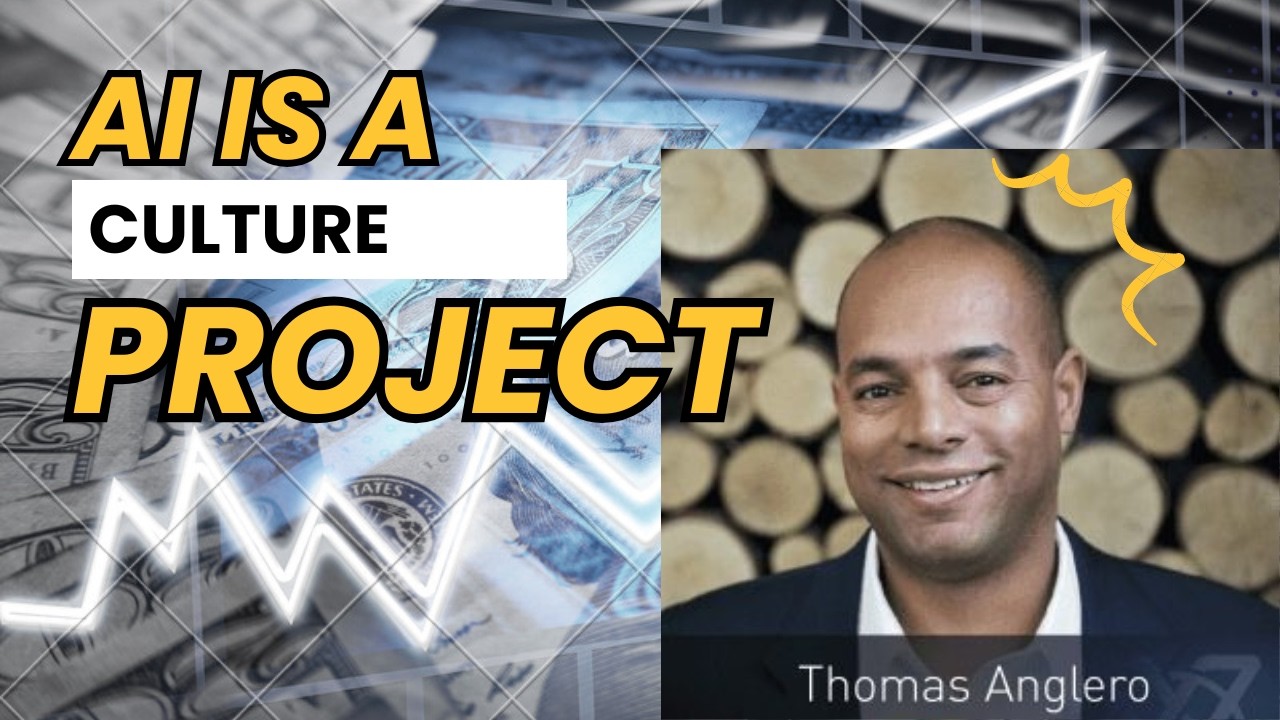
Thomas Anglero argues that AI adoption succeeds when leaders treat it as culture change, not just technology. Share your own AI stories with employees, train them through hands-on use, and watch how it saves time and improves work.
Chapters
I was meeting with a bunch of leaders the other day, and they were really proud that they had selected a person to lead their AI initiative inside of their company. They were very proud to have allocated funds. They are very proud to have scheduled on their plan as to when they're gonna start, how many people would be implemented to different phases. And I thought to myself, is this how you implement AI? I mean, that's how you implement any project. What we've been doing for decades, how you implement a project, but that's sort of like you implement a project using Microsoft Word or Excel or using a new tool, or we're all gonna shift from Windows to, uh, Apple, which is Linux, you know, it's like a technology project, but an AI project turning on, activating, beginning an AI project. That's not a technology project. That starts with one fundamental thing, culture. An AI project is a culture project. That's where it starts. That's the foundation stone for the AI project. If you jump right into the, like building a house, don't worry about the foundation, skip the foundation, just build the house. What happens? You don't get the outcome you want. The house will fall down. Somebody's gonna get hurt. Translate that into business terms. You don't get the outcome you want. The project will fail. Somebody will lose their job. What's the difference? The foundation. When you start an AI project, I am so happy for you that you have somebody to lead your AI initiative. Maybe even had hired somebody who are head of AI. That person that you hired head of AI, is that person insanely good in soft skills? Is that person A non-techie? Is being head of AI meaning you have to be the nerdiest person in the company, or does it mean you have to be the most non-nerdy person in the company? AI is, as we approach AGI, right? Divergent AI, we'll all want, right? The all-knowing AI. What we're really looking at is something that knows us, knows how we think, can predict what we're going to think before we think. We start to describe a person. We're starting to describe a character. Doesn't that sound like you're describing a new employee in your company? You're about to hire a head of a department, a head of a new person, a head of AI. Let's stick to that example. A new head of AI. Everybody's all excited. Who is this person? They say, what this person does, What does she do? What sports is she into? Is she married? Does she have kids? How many degrees does she have? What school do you go to? Where does she work? AI is getting damn close to a person and we need to treat it as such. And hence that head of AI, that person and that character and a personality. It needs to be able to say that AI, because it's so knowing and has this fullness, is that I'm going to implement a program to learn, teach everyone AI, for everybody to come up to speed with AI. And that is we're all gonna get in touch with the comfortableness of communicating with ourselves because it's a cultural project. That's where you start. It is not a tech tool. The best way to use AI, to be comfortable with AI, then become an expert in AI. And by the way, get comfortable with AI and become an expert in AI. They're so close to each other. They're milliseconds apart. They're, they're an epiphany. They're a thought away from going, I'm sort of comfortable using it to like, holy God, I love this thing. I know how to use it. And you do that by just talking to it. I was working on a project to build my website, right? My new website, anglero.com, A-N-G-L-E-R-O.com, if you wanna check it out. And I don't know how to build a website. I mean, I've built websites before. They're all ugly as hell. I don't, don't ask me to build a website for you. Um, the old school way, I could build one with AI.. And you know, I didn't wanna vibe code my website. I wanted to build it with AI, not just have AI build it for me. And I asked Claude and Drop It Claude, I asked, I don't, I technically know how to do HTML and all that, but in terms of the design, the layout, the colors, the fonts, that's not me. I have no style in me. I have, don't, don't ask me to get dressed in the morning, right? I have Style is not my thing. And I told AI that, I told Claude that, I actually had a conversation and I told it that in words. And, and I use a text, I use a speech-to-text program. So I like to speak, obviously. And it came back and it told me, fine, you're not comfortable with style and all that. That's not your thing. That's literally what it said. And it told me back, what do you like? What, what do you, what, what appeals to you in life? And things like that. And I said, oh, okay, no problem there. I said, I love Scandinavian furniture design. I think the smoothness of the wood, the shapes, the curves, nothing's aggressive, nothing's heavy. It's about extenuating what nature is the rawness, the colors, the softness. I mean, you touch these furniture and it's just— you don't want to ever leave. The wood, the leather, I love it. Claude took what I said and then said, got it. And it returned back to me a color palette for my website that if you go to my website, there it is. It built my website based on my colors that what I love and appreciate out of furniture design. That's an epiphany moment. I built a website based on what I love and appreciate in life. You can't do that in regular HTML. When you ask a coder, build me a website, you have 5 days, you got 5 hours. There was no conversation about what I love, what touches me, what I appreciate. But with AI, the foundation of our conversation was about what I love, what I appreciate, what touches my soul. If I was your, if I was your head of AI that you were hiring me, and I would, the first thing I would start, the first thing I would do with this cultural project and telling everybody, listen, we need to change the culture. Maybe I wouldn't tell everybody we're doing a cultural project. That sounds funny. Cause some people say, whoa, we're changing the culture of the company. It, it doesn't resonate with people. It's got too much history in the wrong way. But I would say, we're gonna have a conversation. Cause what I'm gonna do is, as the head of new, your new head of AI, is I'm gonna change the culture of this entire company. I'm gonna change the culture of every individual here. I'm gonna elevate them. I'm gonna make them more comfortable. I'm gonna make them feel that they have a new person they could talk to, a new outlet. And the end result is I'm going to 5x or 50x their, their, their outcome over time. And we're gonna do that by asking them to have a conversation with AI. And for me it was, I'm gonna build a website. And we ended up talking about what I love in life. What touches me, what I appreciate, those intangible, tacit things that you can't explain when you feel something. When you pet a cat or a dog, you just feel the fur. And then it built a website around that, or at least a color template and all that. From that point on, building a website was easy because the website was based on who I am. And as your head of AI, I would have every employee, I would ask them to build a website, but I would say, working at what project you gonna work on, or you are working on, what's your deadline? What's your challenges? Now, don't answer those questions to me or Just tell this to the AI. Or maybe I have the conversation with them, we have the AI, then we, the AI is listening to us and the whole time the AI is understanding and learning and listening and then comes back to the person that, well, this is how we're gonna proceed. So you just gotta get the person used to the fact that it's just a conversation. It's just a conversation, but it's a conversation with someone who's solely out to help you. They don't have an agenda. They're not gonna take credit for the work when the whole project is over. God, we're sick of those people, aren't we? They're gonna be there for you 24 hours a day, 7 days a week. They're gonna work tirelessly. When your employees understand that, that AI is there for them on all those levels that I just described and more, there is no more hindrance. There's no more, um, doubt and negativity towards AI. This is just this huge embracement. Of AI. And as soon as that person understands that, then you have that little moment of going from I'm comfortable to an expert. And then you have the next moment, which is that person's changed. That person now not just understands, but they're not gonna be the same person anymore. And that means you just change the culture of that person, which means you just change the culture of your office, which means you just change the culture of your company. AI is a cultural change of how you work, why you work, when you work, and who you work with. For my website, I think a normal human, if I'd hired a web developer, I don't know, that would've been a huge budget. But I know one thing I had to do, one part that I did before when building a website, and I know it would have taken me— yeah, I had to find photos and I had to select a couple of photos out of my photo library, and I know that took me many hours before. It did it in 6 minutes. That's the outcome you're gonna get. That's the benefit. And when an employee who has a simple task that they know it's gonna take them half a day of work and the AI does it in 6 minutes, that's that moment of I'm comfortable with AI to I'm an expert in AI because it did something for me. It made me feel better. It did, it, it helped me with my work. It saved me time. Not just time, but annoyance to go through hundreds and hundreds of photos to pick out just a handful of photos for a website. I don't know if you've done that, but it, after photo number 50, they all start to look the same. This is a massive shift in your company. So when you say that you want everybody to use AI and you want everybody to embrace AI, How about you start by telling your story, how you started with AI and how it changed you? I just shared my story about what I've been working on recently with my new website. I think it's a perfect example. What's your story? Have you used AI enough that you have a story? You should have a few stories. That's just my latest story of what it did that just like totally blew my mind, absolutely blew my mind. And I, it, this should have been hundreds, hundreds of hours of man hours of work. And I know when you look at them, you go to my website and you, you, you see the final result and you go, beautiful, but is that it? Yeah, because sometimes the most beautiful things start so huge and you come down because you have people who are asking the right question and AI and machines, and you're refining, refining, refining to something just So beautiful, so simple. Scandinavian design, so simple but so beautiful. But if you did it the old way, could have took you forever. You do it with AI, save you tons of time. You're not tired, you're not aggravated, and actually it was a lot of fun. A lot of fun. I actually even told my AI, thank you, so many times. Be polite. What's your story? You as a leader, what's your story that you're gonna share with your people that's gonna make them more comfortable with them using AI? If you don't have a story, Never too late. Start talking to your AI. Tell it, I don't even know how to start. How do I interact with you? How do we begin? Or better yet, I have a pile of paperwork here. I have to look at spreadsheets. I have to look at budgets. I have to look at pipeline. How do I do this? How do we work together, this pile of paperwork and you? How do you help me to do this better? That is the best place to start if you want to start. And I'll tell you, this is how I'm going to help you. This is how I'm going to get you through all these tasks that you have. What is your task? Can you upload all those PDFs? Can you upload all that documentation? I am here for you. God, you know what it is? I think some people have just forgotten because it's been so long the last time they heard somebody say, I'm here for you. I'm not gonna go home. I'm here. I'm gonna stay in my cubicle. I'm gonna sit right beside you all night long. We're gonna get this thing done. It's been a long time. Welcome to AI. That's your new colleague. It's there for you. It can't pour the coffee for you yet. That's the humanoid robots. They're coming, uh, in 2027. But AI, it's, Here for you now. Share your story with your people, and that's the best way to be a great leader in these early days of AI. And emphasize early— it's getting better every single day. It really is. But you as a leader, you have to be different. You have to realize that who you were, how you've built yourself up to who you are today as a leader. That's okay. And that's great, actually. Congratulations. But now with AI, you're gonna be a little different. Things gonna change and your soft skills are gonna be more important than ever because AI could do a lot of the crunching. But the human beings in your office, they're gonna need a lot, need a lot of understanding and communication. Tell your story to your people, and that will change the culture of your company. I'm Thomas Anglero. This is Clarity at the Top podcast. That was fun. A lot more fun to come. A lot more stories to share. Send me an email. Let me know what you think. Let me know what you want me to talk about. And check out my website, which I've said enough. I'm not trying to plug, but you get to see my story of real life, right? Inglourious.com. And just talk to your AI. I know it sounds strange, but a few years ago when everybody bought the Amazon Alexa, it was really weird when everybody was going, Alexa, what time is it? Alexa, what's the weather? Today, nobody even thinks about it. With your iPhone, the Siri, right? Nobody thinks about it. So why is it such a big deal to talk to AI? We've been doing it for years. Just another machine to talk to. Take care. Lead strong. Be strong. You are strong. Until next time.
More from Thomas






IBM Watson AI Lab for Cancer presentation to Ullern HIgh School / Thomas Anglero

Will You Lose Your Job to AI / Oslo Business Forum / Thomas Anglero & Richard Qwest



