This content was created by Tilly Lockey. This content was uploaded by Tilly Lockey. This is a YouTube interview segment titled "Meet The Teen With The World’s Most Advanced Bionic Hands | This Morning" (published April 16, 2025). It features hosts from the This Morning show interviewing Tilly Lockey (a 19-year-old bionic-arm user) alongside Joel Gibbard, a robotics engineer from Open Bionics. The conversation covers Tilly's story after contracting meningitis as a toddler, the evolution of her prosthetics, a demo of the new Hero Pro wireless, muscle‑operated 3D‑printed hands, technical details about control and pressure sensing, NHS availability, customization, and the wider impact of the technology.
Chapters
We're starting today by meeting a real-life superhero.
After contracting meningitis when she was just 15 months old, Tilly Lockey's hands were amputated to save her life. But through state-of-the-art bionic arms, she's been able to live her life to the fullest.
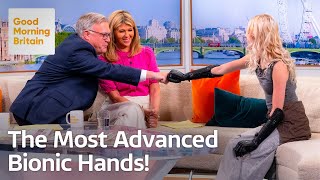
Tilly is now 19 years old and yesterday became the first person to get the most advanced wireless hands in the world, which are incredibly controlled by her mind.
Tilly joins us now alongside robotics engineer and all-around clever clogs who helped design her hands, Joel Gibbet. Welcome both of you.
Yeah, welcome.
Tilly, I haven't seen you for ages. I know. You came on the show a few years ago, didn't you?
2020, I think you was last time.
Yeah, yeah, a couple of times. My first time with you guys though, so—
Yeah, nice to meet you.
Nice to be chilling with you.
It's nice to have you back, Tilly. Let's start at the beginning for people who don't know the story. You were just 15 months when you contracted meningitis. Yeah. It came at a cost. You lost both of your hands at the time. And the thing is, with something like this, it's such a big thing. Do you even remember, or do you even remember a point when you felt different from anyone else?
Yeah, like, it's completely life-altering, body-altering operation, obviously. And luckily, I was so young at the time, so I don't remember it. I've kind of, like, had no hands my entire life, you know? So it's just something that I've always known myself to be like. And growing up, yeah, there's definitely some challenges. Like, you're adapting to a world that is designed for four limbs at the end of the day. And something that has been a journey has been prosthetics, and through my own experience, I've been able to see, like, that evolution firsthand, you know? So it's been really, really cool.
I think that's the most fascinating thing, is how many iterations this has had for you. So, I mean, when you started, what were your bionic arms like? What were you using?
Well, my first prosthetic I ever got, I was 2 years old, and I was, like, pretty much fresh out the bandages. And that wasn't technological at all. It was basically, like, a tube to put your arm in. There were, like, these 3 prongs tied together by elastic bands. And the way it operated was with this hook on the thumb, which would attach to a harness, and then the way I'd move my upper body would pull on strings and make it move. But obviously, yeah, 2 years old, got barely any bodily coordination anyway, so it was a bit of a nightmare. And now you see them and they're like 3D-printed, muscle-operated, and yeah, it's been wild.
And when you're little, all of that, your gross motor skills, your fine motor skills have to be developed with that in mind as well, I suppose.
Yeah, yeah. And I think for me it was like more I couldn't really, I wasn't just adopting it as my hand, like I just didn't really know what was even going on at that point. So it's been a journey. It's been a journey.
Now obviously you're here to show show off your new bionic arms. Yeah, I've been watching them, you on Instagram actually. It's so interesting. So tell me about these arms that you've got at the moment.
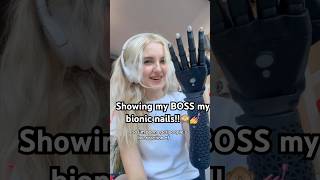
So these are the brand new Hero Pro. We had the Hero Arm, and this is Hero Arm next level upgrade. So they're pretty cool. They're still like 3D printed, muscle operated, but we've got all this extra capabilities now, which is really, really cool.
And Joel, you actually designed these. What got you into bionics?
I, well, probably playing with Lego as a child. What got me really interested in technology, that evolved into electronics and robotics, and then I wanted to do something that would be— that would have a positive social impact with technology. So got really into bionic hands and prosthetics. How can I—
What's it like as an industry to get into? I mean, presumably there's a lot of qualifications you need before you even start, but it must be so innovative and so exciting. Looking at Tilly's journey, it's come on so much in the last, what, 10, 15 years?
Yeah, well, yes, it's come on enormously. One of the reasons that inspired me to get into it was because technology wasn't really moving forward from the sense of what people were actually getting for prosthetic limbs. So there's lots of research taking place, lots of really exciting things, but they weren't really making it to market. And so that was one of the key things was like, could we take this really cool technology but actually make it accessible, make it accessible to the NHS, make it so that everybody's actually getting it?
So when did you meet Tilly then? Tell us about that story of meeting Tilly.
It was probably like you were about 9, 10 years old, I think, at that time. So we initially, we wanted to work with users of prosthetics very much from day one. Yeah. So we were putting out calls on social media to say, does anybody want to help us test the, the new designs, prototypes that we're making? And was it you or your mum got in touch with us? I think it's your mum got in touch with us initially. And we were like, yes, that would be great. We want you to help. And even from 9, 10 years old, Tilly was giving us fantastic ideas for how to design the arms.
Tilly, what's extraordinary was before we came on air, you said you're still getting used to these.
Yeah.
You sort of don't know your own strength.
Yeah, I mean, they're twice as fast, twice as strong. So, you know, it's definitely something to get used to. But I mean, even better, you know, I get to be bigger and stronger now.
So can you demonstrate a few of the things that you can do? Can you pick up that glass there?
Yeah, so— They're all muscle-operated. I can just control it like that. I can do anything I want to do with my hand.
And you're doing that with your mind? You're just thinking—
I mean, everything ultimately comes from the brain, but what's really great about these is it's just these two muscle sensors. So it's only squeeze to close, flex to open, cycling through grip modes, and even that becomes second nature after a while.
Joel, how does the—
Unbelievable.
—mechanics of that, like, so how does that work?
Yeah, it's a good question. So if— basically, most of the muscles that will move your hand and fingers So there's like 24 movements in your hand and wrist. Yeah. But all the muscles that are controlling them, nearly all of them, are actually in your forearm. And they connect to tendons that connect to your fingers. So even for somebody that doesn't have human hands, they've still got most of the muscles. Yeah. So the things that Tilly's thinking about to make those muscles move would be the things that we're thinking about to do those movements with our hands. So it's kind of intuit— I don't know whether you feel that it's intuitive. It's intuitive for somebody that lost a hand when maybe they had previously used one. You're saying you can't really remember, so— Yeah, it's odd.
Like, I wish I had the other hand so I could compare. I'm like, I genuinely don't even know, but it works.
And is it a constant fine-tuning? Because you were saying that they're quite strong, they're very strong. Did you have to fine-tune? Would she have smashed that glass in the past?
She wouldn't quite be able to smash the glass, but we've— so the hand detects the amount of pressure, and so it will kind of automatically stop applying pressure when it grabs an object, but then Tilly's able to give it another signal to increase the pressure if she wants to. So the idea would be you could, for example, grab something like an egg and then smash it and crush it on demand.
So could you operate that arm when it's not attached to you?
Yes, so that's the thing, and it's— we've posted about it on social media, and that's what everybody is like, this is crazy, mind-blowing.
We've got to see this. We have. Or just help Tilly Lockey?
Right, this is completely wireless, so you can actually just detach the hand like that. You're thinking about it. And I can still operate it the same way as if it was attached. Make a move. That is incredible.
That's unbelievable.
Yeah, so it can do little tasks for me when I can't be bothered.
Have you ever had any mishaps where you've left it somewhere?
Well, I am sure that I will be like, something like that will happen. I haven't had them long enough to make a mess of it yet, but yeah. Also, the Practical Jokes and Wind-ups, you can use that for.
Oh yeah, so much better. Unbelievable. Yeah. Oh my goodness.
Joel, what's the future for this? Like, obviously it must be hugely expensive, the research and development and the manufacture. So are we gonna— will there be a time where this can be available on the NHS? This is available on the NHS now.
Wow. Yeah, yeah, yeah. So these have been developed with a lot of feedback from NHS prosthetists, specifically designed to make sure they are available through the NHS.
And can you change the colours and things like that?
You can, yeah. So there are covers you can put on the outside of the arms. You have different designs and colours.
I mean, this has been life-changing, especially for your music as well, Tilly. It's really been life-changing for that, hasn't it?
Yeah, I mean, it just gives me the opportunity to— it's just things people take for granted, like being able to hold a microphone and like express with the other hand, even to be able to like shake someone's hand or like throw a peace sign, you know. It's the little things like that. But yeah, if I didn't have them, I would just be like stood behind like a mic stand probably. But it just allows me to like prance around and be all crazy.
So the company, your company is Open Bionics, and Tilly, you're working with Open Bionics now. So what a great poster girl to have, right?
Couldn't think of anyone better. No. She's fantastic.
Tilly, just if people are watching this at home and they're going, the start of a similar journey that you were when you were 3 years old, and the parents are watching and they're at the depths of despair at the moment, what message would you like to give to them?
I would just tell them— I mean, it's all about raising awareness and making sure people know what's actually out there. Like, so many people— I've been posting about it for years, and so many people see these and they're like, I feel like I've missed like 10 years. Like, when did this happen, you know? So it's just getting out there and making sure people know that they're on the NHS as well, because sometimes people will see them, be like, oh well, it's a— like, it's a pipe dream for me, I can't afford it, you know what I mean? But there is all this support now. So if it is something you want to get started in doing, like you can and there's options available. And I would also say be open. The best thing about Open Bionics is they're so open to feedback and it's through people like using it, like and going about their day-to-day lives. They're the ones who can give feedback and make them ultimately better. And that's what I do.
And in a wider context as well, like the fact that people at home who might be going through a similar thing can see a 19-year-old that's young, vibrant, that's, you know, that's got the rest of a life ahead of them. Exactly. Yeah. It's brilliant.
Thank you.
Thank you. Thanks. Thank you so much for joining.
Thank you so much for visiting our This Morning YouTube channel. Uh, we upload new content every single day, so go ahead and hit that subscribe button, and we'll see you in the morning.