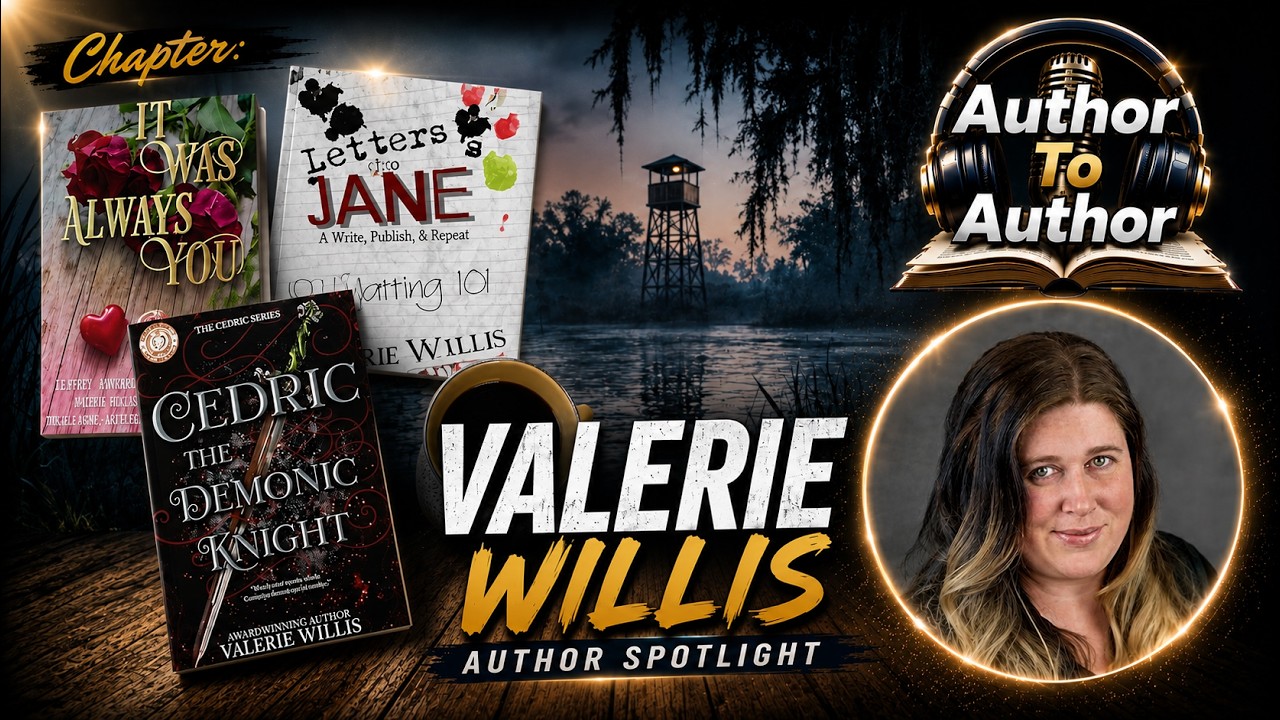
Valerie Willis writes fantasy and paranormal romance and self-published her debut novel Cedric after traditional agents rejected it for being genre-defying. She shares her approach to audiobooks, book design, and a "plantser" writing method that mixes pantsing with plotted outlines, plus her upcoming series "I Accidentally Reanimated the Billionaire's Hellhound."
Chapters
Welcome to Author to Author, Chapter 2, Valerie Willis. This podcast channel is all about authors for authors. Valerie Willis is a Florida author spanning fiction and nonfiction as well as publishing. She joined Four Horsemen Publications in 2020 overseeing design of book covers, typesetting, and author branding. In a moment, we'll meet Valerie Willis. Author to Author is supported by Cybershoot Hosting. Funny name, fantastic service and support. Valerie Willis, welcome to Author to Author. How are you?
I'm doing great. Thank you for having me on here. I'm so excited to be here today.
Thank you so much. What type of books do you write?
Oh, I love writing fantasy romance and paranormal romance. I pack in a lot of mythology and dark history and a lot of what I do, um, and I like writing novels and series. So a lot of people, when they discover me, you're not going to find standalone books. It's going to be ongoing I just have these long drawn-out ideas and I cannot wait to share them with everyone.
You're so much on the opposite side of the spectrum for me because I'm into short stories and, and it's, it's, I'm working on, I've been working on the same novel for such a long time, so I really, really admire people who can, who can do what you're doing. And series is the, is the brilliance of marketing. And, and I, I managed to change, chain some short stories together, but I'm still working my way up to novel level. I'm not on that level yet.
It's crazy because I started writing as a kid, right? And I still have it. In 5th grade, I filled front to back a composition book of just the same story of a girl who plane crashes in Africa and goes on this grand adventure because it was the early '90s and everyone was busting out movies where Africa and the cheetah and all that stuff. So I kind of know where I drew from. But I even wrote long-winded ongoing stories in high school, and I kept them in binders, and it would— and I had several copies that would start circulate my friends. And then it wasn't until 2009 that I decided to take writing more more serious, right? So I've always written. We always get asked that question a lot as authors, you know, how long have you been writing? I've been writing since a kid. How long have I been professionally, like, serious about writing? It was 2009 where life hit me pretty hard. I was— uh, economic bubble burst, so I was laid off. I ended up pregnant, uh, just before being laid off. With my first kid, um, and then I ended up with skin cancer. And this was all in a couple weeks' time that all of this hit me. And my only regret, regret was, what— why didn't I do anything with that novel I started writing in high school? I should finish that. And that's what got me down that path of learning how to design books, learning how to do this professionally, what's the difference between the two, and things like that. So that's how that all came about.
It's about time you should introduce us to Cedric.
Cedric, the love of my life. So this was the first book I published. This would be my debut novel, and it was quite the adventure because when I first did this, I wanted to traditionally publish. So I queried it, and the lit agents, a couple of them came back and were like, "Fun story. You've mixed so many genres, we don't know how to market this, and that's why we won't touch it." And for the first time, it like— no one— all the resources, all the webinars and workshops I had gone to prepping for this moment, none of them prepared me that that could be be a reason they would reject a book, right? So these same lit agents, and during a time where it was still on the fence of supporting self-publishers, gave me materials and instructions and advice on how to self-publish. And I hit the ground running pretty hard when I finally did self-publish that first version of Cedric, and I started approaching the indie author and self-published side and was like, hey, uh, because at the time there was a bunch of magazines and stuff that if you did your own interior, your own cover, uh, and things like that, that they would feature you for free in their, their websites and things. And every time I would get rejected because they're like, there's no way you designed this book. And I'm like, but I went to school for graphic design. I would hope I had the skills and the knowledge and experience to make a book. Um, but it was one of those things that I started writing it in high school. I have tons of doodles and sketchbooks from that time, uh, because I was going to make this a graphic novel was the initial intent. Uh, when I learned some things about professional writing, because I was trying to first do that book from high school. So I had another book that was written. I realized that I didn't know how to fix it. So let me start writing a story fresh with all this new advice and see what my writing looks and feels like from, from the start. So I started laying my graphic novel idea to paper. And that's when I realized I could totally tell a story way faster typing it up. Than trying to doodle it out. And I just took off and I had all this research. And it was wild because Cedric took me 3 years, but the second book only took me 75 days to draft out because I had cut my teeth enough on that first book and really went into Cedric with the mindset of this book is going to teach me to be a professional author, and there are certain things I need to know, certain things that I need to stop doing, and be a little more confident of what my writing style should look like. So it was a good time, and then finally I braved and entered it in Reader's Favorite, and it got bronze on the first try, so that was pretty pretty, pretty cool to also get that gratification that it's not— it didn't make it traditionally, not because it was a bad story or bad writing. It didn't make it because it didn't fit in a box. It didn't fit into just fantasy. It didn't fit in just into historical. And they're not wrong. It's been a challenge advertising and figuring out how to market myself. But as time goes by, it's getting easier because readers are now into a lot of more mixed genre books, and the indie scene has exploded in great ways that have kicked down a lot of walls and red tape that used to exist. But yes, I love Cedric. Uh, the idea came about because I did not like sparkly vampires. That's a fairy. Fairies are sparkly and they steal souls and blood. That is how the folklores of Romania and Slavic tribes portrayed them originally. So this was sort of my ode of let's go back to the original, like prior to Christianized versions of these monsters and things and see what used to be sort of spoken about at the fire pits. You know.
This is, um, in print book and also an audiobook?
Yes, it's an ebook, hardcover, print book, paperback.
Um, covering all the bases, huh? Covering all the bases.
I try, I try my best. Uh, I at least always make sure that I have the paperback and ebook at the very least. Hardcover, I started working through through, uh, when they finally opened up that POD, that print-on-demand option, about 2 years ago. So that's been a rather newer thing that's gone a little wider, and they've smoothed out enough of the kinks for me to invest my time in that. So that's been a really fun adventure for me.
What is the market for hardcover as strong as, as for paper books, or is paper book still the king?
It's very interesting because it really depends on the genre and your readership. So like, at a live event, I'm going to sell a lot more paperbacks a little easier. But online, on that first year of release, I can almost sell more hardcovers than I do paperbacks.
Very interesting.
So it's a very interesting trend. It shifts slightly every year, but it's it doesn't shift enough to not, not go ahead and take the moment. Like, I sell enough hardcovers to justify the, you know, investing the time in creating it and uploading it and maintaining it. So, but I also have a lot of fun with it. And I like to, as a book designer, push the design of the book. So a lot of people, as especially at the tabled events, they'll see the hardcover and sometimes buy it because they open it up and they're feeling and touching the book and they're like flipping open that dust jacket and realize it's not like that false or pretend linen look. I actually ghost the COVID and I take off the font so you have just the image underneath the dust jacket. So it's a nice little touch. That they still have all that art and then it's not obstructed by font anymore. So it's pretty cool.
Also, we brought up the subject of audiobooks and I was really impressed with your audiobooks and I've got a sample here. The contrast between your audiobook narrator and a lot of what's out there is outstanding. Let's take a moment and listen to an excerpt.
I am cursed to have this wench as my bride. What you tell me is true. Why do the spirits taunt me so?
You?
I'm the one who is cursed. Pulling herself to her feet, she attempted to shove him. I hate you. You have made my life a living nightmare. You're the one who chose me as a prize. How dare you point the finger at me? You're the monster. Go on, cry some more about it. Yelping at his shout, she shrank back from him, noticing his tanned skin growing paler.
That is such a contrast with the automated narrations, and that brings the contrast So, so it presents this, the contrast, so well. Tell me about this. This— you've got a magic narrator. How did you ever get somebody that good? That's Ken.
That was, uh, no, that one is— there's two narrators for that book. So that, that excerpt is Michael Gentile, and unfortunately his health bottomed out and he could not finish the last couple of chapters. And even Ken— I love Ken, he does a great job through. Uh, Michael comes from a background of drama. He's an— he was an actor and things like that, and that really comes through. And we also talk about this— it's not just the book publishing industry that is facing this wave of AI-generated audio or scripting or voice acting. They are also seeing this trend over in the game industry. And so one of the biggest wins we had in the game industry that really does the same thing as we're discussing is Baldur's Gate 3, right? Uh, it's blowing up crazy, but they took over 2 and a half years recording actors for all the scripts for that game. And that— and it's the same thing that I tell people, that I, I get it, that there's a lot of the services are free for those audiobooks. But they have tools in there to help you add pauses and double-check those words. Like we were just discussing before recording, how if you've got a book on music, make sure that bass is pronounced bass. And you may have to change the spelling in the narrative script. Because a lot of these— but you have to also be careful what you're using, because a lot of those are strictly won't let you adjust your book without changing it to the wrong word. The crazy thing about it, though, and the major difference that AI will never, I don't think will ever be able to do is one, it doesn't pick up on cues, like the social cues or emotional cues, and know when to shift tone. It's, it'll, it's the human emotion is too complex for computers to logically put into coding, so to speak, right? There is something amazing about breathing, and you don't get breathing with AI voice acting, right? You don't get the— and just that sound alone can convey so much. It's almost like the body language of your ears is that breathing sound. Or the— there is no— you can't type anything to make that sound with AI at all. And the other thing is the shift in inflection of the tone, right? We can mimic it as close as we can, but we can't— like Michael does in that excerpt, he makes his voice more gravelly for Cedric and then softens it for Angelene, and there's no real way to successfully make sure that AI can mimic that sound or elongate those sounds someplace underneath the words that are being spoken. But it's still— I get that option, but I just have a hard time. It just doesn't feel the same. It just it doesn't feel as genuine or as raw as when someone voice acts, or at least records a book, and you can hear the, the clicking of teeth and things like that. It's there, it's such a soft nuance, but it does make a world of difference.
Writing is about communicating, and nothing communicates better than real. Speaking of real, speaking of real, moving into another direction Um, tell me about Formatting 101.
So I keep getting asked, do you have a book recommendation on how you format your books? About, um, everyone just marvels over— and I—
it worked—
how I have beautiful, beautiful interiors. And they're like, this is better than the Big Five are pumping out. And it's because I like push, you know, I really like to push the tech and I love books and I love designs and nothing's more exciting for any reader, including myself, as having a pretty interior for a book that's easily read. But that comes from years of experience self-teaching myself how to format books and things like that. I was a stay-at-home mom for a long time. When I first started writing. And the kids went into school and I decided I'll go into a publishing or typeset role now that I've self-taught myself so much and see what else I can learn. And I stepped into that role thinking, oh, well, they're a top 25 publishing publisher across the globally. And I realized I had nothing I knew to learn, but I had to bring them up to speed. And that's, that's where the difference was. And then they're like, well, what book do you recommend? Or how'd you figure this out? And I'm like, well, trial and error for a majority of what I have. But I couldn't find books. I could not find a book. The closest book I could find was the book Blueprint by Joel Friedman. And that one has out since the 2000s, early 2000s. Now the great thing about book formatting is that we still follow a lot of the same cues as the Gutenberg Bible when it was first printed in the 1700s and 1800s, a lot of what they've established during those centuries. But there's no like book saying this is how you, you know, the modern way of typesetting, this is why we do the things we to do. So after being asked a bunch of times and realizing there isn't— I could not for the life of me find even a blog post that reflected— I sat down and started writing this book and just unloading everything that I knew and know and double-checking things. I know I wrote this book to make sure that it covers 3 types of people, right? I wanted the book to be able to be used by someone who simply wants to design books for other people. I wanted the book to be usable by the, the self-publisher, indie, self-made author who wants to be the person who wears the many hats and how to prep themselves across the board for that. But I also wrote it for the author who might want to be able to just communicate prep their manuscript a little stronger for their publisher, whether they're going with a big guy or small guy, doesn't matter. The way we prep those manuscripts and rely on your manuscript is the same no matter which path you choose. Um, so, and then of course I broke it up by types of books because I wanted whoever picked this up to be able to go with it where it matters the most and then cater each those of those pieces of advice and information to that type of book. So you can skip the whole front section, go straight to whatever chapter you wanted. But it was— I definitely tried my best to design it to be very artful, to be very stimulating, but also put you where the information is, where you needed it the most.
What I liked about it was you get down even into the basics. And one thing I was amused by was you ran into somewhere with working with other people, you ran into a confusion between forward and forward.
Oh, I see it all the time. I'm like, and of course it takes me back, 9th grade, I had a wonderful English teacher who was very adamant of teaching us the whole Latin prefix and all that, right? And I got upset obsessed with that. So that's how a lot of my spelling and the way I break down words works is based off of that system. And it has done me quite well because I will see where someone has put F-O-R-W-A-R-D and I was like, that's to move, that's to move, move in front of, sort of, when you break down those Latin aspects. Forward, which is what you should be putting in your book, which is F-O-R-E-W-O-R-D, is basically a short way of saying beforewords, right? Because that's why it has the back end of before starting it. And the last word is word because it's trying to express this is coming before the important— the word, the book kind of things. So that's how I try to explain it. I'm like, you wouldn't— forward, as in the motion, is just one letter off from toward, and that should be your warning immediately, where the other one has before, before the words forward. So that's pretty much the advice I try to give people when they're like, how can you— how do you know But being an adamant wordsmith, it drives me nuts. And I, I correct— I've corrected many, many authors. It's a common mistake. And I think part of that mistake may happen because self-publishing has exploded, but there's no vetting system. And a lot of people may rely on sources that are doing it wrong. And, you know, when you're checking on stuff, stuff that didn't do that part correct, it carries over and escalates further. So I try to do my best. And I get asked a lot of questions about what front and back matter is, and which one do I include. So I took the time to kind of lay that out and list those things out as well, to make sure that people kind of understood, you're building a book,. And you may have told your story in your manuscript, but you might want to consider adding those extras on either end as well and making sure your editor goes through those things as well, because most people write the foreword and forget to send it to the editor, and that's another problem.
So that's way before you get to arguments about the Oxford comma.
Uh, no, I, I prefer the Oxford comma. It's less confusing that way for me visually.
I've argued with Grammarly a lot of times, like, no, you just changed the meaning, please pay attention. Just to totally contrast back in the other direction again, uh, tell us a little bit about It Was Always You.
So this was an anthology, uh, hosted by Ellie Perez and Todra Candle, and, uh, I got invited to join that group. It's a— I mean, every author in that is wonderful storytellers. And it's funny because it's more contemporary than what I normally write. Most of my stuff, there's a werewolf, there's a vampire, there is some mythical god or creature that intervenes. And that's one of the rare times, uh, that you just get to see my writing without that element attached. And I believe the story title is Mallory Loves Me. And it was inspired by when I was 19, I went to work at Harley-Davidson. So it's sort of inspired off of that experience. And that I ended up getting a night shift with a guy that I thought hated me, but he started singing me, singing to me and things like that. So it was like this whole ordeal. And then It's sort of, and I know the lit agent, Celeste Hernandez, says this all the time. She's like, some of the best stories answer the what-ifs, right? So my question was like, what if this had developed into a sort of a friendship into like this epic romance? So I just went from there as a personal starting point, but evolved it into what would this look like if we develop it further. But it was such a fun ordeal to be part of that. And of course, everyone's like, wow, Val, I didn't know you could write contemporary romance. And I'm like, but I've been writing romance. It just doesn't have the paranormal fantasy feel of it. Like, I can strip those things back, but it's not as fun. You know, I prefer it when the guy wants to eat me. He confuses me with his love for hunger sometimes, okay? That's totally cool with me.
Let's get into the basic structure a little bit. There's various methodology about— are you a plotter or a pantser? I mean, do you start— do you follow with a plot, or you just let the story lead you? Which— which you— I find myself going in both directions. Sometimes I'll come up with an idea at 4 o'clock in the morning or 2 o'clock in the morning, and I'll get up and I'll, you know, blast through it, and by noon I've got a short story completed., and, and sometimes I get to the end and, oh, that's where it's going. So what, what style are you?
I like to tell people I'm a plantser. I'm a, I'm a little bit of both. So a lot of times when I'm writing poetry or short stories, I'm a pantser through and through. I have an idea, I have an idea for a character, I know what tone or message I want the punch to be, and I just sit down and I just barrel through it. With the novels though, it's a little more complex because there's some research, there's world building, massive world building, especially in the Cedric series with the way that I'm doing it. And so what I do is sort of like plot points and I do, do and want lists or a need and need and want or do and don't list, sort of both for my characters, my plot and my world, right? For each story that I'm telling. A lot of times I know sort of where I want to start. I know a couple key events I want to happen. I know what the climax of the story and where I want to end it a lot of times. But as for the chapters that fall between and how they're going to get from point A, B to C to Z, I usually don't know. And it's— anyone who has written with me knows that there have been more than enough times that I'm sitting there and I'm— and I go, "No!" It's like I'm watching the show for the first time, like a soap opera. I'm like, "That can't be true." I have— my editor who I write with a lot, Jane Paquette, she's watched me go, "No, that can't be true. I have written 4 books in series, this fact about this character can't be true because I have written 4 books not knowing this very important detail. And watched me crack open all the books searching my writing. And this is the cool part I think most pantsers experience is realizing that somehow your past self has known about this fact you're just not getting up to speed. Because then I'm checking his dialogue and I'm like, he has dodged answering this every time and I did not pick up on it.
So we came down to the question of, does the story lead you or do you follow the story? Which, which, which, which area do you fall in worst or most?
I think, uh, the story leads me a lot for for the most part. It's very rare that the idea comes because I've sat down and I'm like, I'm writing this type of story and these are the story beats. That's— I don't plot that detail. It's more of, I have this idea and the character's telling me that this is, this is going down this way. That's, that's more of the thing. Or I've had a dream and I'm just trying to recreate the dream and then trying to fill in the gaps. Of what I assume might be part of what that means or what that is unfolded.
So there's research involved in any kind of writing. So where do you fall, Google or AI?
Google. Google. Um, AI, I usually— the only time I use it is for like marketing. It can save it. As an author, as we all know, marketing is the bane of our assistant, and I usually use it for tasks that would take me hours or days to accomplish.
That summarizing and promotion blurbs.
Yeah. Uh, so one of my biggest tips for authors out there who want to use AI for marketing, as you— ChatGPT is great. You go on there, you create a fresh one, you— the first thing you do is take— tell it literally take on the role of a book marketer or social media book marketer, right? And what that does is it's going to cut the fat, it's going to cut out anything that's irrelevant to that instantly before it starts. So you get cleaner results that way when you tell it what role it's playing. It's almost like a role-playing game with a computer. And then you literally can say, hey, Make me a social media schedule with themes for the following social media list, uh, for a dark fantasy romance author. And it will give you times and days where to post and what type of topics to post that are hot. Now you have to go back and it does it in a spreadsheet. It's just well organized. And you do this every so often to make sure that you see where the trends are shifting to shift what your content is. But that is a great example. Now, could I have figured this out on my own? Probably. Would it have been a 5-minute thing? Absolutely not. It would not. I would have to dig through everything. I'd have to gather authors that are similar to me. I'd have to pick apart all their stuff and what's trending and not trending, which visuals are working and not working, what themes are working and not working. And it cut out all that time, the lost time that I would have experienced, and I can go straight into producing my graphics that correlate with these ideas and things like that, and then schedule out those times and days. And every time I've done that, my across the board on my social media always jumps up anywhere between 30 to over 200%. 100% and, and impressions again and every time. It's— AI is a great marketing tool. I think the best analogy I've heard is that AI writing is pretty much doing what the handheld calculator did to math back in the day. We just have to figure out how this tool should and should not be used.
You have to lead it by the hand because what I've— my, my impression of AI is it, it's good at gathering up material, but if— but I can always tell when somebody has just copied and pasted because it always comes off like a 10-year-old trying to sound like a college student.
Uh, I went to a workshop, uh, with the Florida Authors and Publishers Association, and I loved how he described it. He says, pretend this is your acid tripping librarian. Um, she, she's great, she's great at looking up stuff stuff, but every now and again she's going to give you something so off topic or made up that you have to question what she just took.
That leads me to this: where do your ideas come from?
My head, music, everywhere. I mean, um, the Tattooed Angels trilogy started because one night I was listening to music and I heard Tool's Lotterless for the first time. And there's lyrics in there that made me think, well, what, what would a character be like if this was their theme song kind of scenario? And then from there, the story came. For Cedric, it's, you know, I— oh, I wanna, you know, I wanna like a— I want an anti-hero. I want a bit of an a-hole for a main character. I'm tired of all these fluffy YA stories. I want something nitty-gritty and dark, and, and I want it all based off of mythology and medieval bestiaries that people have forgotten, like things that people don't know anymore. So like the entire book of Cedric is quite inspired by the Russian night hero tales, which were common stories during the timeframe that he exists. And that he's loosely inspired by Ilya Muromets. And even his horse is named the same as that guy's horse, which is Barushka, which is sort of Russian for Barbara, but the horse is male. And I've been asked that question. They're like, and I'm like, I know. I'm like, it's because he hates the horse. He gave it a girl's name. So the horse bites him, doesn't— he's like, don't touch me. You know, it's that play of if you know, you know kind of game that I play with that one. Under my other names, VC Willis, it was a dream. I had this epic dream, and by the time I came out of that dream, I had this weird understanding of these neat mechanics of a fantasy world. That's probably my biggest worldbuilding piece that I've they've juggled. Like, I think my favorite aspect that the dream gave me was that the caste system in this medieval feudal kind of world, you could tell where someone falls, whether they're a nobleman or viceroy or a prince, based on the knots or layers in their braid. And I'm like, that would totally function, that would work. And I just love the visual aspect aspect of that. As for the spicier stuff like Honey Cummings under that pen name, they're the what-ifs, you know. I'm a ham as a reader for shifter romance, and I'm like, but no one does enough cryptid stuff because I like, you know, the folklores and Appalachian monsters and things like that. I go to Bigfoot panels and And I often get stuck on panels with Mark Munzee from Erie, Florida. So I have a lot of fun in all those aspects. And so my inspiration comes from a lot of things. They come from actual legends, actual history, sometimes dreams, sometimes music. It's just whatever. Everyone's like, do you ever run out of ideas? And I'm like, I have a folder where I keep the list of characters. On the end of the stick, and I have to finish— I have to finish first before I can start the next.
From my own experience, 3 o'clock is the time when, if I've got a problem with it, I go to sleep with it, and 3 o'clock in the morning I got this notepad, I've got this pen that has a light on it so I don't wake anybody up. And so a lot of times I'll solve a problem at 3 o'clock in the morning and I'll write it down, and the next morning the big problem I have is reading what the heck I wrote, reading my handwriting. But other than that, yeah, and then go to work on it if I've got that motivation. But what is your most productive time of day?
I'm more of an evening and early morning kind of person. I recently picked up a new job and they're like, are you sure working from 3 PM to midnight is going to be okay for you? Because you know, and I'm like, yeah, I said, what you don't understand is that every night I write usually between 10 PM until almost 3 AM is when I put down the most words. I'm awake, I like how dark it is. It's quiet in the house because everyone else is asleep. There's no pressure to be doing anything. There's nothing I should be doing around the house by that point in the day. So it's, it's when I hit that calm, and that calm comes after 10 PM a lot of times. Um, do I call it early some nights? Yeah, you know, not every night, especially if I have an appointment or something early in the morning. But for the most part, people can catch me online writing from 10 PM to about 3 in the morning, and usually I'm on Discord, and I'm either in my Discord of Val's Musing or the Author's Accountability Discord, uh, hosted by Four Horsemen, things like that. And I usually love it when people chime in and they ask me questions and stuff, so that, that keeps me going too.
What motivates you the most?
Oh, just trying to get to the end of the story myself. I want to see how it ends too. I have no idea. I have to know how this ends. And then every time I start a book, I'm like, wait, no, that came— ah! I'm like, and I thought the story was almost over. And then there's all this new stuff that unfolds. And I'm like, oh man. Like, it's wanting to see how it ends, how this closes up. So Touched Angels trilogy, that was awesome. That high school story. It was very difficult rewriting the first book because there was a lot of nostalgia involved. I knew what it was, where I was going with book 2, but I had no idea what book 3 was going to be about until I got book 2 written. And then I was like, oh, oh, and then I still didn't know until I wrote it how things were going to close up, um, and exactly who's going to make what call and decision at the end. Because there was 3 main characters that everything pivoted on that would have to— someone would have to choose change to fix things kind of scenario. But the question was, who is going to be the one to incite the change or encourage the change? But I was very pleased with how it ended because it's— because each book, that's a dark YA fantasy. It's sort of like an ode of lessons I wish I knew a little bit better in high school. First one is, you know, he's failed reincarnation. So in Rebirth, it's does Hoten become this person they say he is, or does he choose his own path or rethink the path that he was going on originally because he's mortal now. He can't be a rock star like he intended, right? It's sort of that same age-old sensation we have when we first leave high school, right? It's like, oh, I was going to be this thing, but now that I'm— I've crossed that line, that doesn't seem so feasible, you know? Uh, should it be a doctor like Mom said I should be, or should I be a Veterinarian animal, you know, uh, doctor. Uh, and then the second one is about not being your sibling's keeper, your family's keeper. Like, you will break yourself and forfeit your own life and time and effort and energy trying to cover up and fix someone else's issues. And then there's a built-in expectation that you'll always be there for up after them. Like, you don't fall into that scope and, and know when to put your foot down, right? You can't help those who are unwilling to help themselves kind of scenario. And then the last book I think is a great lesson is that because it's always been tradition doesn't mean you have to keep doing it, especially when it's toxic and harmful. It's fun, it's fun to see at the end of the day, what each book produces for itself and the lessons or the message that ends up being portrayed that I had no idea needed to be said. So I think the Tattooed Angels trilogy does it the loudest out of everything I write. But every story that I see, when I finish it, I sit back and I'm like, huh, like, like, Pasquale knew what she was doing. Because future Val or present Val is very impressed that we, we managed to make that message somehow, uh, be delivered in there.
Does being a writer kind of ruin watching movies for you? I find myself analyzing stuff I'm seeing on television, and that's a plot hole, and, and I can, I can tell that was by it. I, I watch a whole series of things like on Hallmark, and I can tell where when the original writer stopped and a new writer started, because I can detect the nuances of change. And, and I know that you do the same thing, and it almost ruins it.
So I kind of get excited. I, I, I— do I choose things and have changed my mindset when I go into watching television series and anime and, and movies? Absolutely. Um, my husband, my Has it ruined it for my husband? Absolutely. He's like, I'm like, yep. I said, and next it's going to be this, and next it's going to be that. And then it plays out and he's like, how did you know? And I'm like, well, there's principles of storytelling, right? And the human element. So for instance, Damsel, this is a movie on Netflix. It has Millie Bobby Brown in it. She's wonderful in it, and it has a dragon. And I like— people weren't sure how to feel about this, but what I love about this movie, and I reference this, so what I do now is I reference what I've discovered about movies and things. And I know for a lot of people, instead of sitting down reading a book, being able to watch a movie and just see how it unfolds sometimes conveys a little faster. I tell people, watch Dansel. It is a— first off, we have a plot that daisy-chains tropes and archetypes and then breaks them to convert into the next one. You know, uh, opening scene, you have a wintry landscape, a barren land, and the princess is out there chopping wood. We've seen— we know what trope this is. And fantasy romances, right? And we can suspect that this carriage that's all dolled up with all this extravagance— oh, she's going to be given to the kingdom or married off to the kingdom to save her kingdom. You get there and they're not really seeming to be preparing for a wedding necessarily, and now it's turned into a wedding ceremony. It now has been shifted and broken into she's being sacrificed to save all the kingdoms or their kingdom. So it just keeps daisy-chaining stuff, right? What I loved about that movie is that it's very clear that the writer is a short story writer. And people are like, well, why would you think that? Why would you say that? I said because the emphasis each scene, each plot of shifting trope within that trope, they hit the 5 senses every time. And you can sit there and knock them down and guess which one's coming next, and it just repeats like that. But it worked. That movie was entertaining, it was fun, it had some surprising plot twists because of what they did for that. So has it changed how I watch movies and things? Absolutely. Because I break it down, I recognize the elements. And then I get excited. And I tell my friends, like, you need to, you need to come watch this. And I need you to keep the following things in mind, and see how you can implement that in your own writing. So I use it more like a tool than anything else, which is kind of weird and wild at the same time.
Speaking of what's next, what's next for Valerie Willis?
Oh, right now I am 72,000 words into a draft. Uh, this is actually going to be a series because people have complained. It's a series of standalone books, and I'm doing a little bit more formulated because, uh, it's sort of a what-if fun statement. Uh, it— so it's inspired by— how long ago was that? Like 6, 7 years ago, I had a friend, uh, do one of those, "Ah, you can't mix paranormal romance with romance comedy. That'll never work." So to prove her— to prove her otherwise, I, I'm like, what if you did? What if, you know, Taking a lesson from Saritza, what if you did mix those two? Why wouldn't it work? That would be hilarious. And that is how the story concept of I Accidentally Reanimated the Billionaire's Hellhound came about. And that is the book I'm working on. And the idea is this a— is this sort of a modern setting with a layer of supernatural mythology? Caked into it quite a bit, and that it's going to be within this series. It's just going to be fun books that are right between other stuff to kind of cleanse my— it's like a palate cleanser for me where I don't have to take it too serious. It reads more like the contemporary stuff that I write, like in It Was Always You kind of vibes, but with my paranormal put back into place. And I mean, the opening scene is she's a veterinarian for a supernatural vet office and does the night shift, and a billionaire has brought in his hellhound who has eaten a holy relic, and that she's trying to save it. So I think that's a great inciting incident, and that would be like a hell of a night shift for any veterinarian, I think.
Valerie Willis, Valerie Willis, thank you so much for joining us on Author to Author. It's been a pleasure having me. I'm Tim Trott. Please click the like button and remember to subscribe so you won't miss the next chapter. To be a guest on Author to Author, please contact me at ata@timtrottwrites.com.










