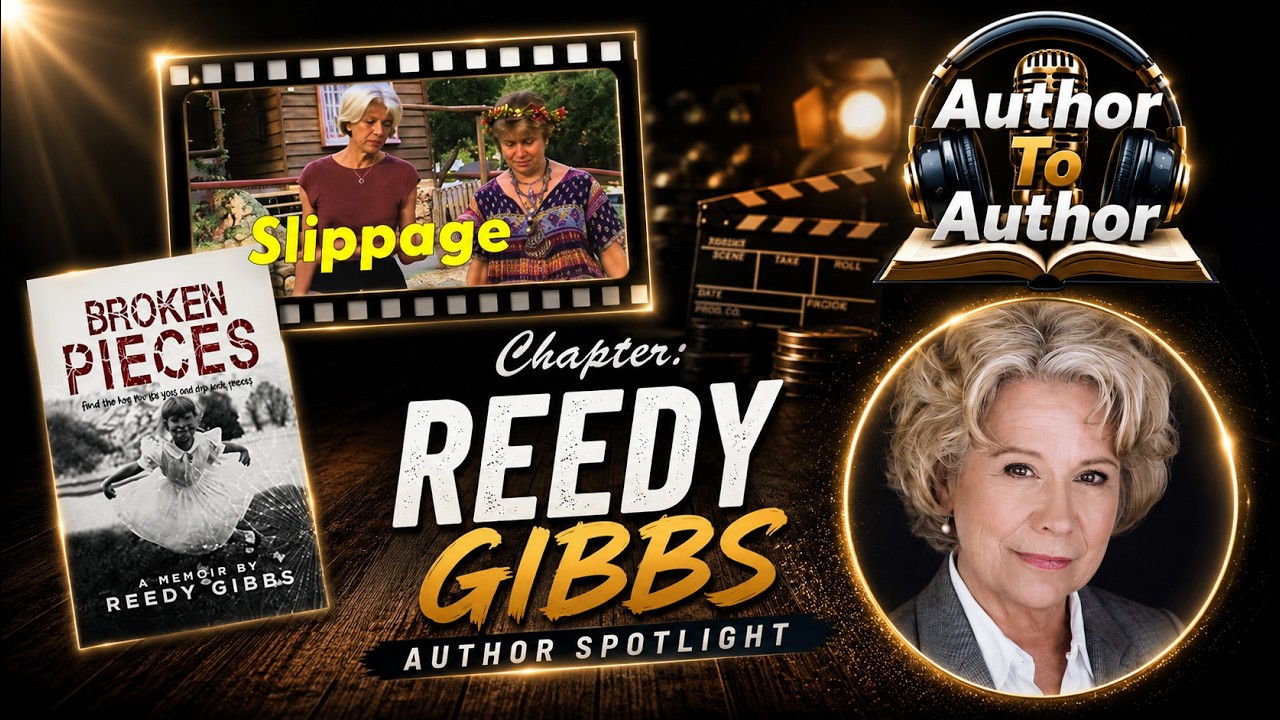
Actress and screenwriter Reedy Gibbs wrote her memoir Broken Pieces and the Fun Things You Can Do with Them using journals and family interviews, earning 4.5-star reviews without formal writing training. She self-published through Paper Raven Books and is now collaborating on a memoir with three other women in their 70s to show it's never too late to write.
Chapters
This is Author to Author, and I'm Tim Trott. This is the channel where I introduce you to interesting authors. Reedy Gibbs' bio describes her search to find something she could be good at. After almost flunking out of high school, she found her inspiration in dancing and acting. She went from acting to writing and finally to producing a short movie. Then she became an author. Earning 4.5 stars in her first book, a memoir. In a moment, we will meet Reedy Gibbs. Author to Author is presented by Cybershoot Web Hosting, where you should host your author website.
I would like to welcome Reedy Gibbs to our Author to Author podcast. Hello there.
Hi there, how you doing, Tim?
You happen to be an author, which we'll talk about later, but as well as a screenwriter, actress, and a movie producer. And all those talents came together in a short film called Slippage in 2016. The description reads, a couple of estranged girlfriends get wickedly stoned and slippage happens. Oh no. Fill us in, give us a little bit more about that.
Well, it's kind of loosely based on, I mean, I took some liberties with it and with the help of a couple of friends back in the days of the '70s when I was living in a yoga commune back then and some other girlfriends and I got together and thought about ideas to make a little short film. So, um, the story is relevant because it's true, but it's, it's, it's intermingled with other things.
So it's not, uh, it's based on truth, but, uh, you took liberties with the truth.
I did, yes. So it's not all true. It's based on, it's based on a true story.
And we'll get into more detail about that a little bit later. That wasn't your first rodeo by any means. You started with Overexposed in '92, Crossing Fields, Taylor's Return, Little Savant, Now You Know, The Movie Hero, Mysterious Skin, and Brick in 2005. So when Slippage came along, that was in 2016, I understand.
And I didn't write any of those other movies. I was just an actor.
Right, right.
You were actress in those, but then you took the reins and decided to put put it all together. Let's look at a brief scene from that video.
No, let me explain. It was just once. Just once. Only once. I promise. You all right, buddy? Did you see that?
When was it, huh? When did it happen? Huh?
Come back here. Oh, God. Oh, man. You're in good shape.
I do Pilates. Oh, do you really?
I was thinking about doing that, but my back.
That's why you should do it. And I lost 10 pounds. I mean, you could lose at least about—
And, and so it goes. The movie is on YouTube and a link appears in the description in this video. That, that movie won a few awards.
Yes, you are— won 3 awards in film festivals.
So yes, the one thing I wanted to say is that was talking about the '70s, and I once heard a line I love one time. It says, if you remember, if you remember the '70s, you weren't there or you made a diary. So obviously you kept a diary at time. That's— I'm just going to give that as a given. But you did write a book, a memoir called Broken Pieces and the Fun You Can Have with Them. 4.5 stars, not too bad, by the way. So set the scene for us for that.
Um, set the scene for you? Okay, well, and the, the actual— so, uh, so it's Broken Pieces and the Fun Things You Can Do with Them, and it's by me, Reedy Gibbs, and you can get it on Amazon. And, uh, Well, I— when, when, uh, when you're living in Hollywood, where I'm currently living and have been for many— for several decades, um, and Hollywood doesn't seem to have a lot of work left for people when they get— women especially— when they get older. And so I needed to do something to create a creative project for myself that was relevant to me. I didn't really— I've always been— I've always thought about writing a memoir because I've had an unusual life. And so, I took a wonderful class, which is now on Zoom, by Jack Grapes, and it's called Method Writing. And so, I started delving into my past From about age 8, my memoir goes from about age 8, I was raised with— I was the youngest of 6 children and my eldest sibling was Paki, my brother Paki, who was a genius and— but he was also mentally disturbed. And so, I kind of got the brux of his— you know, of his declining mental problems. And, and so I started there, and then where that took me— and I won't do any spoiler, spoiler alerts— but so, and so there was that time, and then there was further on when I lived in a yoga community and made a lot of friends. You know, we were hippies, so we were stoned a lot, and So I, I kind of finally put it together after many years of studying and delving into my past, squeezing in everything else I had to do in my, in my daily schedule. And I kept it up. And, you know, the interesting thing for me is that I don't come from a big background of higher education. This is— I studied acting after high school, and then after that— so what I'm saying is that people with a different kind of mind like mine is you can still do it. You can still write and make sense of your life. And it was so fulfilling to actually do it and go beyond the place of feeling like, well, I'm not smart enough to do this, or I'm not good enough to put it all together.. And it worked. And I kept following that little voice inside of me where it said, that's okay, keep going. You're not, you know, I know my mind is different. I'm more of a creative than a scholar person. And so that was really helpful and made so much sense of my life. I can't tell you how the research into my past and talking to my siblings, and who are all now gone, So I'm an orphan. Anyway, so that's kind of the, you know, through the years I just pieced it all together and with the help and guidance of friends and, you know, other dear people who helped me to put it all together, I came up with it and it's gotten really fine reviews and I'm just Couldn't be happier.
I'm working on reading through it, and I came— you said that your, your brother was a genius. I, I read in your book that the IQ was measured at 185. Is that, is that accurate? Was that, was that what I'm—
that's what Mama told me. Yeah. Yes, that's what Mama told me.
So also really sad. I'm, I'm in the book right now to the point where you're dealing with an outdoor plumbing and you're had to go to town and you're in a pickup truck and a head-on collision in the ice. Other than that, never, you know, a very, very dull book. To the very opposite. Yeah, that was never a dull moment.
That was, that was, that's not, that wasn't a, that wasn't my best day, no. But, uh, yeah, I got it all put together and, and, uh Well, thank you for reading it, Tim. I appreciate that.
Did you keep—
I talk to people who make memoirs and they never admit to me, did you keep a diary or you said you had to question your relatives and whatnot about that, but did you keep a diary? I don't see how you could do a memoir. I don't remember what happened last year.
I kept a journal or a diary through the years on and off. And I tried like crazy to keep it all from my brother, who was knucklehead. But yeah, on and off though, it wasn't constant. And when I did move with my ex-husband out to Ananda, a yoga community, that's when all bets were off and I just did the best I could to stay up with my life. And let's see, so what was your question?
That's all right. I was asking whether you— how did you keep track of such things? And you said you kept a journal, same thing as a diary, but that serves the same purpose.
But you know, I got to say, I got to say, Tim, that this was not all from journals or diaries. This was stuff that was burned into my memories. So, you know, starting way back in my childhood that I couldn't let go of, that I— that was— had such impacts on my life that that was just from memory. And I just created the whole— the different scenes through my memory and through creating as authentic a representation of my experience as I could get. So like I say, it was not from keeping notes, no, you know, just scads of journals and everything.
That makes your accomplishment even more amazing. For a self-taught writer, it's very good. I love some of the descriptions. The one I wrote down was the room smelled like springtime burgers and dirty socks.
True story.
Anyway, that wasn't your, your one and only publishing adventure. You've started another one. You have another book project in the works. You've formed— I tried to say a writer's group, you kept correcting me and saying it's a collaborative, so okay, I'll give you that. So, so tell us about that, your next adventure.
Okay, well, first of all, I'm a self-published author. I tried to go through the usual route of a traditional publicist but there were too many hoops to jump through. We were supposed to have a gazillion Facebook, you know, Facebook list of people, and which I did not. I'm not a huge fan of Facebook because I don't have time to sit around every day and answer everything. And so I figured I'm going to have to go for a different route. And after, you know, after trying to reach out through the internet, trying to reach authors, trying to reach publicists and literary agents, and kept finding too many hoops to go through for this, for my particular mind. And so, I— the internet saw me searching and started coming up with self-publishing sources., and I found Morgan at Paper Raven Books, which I couldn't speak more highly about. They're amazing. And they helped me put it all together for a fee, but now the whole book is my— I'm the owner of all my words. They helped me edit it, but it was always my choice to keep the edits and everything. So it was such a wonderful experience with them, and now I'm with them for life. I can consult with them and everything. And so it is self-published, which I'm really happy about. And I've been doing a lot of promotions to get it out there because it's a different route to go, self-publishing, and you have to be as active as you can be, which, which I feel a bit limited just to fit everything else into my life and keep the promos going. But I've had great response and Through Paper Raven Books, I met a lot of, a lot of self-published authors, and it's been such an enriching experience. And 3 other memoirists, women in their 70s, we came together. We really liked each other, liked each other's work, and so we decided to put together a book that basically states It's never too late. And so, we're— it's a collaborative book and we're each writing our own chapters about how we went about it. And it's so interesting right now. And we're— we've just finished chapter 3, each of our own individual chapters. And so, we don't have a name yet. So, if anybody thinks of a name, please send it to me.
You're not exactly across the street from each other too. You're very much into the technology.
Exactly, and that's what's so fascinating about this whole process is that one of the, I live in Southern California. One of my, Abby lives in Virginia Beach. Brenda lives in Maine. Sue lives basically on a sailboat and has been for 24 years and is now mainly residing in Malaysia. So, we all came together through Zoom and Paper Raven Books and we're starting this project. And it's really exciting because the benefits of writing your memoir or writing in general have been Unbelievable. It's changed my life. And I never thought I could do it. So if you never thought you could do it, you can. I'm proof.
That's probably the message of this podcast because it is not author to reader. It is author to author. And there you have it from the author's mouth, so to speak.
And yeah, I can't encourage everyone enough. Just, uh, just to find yourself, uh, you know, a great teacher, study for a while, figure out what you want to write, and, and just do it as much as you can. If it's 1 hour a day sitting down and writing, or 3 hours a day, or just whenever you can stick it into your schedule, just do it. It's, it's just so much fun and so life-affirming. And for us older senior citizens, um, it's enriching. You know, my kids and grandkids have moved away, and, and due to COVID things got crazy, and it brought my— it brought me back to life. It's just like nothing you've ever experienced. And that's also from the words of other authors in the self-publishing industry, how just satisfying and enriching it can make your life.
But not to dull the blade any, the writing is actually just the beginning, because then there's a whole new set of circumstances to deal go with, but we won't scare anybody away with that. Thank you so much for being—
no, and, and, and then one more thing. Um, if Paper Raven is your choice, which I highly recommend as a self-publishing source, they help you through everything, everything, so you get it done even if it's way beyond your, uh, what you always thought your mental capacities could handle. So it's, it's well worth it. And, um, thank you so much, Tim. This has been delightful, and I encourage you and send you all love.
If I can only add to what you said, if you are— if you're, if your part is the writing and you're kind of weak on the other things, if you want to learn— don't want to learn a whole new thing about the, about the marketing and all the rest of it, it's good to have a publisher like that working for you. There are some, there are some snakes out there that'll bite you for a fee, and it's, and it's very good. You have to be very, very careful about how about who you select. And you talked about Facebook— those people that pop up on Facebook and say, I'll do it all for you for a fee, run, run very fast.
Except, except Paper Raven Books did charge a fee, but they, they, they helped me through everything— editing, book cover, publication, everything. So there is a fee charged for people that self-publish, but you just have to keep an eye on the honesty. And Morgan, Morgan Gist McDonald is the most honest, most philanthropic-minded person. She does things for authors, not, not just to make money. And, and the people that they've hired, you know, the editors I've spoken to, the everything, have been top of the line.
Maybe I should have phrased that a little differently. There are authors There are people— okay, if you say I'm an author on any of the 400-something author Facebook pages, you'll be descended upon immediately by these people that are pitching things. These are not— these are in most cases— I don't think Reedy is going to jump on somebody just because they say I'm an author on YouTube or on Facebook. These are the people you have to seek out, and by reputation and by referral. The ones that jump on you and say for $4,000 I'll sell you all the services you need to sell your book that's only going to sell 3 copies. There's, there's way too much of that around.
And, and one thing I'd like to add is you can book just a quick interview with Morgan, the creative in Books, and they will walk you through and create a package of what you want done. And it's very reasonable considering everything they do, whereas if somebody says no, it's It's basically $4,000, we'll do everything. No, she walks you through it. She knows the Amazon algorithms. And so it's not a fly-by, you know, it's, it's very organized, very researched, and very, um, honorable.
We'll put a— if you'll supply me with a link, I'll make sure we put it in the description for this video.
Okay, absolutely.
Rita Gibbs, thank you so much for taking your time to be with us. This has been really interesting, and, and we've expanded the range of, of, of our, what we're about, our, of our topic beautifully. And you, you've really contributed a lot to, to the program, and I really appreciate it. And thank you very much for being with us. Thank you for joining us for this chapter of Author to Author. Please remember to subscribe so you can join us when we meet our next author.
If you'd like to be a guest on this channel, you can contact me by email. The address is in the description of this video.










