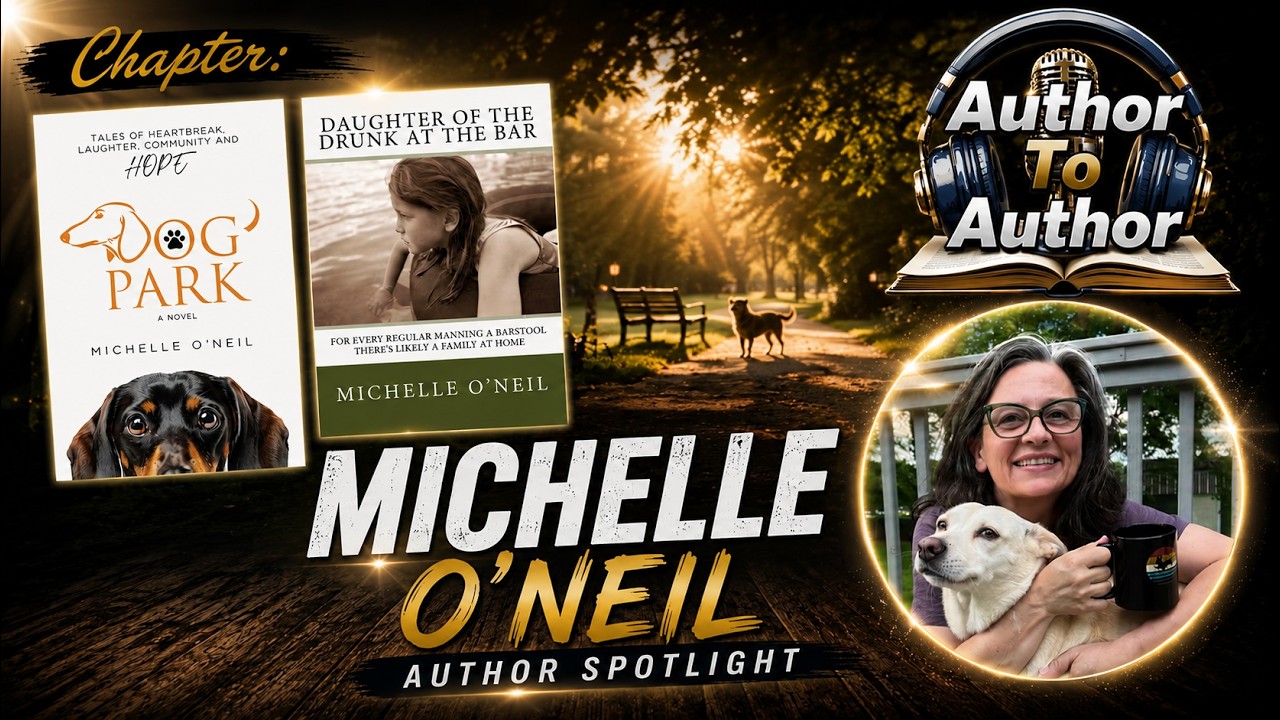
Michelle O'Neill wrote Dog Park after watching a pandemic dog park in Florida, and Daughter of the Drunk at the Bar to process her father's alcoholism. She built characters using Pinterest boards and family stories, wrote at 4 a.m. while nursing and teaching yoga, and self-published both books. Her next novel follows a woman in her 50s facing ageism at work.
Chapters
This is Author to Author. I'm Tim Trott. This channel is about authors for authors. As a writer, I like to discover how other authors find their inspiration and motivation. Michelle O'Neill is the author of Dog Bark. She also wrote the memoir Daughter of the Drunk at the Bar. She has a background as a freelance writer in Washington, D.C., and her work has been featured in Literary Mama, Brainchild, Age of Autism, The Bark, Cool Cleveland, and other publications. She's an RN, a BSN, and teaches yoga in a large retirement community in South Carolina. She's married and has 2 kids, 2 dogs, and 2 cats. In a moment, we'll meet our guest author. Author to Author is supported by Cybershoot.com, the right host for your author website. As with writing, there are several options for publishing an author website. One is hiring a professional to design and manage your site for you. Another is self-publishing—you take on the writing and formatting and put it all online. The third option may be more attractive. A professional web designer lays out a format you like, fills in most of the blanks, shows you how to manage the editing, and is ready to answer all your FAQs. That puts you in control but without the technical frustration. If your collection doesn't include this third option, You need to pick up CyberShoot.com. The COVID price is only $10. There are other advantages too, like having your own email byline—your name at your own dot com. Trust me, Gmail and Outlook don't need your marketing help. And there are security advantages to controlling your own email identity. Why not get the rest of the story at CyberShoot.com? Hello and welcome, Michelle O'Neill. How are you today?
Hi, thank you so much. I'm good. How are you?
The novel Dog Park, and I'll put it up on the screen, explores themes of community, heartbreak, and hope through the lens of a dog park setting. What drew you to this unique setting and how did it shape your, uh, how the way you develop the characters?
Well, the, the idea came to me during the pandemic and where we lived at the time, we actually lived in Florida at the time. The dog park remained open when all the other businesses were closed. And so my husband and I would go walk laps around the dog park as a, you know, a form of exercise for our dog. And I started to realize how vital it was for the socialization of humans. And I started looking around and seeing people and just wondering what their backstories were. And then I just started making up characters. I started making up characters and their stories started speaking to me. Was speaking to me, and I kicked it around for a few years thinking that it would be a sweet little book of vignettes about how people got their dogs, how they, you know, found their puppies. But it turned into a much darker tale. It turned into a novel that had a lot more drama and twists and turns. And so it's very different than what I expected to write to begin with.
There are some very strong female characters in the book. How do you get at writing female characters, and there are specific experiences or inspirations that guided you in creating them? Hmm.
Well, I do know a lot of strong women, that's for sure. You know, I've got a grandmother that lived to be 94, and she divorced her husband probably in the '40s before it was kind of commonplace to do that. And she raised 4 children on her own working as a secretary in a lumberyard. So, you know, she's always a role model, and I'm sure her strength comes into play somewhere in the book. But just, you know, a lot of strong women, friends, relatives. Yeah, you know, I didn't think of the book that way, that it was about strong women, but I guess you're right, it is.
From fiction, in a total oblique turn from that type, from that format, is another book, A Daughter of the Drunk at the Bar. That's a total— that's 180 degrees in another direction. Um, shared the deeply— in that book you shared the deeply personal story of growing up with a father struggling with alcoholism. What inspired you to write that memoir? What— how did you bring yourself to it? And how did you navigate the emotional challenges of revisiting those experiences? That's a tough road.
Yeah, you know, I think before writing that book, I think I was carrying a lot of shame about my childhood. Like, one of the themes in the book was just trying to hide everything that was going on at home, you know, almost like putting on a mask to go out into the world. Like, no one that knew me in school would have known what my home life was like, and I worked really hard as a kid so that no one would know. So I think part of writing the book was just to release any shame that I had that really wasn't mine to carry. And it was very cathartic. It was very personal. I put the book out and barely promoted it at all. I kind of went into hiding a little bit after I put it out. Interestingly, with the new book, Dog Park, there's been a resurgence in interest of that book. And just last month, it was downloaded more than it had been downloaded in the whole time since it was released in 2011. So it's coming back around again. It's, it's, uh, it's getting more readers. And yeah, you know, um, it was tough writing it, but I think it was very important. I think it's important to tell our stories and to, you know, I know that there are other memoirs that I've read that really helped me as far as healing goes, and I wanted to I wanted to be a voice for others as well.
Somewhere you described the book as both tender and tough, and you mentioned it right there as well. How did you balance the raw, painful moments with the more hopeful ones? That's a tough thing to do.
Well, you know, life is like that, right? I mean, there's moments, there are moments that are just very poignant And there are moments that are very sad, very infuriating, but they're also— even in a story like that, there's a lot of humor. And sometimes we use humor to get by in life. And so the book, even though it's a rough subject to tackle, there's still a lot of funny parts in the book. And that's just life. You know, we're all— we're made up of all the emotions, right? We experience all of them.
In the book, you kind of capture the 1980s with cultural references like the Bee Gees, and why was it important to place it in that particular time period?
Well, that's the time period I grew up. I was born in 1968, and it was also really fun to go back to that period when I was writing the book. So I would put on music from from that era. I would look up, I, you know, there's a, there's a Love's Baby Soft reference. All the girls were wearing this like really cheap perfume called Love's Baby Soft. So I actually bought that and would spray it around a little bit to bring up those memories. You know, looking at the styles, the Farrah Fawcett hairdo and the, the teased hair in the '80s and, you know, bell bottoms in the '70s, things like that. When I went back and studied and immersed myself in that era, more and more memories would flood back, and that would help me write as well.
Both of your books deal with human complexities and hidden struggles. What is your secret to creating authentic characters that resonate with readers? Just diving into the mood or immersing yourself in it? That can be cathartic, or—
how do you do that? Yeah, you know, definitely diving in. I, I based a couple— like, they're the character Becky in Dog Park. She's a teenage girl that's having trouble, and she's got to, you know, to deal with a lot of problems in her life. And there were a couple of actors that I actually based her on. I don't know if you know Aubrey Plaza from Parks and Rec. And then there's another character, I can't even remember the actor's— the actress's name, but she was in a wrestling series called GLOW on one of the networks, Showtime or HBO or something like that. Just these real angsty, moody, um, girls that were really actually good girls inside but were dealing with a lot of issues. And so I had a Pinterest board and I had their pictures on the Pinterest board. I had pictures of every single dog on the Pinterest board, every single character, you know, just conjuring them up in my mind and kind of studying them and, and figuring out what they would say and what would be happening for them.
What was the transition like? What was the period of time between these two books? You had a memoir form with the daughter of the drunk at the bar, if I can say it, and a fictional narrative. Yes. Ultra-real and ultra-fiction. You got the two of them balanced. Was one more challenging or rewarding than the other?
Well, I think the memoir was more challenging um, because it's so personal, you know, it's just so personal. And so when I was writing that, I was just dealing with a lot of, um, not so much as reliving— well, I guess it was reliving, like going back to some difficult times and, and, and processing that. So that was definitely more personal and more challenging to put out into the world. Like I said, I barely promoted it because I just I don't know, I just couldn't. I wasn't there yet. I couldn't do it. Dog Park was a lot more fun, I think, because it's fiction. You have a lot more free rein to make the characters bigger and, you know, make things happen that weren't really true. With memoir, you have this responsibility to tell the truth, you know, at least as much as you remember it. With fiction, you can go all over the place. You can do whatever you want. So it was a lot more fun.
You come to this with a nursing background, but you also were a freelance writer in Washington, D.C. Did that have any influence on the way that you write?
Well, you know, I always loved to write since I was probably a kid, and I had a teacher in 10th grade, very critical of a poem that I wrote, and he basically scared me off of creative writing. So I went into the broadcast journalism field, and that's when I went and worked as a writer in Washington, D.C., and an editor. I thought that I wasn't a good writer, so I only could do news. I only could do the facts. And I kind of stuck to that for a while. And then I don't know what changed. I don't know how— I don't even know how I started writing fiction. I didn't think I ever would. I really didn't. Maybe it was just the craziness of the pandemic that just put me in that space, but, you know, for most of my life, I thought I would only be writing nonfiction.
A lot of writers have to balance the writing with their real life. You've got an awful lot on your plate. You're balancing a whole lot of different things. You're an RN, and you're also teaching yoga, and you got so many other things that you're doing. A lot of us have tried, have to fight to find a time for, for writing. Your problem must be immensely worse.
Well, yes and no. So when I'm like, I'm not working as currently, so that frees up a lot of time. You know, the last 2 years I was working as a nurse, but then I stopped that job and I started teaching yoga. So I wasn't doing both of those things at the same time. Now I teach yoga at a large retirement community in South Carolina. And that's what I'm doing. I also have my family, you know. I have a daughter that's 25. She's on the spectrum. She still lives with us, and I have to drive her everywhere, and she still requires a lot of my attention. So yes, it's always a balance, but I'm not doing all of it at once all the time. And the way that I write is I wake up early in the morning. That's how I get it done, and that's when I, that's when I feel like the best work comes. If I try to write in the afternoon, I'm just too tired. It doesn't work. So I'm just naturally a morning person, and when I wrote my memoir, I would wake up at 5 in the morning. I had little kids that time, and I would get 2 solid hours in before they even woke up. Now I have a little bit more freedom. I can wake up at 7 and write till 9.
Not a lot of writers experience the extremes, both— well, not, not just fiction and nonfiction. I would consider a memoir to be ultra nonfiction. So from that perspective, that broad perspective, how— what advice would you give other, other writers about writing memoir, about balancing, or, or balancing fiction and nonfiction or memoir versus how do you live in all of those? How do you live on all those planets?
Well, I think good storytelling requires the same thing whether it's fiction or nonfiction. You want to have, you know, a compelling story. You want to have good pacing. You want to have good transitions so that the reader is like wanting to turn that page. So either one, you're telling a story. Um, and so I would, I would study storytelling whether you're writing memoir or fiction.
Taking that a step further, here's a question for you: self-published or traditional, and the reasons?
So I went with self-publishing both times. Um, the reason with my memoir is probably because I was still pretty scared and I was still playing really small, and I was kind of afraid of what would happen if it did go out. And afraid to pitch agents and things like that. With the novel that I wrote, Dog Park, I was less afraid, but it seems like, you know, the first book came out in 2011 and the second book came out in 2024, and so much had changed in the publishing industry since then. And I have a lot of friends that are published authors, and what I was hearing from them was that they would get maybe a dollar a book, you know, when all the deals were done. And I also heard that a book that was considered successful, it traditionally published, would be considered successful if it sold like 5,000 copies, unless it was like one of those phenom books that just exploded and got on Oprah and that kind of thing. And so with, with the advances in self-publishing, and, you know, I went with Paper Raven Books, so they did help me. I kind of did a concierge, like I picked and choose what I needed from them. They didn't do the whole thing for me, but they did the formatting. I had already hired a private editor, so I just felt like my odds were my odds of getting the book published traditionally, I don't know. I just, I felt like it would be better for me to go the independent route. If my book sold 5,000 copies and I only made $5,000 traditionally published, that would probably be the end of it, right? But if I went independently and I did my own work and I could push the book out there more, financially it would make more sense for me. And also, you know, I didn't know if my book would be picked up. I did have interest from a small publisher, but ultimately I chose to go independent, and I'm really happy with the decision.
I think actually it's more of a hybrid because you're not totally on your own and you're not turning it over to somebody else, so you're kind of a hybrid, a happy ground in between. So what's next for you as a writer? You got other projects you're getting involved in? You got a wide spread between the first one and the second one. How far are we from the next one?
We are, um, I dove right in and I'm writing a second novel right now. I'm just about finished with the first draft. I'm 60,000 words into the first draft. And this book is about a woman who's in her 50s, who after a series of, after a long period of being home with a child with a disability, goes back to work. And she's treated horribly by her bosses, which are very young, like in their 20s and 30s. And so my elevator pitch for it is it's like a reverse of The Devil Wears Prada, where an older woman goes back to work and she's treated horribly by a younger boss. And, you know, a lot of drama ensues there, and I'm having a lot of fun with this one.
Your website is on the screen for anybody to visit. It's over my shoulder right now, and we invite anybody to go there. Michelle O'Neill, thank you very much for being with us on Author to Author.
Oh, thank you so much for having me. I really appreciate it. So nice to meet you.
Thank you for joining us for Author to Author. Please share this video with your friends on social media. Remember to click the like and subscribe button. Click the bell so you'll be reminded when it's time for the next chapter of Author to Author.










