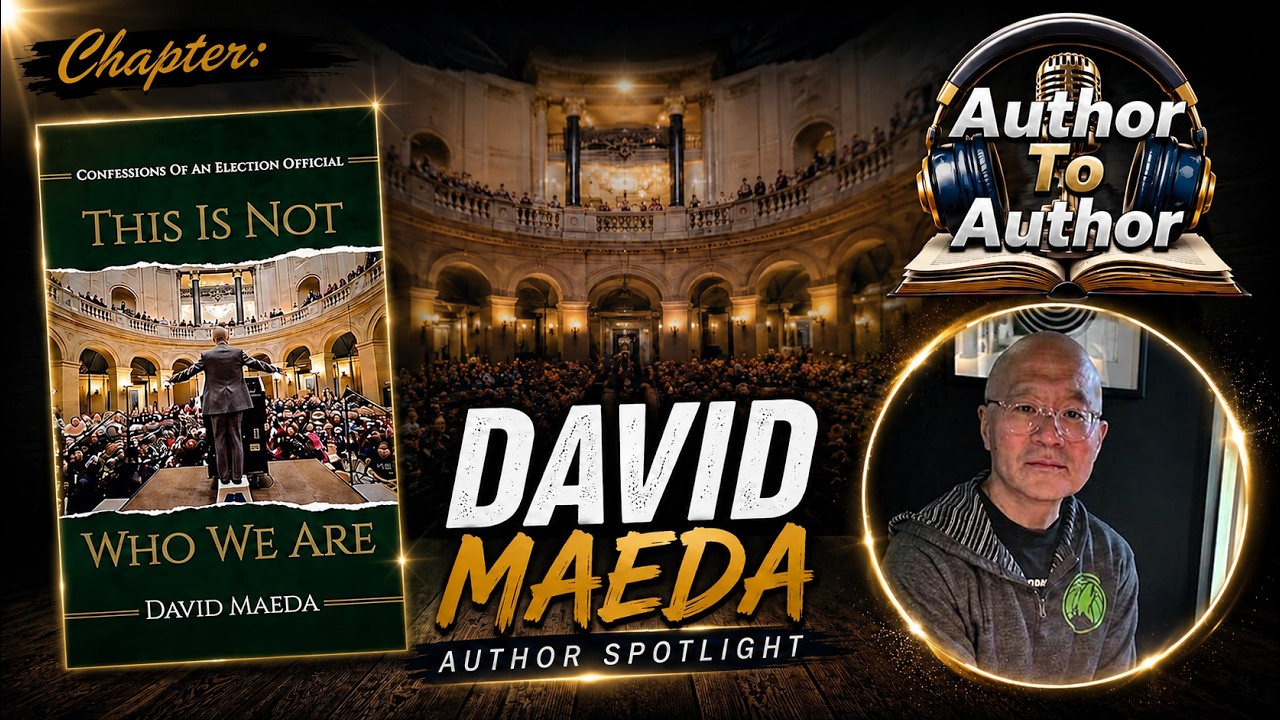
David Maeda, former Minnesota elections director, wrote a memoir that started as a guide to election administration but became something larger. He weaves together running the 2020 election during COVID, his lifelong depression, his Japanese-American identity, and stories about music and friendships. The title, This Is Not Who We Are, is both cheeky and serious.
Chapters
This is Author to Author. I'm Tim Trott. This channel is about authors for authors. As a writer, I like to discover how other authors find their inspiration and motivation. David Mayada spent his career as an elections official at the city, county, and state levels. In 2019, he was appointed to be the Director of Elections for the state of Minnesota. His personal vision is to make a difference in the world by inspiring others and being inspired by others. And to grow his compassion and empathy by being more mindful of his spirituality. In a moment, we'll meet our guest author. Author to Author is supported by Cybershoot.com, the right host for your author website. As one author to another, you need your own website. You can sell your books direct to the public, manage your email list, you can even automate your newsletter and social media posts. It's easy with WordPress. That's right, WordPress. Half of all websites are built with WordPress. That's half a million websites, and it's still growing because WordPress has the utilities and tools that make it all work. Why is it called WordPress? Because under the hood it looks just like a familiar word processor. Cybershoot Hosting helps you bring it all together. Cybershoot can help you find a domain name, install WordPress, and show you how you can take control. Not that hands-on? No problem. Cybershoot can build your author website and help you maintain it with updates and changes for as little as $5. Unhappy with the way you're treated at GoDaddy, Wix, or Squarespace? Fed up with foreign support or robots? We'll help you move. You can start by going to cybershoot.com. That's shoot like a parachute. You'll like the difference. Large enough to serve, small enough to care. cybershoot.com. Hello, David Maeda. How are you doing today?
Great, nice to be here.
Your memoir, This Is Not Who We Are, connects your personal studies with broader societal challenges during the 2020 election season, not to mention the pandemic. What inspired you to weave these personal professional threads together in this way?
So I actually started writing the memoir, um, close to 12 years ago. And it originally— so I've spent most of my career in government and specifically as an elections official, so running elections in the state of Minnesota. So originally the memoir was strictly going to be about how does one get into the field of running elections, because it's not— I don't think a lot of people think about that, and certainly wasn't something I thought about when I was in college, but I just kind of fell into it. So the memoir was meant to be just strictly about my getting into the elections administration field, but I wrote a few chapters and decided that wasn't going to be enough to carry a book. And so, I turned it more into a true memoir where I tell different sides of my life, including my career in elections, but I've had a lifelong struggle with depression. So, a lot of the memoir is about mental health issues and making sure we don't stigmatize those of us who suffer from mental health issues. There is a— I'm a big cat guy, and there's a chapter about my cats. And then there's a chapter about growing up as a Japanese American in a very white community. And then the last chapter really kind of touches on what you introduced, life since 2020. I finished writing the book in 2023, but I kind of covered my life from 2020 to 2023. I included how contentious elections have become in our country, and I really deep dive into kind of conspiracy theories and those sowing doubt in our communications.
As a longtime election official in Minnesota, you experienced the inner workings of elections during a tumultuous time. What was the most unexpected challenge you faced during 2020, and how did it shape the narrative of your book?
The most challenging thing about running an election in a pandemic, obviously, is none of us in my field are public health officials, and we quickly had to come up with a system where people didn't have to choose between getting sick with COVID or voting. We didn't want that to be the case. So, I worked with not only officials in Minnesota where I'm— I was the Director of Elections for the state of Minnesota, but with also directors of elections from every state in the country. We kind of all have different systems, but we really paid attention to the states that have all mail voting because at some points during the cycle, it really appeared that we were going to all have to vote by mail, that we were— it wasn't safe running a polling place. In Minnesota, we ended up opening our polling places, but close to 65% of our voters ended up voting by mail. And that was really different than anything we've experienced before. So it was trying to find the way to allow people to vote in person that wanted to vote in person, allow them to do so safely, and then standing up a system that we really didn't have in place and so many people taking advantage of male invalidity.
You described grappling with depression and expectations of who you thought you'd become versus who you are. How did writing this memoir help you to reconcile those feelings, and what do you hope that readers take away from that introspection?
That's a great question. Um, so my depression basically started when I was in junior high school. I think a lot of it had to do with my being a different race than most of my classmates. I think that really, that really comes out in the memoir. And I didn't expect it to come out in the memoir. Just writing about how my depression started all the way through today where I'm still suffering from depression. Some of the things that I was able to identify in the memoir are things that kind of trigger my depression, race being one of them. Um, being a very, um, I would say private person, which seems odd for someone to share everything I share in my memoir, and it is really personal story, but being a very private person, it's, it's been hard for me to make a lot of connections in my life. Um, that's why I think I became a cat fan, because I've been able to connect with the cats of my life. But, uh, it really— so I was hospitalized right after college to be, um, for my depression, and that was a very traumatic experience that I still have nightmares about. And so I wrote about that. Um, and then just some of the different things I've tried over the years. I've been on antidepressants that have minimal, um, effectiveness. I've been in therapy most my life. Um, I, I've tried ketamine recently. And just writing about— I was hoping that by sharing my story of my depression, that people with— that are depressed as well, um, again, I mentioned the stigma against mental health issues, that more people feel, um, safe in sharing their story. Because I think it's really important being someone, as I've grown up, be— being my most authentic self. And so I don't want to hide the fact that depression has played such a large part of my life.
Oddly enough, you have a lot in common with a certain individual called Elon Musk. Uh, memories— memoirs can be therapeutic, I suppose. The book includes vivid anecdotes from your life, like spinning 45 records as a kid and dealing with anti-Asian sentiments. How did you choose which personal stories to include to reflect both your identity and the broader American experience?
Yeah, the spinning the 45s, that was something my mom was always amazed at. Before I could read, she would ask me to pick out a specific song in our stack of 45s, and I was able to do that. My mom never figured out how I did that, and I don't really remember. But music has played such a tremendous part of my life. I worked at a record store for many years. I thought writing about my love of music would resonate with readers because I know a lot of people that music is just vital to their life. And I think anybody that's really a music fan would get that out of my writing what I have in my memoir. As far as my race, again, I didn't really think I was going to write the story of growing up being a Japanese American, but it— as I was writing my memoir, it really came out that it has played a large part of who I am. Obviously, I'm not looking like other people that I grew up with. Always made me wonder if I was inferior to them. And it was hard to write that, but it was something that was kind of at the surface level. I hadn't really thought about it a lot, um, so I'm glad I was able to share that. And then it was really important— one of the important things about my family is my father's family was in Seattle when Pearl Harbor was attacked, and he was— their family was one of 100,000 Japanese Americans that were interned. He was in a camp in Idaho, but he didn't like to really talk about that, but it's played a large part of myself growing up wondering what it would have been like for me to be in that same situation. It's really an important story for all of us who are Japanese American.
You mentioned in the book that a 9-year-long friendship was significant in your life. How did that relationship influence your perspective in connection with the purpose and personality in your work as an election official?
So, the relationship began just as a one— we didn't think it was going to be a long-term relationship, but over the years, we really established a safe space for both of us. She's a person who's had a very difficult upbringing, and so she has a lot of struggles of her own. And what we were able to do, and I'm not exactly sure how we did it, but we created the space where either one of us could talk about whatever was going on in our lives and the other one wouldn't judge the other person. And that was very unique to me, to have that type of intimate relationship with someone where I could share my true authentic self and she wouldn't run away, scream, go away, running away screaming from me. And she felt the same way, that she could share her story with me. The memoir really started up once I got into writing the memoir. Really, we played around with the idea of it being a shared memoir where she'd write her story, I'd write my story, and we'd combine it into one. That didn't end up happening. I wrote a chapter about her, but it's only one of the chapters in the book, as I mentioned. But just being able to find another person that I feel that safe around, I thought it was really important to tell that story.
The reviews of your book praise your memoir for its honesty and relatability, avoiding the typical highlight reel nature of autobiographies, are some of them. How did you approach the writing in such— with the such vulnerability, and what was the hardest moment to share in the book?
I think, um, as I was writing the book, and again, I was— I started out thinking it was just going to be about my career, and then it turned into a bigger project than that. Once I decided it was going to be more of a memoir and less about how I became an elections official, I really thought it was very important to be me, to tell— to be willing to be honest about my flaws, things I failed at in my life. Again, the goal really was to be as authentic as I could, and that was kind of the whole idea behind the memoir. Um, and again, I did that not out of vanity that I think I have that unique a story to tell, but I, I wanted it to start other people thinking that they could be their authentic selves. Um, kind of like we just talked about this important 9-year relationship, um, where I, where I am able to be my authentic self. I wanted to be able to share that with more people and hopefully get people telling their stories in an authentic way. I think that's really important, especially in the world we're in today where so many people are at disagreements politically. I think if we see another person as a person, we're less likely to be at each other's throats, and I think that's really important in today's world.
The title This Is Not Who We Are is a reflection of identity, both personal and national. What does the phrase mean to you, and how does it encapsulate the message of your memoir?
So there's two, really two reasons why I named the book that. Number one, I tried to use my sense of humor. I've always been told I have a very unique sense of humor, and calling a memoir This Is Not Who We Are seemed a little cheeky. That, of course, this is who I am. But the other reason, during the pandemic in 2020, There were an increase in the number of attacks on Asian Americans. People calling it the China flu or the Kung flu really put targets on the back of Asian Americans. At the time, I was serving on a board called the Council on Asian Pacific Minnesotans, where we represent the very diverse, different Asian communities in the state of Minnesota. People that were immigrants to our country, people who were refugees to our country. There's not one broad Asian American story to be told. But it always bothered me during the pandemic when somebody would appear on a news show and basically say, "These attacks against Asian Americans, this is not who we are," because it really— over time, it really is who we are. I mean, we disagree about things like race, sexism, anti-LGBTQ. It just— we look for things that are different about other people to attack them on, and that is sadly who we are.
Taking that a bit further, you write about navigating life as one of the few Asian Americans in your community. How did that experience inform your perspective on the societal divisions you witnessed during the 2020 election and of course extending to today?
So that's a really great question because growing up I was never able to judge myself against my classmates. Excuse me. Did I look as good as this guy over here? Did I— was I smart because I was Asian? All the stereotypes about Asian Americans I had to think about growing up. And then when I got into junior, I decided to kind of flip that on its head, that I was different than everybody else. At least my race was different, made me different. And so I was going to use that to my advantage because I didn't want to be like everybody else in my class. I was glad to be unique in a way. And that's kind of how I kind of flipped things on its head, thinking about growing up Japanese American. And it was a— the board I mentioned, the Council on Asian Pacific Minnesotans, it was such a great experience for me personally because I was able to learn this, like I said, the very different stories of Asian, different ethnic groups that are all lumped under the umbrella of Asian American, but we all have our unique stories to tell. And that was such an important lesson for me. And I hopefully capture that in the memoir because that was a really important lesson in my adult life.
Your book touches on the emotional toll of pandemic and political polarization. How did your role as an election official give you unique lens on these challenges, and what insights did you gain from your resilience?
It was really a difficult time to be an election official from 2020 all the way through 2024, and even today, because we had a president of the United States that was calling the election rigged, and he had certain, certain core people that actually believed that. And so, um, I started in elections in 1996, and all the way from '96 until 2020, the things we worried about were running out of ballots on Election Day or having our poll workers not show up on Election Day. There are logistical things, but in 2020, since 2020, it's kind of got flipped on its head. People not actually not believing in the accuracy and the security of our elections. So a lot of my work in the last few years was really trying to get accurate information out to voters so they could have confidence in our elections. And I write about that too in the memoir because I think People don't really think about how an election is run. They show up at their polling place on Election Day, they cast a vote, but they don't think about all the things that go on year-round to make sure our elections are fair and secure. And the many people dedicated to the profession who are really some of the most amazing people I've ever met that are really dedicated to the profession of running fair and clean elections. I'm very proud of them. Election officials here in Minnesota. There's some of the most talented people I've ever met, um, and, and they do a great job, and that story needs to get out there, and it's kind of slipping away from us since 2020.
The book is about 2020, but I think the, the relevance has increased rather than decreased with time. The book draws parallels to other memoirs like Lost and Found by Katherine Schultz, one that I found Were there specific works or authors that inspired you while you were writing, and how did they shape your approach to the storytelling aspect?
Well, I share your love of the Kathryn Schultz memoir. That did inspire some of my own, just the way she wrote about her— the black and white views that people— getting away from that, I thought was a very fascinating thing to write about. The other one, I'm a big Bob Dylan fan, um, and Bob Dylan wrote his memoir, um, early 2000s, and it really did inspire the, the structure of my book. Bob's, I think, is 5 chapters. He writes about different periods of his life, and that's kind of the format that I took in my life. I, I took different parts of my life and wrote a chapter about them. And so I would name those two as the ones that really inspired me.
Musical influence, looking at the background behind you, never would have guessed that. Hmm. What do you hope that some readers, especially those navigating their own personal or societal challenges, depression notwithstanding, will take away from This Is Not Who We Are? And are there future projects where you will continue exploring those themes, which I'm very hopeful of?
Well, thank you. Yes, I think the themes are being one's authentic self is really important. Again, I mentioned the stigma against people with mental health issues. I hope people feel more free to talk about the things they're struggling with. Cats, I love cats, as I mentioned. The chapter that makes me cry the most when I reread my memoir is actually the one about my cats because I write about all the cats I've lived with over my life. And many of them, of course, have passed away. And just reliving their unique lives all the way through up until I had to make a decision to let them go, that always chokes me up when I read it. The importance of writing, I write about why writing is so important to me. I think it's an outlet that many of us use for our own mental health, just journaling, whatever. Those are some of the things I hope people take away from the book. As far as am I planning on a sequel, and I really wasn't when I finished this book. I thought, this is my story. Um, I'm 60 years old. I'm not— hopefully I have many years in front of me, but the memoir really reflected on a lot of things that have happened far in the past that I've reflected on over my life, and, and I think that's what makes memoir such interesting writing is you're reflecting on things from the past. And not that I wouldn't write about current events. So, I really wasn't planning on writing a sequel, but then it was challenging to get this book published. I had to make a decision on did I really want to share this much myself with the world. So, there have been things that have gone on since I published it that I've been jotting down notes, and I'm really hoping to write another book. As far as writing the sequel, one of the things that has happened since I published my book— I tell a story in my book about the girl I had a crush on from, uh, 7th grade all the way through 12th grade when graduated. I tell that story in the book. It was not a successful relationship. I was so shy back then, I had a hard time talking to anybody really. But, um, so I don't think she ever knew the depth of the crush I had on her. And after the book was published, we happened to be invited to dinner together with some of our high school classmates. So we hadn't seen each other in over 40 years, and I ended up seated right next to her. So we had the first, I think, real conversation of our lives was that evening, and we decided to grab coffee in the future. So we grabbed coffee. Turns out she's a big cat fan. She has two cats of her own. We had a lot in common. She was our first chair of clarinet, so she was a very talented musician, and so she's really into music. And so it was really nice having this conversation with somebody I was just deathly afraid to talk to in high school, having a real conversation with her and really discovering that she was just a nice person, that all those years ago my instincts about her were right. She's a really nice, intelligent, funny person, and it really made me sad that we, we didn't become friends back then because I think we have so much in common. And we're still in touch. She said she was flattered by what I wrote about her in the book, and so that's nice. So it was a nice reconnecting with someone, and that's something I, I want to tell a story about to a broader audience. So that would definitely be in the sequel.
I really appreciate you taking the time to be with us here. It's been very informative, and, and if there's one common thread between all of the interviews we've done. I've just been noticing it's been 3 things: dogs, cats, and music, and you fit right into that pattern. Thank you for being with us on Author to Author.
Thank you, and thank you for having me. It was really nice having this talk with you.
Thank you for joining us for Author to Author. Please share this video with your friends on social media. Remember to click the like and subscribe button. Click the bell so you'll be reminded when it's time for the next chapter of Author to Author. Mr.










