A Generation Without Thresholds
Angela and SPEAKER A explore how Gen Z lost traditional markers of adulthood. Housing costs, student debt, and digital surveillance have made moving out and stable jobs feel impossible, while young people create fragmented online personas instead. New rituals like repair cafés and open-source projects offer smaller, witnessed moments of responsibility.
Chapters
Let's start with the big picture. In the mid-1970s, nearly half of Americans in their late 20s and early 30s had crossed the classic markers: living independently, steady work, marriage, and children. Today, it's under a quarter. That isn't a minor delay; it's a breakdown in the sequence that used to organize the journey into adulthood. What matters here isn't only the milestones themselves but the public recognition that came with them. A rite of passage is essentially a public threshold with witnesses, people who say, "You've crossed, your status has changed." Exactly, and that witnessing piece is what we're losing.
Anthropologists would call the space between childhood and adulthood "liminality." a temporary in-between state that rituals are designed to resolve. The problem now is that liminality isn't temporary. It lingers. Without shared ceremonies or clear thresholds, identity feels provisional, and people reach for other ways to stabilize who they are. That's why we see so much documentation, posts, photo dumps, status updates, because if no one confers recognition in a room, the instinct is to produce it on a screen, And note the causal direction.
It's easy to say Gen Z chooses caution, but it makes more sense to read the caution as a response to vanished paths. If the route to recognized adulthood is blocked, you're going to hedge, iterate, and delay. That shows up as carefulness, not because risk vanished, but because the rewards tied to risk—recognition, status, belonging—are far less guaranteed. So the thesis for this episode is simple: when rites and witnesses thin, people invent substitutes. One way to picture it is the difference between a graduation ceremony and a congrats post. The diploma confers standing because people who know your before and after are in the room. A post can applaud you, but it can't induct you. That gap shows up in small things too, like friendships that form online but never get the dinner, the help you move, the show up when it's hard moments that turn acquaintances into a community that remembers you.
Exactly. And you can hear it in how young people describe feeling known. They don't want louder applause. They want durable witnesses. Which is why the same person who's comfortable narrating life online will also say, "I'm not sure anyone really sees me." It isn't performativity so much as the missing chorus, the group that can say, "We watched you cross," and make it stick. Let's walk the economics.
The median US home hovers around $420,000. A standard 20% down payment is $84,000. Many early-career workers carry student loans around $30,000. And pay rents that eat potential savings. So the first right, moving out and establishing a place of your own, shifts from achievable to aspirational. We hear, "Just budget better," but you can't budget your way around structural arithmetic. When the first threshold thins, every downstream threshold wobbles. And work doesn't compensate. Entry-level roles often require prior experience, while paid internships and apprenticeships haven't scaled to meet demand. Early career tenures shrink to months, schedules hybridize, side gigs become normal. AI boosts task efficiency, but it's stealing away the rung at the bottom of the ladder. The consequence is psychological as much as financial. Adulthood feels like a continuous audition rather than a stable membership. If commitment is a bet on continuity, precarity lowers the odds enough that people delay big commitments—housing, partnership, parenthood—not out of indifference, but because the signal from the system says, "Not yet." You can watch compensatory cultures form around that pressure.
Secondhand and repair aren't just moral choices; they are survival tools that also carry a public ethic of care. People optimize—micro-shifts, stacked contracts, certification sprints—because the only reliable unit of progress is the next small credential. It's rational behavior in a system that withholds the classic badge of arrival. But every optimization is also a reminder that recognition has to be pieced together rather than granted. A telling example is the rise of near moves. Living 3 roommates deep, minutes from where you grew up, or boomeranging after a short, expensive stint away—it's not failure, it's arithmetic. When first-time buyer age drifts up and rents swallow savings, the rational move is proximity to support. But proximity blurs the signal: you're responsible for yourself, yet you're not fully separate.
And the labor side mirrors it. You see resume stacks built from microcerts, contract sprints, and short tenures—smart strategies for volatility—but they don't generate the old badge of arrival. Even AI tools that help you prep and apply just accelerate the tryout cycle. The outcome is competence without conferment—you can do the job, but the system won't call it a milestone.
Beneath economics sits the oldest right of all: separation. Increasingly we see trailing parents, renting near campus, shadowing semesters abroad, remaining in the daily loop through family chats and location apps. These are acts of care, but they also function as anti-separation technologies. In the classic pattern, you depart, face trials, and return transformed. The departure is what initiates the change. When the departure softens into ongoing co-management, the initiation stalls. It helps to name the developmental mechanics. Many Gen Z kids grew up with high supervision, scheduled play, tracked whereabouts, and rapid parental troubleshooting. That can increase safety, but it reduces time spent solving problems without oversight. The ordinary friction where autonomy gets practiced. So at 18, the system expects independence while the habits are tuned to supervision. You get rising therapy participation and rising self-reported anxiety, not simply as pathology but as a shared code for living without recognized thresholds. Anxiety in that sense is a language for presence. I'm monitoring, I'm trying, I'm not quite there.
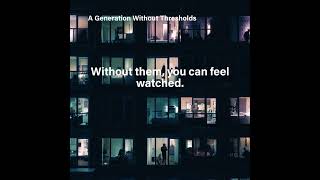
Which raises a hard question for families: is the refusal of rupture an act of protection or an extension of childhood? Probably both. But rites of passage require a before and an after, and a soft continuum can erase the boundary. The cost isn't just emotional, it's narrative. If there's no moment when everyone agrees you crossed, you keep proving competence in place of being recognized as changed. That's a recipe for exhaustion. The tech layer matters here. Location sharing and the constant text check-ins keep everyone safe, but also keep everyone on stage. In a classic rite, distance and silence do some of the work. Without them, you can feel watched even when no one is judging you, which keeps the threshold from closing behind you.
And it breeds a kind of double bookkeeping. Parents read involvement as love. Young adults read the same behavior as an audit. Both are true. The cultural task isn't to shame care but to reintroduce ceremonial breaks—small, explicit handoffs that say, "You've got this. We'll be here if asked." That simple script—ask, don't preempt—often does more for adulthood than any productivity hack. There's a human doom loop in play, The more we optimize for control, location sharing, coordinated calendars, the less everyday friction we allow. But that friction was training. Buying a MetroCard, waiting with strangers, handling a small mistake without texting home.
Remove those micro-trials and you stall autonomy. And anonymity gets recoded as risk. Wearables and constant tracking make it harder to be unobserved, even for an afternoon. But a slice of unseen time is where independence forms. If you're always visible, you're never far enough away to find out who you are without someone watching. Now shift to the social layer.
We've entered what some call the age of anti-social media—tools that promise connection but yield isolation and performance. Over the past 15 years, face-to-face time has declined even as daily use of platforms has risen. In traditional rites, the witness is a community member who remembers your before and after. Online, the witness is an algorithm that tallies attention. The mirror reflects back what engages, not who you are.
That changes how identity is rehearsed. Teens increasingly treat their "for you" feed as a credible mirror. So the currency becomes calibration—adjusting tone, aesthetics, and timing to match inferred preferences. Let's define a term that has been rising: modular selfhood. It's the practice of presenting different context-specific selves—work, group chat, public feed—without assuming any one of them is the whole. As a survival strategy, modularity conserves energy and reduces risk. As an identity practice, it can start to feel like permanent revision. It is versioning without a release.
And here's the core analytic point: metrics measure attention. They do not confer standing. A viral post is not a right. A comment count is not a community verdict. Without human witnesses who can say, "We saw you cross," performance never resolves into personhood. Which is why people report more followers and fewer close friends at the same time. The system raises visibility while lowering recognition. You are seen but not by those who can confer a lasting identity. Consider how quickly teens tune content to "hit" the feed, Timing posts after school lets out. Trimming captions to align with a trending sound. It's skillful, but the reward is attention, not admission. You're optimizing for a mirror that reflects the crowd, not for a community that remembers your change.
Which is why close friends, lists, and alt accounts feel so important. They try to reinsert human context into a machine loop. The practical move, culturally, is to pair online fluency with offline witnesses: a critique circle, a club that meets in person, a team that keeps minutes and rolls. Those modest structures turn performance into participation. But we have quietly built a kind of parallel city for staying home. The feed is the front door, the street is just logistics. The mirror isn't only psychological, it's architectural. Symbols step in when story's thin. Take the Shirley Temple revival that has been surging recently. The adult Shirley Temple is showing up in bars and brand launches. Most under 25 don't know the original star, they just pick up on the maraschino cherry signal. Here's a term we use: recombinants. It's the cultural process of taking fragments—images, objects, rituals—out of their original context and reassembling them to carry new meaning. The Mocktail now codes playful purity, composure, and opting out without social penalty.
You see recombinants across the landscape: vinyl records, flip phones, Y2K textures, handwritten notes. Surveys show a notable share of young people feel nostalgia for eras they never lived through, and many say it helps regulate stress. That's not retro for retro's sake; it's temporal regulation, borrowing slower, tangible anchors to steady a fast, opaque present. There's another layer here—many Gen Z childhoods were documented and supervised, so innocence exists more as a symbol than a felt memory. Reaching for the symbol becomes a way to stabilize the now.
So when you see vintage tech or mocktails, read them as small stabilizers. In a culture short on shared rites, fragments with residual meaning become portable handrails. They don't solve the absence of thresholds, but they give you something to hold while you improvise the next step. In a workshop era, a good handrail is not trivial.
And those choices travel well because they're legible. You don't need the Shirley Temple backstory to read "gentle boundary," just like you don't need to be a purist to understand visible mending as "care and thrift." Recombinence works when fragments still carry enough shared meaning to steady the present without a lecture. Ritual scarcity doesn't erase the need for meaning. It redirects it. We're seeing renewed spiritual seeking in some pockets, especially among young men, alongside a hardening of rhetoric. It's important to separate revival from revolution here. As David French warns, we are closer to a religious revolution than a revival, and there is darkness right alongside the light. Revival bends toward humility and repentance, Revolution bends toward certainty and victory. When the appetite for coherence detaches from humility, it can slide into faction.
And the same logic migrates into secular life. In wellness, clean becomes a virtue category, and optimization language takes on moral weight. The old archetypes—sin, purity, salvation—don't disappear. They change venues. Online, a moralized lifestyle can offer the clarity that work, housing, and family aren't providing. But clarity purchased by exclusion has a cost: it offers status without the shared obligations that make rights constructive. You belong because you are right, not because you crossed and took on responsibilities.
which returns us to modular selfhood as a practical response. Choosing the cast for the day's story preserves energy and navigates risk. Yet without a community that can integrate those parts, you can feel like a project under permanent review: agile, productive, and tired. The missing ingredient is not more calibration; it's witnesses who can say, "That was a crossing, we saw it." Welcome. You can watch the slide from Seeking to Sorting in Small Online Rituals. The rules lists, the purity checklists, the callouts for not using the right terms. Certainty feels like relief when everything else is provisional. But certainty that relies on enemies erases the curiosity that rites once protected. You cross, you learn, you serve.
And there's a secular fix we can borrow from those older rites: the pairing of privilege with obligation. If your group confers status—spiritual, wellness, career—what service does it require in return? Mentoring newcomers, funding access, doing unglamorous work. That exchange is how identity hardens into responsibility instead of ideology. So what's emerging isn't a fix, but a few provisional passages. In pockets—often urban, often resourced—practices create witnessed contribution. Community repair cafes and tool libraries can turn maintenance into a weekly rite, but they're fragile. Volunteer burnout is common, tools break, and names on a board aren't a paycheck. Open-source cohorts make apprenticeship more public, Your first accepted pull request is a threshold you can point to. But access is uneven, and gatekeeping still shapes who gets seen. Nightlife looks more like pop-up ecosystems now. Warehouse sessions, listening bars, and invite-only socials coordinated through group chats. They can set norms as well as vibes. Show up, contribute, get acknowledged. Yet they face venue churn, safety risks, surveillance, and quick co-optation by brands or landlords. When these spaces hold, they confer recognition. When they don't, they remind us how thin the infrastructure for belonging still is.
We should be honest about scale. These are pocket practices. Often urban, often resourced. But they teach a structure. The important contrast is with algorithmic metrics. These proofs are embodied, remembered, and shared in a room. They travel online afterward, but the recognition originates in human presence. That's the logic of a rite, even when the rite is small.
And that suggests a different definition of growing up for this moment. Less arrival, more a sequence of witnessed crossings. Today you fix, next month you teach, later you hand the keys to someone new. Contribution, then recognition, then responsibility. If the old chapters closed, these are the short chapters that hold. Ambiguity stops being a void and becomes a studio where culture tests new forms of belonging.
The task isn't to restore yesterday's rights, it's to build modest, testable, shared ones. Places where someone can say, "You mattered here, and we saw it." Gen Z is not outside meaning. They're inside the workshop, assembling small proofs of belonging that add up over time. One witnessed contribution at a time, a generation learns to cross without the old gates, and to mark those crossings for each other. And the pattern scales by rhythm, not size. Make, show, be marked. Then teach, hand over, step back. That cadence is a narrative system in miniature—disruptive codes that challenge the existing order, emergent codes that experiment to work out new techniques and rituals, dominant codes that solidify new practices through social cohesion, and residual codes that make these aspirations the new rules that can scale within an evolving society. You don't restore the old gates; you build crossings people can repeat until they become culture.
Thanks, Angela. Alright, listeners, don't forget to subscribe if you want more on the intersection of culture and foresight. See you next time on Analyzing Trends.