Episode 11. Servant Leadership in Security: Scaling Teams and Driving Revenue
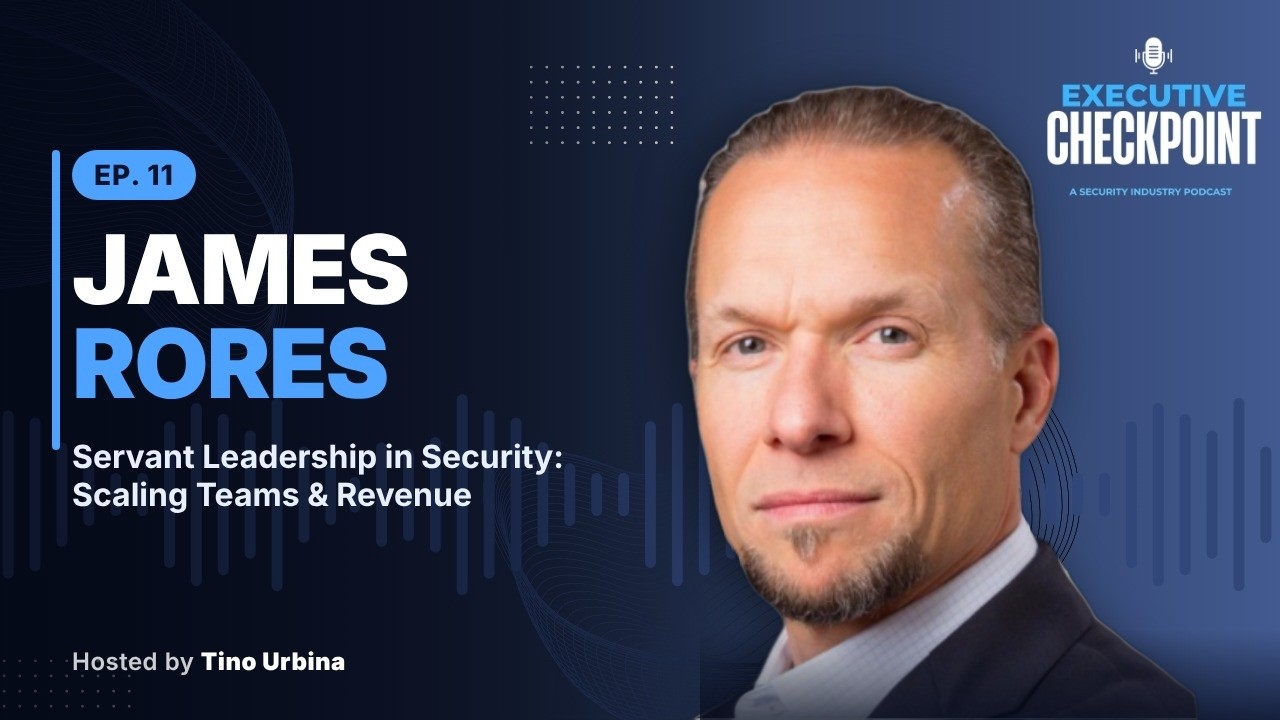
James Rores, CEO of the Flores Group, explains how servant leadership transforms security sales. He moves teams from transactional pitch-and-defend tactics to a trust-driven approach using his WINs model, arguing that only win-win leadership is sustainable and that leader insecurity fuels toxic behavior.
Chapters
Welcome to Executive Checkpoint, the live podcast for security professionals. Each week, we explore industry trends, challenges, and insights with leading experts. Welcome to Executive Checkpoint, where security professionals gather insights to navigate the dynamic and ever-evolving world of physical and cybersecurity. I am your host, Tino Urbina, and today we have the privilege of speaking to James Rohr, CEO of the Flores Group. James is a transformational leader who has spent decades helping organizations rethink growth. Leadership and sales through the lens of servitude leadership. As the creator of the WINs model, he has coached thousands of executives, guiding them through how to remove friction, build trust, and accelerate success. His insights have reshaped how businesses approach leadership and customer engagement, making him a sought-after advisor for companies across many different industries, including the security industry. Today, we'll dive into James's journey, how he developed a leadership philosophy rooted in service, the impact of trust-driven sales, and what security professionals can learn from his expertise in growth and transformation. So we're excited to have you, James. It's been a minute since you and I chatted, and here we are. Welcome to the show.
Thanks for having me. I'm looking forward to the conversation.
Absolutely. So James, let's start with your journey. You spent decades coaching executives and organizations in growth and leadership. What originally drew you to this field? And at what point have these experiences shaped your approach?
Yeah, yeah. That's a great question. And, you know, I'm now, and I hate to admit it, maybe 32 years or so into this journey. So I think like anyone with some time behind them, they look back and try to make sense of it all. And I guess that's what I can try to do. But I can tell you that, you know, how I got started really was interesting. When I left grad school in '91, I left unemployable. I had the arrogance of my MBA, the arrogance of my youth, and the arrogance of having been raised an entrepreneur, right? So I was not fit for any team. And, you know, I think back then I would have been proud of that realization. Today, of course, I understand that that doesn't work, work well, especially when you have ambitious goals and you want to accomplish things and you see opportunity in front of you. being that, that loner only takes you so far.
Right.
But it took me 15 years to kind of learn that lesson. So I spent the first 15 years of my career in sales for high-growth venture-backed organizations. And I worked with 8 organizations in 15 years. So you can tell I was a little unstable. But was part of 6 exits and 3 public events and had some success. So I learned how to be successful really using all the wrong, unsustainable ways to get there. And so I burnt out in '05 and took some time off and retooled my life. Since, and then founded this, this company in '06. So since then, I've been doing this and worked with about 27,000 sales and customer-facing team members, and have over the, over the last few years been thinking about, you know, how to, as you, as you've experienced, frame what I've learned in a model that we now deliver to folks. And, and yes, I can, I'm, I'm an example. of somebody who can change. It wasn't easy, but, you know, it happened.
Well, I think that, that's proof that it, it works, right? That it has a positive influence, right? You know, one of the things that, um, we talked about earlier, uh, before we started the show is, uh, servant leadership is a core principle in your work. How do you define it, and why do you believe it's essential for success in today's business environment?
Yeah, that's a great, that's really a complex question. You know, I was introduced to servant leadership through my coach when I burnt out. And really, it was at the top of my career at the time. You know, I'd never been more successful and I'd never been less, or I'd never been, yeah, less happy. I mean, I was just a wreck.
Right.
And I was introduced to servant leadership through the book written by James Hunter called The Servant, which is a great book. Very short, 110 pages, but very poignant story about servant leadership. What I took from the book and my research on servant leadership is a very simple way of thinking about it. We want to serve the shared goals for growth, and we want to lead people to change. So in the context of sales, or in the context of executive leadership, if you're looking to create a team dynamic, and in sales, we create teams that include buyers and sellers. We can think of the buying center as a, as a team that we can earn the right to lead, just as an executive earns the right to lead their team. And if you can lead from this perspective, right, I want to serve a shared goal for growth. And I want to lead you down a shared path to change. What's nice about that model is, is the word shared.
Right.
It's not about, it's not about you. It's not about me. It's about us. What can we do together? And today, to your point, the last part of your question, today, this is more important than ever. We are exhausted by an individualized way of looking at the world and our life and our existence and what matters to us. We're all hungry for, you know, those connections and meaning in the things that we do. And if we can think about— think this way and practice this way, we can really differentiate ourselves in the marketplace.
I think that's a key element of, you know, shared experiences, right? Including leadership and understanding of mutual interests. And, you know, it makes me— I can see some leaders having the struggle with balancing the relationship with their team's authority and service. What do you think are the biggest misconceptions about servitude or servant leadership? Because, you know, we're talking about shared experiences, and I can see some people going, well, I still want to be the boss, right? So what's the balancing act for people? What are the biggest misconceptions leaders or folks in youth coaching leadership feel the need to adjust?
That's a, that's another great question. It sounds like you've, you've practiced this and had some experience yourself.
A little bit.
Yeah, yeah, yeah, man. You know, I think when people hear servant leadership, they think of this idea of win-win. And they think of the idea of win-win as a cop-out or a negative thing or a, or you selling out. And it's interesting if you think about servant leadership as one option, right? And we talk about 4 types of, 4 profiles of a leader.
OK.
When you think of a servant leader, We think about this idea of someone who is showing up not to prove themselves like a power leader would, right? A power leader is going to walk into the room and leverage force to assert themselves and get what they want. In order to do that, you have to have a win-lose mentality or a— You have to be playing a zero-sum game where there is a winner and a loser.
Right.
When I started selling, that's how I was taught to sell, right? Don't be a loser. So every time I lost a deal, I was a loser. Every time I won, I was a winner. Living that kind of instability takes a toll. It's not sustainable. But that's the way a lot of leaders work today, right? Narcissistic, For whatever reason, they feel like they must use that or leverage that force. So we become a power leader. And then we, or we be— the other type of zero-sum game we can play is the passive leader who leverage— who does the same thing, but without the aggression. They might try to seduce you or they might try to use manipulation to get their way. So, it's like, for example, it's like an act of seduction in sales might be, let me give you a lower price or let me overserve you to get the deal.
Right.
It's a different form of force. It's a more passive form of aggression. That gets you that deal. And so I might treat my employees the same way as a leader. But in both realms, there's a winner and a loser. And then there's the 4th type of leader is the toxic leader. And that person operates in a way where they don't care if there's a winner or a loser. That's both of us are going to lose in that case, right?
So Basically, right?
Yeah, exactly. They're playing a different game. The only form of leadership that is sustainable is the win-win where we, where we, I want to build a team of people who share the dream or the vision that I have. I mean, you can't, if you look at the, just look at sports, for example, and sports is not the best analogy for leadership. But if you look at what's happening in football, Right. Any team that's on its way to winning a championship, they do not have a collection of people who operate, who work together out of fear. They have a collection of people who are handpicked and cultivated and share, right, that common goal. And they are all being led down and leading each other down a shared path, right, to success.
Right.
And I mean, you just can't deny it. It's the best form. It's the best way to lead. The challenge isn't the method. The challenge is learning how to do that despite all of our frailties and flaws as human beings.
I think, well, I think leaders, you know, I think the concept of being a leader is not showing, you the cracks, right? Being strong or showing strength for your team and whatnot. And sometimes that's misconstrued and used in the wrong way, and it goes into the negative personalities that you're mentioning. So does the WIN model fit into this organizational way to remove friction from, in sales or leadership. Is that a portion of what the WINs model creates?
That's a great— thank you for asking. It's a great question. I want to just, I want to answer that in the context of something you said that was very, very important. You know, this desire as a leader to take control or take command of a situation or the feeling that we have to take control or take command. Why Because our name, our reputation, whatever is on the line. And, and that, that is an example of insecurity at work, our insecurities at work. So the number one, the number one creator of ineffective or negative or toxic leadership is the insecurity of the leader.
Hmm.
And you can think of insecurity as 2 sides of the same coin. There's, we are either as human beings proving, or we are hiding. So I'm either proving as that power leader, or I'm hiding as that passive leader. But it's all, but we are kind of like operating in a comfort zone of insecurity that we've cultivated our entire lives, right? If you think of any personality assessment that you've taken as a professional, your personality is subject to the insecurities that you carry with you and have developed over the course of your life. So we are, we tend to be subject to those insecurities, especially when we're in high-pressure or high-stress situations.
Exactly.
In a relaxed situation like this, Our insecurities aren't at play, and it gives us a chance to operate with clarity. As soon as we have, we're in a situation that's threatening us or threatening, threatening maybe something that we value or care about, or maybe makes us feel insecure, that stress level goes up. And now we resort to those learned behaviors. And that's where, when we, when we allow our insecurities to take over, that's what creates a situation that you identified where we allow that insecurity to take over the situation. And then we operate in a way or behave in a way that after looking at it afterwards, maybe we're not that proud of.
Right.
And we think to ourselves, I could have been better, I could have done better.
Sure. You know, it's interesting you mentioned critical moments or high-stakes environments because professionals in the security industry, we operate under high-stakes environments, you know, and sometimes mission-critical. So, how can they apply— how can that leader apply your philosophy in shipping those relationships within a team or the organization?
Yeah, yeah. So great question. So, and I appreciate that. You know, when you think about all this stuff, right, we could make the challenge so big, it would be impossible to figure out where to start, right? So what I have done is just, I've just, I've just thought about attacking this in the context of the conversation.
Sure.
So how do we, in the context of sales, how do we master the buying conversation? How do we practice sales as a healthy leadership competency? So how do I show up and lead someone down a path to a successful buying decision? In other words, a decision that is in their best interest and my best interest. And if any of us who have been buyers, we know the difference. We know the feeling of working with someone who isn't operating in our best interest. We can tell right away by the questions they ask, how they treat us, the answers they give us. We understand what a transactional selling or buying experience is like. And so we just want to be different. We want to be Opposite of that, right? So we think of most sales training today is wrapped around a transactional model that whether, and it doesn't matter if you are a, you think of yourself as a consultative seller or a value seller or a customer-centric seller, any of the modern sales training courses out there And you could name them. I've identified 18 from 150 years old to, you know, present day. At the end of the day, they all distill down to a very simple process where we're maybe learning a little bit, but we're pitching. We might do some discovery, but we end up pitching right away. Then we propose and then we defend, right? Where it's a very transactional model. Where we can't wait to get to, let me tell you about my solution. And then because you're presenting a solution to a buyer, they look at it and they say, well, wow, that's interesting, but I have no idea whether I should buy that or not. So let me go compare it to other competitors. So when you pitch, you immediately give that person a chance to go or a reason to go shop.
Right.
So when they go dark on you and ignore you, for weeks or months, it's because they're shopping, because you position them to go do that. And then when they come back, you give them a proposal, an option to buy this package for this price. They're like, wow, thank you, but I don't know what to say because I haven't compared your price to anybody else. So they go out and compare now your price. And then if they come back, now they're— now you're defending, you're in a negotiation. So that's The transactional model in sales, that's what it looks like. And the same thing can happen as a leader of a team. If you just tell the team, here is, you know, here's my solution. And they're like, and they don't have context for it. And they haven't been part of the identification of the problem. Now you're trying to sell them on a solution that has no context and has no obvious meaning to them. So what do they do?
Right.
They now talk among themselves. They start shopping the idea. Does this make sense? Does this sound ridiculous? And then you're now fighting as a leader. You're now fighting all this friction that exists inside that team that you created by virtue of the way you treated those folks.
Self-inflicted, right?
Yeah, exactly.
Went back and framed it because I was, as you were sharing, I was thinking that I can see a lot of folks getting into conversations that have nothing to do with sales per se, but they're in a technical environment and they need to get a point across, a difficult conversation, and they are creating their own worst nightmare, right? At the end of the conversation, they expect a solution and what they got was probably more problems. So, I feel like change is very difficult, especially in industries like security, because we are risk-averse. So what strategies do you recommend, you know, someone to overcome resistance to new leadership or a new growth approach? Or in fact, we, we've been talking about here recently about AI and its impact. Change is difficult. So what is your strategy to, to overcome that resistance, internal or team?
Yeah, it's, it's a great question. Change is difficult for most folks. But I'll let you in on a— it's a little secret, but it's going to feel so obvious, right?
Those are the best.
Exactly.
Where people go, oh, yeah, huh.
Right, right. You know, we can get into the science behind it, but we don't have to. We can just talk about it at a high level. Let's just assume that change is difficult.
Right.
Which is more difficult, right? When I understand the solution better than I understand the problem, or when I understand the problem better than the solution? What we find is that with buyers especially, and the example I gave earlier, is that if you spend most of your time talking about your solution and the buyer really doesn't understand the problem, Right. Change is way more difficult. You create a much longer buying cycle and much more friction, much more confusion in that process. If you, if you, if the buyer has a deeper understanding of the problem they face, then change is much easier. It happens much faster. And the thing that most salespeople don't think about is the amazing value to you if you're the person that helps the buyer understand the problem at that deeper level. When that happens, that's when we become thought leaders. That's when we become trusted advisors. Right? That's when we become subject matter experts. We don't become those 3 things because we've told them we're that smart. We've demonstrated our wisdom by asking them questions that expose the reality of the situation they're in. We open up their eyes. The questioning paradigm we train on is we direct, we connect, and we expand. We direct the conversation by helping folks walk through a very specific cycle, the WINs model. We then connect by demonstrating our empathy and understanding of where they are. And then we expand by helping them think bigger about understanding the problem at a higher level than they do today. Because again, as a salesperson, you understand the problem your clients face way better than they do. Because you've been doing this for so long, you've talked to hundreds and hundreds of people. So share that wisdom, share that knowledge, not by telling them, but by asking them deeper questions that allow them to stop, pause, be thoughtful about where they are. And if you establish a situation, a situational relationship like that, you then earn that mantle of leadership. And then you become the person they want to talk to every time a challenge arises. And you become the person they want to refer to their friends, refer to their constituents, And I know, Tino, you, you've had that happen in your career. Most of us have experienced that, but most of us don't have a model to replicate that.
That's key. And you know, there is one thing that you touched base on. I think when you bring value to the market, in this case the expertise to ask the right questions, and I was told some, some time ago that Questions are essential, but the right questions are what makes change, right? We're in an industry that evolves. So is leadership. Trends are going to continue to evolve. So what do you see in our future for leaders? How should professionals prepare for the future? What are the things that you see coming our way?
Yeah. Oh, I mean, it's a great question. And I have a ton of respect for the industry. We do a lot of work in security. We do a lot of work in safety. And, you know, one of the things that we just cannot get away from is the impact that technology and advanced technology is going to continue— has played and is going to continue to play on in the area in terms of solving The challenges that are in front of us. And a lot of this technology is creating, they're creating the problems that are in front of us. I talk often with folks about AI, for example, and how, and you've heard, anyone who's been in sales for any length of time, I've been in sales through multiple recessions, for example. And we always hear about, when we come out of these recessions, we always hear about how those recessions have impacted or will impact business and, and sales. When we saw the internet occur, you know, and again, I was part of that kind of birth of the internet in the late '90s and early 2000s. And we heard that it was going to replace salespeople, that sales folks were going to go away. Now we're hearing the same thing around AI.
Yeah. Right?
Like, it's gonna, it's gonna make us obsolete. And You know, I think, I think that the more advanced we get, what happens with human beings, what's happening with human beings today is the more isolated we get as human beings, right? I remember as a kid, we used to watch TV. We all sat around the same TV. We all watched the same show together. We all had these shared experiences. Right now, my kids are out of the house, but when they're home, all 4 of us, me, my wife, my 2 daughters, we could all be watching different things in the same room on 4 different devices.
Oh, that's a problem. Right?
And I know that's a common experience, but it's occurring throughout our personal lives as well as our business lives. So what I'm getting at is this movement toward isolation creates a void. And as human beings, we crave community, we crave connection, we crave having a conversation with somebody who cares about us, who isn't trying to just make a buck. If you can position yourself as that kind of human being that has a level of interest, right? You don't just care about the deal. You care about the right deal for you and for the person you're talking to.
Right.
Adapt and adopt that sensibility and do it sincerely, right? Not in a manipulative way because manipulation is defined by your intent. What is your intent? If the intent is a shared success and you can show up that way, you don't necessarily need to have a deep skill set. You'll be attractive in and of yourself based on the way that you show up. Now, you'll need the skill set to make sure you're talking to somebody who you can serve, right? Because we're not going to just lead or try to sell everyone. We want to find folks, we call them our always buyer. We have to know who we are best equipped to serve. We can ask a few questions and understand if we're talking to that right person and then continue to lead them. down that path to change. But if we can start with that desire, right, to create a shared, positive shared experience, I'm suggesting to you, Tino, that as human beings, especially today and into the future, we're going to be craving that more and more. So folks like us who embrace that approach will become more valuable, will become more Differentiated, right? More unique and more special and more successful.
Right. You know, I agree with you. I think short-term is always greedy. Long-term is always a better path. I think I speak for myself, and I'm sure you feel the same way. If you're in business, your brand is— and especially in an industry like the security industry, Is key, right? And it's a small industry, so you do the right thing for your clients or customers, it's always going to pay out in the long term. Well, James, one last question. I think this has been a great interaction. We need to do it again for sure. Skill-wise, think about you when you started your career versus today. What's the one skill that you feel carry you to where you are today, or the one skill that you will advise someone at that point in their career to acquire so they can see themselves in future successful as a leader?
Wow, dude, you're, you're causing me to, to make— take an inventory of all the things I've done wrong in my career.
Don't we learn from that? Yes.
Yes. So that might be, you know, that might be, um, the best skill, right? That, that willingness to, you know, so I'll put it, I'll put it in a simple way, right? So most human beings, and again, I'm a, I'm an older dude, right? I got a young heart, but I'm chronologically, I'm an old dude, right? So, um, I have some years behind me. I hope— hopefully I have a lot more years in front of me. But what I've learned is, you know, we all walk through life, right? I just had a— recently had a dear friend of mine pass away. And, you know, all of us have these moments where we experience an unexpected passing of a friend or a loved one, and it causes us to stop and think. And we, for a moment, we become more aware of the fact that this all will end someday, right? So I think, so I think not losing the awareness that, you know, we are not these, we are not these blocks that just kind of pass through life and everything else around us is changing and we have to maintain this level of stability and control. And this illusion of control as we go through our careers, as we go through our lives. The greatest skill I think that I've developed over time is recognizing that there's a beginning and an end to everything that I'm doing. And we've all heard this idea that the only constant in life is change, is impermanence. But most of us don't think of it as applying to us. It applies to other people, right? But if you can think about the fact that, you know, that change is happening all around you and allow that change to also occur to you, allow it to also happen to you.
Right.
Instead of being this stable block of, I'm not going to change, I'm going to continue doing it this way, which, as you know, right, if we refuse to adjust, we'll become passé, old, you know, will be thrown out before, way before our time. So I think being inquisitive, that having that growth mindset and being willing to be introspective, evaluate yourself, evaluate situations, not in a critical way, not in a negative way, but in a critical way that will allow you to make strong decisions about what's next. I think that is, that's an amazing skill set and will serve you decade after decade after decade. And you know what? As you get older, it will allow you to work smarter, right? Not harder.
And you know, I'm just—
Give yourself as you go through a career, imagine being a transactional salesperson throughout your entire career. As a transactional salesperson, you make every next sale harder because you're not doing anything to build equity or trust within your community. You have to change communities like I had to do in my first 15 years. I had to change jobs every 2 years. But if you can think of yourself as a servant leader and what we call a growth multiplier, Every job, every next sale becomes easier because you're building equity.
Right.
In the community that you're serving, as you said. And life gets easier. Things get success. And the success that you can achieve far outstrips any imagined success you might have had when you started your career.
The multiplier. I love that. Well, James, Ben, thank you for sharing your wisdom and experience. It's been very— we need to continue this conversation deeply. And I think it will be great to have a group of people that can join us and have a conversation.
Yeah.
And so for folks that want to get in touch with you, I love the wisdom that you share and some of the WINs model and whatnot. Where can they find you?
You can find me on LinkedIn, James Rores, R-O-R-E-S, or my website, jamesrores.com. And it's easy to get ahold of me, and I'm willing to talk to anybody once. So hit me up. I'd be happy to have a conversation.
That's great. Well, again, thanks so much. Thanks for joining us in this episode of Executive Checkpoint. Until the next time, stay informed, stay secure, And we'll see you at the next checkpoint. Thank you.
More from Tino


EPS 37 Security Is a Human Business Leadership Risk and Resilience Lee Oughton





Eps 33 It’s Not in the Manual: Real-World Leadership for Security and Risk Professionals

Episode 32 Security, Converged: Why AI Needs People, Process, and Purpose Kasia Hanson

