Episode 15 Inside Executive Checkpoint: Live Q&A
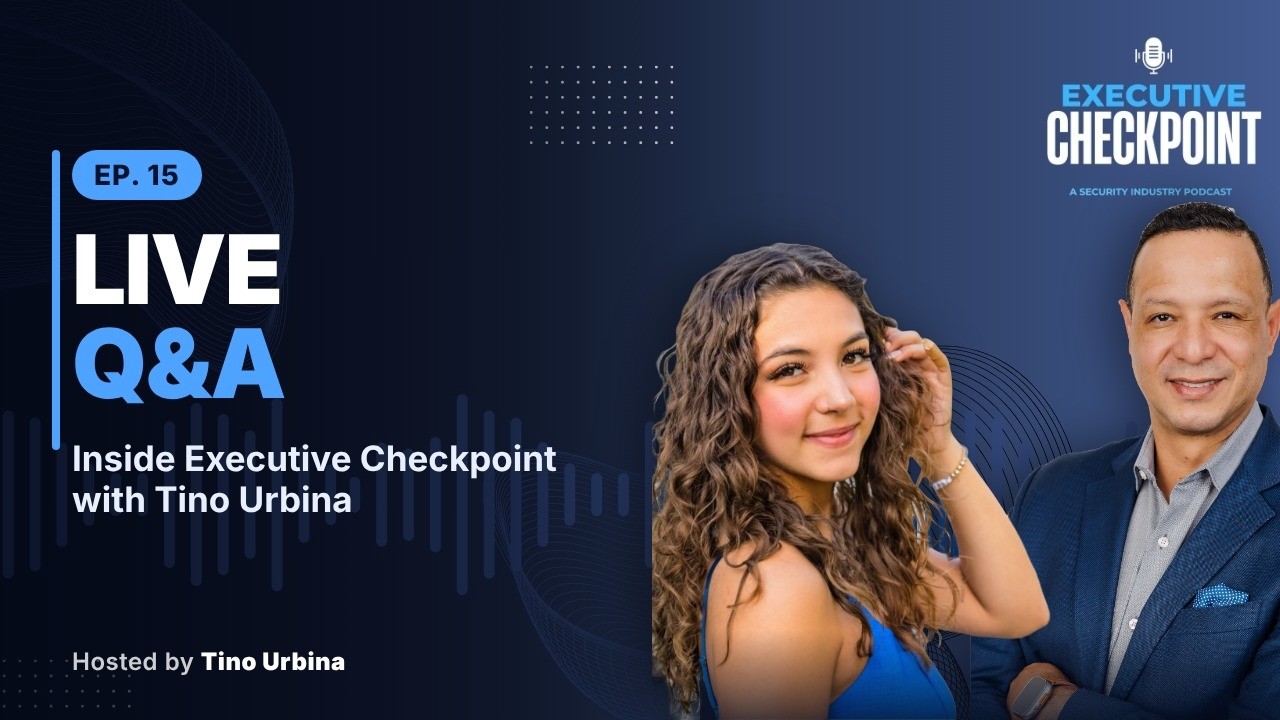
In this live episode of the Executive Checkpoint podcast, host Tino Urbina, joined by his daughter and new co‑host Sophia Urbina, pivots from a cancelled guest interview to a listener‑driven Q&A. The conversation covers the origin and mission of the show—creating a platform that bridges physical and cyber security professionals, sharing real‑world wisdom, and avoiding product hype. Tino explains how his 20‑year career, moving from physical integration to cybersecurity, fuels his curiosity and informs his interview style. They discuss guest selection criteria, highlighting leaders who bring diverse perspectives and compelling stories, and note memorable past guests such as Pierre Bourdieu and Melissa. The duo identifies AI’s rapid evolution as the top industry trend demanding cross‑disciplinary understanding and governance. Production challenges are addressed, especially scheduling high‑level guests and maintaining consistent quality. They share metrics (78,000+ views) and outline future plans: larger audience, multi‑panel episodes, sponsorships, and partnerships that preserve the show’s diagnostic, wisdom‑focused tone. Throughout, they stress the importance of curiosity, networking, and continuous learning for security professionals, and encourage community participation.
Chapters
Welcome to Executive Checkpoint, the live podcast for security professionals. Each week, we explore industry trends, challenges, and insights with leading experts.
This is your insider access to the minds driving Welcome to Executive Checkpoint, where security professionals gather insights to navigate the dynamic and ever-evolving world of physical and cybersecurity. I'm your host, Tino Urbina, and today's episode is going to be a little different. We had programmed Maxie Reynolds, and unfortunately, she had a last-minute scheduling conflict. Oh, no. So, we're going to be talking about You know, we have executives, CEOs that are coming into our show, giving us some of their time and wisdom, and sometimes schedules come— there are conflicts of timing and schedules. So we appreciate that. We'll have— we're going to have Maxie in the next couple of shows that we have scheduled to engage in a very interesting conversation. She has an incredible background. So we're excited for that. I'm a little disappointed that unfortunately we were not able to have her live today. However, I do have— we're going to have an interesting show. We're going to utilize this to pivot. And knowing that this possibly happened, I asked a few people in the industry, and some of you submitted some questions over the last several episodes that we think they're pretty interesting and would like to answer. And for that reason, I also want to introduce you to the new assistant producer and today co-host, Sophia Urbina. She happens to be related to me, is my daughter. And, you know, hi Sophia, how are you?
Glad to be here.
So I got Sophia a little bit by surprise this morning, telling her that she was going to help me be the co-host for this show, and she's a good sport. And Sophia, we collected a few questions from some previous guests, and we also summarized some of the ones that we got from the viewers. So we appreciate your contribution. And what do you think? Are you ready to do this?
Yeah, these are some great questions.
All right, so let's get started with the first one. What do you got?
Okay, so what inspired you to launch Executive Check Point?
That's a good question. I, um, this is a passion project for me. I saw an opportunity that there were so many brilliant people in the security space, both physical and cybersecurity, and, um, we needed a platform, I felt, that can bring, you know, experience, wisdom, and share knowledge to the industry. I wanted to create a space that allowed people to come together and learn from each other. So that's, that's the main reason.
Yeah, awesome. Okay, now this one I actually am very interested in. Um, which guest has made a lasting impression on you and why?
Oh, that's a good question. You know, I, I feel like I'm gonna disappoint people for not including it, but I feel everybody brought something unique to the conversation. I'm forever thankful for Pierre Bourdieu being our first guest. He's always been a good friend and a good mentor. I will pick him for that particular reason. He was the first one to support the project, and he does have a really unique perspective in the industry, you know, bringing together both disciplines that this show is based on, cyber Cyber and physical security. I think I'm gonna stick with that answer. I think Pierre did a really good job, and he's a good supporter of the show. So thanks, Pierre. Yeah, there's many more. I mean, I can think of Melissa. She did an incredible job. You know, our upcoming guest, Chuck, you know, did an incredible interview with us. So again, I know I'm gonna get some heat on this one, but, uh, I love you all.
Okay, now who made the worst impression? No, I'm just kidding. Um, so for folks who are tuning in for the first time, uh, what's the core mission of this show?
Well, it's about connecting security professionals. It's not just, um, hitting on the hype of new technology or promoting products. We, we want to make sure that we are allowing experience, wisdom, uh, good practices, and, um, voice— our voices to be heard— and a space where you can share and be listened to in the industry. That's, that's what I will say the show is all about.
Was that something that you felt like was missing that you wish you had had when you were starting out in the industry?
Yeah, that's a really good question. I, I 100% feel that that's a really great need. And I will say that leaders need perspective, right? And a lot of the folks we have on the show happen to be in leadership positions from CEOs, from CTOs, that it's great to hear from your peers if you're at that level, right? and have different perspectives, as, as well as if you are new in the industry and you're looking to understand how to maybe get to those positions or how to be better prepared yourself to be a good professional in this industry. I think we cover a lot of those things. So yeah, I wish I would have access to an outlet where I can log in and get fresh information. One thing that we're doing that is a little different I'm adding thought leaders from a little bit of different backgrounds. Here coming up soon, we have Vince Placenti. He's a well-known speaker and strategist, business strategist. So we'd love to have him not within the security realm, but a great perspective on performance and achieving goals. And I think we all can use that from leadership to new folks. We're trying to mix it up a little bit.
Yeah.
And I think that's a great question. I wish we would've had something like this. So there you go.
Yeah, I definitely think it is good to just have so many different perspectives, like you said, from just so many different leaders in security industry. But then you're also saying that you're wanting to bring in people from outside. So I think that's great too. Let me see.
Well, Sophia, let me ask you, so you went just recently to an event, I think it was a networking event for ASSIST, and you met with a lot of young people in the industry. What was your general take in the industry? What's your perspective being so new and in this case helping me promote this kind of activity in the community?
That is why fun and interesting. I was obviously nervous because I knew I was going to be the youngest, but everyone said that they weren't expecting to get into security, but now that they are, they are all— everyone just knows everyone, it kind of seems like.
Yeah, it is. It's honestly, it's a small industry, and I think a part of that means you, you want to be a good professional and develop good networks, right? and learn from the best. And I think, I think this show kind of allows us to make that connection between the seasoned professionals and leadership, as well as young incoming, you know, new professionals in the industry. So I'm glad you enjoy it. What else we got?
Um, so let's hear more about you. Can you share how your background informs the way you host these conversations?
So let's see, I've been in industry now for close to 20 years and started with the integration side, moved to manufacturing. And in that, I've discovered that as the industry evolved, I ended up having more and more conversations going from the analog side, you know, uh, you know, earlier technologies from video to access control to now the digital world. And at one point the internet converging with, uh, IoT, IoT, Internet of Things. And, um, I felt that coming from the physical security side, I needed to understand better the cybersecurity side. And there were people, uh, like Pierre. Pierre, Pierre was a big influence on, on those conversations. Because we were meeting more and more with decision makers with both sides of the scale, right? From physical security to cybersecurity. And so being prepared for that instigated the curiosity to learn more about cyber in my side. I also discovered that a lot of people in the IT side, on the cyber side, we speak different languages. And so that Those conversations need to be more congruent. And, um, that kind of drives a little bit of the conversation. I, I look at it from the perspective of curiosity, right? I want to learn from these folks in cybersecurity. Perfect example of that is, uh, Maxi Reynolds. Uh, I am very interested to learn about how we put, um, successfully, uh, new technologies like underwater data centers, which everybody I speak to is—
Mm-hmm.
Very curious about it, right? And, you know, we also talked about technologies, new technologies, AI and such. And so we— it's coming from a place of curiosity and wanting to understand better and seeking wisdom, right? I feel like we always, we always need to continue to learn.
That's a great answer. Curiosity and wanting to learn more and share that. What's one trend in security that has your full attention right now?
I mentioned, I think the evolution of AI is not just a responsibility for us to understand it better, but to seek information to how to implement it in the best, most safe way. possible. People, process, technology, and governance is gonna be key, um, for this. And I feel that a lot of security professionals, especially, I'm gonna reflect on my side of the equation a little bit in the physical security side, we are not as equipped to understand AI. And, uh, I think that's an urgent conversation we need to have. And so more and more I'm gonna start bringing, I'm talking about the basics, uh, just so we can have a solid foundation to build on. And, uh, and as we do, you know, have a better understanding of implementing, bring the experts to help us do that, not only from the manufacturing and integration side, but also to the end user as a solutions provider. We are all gonna have to come together and do that. So to me, that's AI is in the forefront of what the industry needs to be focusing on.
Yeah. So you really do think that's gonna be like the future just for security in general?
I think, look, I look at AI security, my point of view, it's composed of the physical side, the IT side, and the human factor, right? I feel like the human factor had a limit, right? You can only have a guard watching a screen for so long, right? Up to a point, they get distracted with something else or something happens and then is left unattended. For example, that used to be the case. Now with video analytics, deep learning, we can determine, use it as a tool to amplify the human component to make us better, faster, and automate some responses, always with the management of a person to, to manage some of those technologies. But It's a huge compliment, right? It's going to be a big compliment, and it's only going to be there for the next several years, and it's moving fast. So yeah.
I mean, that makes sense. Okay, so this is one that I know a lot of people probably are wondering, is how you choose your guests.
We throw darts at a board. No. Draw a line. You know what, honestly, I look for people who are real leaders. Like I mentioned, Melissa, I think she's a wonderful leader. We need more women in the industry. I mentioned that to you. I'm a proud father of 3 smart, beautiful girls. But we also want to talk to people that are eager to share, you know, build and bring that legacy to the rest of the industry, share their lessons, right? I love to— the idea, the concept in business to shortcut distances. And, you know, you and I talk about this all the time. How do you shortcut learning, right? You learn from the person with the most experience, right? That's what the most successful people do. Now you can go through hard knocks and learn that way, but To me, able to do that and also be able to pivot. A lot of our guests are people that find themselves— Eric, Eric is one of those, for a matter of fact, have an incredible idea, was told them so many times, and he choose to follow his instincts and pivot, and now is the CEO and founder of an incredible company. I love those stories. I'm sure people that watched, watched the episode can agree. He is full of little great nuggets of wisdom. And, you know, Pierre, Eric, you know, there's so many that we have so far that I'm very thankful for them to allow us to bring them to the show.
Awesome. So speaking of guests, which episode sparked the biggest reaction from your audiences, our audience, whether that is just from the guests or the topic itself?
Um, interesting. Ooh, you know what, I'm, I'm gonna, I'm gonna, uh, to avoid conflict since I mentioned a few names, I'm gonna, I'm gonna say that the one that I think is gonna be most interesting and just supposed to be today is with Maxine Grimace. I think she has some very interesting background. She was a hacker. She is, uh, a Stone Woman in Hollywood. She's Scottish. Let's see, she wrote a book about hacking, if you haven't read the book, but she just has a very interesting background. I think that's going to be one of those that everybody should come back to watch. So I'm going to leave it at that. I love everybody else that has been in the show, but I think that's the politically correct one to position as the most interesting. All of them have been wonderful.
All of them. Yeah. You're getting the audience ready for this big interview next.
Hey, I'm excited. I'm excited. Different. Different from everything else. So what else you got?
So what has been the toughest part about running a podcast, like behind the scenes?
You know, that's a really good question. I— scheduling is, is, is good, and there's a reason why you're obviously joining the team. Um, it's becoming a very, um, um, driven, um, podcast for me. It's, it's driving a lot of things, uh, in my mind because, um, scheduling, managing the guests, keeping in touch Setting things up can be time-consuming, and I have a busy schedule as it is with my professional life. We also lead with, or we're dealing with, C-level folks. They have schedules that sometimes are complicated, and we gotta adjust and move and whatnot. So right now we are booking for the next, you know, we have probably the next 6, 7 shows set up. And sometimes that's gonna shift and need to reach out to folks and stay consistent with the quality and whatnot. So I think, um, learning how this whole process works has been a very interesting part of it. And, uh, I'm excited to pass the baton to you so you can learn all of this and manage.
I'll be doing the good work.
Thank you.
It's my job. Okay, so what is your advice for professionals trying to keep up in this fast-changing field?
Honestly, I mentioned it before, but staying connected, building your networks, be curious. Curiosity is one of the biggest assets you can have, even if you are very experienced, in my book. Listen to your peers, challenge yourself, and don't get too comfortable. That's how we grow. Uh, I feel the grass is greener is, is you keep on growing, right? You're either growing or you're getting— you're dying, right? So stay curious, uh, build your networks. Don't be con— don't, don't stay comfortable. Learn, keep your ears and your eyes open to new opportunities and new perspectives.
I think that's great advice for any industry, honestly. It's good advice. Okay, and then the last question is, what is next for Executive Checkpoint in the upcoming year?
Well, we're only gonna get bigger. We are very, very fortunate that over the last 6 months, 5, 6 months that we've been doing the podcast, we've grown to have 78,000+ views on the show. We received great accolades from associations, groups, individuals. More and more we're getting requests to participate in the shows. We are very thankful for that. We need more episodes, of course, more voices. And we're gonna— I like to create deeper conversations that might include having multiple people come in and be panelists, right? Have a subject matter and then have 3 you know, over 4 voices that bring perspective to a situation, whatever that is. And I, I want this to be a place where security professionals, you know, feel heard but also inspired, right? Ultimately, we also want to attract sponsorships and we want to attract partners. The one goal that I have in that respect Is, um, keep diagnostic feel of the show where we are not really promoting a company, but we're promoting the, the journey, the wisdom, and the best practices that our guests bring to, to the show.
Mm-hmm.
So some, some partners, commercial partners that can complement that will be a great addition to the future of the show. So I'll leave it up to, to someone to ask more questions. As Tendo said, questions if you are curious about that point.
So yeah, the more questions the merrier. But unfortunately, those are all the questions that I have.
So how do you feel about your first experience doing a little podcast?
I thought it was fun. I liked it.
I think you did pretty good. Let us know in the comments how Sophia did.
And, uh, yeah, rate 1 out of 10.
Great questions. You know, she's, uh, she's a young, um, professional looking to leave her mark, so this is a good first step. Sophia, thanks so much for helping me today do this. I think you did a wonderful job. Um, I want to thank all of you. And, uh, Maxi, I appreciate that you've made the effort. Unfortunately, scheduling conflicts, uh, put us in this situation, but hey, It's a moving target, right? So, uh, we'll look forward to have the conversation, uh, here soon. Uh, our next guest is gonna be Chuck Andrews, uh, uh, Friends with Chuck. I'm sure you are familiar with, uh, Chuck. Uh, I will be in IAC West next week in Las Vegas. I will see you there. I will bring our camera and your perspective to the show. Um, and so until the next time, stay curious.
Stay curious.
Stay secure. See you in the next checkpoint. Thanks.
More from Tino


EPS 37 Security Is a Human Business Leadership Risk and Resilience Lee Oughton





Eps 33 It’s Not in the Manual: Real-World Leadership for Security and Risk Professionals

Episode 32 Security, Converged: Why AI Needs People, Process, and Purpose Kasia Hanson

