Episode 18 "Commanding Character: Building a Legacy Through Leadership"
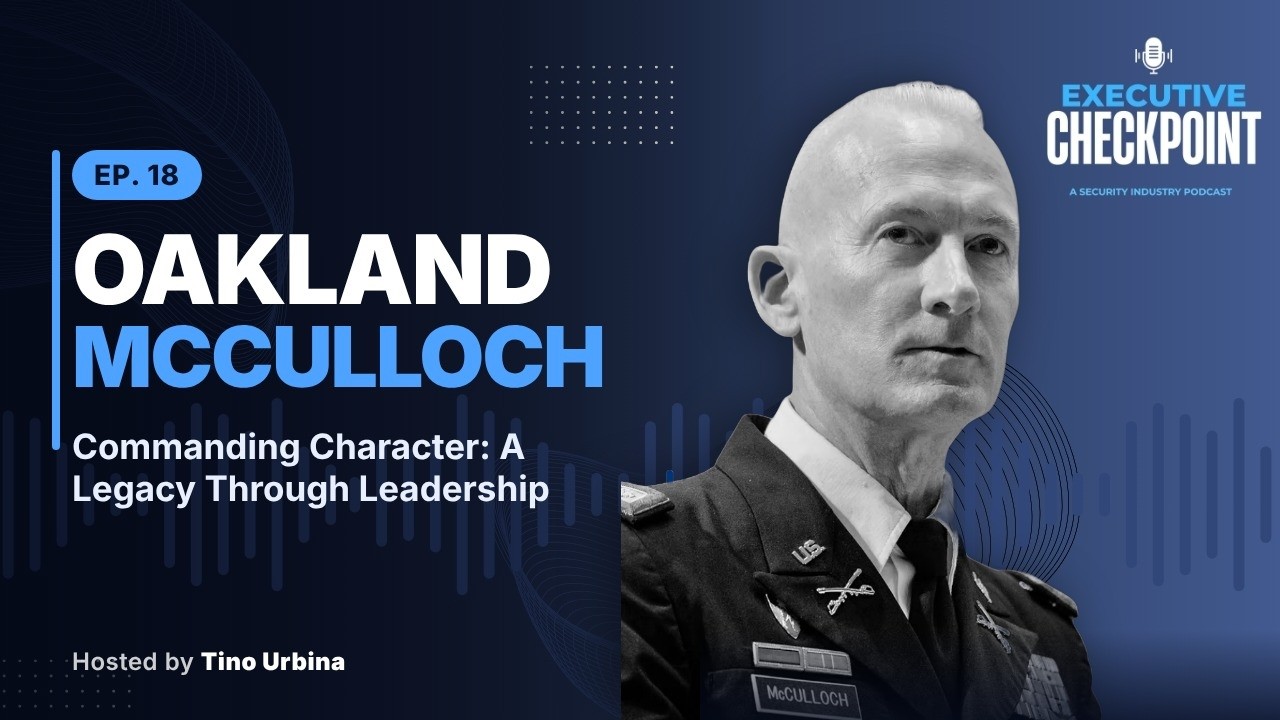
In this Executive Checkpoint podcast episode, host Tino Urbina interviews retired Lieutenant Colonel Oakland McCulloch, a 23‑year Army combat officer, former ROTC professor, food‑bank director, and author of Your Leadership Legacy: Becoming the Leader You Were Meant to Be. The conversation traces McCulloch’s early life in a small Illinois town, the servant‑leadership role models who shaped him, and his decision to attend West Point, then finish at Northern Illinois University. He recounts his military service—including Desert Storm, Kosovo, and peace‑keeping missions—highlighting how life‑and‑death decisions reinforced his belief that leadership is a privilege centered on people and trust. After retiring, McCulloch ran a large Gulf‑Coast food bank, doubling its distribution, and spent 13 years recruiting and mentoring ROTC cadets, commissioning over 600 lieutenants. He explains his two‑part view of legacy: modest organizational achievements versus the lasting impact of developing future leaders. Core concepts such as 360‑degree trust, servant‑leadership practices (walking the floor, getting coffee for the team, learning personal details about subordinates), self‑discipline, and integrity are discussed. McCulloch connects these principles to security professionals, emphasizing that crises test leadership and that empowering teams allows leaders to step back and focus on the bigger picture. He offers concrete advice for emerging security leaders—cultivate integrity, set daily examples, create personal development plans, and manage ego. The episode concludes with promotion of his book, his website (oakmccullough.com), and contact details for speaking or consulting engagements.
Chapters
Welcome to Executive Checkpoint, the live podcast for security professionals. Each week, we explore industry trends, challenges, and insights with leading experts. This is your insider access to the minds driving change in our industry. Well, hello and welcome to Executive Checkpoint, where professionals gather insight to navigate the dynamic and ever-evolving world of physical and cybersecurity. I am your host, Tino Urbina, and today we have the privilege of speaking with Lieutenant Colonel Retired, uh, Oakland McCulloch, uh, distinguished leader and author and keynote speaker With over 4 decades of experience in military and leadership roles, with a decorated 23-year career as a combat armed officer in the U.S. Army— thank you for your service— serving in major operations such as Desert Storm, Bosnia, and Kosovo, Oakland has translated his real-world leadership into lasting lessons for both military and civilian audiences. Following retirement, he shaped the future of next generation of leaders and senior military— as a senior military science former instructor at Stinson University and later as an author of the book Your Leadership Legacy: Becoming the Leader You Were Meant to Be, a powerful guide to servant leadership. Today, Oakland will share his journey. We'll get some insights and how he sees the future of leadership from his perspective and as a former military leader. So, uh, with that said, Auckland, it's a pleasure to have you— oh, I guess, uh, to have you on the show. I've been looking forward to this conversation.
Glad you're here. Yeah, well, thanks for having me, Tino. I, I've been looking forward to this since we talked last time. And, uh, and yeah, I, I would— anywhere you want to go on leadership, I'm happy to talk about.
Well, let's, uh, let's begin a little bit with your, uh, Beginnings, right? Everybody starts from, from somewhere. How, um, your career in the military and maybe early on, tell us a little bit about your background.
Yeah, so I grew up in a small little farm town in northern Illinois, uh, about 1,200 people, and everybody knew everybody. And I mean everybody knew everybody. Uh, you know, you as a kid, you couldn't get away with anything because as soon as you do something, they'd call your parents. By the time you got home, they already knew what you did. I can relate to that. Yeah, great place to grow up. I can't say I'd want to live there today, but it was a great place to grow up as a kid. And I played baseball, basketball, football in high school, was captain of my team there, was president of student government, president of my class there in high school. Then, then I went off to— I knew I wanted to be a leader of some type. And so to me, the leadership in the military was a good fit for me. At least I thought it was, and it turned out to be. And, and so I went off to the United States Military Academy at West Point. I didn't graduate from there. I came home, ran my father's business for a little while when he got sick, and, and then finished up at Northern Illinois University in ROTC, where I met my wife.
Right.
So everything happens for a reason. And then went in the Army for 23 years, had a great career. I wouldn't trade any of it for a minute of it for anything. And my last assignment, I ran an Army ROTC program at the University of South Alabama in Mobile. Love that assignment. I'd still be doing that if they'd left me there. And then retired from the Army. 2009, I ran a food bank, a very large food bank for about 2 years that covered 52 counties along the Gulf Coast of the United States, covered the whole Gulf Coast of Mississippi, the whole Gulf Coast of Alabama, and about a third of the panhandle of Florida. Then I came here and recruited for Army ROTC for 13 years. Now, then I wrote my book. And now all I do is keynote speak— speeches and talks and professional development programs for companies that are looking to grow the leadership in their company.
I see. You know, it sounds to me that your focus has always been service. So again, thank you for your service. And not only in the military and armed forces, but also the public service that you're doing to carry on the the guidance and future leaders. So that's commendable.
Yeah, well, thanks, Tino. I always tell people, look, it was an honor and a privilege to serve the people of this country and to continue to serve. And I really look at it as it is my responsibility. You know, I turned 62 in January, and a lot of my buddies— I live here in Daytona Beach, Florida. I fish. I love to fish.
Oh, I love Daytona.
And a lot of my buddies said, Oak, what are you doing? Why are you flying all over the world talking about leadership? Just retire completely and fish all day. I said, I can't. I said, I look at it as my responsibility to pass on these lessons I've learned over the last 40-plus years of being a leader to this next generation of leaders. It really is our responsibility.
Right. You know what, I can really align on that comment simply because the reason that I decided to create this podcast It's a passion project, right? Because we need guidance on any level of leadership. But when it comes to security, I think that more and more we need to better equip, you know, our CEOs, our professionals in the industry. I wanted to ask you, early on in your military career, what inspired you, that need for service? I know that, you know, it's part of the system, if you want to call it that. I think that my perspective is that you have this innate need to be of service, and that kind of carries on to your leadership style. But where did that— where does that start for you? Where did that begin from?
Yeah, well, it actually started in high school. I had two— I had a high school— my high school history teacher, who I stayed in contact with up until about 18 months ago when he died, Mr. Schindler, Charles Schindler, great man, great American who served in Vietnam during his youth. My high school basketball coach, Coach Terry Niedzwiecki, who I still stay in contact with.
That's great.
They were both servant leaders. They understood that it wasn't just about teaching history or putting together a great basketball team. It was about creating great young men and women, in my history teacher's case, that were going to be good husbands, good wives, good mothers, good fathers, productive members of society. And you could walk into their office anytime, or their classroom, with whatever problem you had, and they would give you advice. They would help walk you through some options that you had to deal with those problems. And so that kind of started it for me. And then I had some early on as a lieutenant and as a young captain, I had 2 great leaders, servant leaders who I worked under. And so that kind of just cemented it for me. I mean, from that point on, I understood that servant leadership was the right way to do it. And that was what I did all through my career and continue to do. I still stay in contact with a lot of the young men and women that I had my hand in commissioning over my 16 years of doing that. And I've commissioned— had my hand in commissioning over 600 lieutenants for the United States Army and for the country.
Wow.
And a lot of them stay in contact with me, and I look at that as Now I'm passing that on, what Mr. Schindler and Coach Terry Nedziwicki did for me. I'm passing that on to the next generation. And, you know, when I got ready to retire from the Army, I had lots of offers to go work in the civilian corporate world, and I just had no interest in doing that. And that's why I picked the food bank, because it was still about service.
Right.
And to me, That is what it's about, is service. Nothing against people who want to work in the corporate world. That just wasn't me. And so that was an easy transition for me to go from the military into another service-oriented job.
You know, and it's interesting. I think you bring a very valid point. First of all, it's proof that they were incredible. Your mentors were incredible servant leaders. And, uh, to carry on that baton. It's a— I see it as, uh, some people think of legacy, uh, as a selfish act to, you know, carry on who you are in the future, but this is the complete opposite, right?
Well, I look at the legacy of service. Yeah, absolutely. Look, and obviously legacy means something to me. I named— I titled my book legacy. So I look at legacy as a 2-part thing. A very small part of your legacy as a leader is what you actually accomplished as a leader in your organization. Now, results do matter in the real world, so that is important, but that's a very small part. And the reason I say that is because if you tie your legacy to what you accomplished in your organization, When you leave, and you are going to leave at some point one way or another, when you leave and the new leader comes in and they change everything, then what's your legacy? So your real legacy, in my opinion, is that next generation of leaders that you help create who understand that it's about servant leadership. It's not about them; it's about the people and. the organization that they have a privilege to lead. It is a privilege to be the leader. Unfortunately, I think too many leaders today have forgotten that it is a privilege.
You mentioned something interesting where the mission is important.
Whether you own a business, you got to make money. I got that. Otherwise, you're not going to be in business. Or in the Army, we always had a saying, mission first, people always. You gotta accomplish the mission. I got that. I mean, that's, that's called real life execution.
How you, how you execute the mission, I think, is the core value that you're bringing in for the service, service to your people. And as an example, they serve, uh, everybody else. So no, I think it's wonderful. Um, I was wondering, you, you, you, you, um, you've been in combat zones and, uh, peacekeeping missions. Was there a point with Those experiences then also shape your value as a— and views as a leader?
Yeah. Oh, I think, you know, you can't serve in those type of positions where it doesn't influence something, you know, and influence you probably for the rest of your life. Some of that's good, some of it's bad. But, you know, I certainly took experiences out of both those— Desert Shield, Desert Storm— and More Kosovo than Bosnia, where you know I had to make some decisions that were like you know life and death situations. And you you have to accomplish what you're doing. But in the end, in addition to that, you got to think about how is it going to affect the people that that you have the privilege to lead. And you know here's here's a good example. You know I had a young Lieutenant who I still stay in contact with today, and and he's on the Brigadier General list. You think that makes me feel old? And and one day, and he came in as a brand new lieutenant to my my staff organization, and I I put him out on a on a mission, and it there was a mortar attack, not against our soldiers, but against a town. I saw him coming out. I went there immediately and he was like the first— his platoon was the first one to get there. I saw him walking out of a building and he had a little baby in his hands that had been killed during the mortar attack. I could see a tear running down his face, which is natural. I mean, absolutely. We're all humans. I don't care who you think you are and how tough you think you are.
Right.
We're human. And and I I told him, I said, "Take care of what you got to do here, young man," and then come see me. And he and he came to me afterwards, and I said, "Look, I got it. You know, this is tough, and you you have emotions and you have feelings that you've got to deal with." I said, "But understand that you cannot save everybody. I don't care. You can have all the right intentions. You can't save everybody. There's certain things you don't have control over." I said, the one thing that you got to remember is that you have a job to do and that there are soldiers who are depending on you for their life. So deal with what you got to deal with whenever you have time, but in the moment you got to deal with what's going on in front of you because your job is to bring as many of those soldiers home as you can bring home.
Yeah. And you need to be centered to be able to do that. I think that's It's a great, great, um, great point and terrible situation to learn those valuable lessons. Um, you, after retiring, uh, you, you, um, uh, mentor a lot of ROTC cadets. Was there a specific point in, in that, uh, in those relationships that you knew, you knew for a fact you were making, uh, changing minds and opening hearts?
Yeah, absolutely. I mean, there were some people that, you know, that I wish I could have done more for, but, you know, it, it, a lot of it depends on them that you can do everything that you want to do, but they got to want to do it as well. But a perfect example, um, when I was running my ROTC program at the University of South Alabama in Mobile, I had a young man who came in and I thought to myself the very first day, I mean, he was standing off by himself. He didn't engage with people. And I thought to myself, yeah, he's not going to make it. And then he just kept coming back and he kept doing the things that I asked him to do, that we asked him to do, not just me, but my cadre. And he was learning and he was doing the things that we taught him. And I could just see every day he got a little bit more confident. He got a little bit better. And about, I don't know, probably the last semester of his sophomore year, you could just see that a light bulb went off.
it.
He understood what it was we were doing. There was a, there was a method to the madness. There was a reason we were asking them to do the things and learn the things that we were asking them to do. And, and he just, he just exploded. And by the, by his senior year, he was the battalion cadet battalion commander for the, for the ROTC program. I mean, that's how much he grew in those 4 years. 3 years. So it's awesome when you can see that. And it's heartbreaking when you see somebody who has potential that you're trying to coach and guide and mentor and develop, who just don't have the discipline, the self-discipline or the habits that allow them to learn the things you're teaching them and put them in place and don't meet their potential. 'Cause I've had several of those that I, when they first came in, I thought this guy or gal's gonna be an absolute superstar. And then they just didn't. And, you know, and you take that to heart.
Sure.
But you also gotta understand that it's a two-way street. You can teach and mentor and coach and develop all you want, but unless they take it to heart and decide that's what they want, Then you can't make it happen.
Absolutely. You know, I can relate to that in 2 different separate instances. One, years ago, as a new director of a facility, one of our senior management was asking me who's ready to move to the next level. And I said, pick someone, anybody. I trained them well. They all know what they need to do or how they need to do things. And, uh, uh, I'm not sure if I lost you, Hook.
I'm still here. I, I don't know what happened. Hold on one second.
I see the thing, the camera went out.
Yeah, there we go.
There you go. But, you know, glitches, we pivot. That's good. There's always— it's technology, right? Something is gonna go right.
Stuff happens. You just got to work through it.
That's right. So, but, you know, I was so proud to tell, you know, senior management, yeah, this— any— pick anybody. And to my surprise, when he approached them, nobody wanted the position.
Yeah.
And the reason was just like, you make it look easy. You love this commitment and we don't. We love working with you and we appreciate that you train us so well, but we don't want it. They wanted responsibility.
Yeah. Well, and there are people like that. And I've run into people like that who I say, the term I always use is a fear of success. They're afraid to go to that next level and be successful because then they're going to have more responsibility. They're going to have more things that are going to be thrown on their shoulders. And they don't want that. They just want to do their job and they do it well. And then they go home at night and they don't have to worry about what's going on and they don't have any responsibility after they go home. And that's okay because leadership position is not for everybody.
Right.
The thing I just said the other day to somebody, I said, you know, leadership, if you do it right, is the hardest thing you will ever do, but it is also the most rewarding thing you will ever do. if you do it right. And I believe that 100%.
You know, I think, um, and now sort of looking at your book, right, uh, it seems to me that, um, Leadership Legacy has a broad audience, resonates with a lot of different people. Uh, what was the main hope for you to communicate with, with the book?
Yeah, so I, I'm a firm believer that leadership is leadership. It doesn't matter where you learned it. It doesn't matter where you practiced it. If you understand that leadership is about 2 things, people and trust, period, end of story.
Sure.
If you can get people to trust you, you can lead any organization. I don't care what it is. I proved that with the food bank. I was a combat arms officer for 23 years. I fought our nation's wars. I went to peacekeeping operations. And then I ran a food bank for 2 years. That's 180 degrees difference.
Oh yeah.
You don't get any different than that. And I didn't know anything about a food bank except that it had food in it. I mean, but, but when I took over that food bank, the day-to-day operations of that food bank, we were handing out 1.2 million pounds of food a year. When I passed it off 2 years later, we were handing out 3.8 million pounds of food a year. We doubled the size of the truck fleet and we almost doubled the size of the staff because I got there and I understood that it was about people and trust. And I started building those, that relationship with the people that were in the organization, got them to trust me, and then we could move forward from there. And I think that that was my main thing was to make people understand that you could— leadership transfer is transferable. Your skill is transferable from one profession to another.
Right.
Doesn't matter where you learned it. And I think that was my main thing that I wanted to do in my book. And I wanted to, you know, I don't even mention the word theory in my book because it isn't about theory. It's about everyday things that every leader can do to improve their leadership skills and abilities, and at the same time empower the people that they have the privilege to lead to be better, better workers and better people. Because I think my personal opinion is a good leader helps develop people, not just workers, but people. And I think that's important. And I hope I did that.
Yeah, I, I definitely feel that, like you said, it's transferable. And we see, especially in the security industry, we see a lot of crossover from Either agency, uh, you know, uh, government agency, FBI, CIA, or, um, other. And, uh, you have military—
Are probably a big crossover for you, police officers.
Absolutely. And so, you know, um, you know, whether if it's physical or cybersecurity, leadership often determines the success or failure of a crisis response. So how do you, how do you feel your principles can apply from that standpoint of view to security professionals and, and the private sector?
Yeah, absolutely. I, I, I'm a firm believer that, you know, it, if, if you don't think a crisis is gonna come, come to you, you, you're, you're—
It's a test of leadership, right? I think that's—
It is going to come, I promise you. And, and I always used to, the way I used to do it and the way I used to teach it to the future leaders of the military and the country is I used to say, look, you're going— if you train your people right, then you trust them. When a crisis happens, you're there. You need to be on the spot. You need to direct, at least initially, what's going to happen. Then once they're out there, the people you're leading are out there doing what it is that they know how to do and you know they can do it, then you as the leader need to take a step back. Take the emotion out of it. Take one step back from that event. Let your guys and gals do what they need to do. And you need to be looking at, okay, what am I missing? What's coming next? What else could happen that I'm not seeing that is going to affect this situation? And then you can start planning in your mind. Okay, if that happens, this is how I'm going to deal with it. If that happens, this is how I'm going to deal with it. And you're never going to get all of the options. I mean, there's always— there could always be something that comes out of the blue that you didn't think about. But at least if you thought through most of the big things that could happen, then you're prepared for when it does happen. And even if it's something else, maybe you can spin it, spin off of what you've thought about and how you were going to deal with that to deal with that situation.
Yeah, that is— you have to trust, right? You got to trust that you've empowered your team and they're going to deliver so you can focus on the bigger picture.
Well, you know, and that's, that's the key to me, because when I talk about trust, I talk about 360-degree trust.
Yeah.
Because I think everybody who's listening to this show would agree that the people you lead have to trust you as the leader. If that one doesn't happen, it doesn't matter. Go home. You're not the leader. But just as importantly, the leader has to trust the people that they're leading. And the people in your organization have to trust each other. That they're going to do the right thing. They're going to put forth the effort, all those kinds of things. Then the last part of that 360-degree circle is that the people that you are serving, dealing with, have to trust you and your organization. If any one of those 360-degree, any part of that is missing, then you're in trouble.
Right. I feel one of the biggest themes of your book is the servant leadership style. So my question related to the security industry, how can leaders adopt and maintain that operational discipline as a servant leader?
Yeah, so I think it starts with you as the leader, that you have to have that idea That it is a privilege to be the leader. And you got— you have to own that, that it is a privilege. And then, then you got to get— you got to get out and know the people, get to know the people that you have the privilege to lead. I always told every single lieutenant that I was commissioning and anybody at a conference that I talked to, my philosophy was lead by walking around. Get out from behind your desk. Now, I got it. Leaders have to spend some time behind their desk. There's reports, there's budgets.
Right.
There's a certain amount of time you got to be behind a desk. But every chance you get, get out from behind your desk and go down where your people are working and spend time with them. I promise you, you call somebody into your office and they ask— and you ask them a question, You will get a different answer than if you go down to where they're working and ask them that same question.
That's an incredible change of perception, right? That person will feel validated. I can totally see it. Hold on. Take a note. That's fantastic.
So that was always my philosophy. Get out. And I had a boss who retired a 3-star general who was one of those servant leaderships that I servant leaders that I mentioned in the beginning. And he, he always— he told me one time, he said, Oak, I don't care how high up in the organization you get, right? Never, ever, ever turn down a chance to go get your own cup of coffee. He said 2 things happen when you do that. He said, number one, you start building some trust because they realize that you understand you're no better than they are. You've got to go get your own cup a cup of coffee just like they do. And number 2, if you're lucky, you got 2 or 3 different ways to get from your office to the coffee pot and back to your office. And along the way, you stop and talk to people. And, and when I talk— say you talk to people and get to know people, I, I, I, I'm a firm believer that as a leader, you should go out every— your goal should be to every day go out and find one person at least one person in your organization and find something new about them. Not about work, but about their personal life. What's their spouse's name? What's their kid's name? What sports do their kids play? What are their hobbies? What do they like? What don't they like? And one of the benefits of that, once you get to know the people that you have the privilege to lead, is that then you can understand when you're handing out projects and missions and jobs, you can understand who would probably be the better one to do that job.
Absolutely.
I don't know how many times I've seen where somebody, a leader, doesn't know his or her people, and they'll assign— they're in a meeting, they'll assign somebody a job, a project, and it's a horrible match for that person. But the person right next to them, that probably would have been the the perfect match. But they didn't know that because they didn't know the people that they had the privilege to lead.
Well, you know, I think that, that there's so simple— I'm sure listening to you, some of our listeners and viewers, they have those aha moments like, well, yeah, of course, but applying it and having the discipline to apply it, I think it goes back to discipline, right? Discipline, trust.
There is a difference between discipline and self-discipline.
Self-discipline.
A leader has to be self-disciplined. Absolutely right.
Well, one segment of our viewership is, you know, new or upcoming leaders, right? So what piece of advice you will give to those emerging security professionals who aim to have this leadership style and integrity?
Yeah, so absolutely. I think number one, beyond anything else, you have to have integrity. It starts and ends with that because you can't build trust if people can't trust you. So integrity in your character, setting the example every single day. And that sounds easy, but it's not.
Right.
Every single day you have to get up and say, okay, I gotta set the example because as a leader, you are setting a new standard every time you do something. You know, little things like if you're walking down the hallway and you see a piece of trash on the floor and you don't bend down and pick it up and put it in the garbage can, then how can you expect somebody else who, who you're leading to do that? You should never ever ask somebody to do something that you as the leader aren't willing to do. So it starts with integrity and your character and setting the example. Then I think it just goes to showing the people that you're leading that you actually care about them, not just as a worker, but as a person. You know, one of the things that I used to do every time I got somebody new into my organization is I would give them the, you know, here's the The culture, the vision, the plan. Got that big big picture. But then I would I would pull out a sheet of paper and I'd say, "Where do you want to be five years from now, Tino?" I don't even care if it's in our organization. Where do you want to be five years from now? And they'd tell me, and I'd say, "Okay, well let's map out what it's going to take to get you there five years from now. What training do I need to get you to? What positions do I need you?" Have you do? What, you know, down the list. And we'd write it out and I'd give them a copy of it and I'd have a copy of it. And then every quarter when I would counsel them, I would pull that sheet out and say, okay, let's see where we are. What have we done to help get you where you want to be 5 years from now? Okay, we've done that. We still need to work on this one. I got to get you to this training or in this position or whatever. And, and, you know, you could just see that they find that they would— they understood that I actually cared about them as a person, not just as an employee.
Right. I think partially is negotiating ego, right? And confidence. You got to tone those to be a good servant leader. Oh, this has been an incredible—
We all have an ego. Oh yeah. Anybody who tells you they don't have an ego is lying to you. Okay. And themselves. Because we all have an ego, and we want people to have an ego.
Absolutely.
That's what drives people to be successful. That's what drives them to be the best at what they do. But a good leader understands when to put that ego aside, and I learned that as a lieutenant. My first platoon, I was a 24-year-old lieutenant. I'd walk into my first platoon, and my platoon sergeant grabs me by the shoulder, and he says, "Sir." Grab an MRE. Let's go have lunch underneath this tree. And we walked over there and he said, look, sir, you're the boss. You're the lieutenant. We will do things however you want to do them. However, understand, I have been in the Army for 23 years. He'd been in the Army almost as long as I had been alive.
Right.
Why would you not listen to somebody like that? And the reason is because of your ego. You know, you got to learn how to put your ego aside because you got to understand that you don't have all the answers. You don't have all the knowledge. You don't have all the skills or abilities. You got to use the talent, skills, knowledge, and abilities of the people that you have the privilege to lead. And if you do that, you will see that that organization and you will grow exponentially. I give Sergeant Pinson, Sergeant First Class Pinson, Remember him like he was yesterday, and I kept in touch with him until about five years ago when he finally died. I give him a lot of credit for helping to produce me as the leader that I am today because he taught me some valuable lessons. You when I talk about mentorship, mentors don't have to be above you. You can have mentors who are below you, who have knowledge, skills, and abilities that you want to learn. You just gotta put your ego aside to understand that.
I love it. Um, well, look, this is one of those that I feel we can do this for several hours. And, uh, I'll always come back on again if you want me to. Absolutely. Absolutely. But here's the one recommendation. If you want to understand better, uh, this servant leadership and you enjoy the conversation, Go get Oak's book. I think that's a good start. We'll, we'll put a link, uh, you can help us with that, Oak. And, uh, if someone wants to reach out from the corporate side to maybe have a deeper dive in, in a corporation, how can they find you? How can they reach you? What's the easiest way?
Yeah, so I have a website, oakmccullough.com. And on there it has all my social media that I'm on, and we connected over LinkedIn. That's where I do most of my connections, although I, I am on all the other, you know, YouTube and whatever else, um, all the social media. And there's a link that you can connect with me there. It also has my cell phone number and my email address. And if you are looking to have somebody come speak at an event that you have, whether it's a a conference or a training event that you want, or if you just want to reach out. Um, I, I also do professional development training for organizations and companies, or if you just want to reach out and connect and see where the possibilities lead, I'm always happy. I never turn down a chance to hop on a Zoom call with, uh, with somebody I connect with, because in my opinion, it's about connection. Again, it's about people, and I, I love to connect with people. And if somewhere down the road you could help me or I could help you, then good for us. But if, if never that happens, then at least we have a connection and we might be able to, to help each other in a small way. I can give you some advice or you can give me some advice. So absolutely, I would love to connect with anybody in your organization, in your network, who would like to connect.
Absolutely. Well, again, thank you very much. I think it's been a very pleasant conversation. We look forward to having you, uh, some other time. We, we, uh, upcoming couple conversations with, uh, maybe not opposing views, but maybe different views about certain subjects. And so we're hoping to see you again. Uh, for our audience, we thank you for watching. Uh, with your support, we continue to bring incredible speakers, thought leaders like Uh, so, uh, stay safe, stay smart, and we'll see you in the next Check Point. Thank you so much for your time. Thank you.
More from Tino


EPS 37 Security Is a Human Business Leadership Risk and Resilience Lee Oughton





Eps 33 It’s Not in the Manual: Real-World Leadership for Security and Risk Professionals

Episode 32 Security, Converged: Why AI Needs People, Process, and Purpose Kasia Hanson

