Episode 21 The Risk No One Talks About
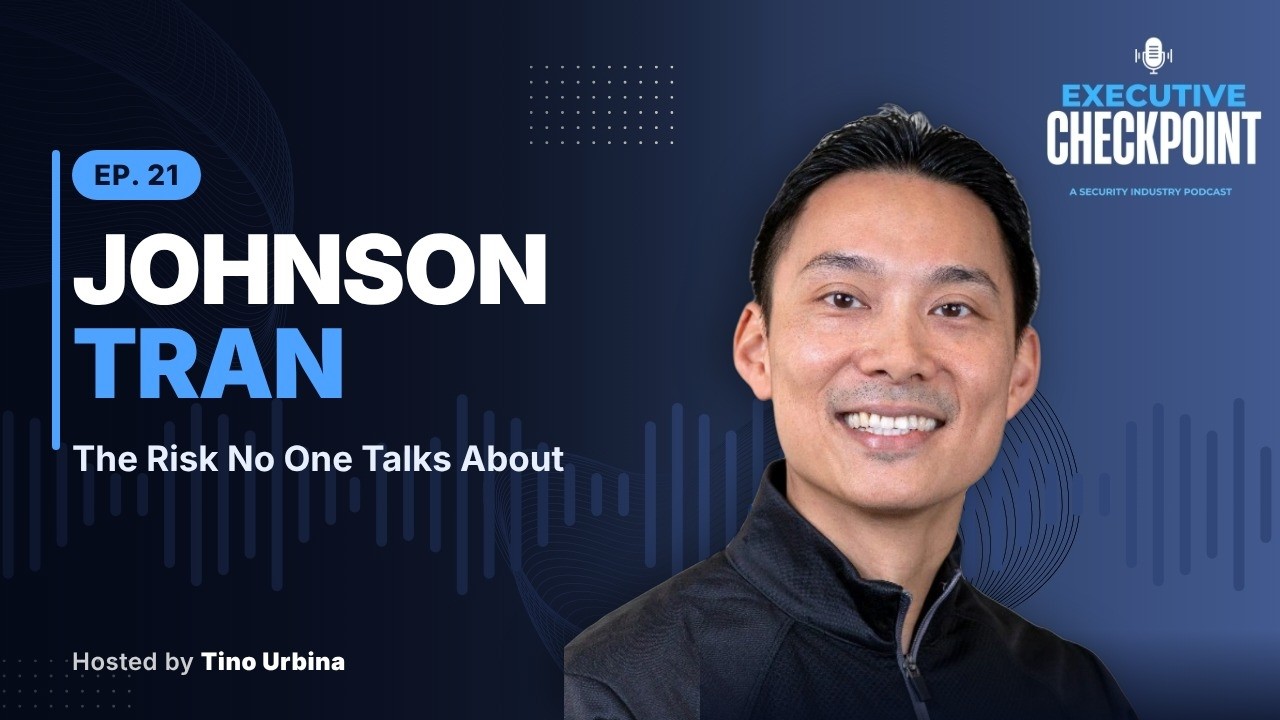
Johnson Tran, Chief Channel Officer at HelpDesk.Tech, survived a near-fatal car crash that shaped his leadership philosophy around faith, integrity, family, time, and health. He built channel models for telecom and cybersecurity firms and warns that most MSP packages are overpriced and miss mid-market customers entirely, leaving security gaps in patching.
Chapters
So I guess here we go.
Let's rock it, man. Welcome to Executive Checkpoint, the live podcast for security professionals. Each week, we explore industry trends, challenges, and insights with leading experts. This is your insider access to the minds driving change in our industry.
Welcome to Executive Checkpoint, where security professionals gather to gain insight into the dynamic and ever-evolving world of physical and cybersecurity. I am your guest, Tino Urbina, and today we have a great guest, Mr. Johnson Tran. He's the Chief Channel Officer for HelpDesk.Tech, and he's going to share with us his live outbound adversary and leading channel strategy across telecom, cybersecurity, and AI. JT, as us friends call him, has a tremendous story to share of resilience, innovation, and purpose. And he is on a mission to simplify IT services and eliminate back-and-forth pain points. He's redefining how organizations approach security, procurement, and collaboration. Today, we explore the hidden risks that go unnoticed in the industry and what it really takes to lead with integrity. All right. So, Mr. JT, how are you, sir? It's been a minute. Oh, we lost him.
Gotta make an entrance. That's what they say. Every time the camera comes on, you have to do a little effect. So there you go, just like a PowerPoint presentation.
Just change it up a little bit.
Come on.
Yeah, since we started talking, you've been standing, which I, I've never had someone just come in and goes like, nope, I'm standing. That's energy. If you haven't met JT before, that's, that's what he's all about. Energy. Good energy. Yeah, man, it's been great. You know, it's been— we were just chatting Before we got started, it's been at least 18 years, right, since we met?
Long time, brother.
Yeah, so it's been a good process and evolution, right? Growth and evolution. And some very— nothing changes without going through challenges. And why don't we start there? I mean, if you don't mind, for those that don't know you, JT, give us a little bit of background, how you started in the industry, what you've done so far, and If you're okay with it, we'll follow with the next question talking about a little bit about your— I won't say challenges, but your experience with physical adversity. So tell us a little bit about your background.
Yeah, man. Well, hey, Tino, thanks for having me. Thanks for all your listeners to come spend some time with us. Look, man, it has been a long time, dude. I've known you forever. And guys, I just realized that Tino is my neighbor. So, this is how crazy it is, 15+ years later, we're on this bad boy talking, and I think you're right down the road from me. So, I could have went to your house and done this. But anyways, another conversation for another day.
For sure.
Yeah. I'll swing by your studio. So, yeah, I mean, I don't want to go too far back. Obviously, a different segment on a different day, but first-generation immigrant story, grew up broke, kind of where the tech world started. You know, we, we as immigrants had to figure out our own way to make it, you know what I mean? My parents didn't pay for my college. They, you know, they gave me a place to live and food to eat, my first car to drive, and it was like a $4,000 Camry, '94 Camry 106. So, so that's all they gave me growing up. Everything else I had to figure it out. And so, you know, I was 19 years old and I kept going into the— actually, Willowbrook Mall, there was a T-Mobile store. It was VoiceStream at the time. And so I kept going there because I would buy a new 2G cellular phone. If you remember the Nokia 3390 and the 8290. Wow. You remember that, Tito?
I do. That's, that's, that's what I'm saying. I'm like, wow. Don't let this fool you. He looks very young. Hey, look.
Hey, look. It sucks. It sucks being 52. I'm just playing. I'm 42. I'm 42.
Jesus, dude.
But no, I, I had you interrupt because I asked you, you remember the $3,390? But dude, it— that's where I started. So I kept going in, I kept buying a new phone with my lawn mowing money or the side hustle. I, you know, I got into this business called Square Donuts because we thought circle donuts were stupid. So we made square donuts when I was 19, and we create— we— I don't say we created it, but we, we, we That was like, I guess, my first real business I got into with a bunch of partners. And so, we were doing that, but then I was like, this extra money I was making, I was kind of into tech. So, I bought a new cell phone because 2G was cool. And every month, I went to the cell phone store. And this guy by the name of John was like, dude, you know more about cell phones than I do. We're hiring. Do you want to work here? And I'm like, well, I don't know. How much you make? You know what I mean? And he goes— and I was 19 years old. He spun his screen around. And I was like, you make this much money selling cell phones out of this little rinky-dink store in the mall? And he goes, yeah, bro. He's like, and this is my worst month. And I go, man, I'm in. So I had to find a way to pay for school. And so that's what I did. I started schlepping cell phones in retail at 19 years old to pay my way through University of Houston because my parents didn't pay for me. They gave me a place to live and food to eat, right? And a car to drive. And so I had to figure out how to make make my life for myself. So that's how I got into the tech industry. It was a means to pay for college so I can go to school full-time and then work at VoiceStream at the time full-time before it was T-Mobile. So that's how I started, you know. Yeah, at 19, and I'm 42.
There you go. So now you are, um, Chief Channel Officer with a corporation and so many things that we can you know, fill in in between. And so with that, with that said, you know, I know that you have a tremendous journey and you're, you know, powerful in your personal life and your professional life. Can you share with us a little bit of that physical adversity? How did that shape your leadership style today?
Yeah, absolutely, Tino. So, you know, I was 19 years old selling cell phones. 2, 2 and a half years later, 2 years and 10 months later, I was, I was basically 2 months away from 22. I'm driving home from Austin. Long story short, flipped the car forward 5 times. I was in ICU for 2 weeks. I couldn't move for 2 months, physical therapy for a year and a half. I basically had to learn. I only had one limb that was working, which was my left arm. So like, you know, I had a 15% chance to kind of walk again to get full function of my left leg.
Wow.
Uh, and yeah, man, so I had to, I had to rehab like this whole arm. I had to rehab my right leg, my left leg. And so I, I laid out in a ditch for 2 hours. I lost 7 units of blood. Yeah, yeah, it's great. People may realize it, right? And they— these are a lot of the untold stories about hardships, and people are complaining about their $10 Starbucks coffee not being warm enough, you know what I mean? Like, come on, y'all, there's bigger things to worry about. So that was my kind of, you know, epiphany where I was like, oh my God, I, I have to change. You know, that, that, that was God giving me a sign saying, you know what, you, you have to spread a different word. You're here for a reason. And so before that, I was doing pretty taekwondo kicks. I've been doing martial arts since I was 8. I would hang stuff like on a basketball net to try to kick them off, you know what I mean? So I was really into it, and then life changes like that, right? And so I had to take about, you know, 6 months off from work and school. So I actually graduated a year— it took me about a year longer than I would have. So I graduated December 2006. Because I had to learn how to walk again. And then I still had to go to school with a limp and all those things. You know what I mean? And I celebrated my 22nd birthday in a wheelchair van, sitting in a wheelchair with a hospital gown, drinking one beer because I didn't want to drink too much because I wanted my body to heal. You know what I mean?
Right.
So, that was that. And then that was kind of the moment where I go, I've got to live different. I've got to look at life through a different lens. And so when I graduated, you know, again, paid my way through college selling cell phones, you know, did the retail, did the business side. And then, you know, I was fortunate. Again, this is the untold things decision makers, executives don't think about. I was fortunate to sacrifice from 16 to 26. And people are like, what do you mean you sacrifice? I go, you're gonna pick a decade that you're gonna sacrifice. It's gonna be 16 to 26 where you save as much money as possible. or it's when you're 55 to 65 or 65 to 75, right? You're going to sacrifice a decade. So I was fortunate to listen to my dad and create an idea about money, which catapulted me to my success today, where if you make $5, spend $3, save $2, right? And then when I started making commissions, it was like, if you make $20, you spend $3, save $17. But that's where it starts. Like, people's business and their professional career, it starts there. I, you know, this is, this is a lot of stuff that I'll share with people. 16 to 26, I saved my money. 28, I didn't have a mortgage. I haven't had a mortgage since 28. And I grew up as a first-generation immigrant in one of the Acres neighborhoods of Houston, you know what I mean? And I got there. And then my joke is, yeah, I've unofficially retired since 36. I'm 42 now, but I technically work because it's a fun game. I do sales because it's a fun game. You know, and and I do it because of what I did from 16 to 26. So so all these hardships growing up with no money, saving like my dad told me, listening all the Bruce Lee stuff, and then getting here is really what got me to you know working at Help Desk Tech and and and that journey. But you know I'll try to summarize it really quick, Tino. So yeah, I graduated college. I I've been in a like 9 different industries. I'm 42 years old. I've been in 9 industries because I had a— I had an industry bucket list. I wanted to make sure when I was 30, 35, and 40, I wanted— I wanted to know who I wanted to be when I grew up. I wanted to know what I really liked to do because I didn't want to be the 80-year-old wish I coulda, shoulda moment.
Right.
And so I purposely did that. But again, the 16 to 26, being debt-free, I tell people that's my number one thing I can tell people. is be debt-free. You don't need things that are flashy.
Exactly.
You don't. And so, I've never been a flashy guy. And Tino, the crazy thing is I got to work in advertising for McDonald's. I did publicity for Universal Pictures. I worked at JPMorgan Chase. I was chasing the market in 2008. You know what I mean? And when everybody was broke and the mortgage crisis happened, You know, I got my teaching certification. I could teach math. Again, Asian stereotype. I could teach math. But I did. Got real estate license. Got all these things. But I did it because I wanted to feel what it was like to do something that I may or may not like to do. But my real path has been building indirect sales models, you know, since 2007 for companies like T-Mobile, for Clearwire when we met. I built an indirect model for a Verizon MVNO. So those are kind of the 3 telecom tech companies that I started building channel models for, right? How do you take a product and how do you make the one-to-many model so I can duplicate myself over and over and over again and create revenue with different go-to-market strategies? And so that's, again, you know, the clarity of not having a bill to pay was probably the biggest asset that I had. Because I got to see clearly how I can build a model, not be stressed out about a quota or a number or revenue or boss chomping down my neck. I'm like, dude, like, come on, man.
You know, it's funny, it's funny you said that. The first one in, the last one out, right? You know, yeah, you never have a boss. You always have— you have someone that respects you and treats you probably a mentor, right?
So correct, correct.
You know, it's interesting, your point. I think it's, it's very true. When you're an immigrant in this country, you don't, I think, realize how well that's going to serve you because you don't expect anything being given to you. And when you get, it's a feel-good kind of thing. It's never like, oh, I should have gotten more, right?
Mm-hmm.
You're thankful and grateful. And keeping your budget. And you know what? It's like most success, I think, comes from Humble beginnings, because you're gonna have the hassle and the drive to get there, right? And that doesn't mean that someone that had a different life experience won't, but it— I think it's— I will say challenges are preparation for greatness.
1,000%, man. 1,000%.
That's what I heard, is you've been through the challenges early in your life to accomplish greatness down the road. Here, sitting in a C-suite, right?
Correct.
The other thing that you mentioned, and I think it was key, is when you start building channel partners, and this kind of relates to sales and business and whatnot, that mentality of lean business that started with your personal experience with lean discipline to, you know, that decade that you put aside to financially be stable changes everything. If you're in sales, by the way, if you're in sales, and you're struggling is because you don't manage your time well and you don't manage your finances well.
Correct.
If you do what John was describing, probably, you know, when the checks are good, right? If you're in direct sales, right? But in business, elevating this to the corporate world, especially with experience with COVID you know, I'm sure that some companies really, really struggle 'Cause they didn't have a concept to apply from the leadership standpoint of view to being lean in a time of adversity. So I, I, I feel like that, that's a, that's a tremendous skill that you develop. Let me ask you.
Yeah, man.
Your fifth philosophy. Fifth, right? You, you put it in your—
I plead the fifth. Yep. Right on the top.
Fifth. And I love it. Can you, can you tell us a little bit about that and where, where is that coming from?
Yeah, absolutely. Absolutely. So, you know, I'll start with this. You know, I've been fortunate to— and here's where it all came from. It actually had to do with, you know, kind of the personal professional life, because a lot of people don't understand, you know, yeah, everybody's heard the yin yang, you know, everybody's heard kind of like, you know, the little balance beam, it has to be equal weight. It actually really does. And who you carry yourself personally is who you carry yourself professionally. Same thing professionally, personally, whether it's money, the way you treat people, the way you talk to people, the way you carry yourself, the way you think. It is 100%. Like, if you have an ego at work, you got an ego at home. You know what I mean? And so it came about this, like, watching— I call them a lot of wolf in sheep's clothing. You know what I mean? Like, working with a lot of people who create this, like, fake facade for reasons why people buy, you know, Lambos or rent Lambos to take pictures and put it on Instagram. And they're like, They're like, hey, man, yeah, I'm a millionaire. I'm rich. Buy my book. I'm like, God, you're an idiot. Just stop. But there's a lot of people do that. And I'm sorry to offend you if you're one of those, but it's true. And that's why, you know, this 5th came about because, you know, I was fortunate. I'll take a couple steps back. You know, as I'm going through my journey of where I went after the Verizon wholesale that I launched, wholesaler, You know, at nights and on the weekends, you know, I was building a software company and I built it for one reason and it has to do with my I plead the fifth, right? And I'll tell you what that means here in a bit. But it was because I knew we were trying to have kids and there was only 2 ways to work from home in 2012. DirecTV customer support rep or build a virtual software company. And I'm like, well, shoot, I'm not going to be a DirecTV customer support rep. You know what I mean? In my prime of my career, I was like, I'm going to go Figure out how to build a stupid software company. So I was just figuring out the fastest path to revenue. And so I picked up some like open source Python ERP software thing. And then, you know, we created this like little small boutique software company so I could feed my daughter and wipe her butt, you know, when she came out. I knew it was gonna be a girl, but when she came out, you know, in 2014, then I was able to like take a break from a call, like right after this, go and wipe her butt and then go feed her her milk during my break and feed her her lunch, her Gerber. So it was it was because of that. Like I did it for a purpose. I didn't do it for the money. I didn't do it because I wanted to tell everybody, oh yeah, I built and sold this software company. Ha ha ha! Like I tell the story because I did it for a purpose. It was it was a means to be able to have the time for my family. So you know that was cool. So I plead the fifth came from a lot of that. I plead the fifth is funny, and it's funny to people because everybody's watched A Few Good Men. Everybody's watched A Men of Honor. Everybody has watched Suits. Right? You know, some lawyer movie or lawyer show. And when you say, I plead the Fifth, it means you're like, right? You're not, you're not, you know, you, you, you're taking the oath to not say anything. For me, I'm pleading the Fifth because it, it's faith, integrity, family, time, and health. What I realized through my whole career and working with people and scumbags and bad salespeople and good salespeople and customers getting screwed and, and, and all that, all that, and then my daughter These are the biggest things that matter. It doesn't matter what your title is. It doesn't matter how big your company is. It doesn't matter that you run a $100 million portfolio. Honestly, me and the world, we're going to forget about it when you die anyways. We're probably going to forget about it tomorrow when you talk to the next host. So even if I said I run a $100 million business and I'm C-level, nobody gives a crap. You know what I mean? They don't remember that. That goes away really fast because you're going to be replaced by the next guy. But what people remember is something like this, right? This is what I want to be known for. There's little things that I say that people are like, man, I never heard that before. Where'd you read that? I was like, I don't read books. So, you know, we're going to talk about that today because a lot of people read books. I don't read books. Never read a book in my life. Never finished it. Hopefully my kids don't hear me say this, but I've never read a book. Never read— I've never bought a book. Never went to the Barnes Noble and bought one and read. I don't read But, but it's I plead the fifth, right? Faith, integrity, family, time, and health. Because these are the only things that matter. If you have one, it probably affects another one, right? Or if you have— it always does. And so if your professional life is forcing you to mess with any of these five, you have already made the wrong decision. Period. Like that's it. You know what I mean? And so I plead the fifth was a way for people to go, oh yeah, I've heard that before. Oh yeah, the lawyer movie. I'm like, no, no, no, no, no. It's it's Faith, integrity, family, time, and health. And they connect the dots and they go, dang, Johnson, that's cool. That's how I'm going to remember you. I don't talk about the money. I don't talk about any of their other stuff unless, you know, Tino, you asked me, right? It's more the philosophies that, that, that I want to instill in people. You know what I mean? Kind of, kind of like I, I say this all the time, as Bruce Lee did. You know, I said this earlier today. Bruce Lee's never had a black belt, but he's the best martial artist in the world. And he's the best philosopher.
Defined by the traditional ways that most people define neither success or ability, right?
Correct. Correct.
What I, what I, what I hear you said is that you're building your legacy based on these fundamental beliefs and applied to personal and business growth, right? Yeah. Integrity, family, time, and health.
Correct.
And I think no one can question that if you focus on understanding all of those will have a positive impact in your life.
Everything, you know, on deal, on the way you conduct your business, on deals you sell. I've seen business people and salespeople do shady things that affect their integrity and they don't care. They screw the customer or they screw a relationship just for their own Just for their own ego. And so, you know, those are the type of people that I'm like, man, you got to take a bite of humble pie every morning, wash it down with a glass of humility, check your ego at the door and put narcissism in the trash, right? And so, so, so for me, you carry yourself differently because that's going to have money follow you versus— and people follow you versus you're always chasing the money, chasing, trying to hit the quota because you're trying to buy the next thing. Because professionally and personally, Tino, quite frankly, it's, it's, uh, you know, I think a lot of people buy the books, join the— and this is not, it's not bad, I'm saying, but a lot of people fill their bookshelves up. They join all these peer groups and communities. They go to all these— I call it the misery likes company table, you know what I mean? And they pay money for it professionally because they're filling a void because they're actually not just doing it properly and correctly. to where their heart, it should be. They're doing it for the wrong things like the money or the fame or the title. And then personally, the money that they make, they do the same thing with the cars and the clothes.
Right.
Because they didn't realize yet that the man makes the suit, the suit doesn't make the man. You know what I mean? So, you have to fill the suit. If you buy a $20,000 suit, can you buy 5 of those cash? Can you actually fill it? Or are you like a really small dude in this $20,000 suit and you're just trying to portray that you're somebody?
Yeah, that makes sense. And you know why? This legacy philosophy, right? And I know because I know you, I know that, um, uh, and I know you know this, but you have impacted thousands of lives through your career because you've managed thousands of people and advised thousands of owners in the IT, uh, uh, channel management side of things where sometimes the advice of a trusted advisor like yourself makes the difference between some of those companies being incredibly successful or total failures, right? And I think that's gonna be very rewarding. So there you go. That's your second portion of legacy, right?
Mm-hmm.
Helping people in, in the biggest scheme. And, and in that sense, in business, and you know, we, we talked about this earlier, but In your mind, what are the risks that are hidden for companies that are totally overlooked when it comes to IT services?
What are the risks that the company faces?
Right. Well, what are the risks in your view? What's the risk that too many organizations overlook in their IT?
Yeah, I think, you know, I think risk is both sides. It's a double-edged sword. So, so the, so the risk— and I'm going to start very basic— the risk of an IT service provider selling security IT services And any tech, right? You know, IT MSPs typically take probably everything you sell, all the apps and everything, and they make it palatable for an end-user customer to not have to buy 62 applications and 62-point solutions. They're the one back-to-pat, they're the one phone call for all these 62 solutions, right? So, but the risk that those guys run, especially because a lot of them are small, is they, they sell at prices that the customer can't afford, right? Because it is a high price. If I go in and say— I know, Tino, you've owned many businesses in the past— I'll say, Tino, you're 10 employees for $2,000 a month. Can I be your IT services guy? Do you have the disposable income to give me $24,000 a year? That's the first question. Is it affordable and palatable? So the risk for the, the IT reseller or whoever's the, the managed service provider, managed services is big. It could be IT, it could be phones, it could be physical security, it could be all kinds of stuff. They run the risk of not being able to sell their services to the customer, right? So the risk they have is they have a low conversion ratio. They have a less than 2% conversion ratio, which hurts them. Talking to 100 people to get 2 people to buy from you, again, I use a joke. I make 100 donuts and I sell 2, I go out of business. Pretty simple, right?
Right, right.
So that's the risk there. Then the risk for the end user, since they can't procure it at a certain price, because they see, they don't see the value, you know what I mean? They don't have the money of $24,000—
Right.
For a 10-user dental office to buy IT services. They run the risk of getting hacked, as you know this. They run the risk, and it could be something stupid. They turned off automated patches and updates and upgrades on their workstation software and hardware, 'cause if, or they don't hit, let's do it, like restart now. Oh no, I'll restart it later. Oh, I'll restart it later. And so 2 weeks go by, I'll restart it later. You literally for 2 weeks left your one measly crappy $200 computer open, but they don't realize that that's a risk because they can't tie that little basic thing to $200 per month. You know what I mean?
So we're talking about business owners and our— or channel partners and are selling to mid-market and they're asking for these prices as is as if they were trying to sell to the enterprise customer, right? Which is like, uh, you gotta make it palatable to your point, you know, understand your market, who you, who you're servicing, right?
Correct.
Correct. And so, well, let me ask you then, what will be the path forward, you think? What's the future of IT, uh, services? How, how do you see companies and, you know, in this case, the mid-market channel managers or owners of this organizations, what's the path forward? What's the future? What do you see being their best way to retain customers and to obviously provide a good service?
I think it's you can't do what people have done 10, 20, 30 years ago. That's the tale. That's a tale as old as time, as Beauty and the Beast says it. You know, you have to evolve. If you, if you think, you know, selling tech, if you think you want to own everything, you want to have full control, you don't want to delegate, that's going to put you out of business. Period. So I think that's where you start first. I think also, and I take complex problems, I make it really simple, Tino. So like, if you can't walk across the street and get a majority of the people to buy your services, just be okay that you're going to spend a lot of money to try to find— I joke, you know, the riches are in the niches, the ideal customer profile. You've heard them all. I'm just joking, y'all. I mean, it's— come on, let's be real. It sounds stupid. And I know we have to follow some method, but really it's how do you find— how do you make it affordable for 100 customers to buy from you? And there's ways to do it. It's a consumer psychology, consumer behavior, sales psychology method versus how you're actually selling it to the customer. So I give you a quick scenario. So in the IT world, people charge $200 per user per month. I go, that sounds— I would never buy that. I personally would never buy that knowing what IT does. I would never buy it, right?
Right.
Yes, I know I need it, but I would never buy it because I can't afford it. I don't want to waste $24,000 a year for a 10-employee business. But if I said, hey, Tino, just like homeowners insurance, car insurance, think about the way we buy, how we, you know, just think about like you walk into a Walmart, you could buy a $50 tire or a $1,000 tire. Everybody in this world has built models where people can actually get a taste, buy a little bit, and then go next. So just like telecom, you were from, right? A cell phone's $25, a family plan. But do you know that an average revenue per user on cell phone service can get up to $100 a user? So you're talking $25 to $100. But if you walk in and say, hey, Tino, can I sell your family, your family of 4, $400 a month for cell phone services? You're automatically going to tell me no. But if I tell you $25,000 and you go, yeah, and I'm your trusted advisor now, I'm a sales guy that you trust, and I let you go pick and choose your add-ons, you pick it and then sign a flood waiver risk, just like we do in Houston for flood insurance. I think that's— people have to realize that when you sell your products and services to get mass adoption, you have to sell it the way people behave and the way people procure because The way people buy personally is unfortunately how they buy professionally and vice versa. That's where the magic happens.
You know, that's interesting that I tell people in my book that you're going to have what people and why people, right? To me, the motivation is completely different. What people are the folks that are buying like you described. They're budget motivated. They're looking to Um, get a service and it's relatively affordable. They're, they're doing what they need to do to stay within those budgets, right?
Mm-hmm.
And the why people are going to be the folks that look at a potential risk and said, well, if I, you know, like you mentioned car insurance, but in the bigger scheme of things in the business side, in the corporate world, if you know, then the risk can cause you a lawsuit or millions of dollars on losing credibility in business. Paying for $200 or whatever, the— it's minuscule, right?
It's totally—
that perspective and the balance of how people buy, you're so right, is, is gonna be either a personal experience, a life experience, and business experience, right?
Yep, yep. But it's, it's the way you break down the $200, you know. It's, it's like I could sell the same $200 package in the IT world and just say, hey, Tino, for $25, for For $25, can I solve 90% of your IT problems? Can you afford $25 an employee? Yes? Great. Hey, Tino, for all the tier 3 NOC system admin stuff, you know, the patches, updates, upgrades, can I charge you another $20? I'm just making up a number literally from the sky, and I know I can sell it this way. For $25, Tino, for your tenant, is that affordable, palatable to make sure all your hardware and software is patched, updated, upgraded? Affordable? Yeah? Okay, great. For security, can I keep the gremlins out? Can I put the guards at the gate for you for $25 a head? Okay, so, so I do this and, and then I go on the flip side, if you don't want it, here's a— here again, here's a waiver. It's a flood insurance waiver, right? Just like people do for their million-dollar homes all the time.
Right.
Now the customer gets to assume the risk.
Yeah. And you know what, that, that is— and to me, that's all the half of it is education, right? Unfortunately, sometimes something has to happen for them to say, well, Geez, I should have, could have, would have, should have, right?
Yeah.
Well, let me ask you, um, yeah, you are in this part of your career and you obviously have, you know, a lot to share. Um, we have some C-level folks listening to the show, uh, and then we have some people that just started.
Sure, sure.
What, what will be your advice for someone that is just starting in the industry, specifically on the IT side of of the scale. You described being in retail at one point in time and fast forward, here you are. So what would be your best advice for someone that is just starting their career and they're looking at this going, man, this is so complex and it changes all the time. What's your advice for those folks coming into the industry to get to where they want to be down the road?
Man, Tino, that's a good one. I think I'm going to use Somebody asked me this on Tuesday, Tino. They said, hey, what would you tell your kids to be successful? You know what I mean? And I go, man, and it was like, I want to tell them a lot, but I think from just my point of view, the number one word you should adopt is debt-free. And I'm sorry to say it's this simple. And you don't need the things that you think you want. What do you actually need? You know what I mean? I drive a— I'm telling you guys, I drive a 2008 Grandpa Gold Toyota Highlander. It's got 229,000 miles and about 100 rock chips on the front like it went through Beirut. You know what I mean? Like, it's— it is— yes, that's what I drive. That is my daily driver. I won't say everything else about everything else, but that's what I'm saying. I'm okay driving that. I'm okay pulling up to meetings in that.
You don't have a payment.
I don't have a payment. I've never had a payment. The last time I had a car payment was 2003. 2003? Yeah, 2003. I had a Mazda 6. I had that car payment for 7 months. I'm like, hell no, this is dumb. So the 16 to 26 sacrifice, if you don't have payments on anything, you don't have anybody making decisions for you. So that's the biggest thing.
Yep.
Companies are going to make the decision for you when they give you an offer letter. I don't care if you say, Johnson, I got 2— I get phone calls. They're like, Johnson, I got 2 offer letters. I go, great, what do they look like? And they go, I got $150,000 from this guy and $175,000 from this guy.
Okay, great.
So they're both going to make you make a decision for you. Like, do you actually need $150,000? Do you actually need $170,000? And then we have that conversation. And then I'm like, what do you actually want to do? What do you actually drive? Do you really need that $800 a month BMW car note? Do you act like— what is it getting you? I haven't seen any hot girls on your arm yet, brother. Like, you know? And so I think it's that. It's being debt-free for the young ones. If you do pick to To be debt-free, think about the idea. If you can't buy 5 cash, you can't buy 1, right? If you can't buy cash in general, you can't buy 1. So if you're young and you're getting into the industry, look, if you wanna buy a car, you wanna buy an $80,000 BMW, do you have $400,000 in the bank that you can write an $80,000 check for that sucker? Like, that's for real. I know you have to pay monthly for a mortgage or a studio apartment. Just make sure you buy a tiny home or a studio apartment if you're just getting your feet wet. And you are in your 20s, right? And drive the Corolla. It's okay. You do not want the girl that wants you to drive a BMW when you're 22. Wrong girl. You know what I mean? Listen, I'm sorry if I'm offending anybody again, but I'm telling you, it's the wrong thing to do. So, debt-free for the young ones.
I love it.
Stick with that. I promise. Just do it for 10 years and you will be happy you got to make as many decisions for yourself as you want. for the next 10 years of your life.
I think that's great advice. I don't care where you are in life. It's so true. So, so true.
Yeah, man.
Um, Johnson, JT, man, this has been fun. The time flies.
Yes.
And I, I do have, you know, a lot more things that we can talk about, but we'll, we'll leave that for the next time and, uh, probably in between.
Absolutely.
But, you know, if someone wants to engage with you and your company and maybe, uh, get some advice, mentorship, uh, where can we find you? Where can they get in touch with you?
Yeah, man, absolutely. So obviously just LinkedIn, Johnson Tran. You could type in Actually I Plead the Fifth and it will pop up if you want to find me there. You know, there was an old Houston rapper, you know, I don't know if you know, do you know a guy by the name of Mike Jones in Houston? He used to do this rap, he used to sing his telephone number on air on the radio in his song so people can call and text him. I actually have a number you can call and text. It's 281-241-7487. Nice. So yeah, you can call, text me there, just, just like the rapper did back in the days. And I'm here to help. I'm not trying to sell you witchcraft or snake oil. I'm not that kind of guy. If you really want, if you really want more of, of, of, of, of what we talked about today, yeah, reach out. We'd love to share it.
Awesome. Well, again, to the audience, thank you so much for joining us today. Stay safe. Stay Stay educated and see you on the next Checkpoint. Talk to you guys.
I appreciate it, Tino.
More from Tino


EPS 37 Security Is a Human Business Leadership Risk and Resilience Lee Oughton





Eps 33 It’s Not in the Manual: Real-World Leadership for Security and Risk Professionals

Episode 32 Security, Converged: Why AI Needs People, Process, and Purpose Kasia Hanson

