Episode 24 Own the Message Lead the Moment with Christa Haberstock
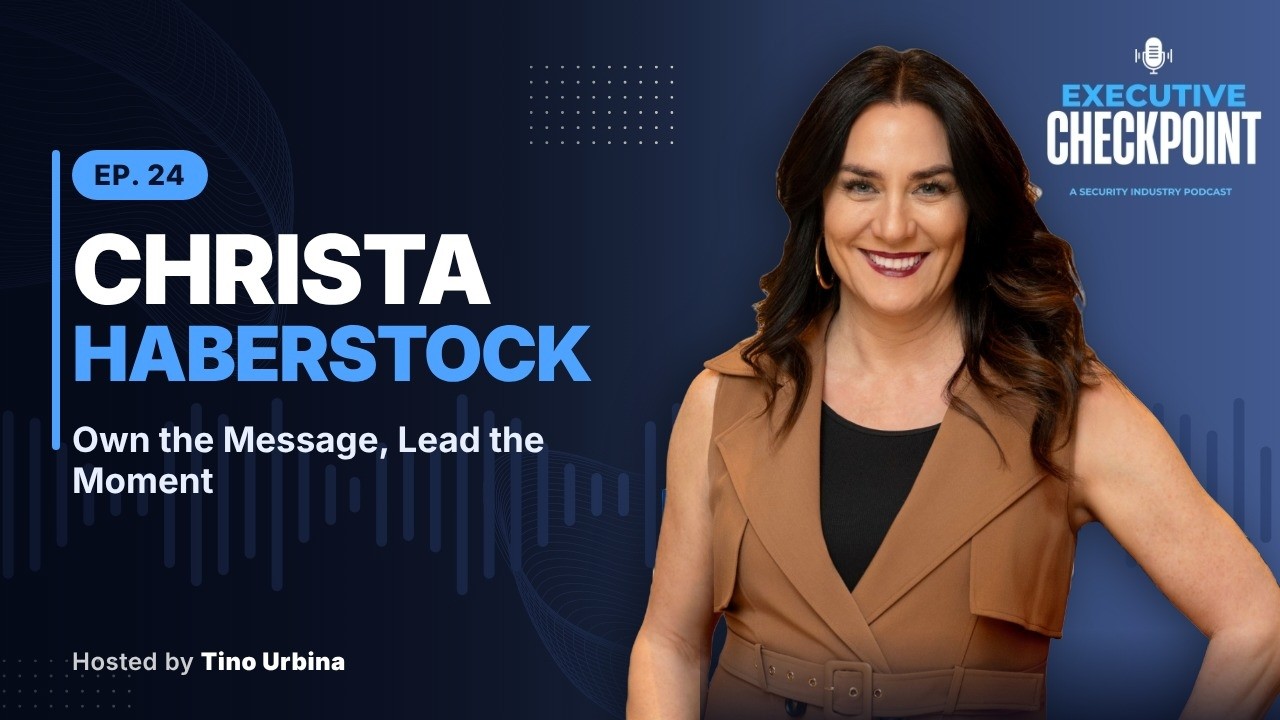
Christa Haberstock, founder of The Obvious Advantage, teaches security leaders how to craft a compelling speaker narrative by uncovering their existing strengths and underlying motivations. She emphasizes adapting language to your audience like a teacher moving through grade levels, and warns that AI will amplify authentic voices while exposing those without a distinct perspective.
Chapters
Welcome to Executive Checkpoint, the live podcast for security professionals. Each week, we explore industry trends, challenges, and insights with leading experts. This is your insider access to the minds driving change in our industry.
Welcome to Executive Checkpoint, where security professionals gather insights to navigate the ever-evolving world of cyber and physical security. I'm your host, Tino Urbina, and today we have a great guest, Krista Harpestok. She's the founder and president for C Agency. She's also an Amazon bestseller author with her new book, Becoming a Bookable Speaker. We'll touch base on that. You'll enjoy it. Krista has also had an incredible career helping executives, experts, thought leaders uncover their message and truly resonate with building trust, drive action, and bringing to be an excellent voice in their industry. Today, she's going to share with us her journey and help security leaders communicate with impact in an industry where the right message Makes an incredible difference. So, Krista, thank you so much for joining us. Uh, Krista and I go a long way. We're just catching up. Yeah, I won't go how many years, but great to see you.
A lot of years.
A lot of years. And you know what, um, I, I, I know you, I know you well, but I think the audience would like to know a little more about you and, uh, your history. So sure. How do you get started in an industry where you're helping experts and thought leaders and executives deliver a good message?
I came to America. That's right. I am. I'm Canadian. In fact, Tino, coming up early January, pardon me, will be the day when it's— I've spent half my life in Canada and half my life in Texas, which is crazy. So, yep. So that would be my official dual citizenship day, I would say. But I was an elementary music teacher in Canada. I came to the States in 1997 with zero understanding of the cultural nuances of the States, which there are. You would think Canada and the States are very similar, but you would know with Mexico and States, it's different.
Absolutely.
It's just cultural nuances. And no understanding, really just a very basic rudimentary understanding of like American icons, American political figures, American sports figures, all that. And that was the industry I found myself in. I was, I was booking and selling those people as speakers and appearances for corporate events. So, and I'd never had a sales job outside of, you know, retail. So it was really, it was really an uphill battle and I kind of had to scrap my way through it and learn how to do it in my own way, which was really a blessing because it developed all sorts of— like, it's developed my skill set in my unique way. And I did well. I ended up, um, really leaning on repackaging, rebranding, re— um, reconfiguring the, the talent profiles to make it what I call bookable and to make it appealing to the buyer. And so that's what I do. I work with executives and I work with anybody really that If you have a pulse, you probably need rebranding. So to make you, to make you more appealing to the market. And, you know, we live in a social age right now where everybody is a, everybody's a public brand. Everybody's a public brand. Even on the, even on the Coldplay jumbotron, you're a public brand.
Oh dear Lord, that's talking about a problem with— right now that's called cosplay.
That's right.
Cosplay.
Hopefully a little bit. Anyways, yeah, so I'm fascinated by it.
It's interesting because, you know, you refer to this group of people that incredibly— I mean, you're talking about thought leaders from Nobel Prize winners to, you know, academics. You think these folks are incredibly good at understanding how to communicate a message, which they were, or they are, right? But to be marketable, to select that one message, a story, right? Just frame it correctly. I think that's what set you apart in the industry to be able to do that. So with your book that recently came out, you're talking about bookable. I want to translate that into a more appealing or marketable or recognizable within the industry that you might be in, in our case on security. So do you have a A method or a process that you might take someone to recognize what might be their best branding positioning?
Yeah, I do. It is something that I didn't even recognize that I was doing until like about a year ago. And I would specifically say to everyone that I was working with on not necessarily a rebrand, but making them see what was already there, like, you're, you're ignoring the obvious. Don't ignore the obvious. And I would have to say, don't ignore the obvious. What? Like, tell me everything. Like, tell me what you've done, what you've accomplished. Tell me all those top-level things. We get that out of the way. And I'm like, all right, so what is your special trait or your special skill that you bring to the table that has made you good at those things? And that takes a little deeper. And then, you know, I actually call it speaker therapy because it turns into therapy. Like, these— it's just expert therapy. You have to get these people to a point where they have to step outside of themselves. Like, one of my favorite quotes lately is, you can't read the label from inside the jar.
Oh.
So it takes an outside person like me or like you or anybody to really dig in. And that's what— that's actually what a therapist is really good for. It's like to help you read the label of what's going on. 'Cause if you're all, you know, on the inside of the jar, you just can't see what's really happening. So the skill and then the, you know, the trait or or the accomplishments and the trait or the skill. And then you dig really deep and you just say, what's your why behind that? Not to get too Simon Sinek, but really it's like, dig in and tell me what's your motivator? What's at your core? What makes you like— what caused you to be that way? And then why do you think that's important to you? And for some people, their why would be— it's interesting to see, like, the people who will kind of go the opposite direction of how they were brought up or the opposite direction of what, um, where they lived, or, you know what I'm saying? Like the, like the nature versus nurture.
Right.
And then, um, some people that are just straight on, well, I was the second child in a family of 6, and, you know, the oldest brother was always the lead singer because this guy that I interviewed was a musician. And he's like, and I'm the drummer in the family, and the drummer is the one who keeps everything together in the band. And I'm like, There it is. Yeah. So once you identify those things, then you get on to the, what's the lasting impact of this? It could be with your organization. It could be with your children. It could be your legacy, or it just could be what's the impact that you want to leave behind? And even if you top-line that with people on your team, it's very powerful to say, what's your driver on this?
Right.
And if someone's misaligned, I mean, everybody knows this. If someone is misaligned with their passion and purpose, they're not going to do their best work. Because they're not going to be fulfilled. So to allow people to align with their passion and purpose, that's really theirs. They don't have to align with a corporate mission. It'd be nice if they did. But what they have to align with to do their best work and really elevate other people on their team is to align with their own passion and purpose. And that, that to me is the work that I do with The Obvious Advantage.
You know what, to me, if you do that, essentially, you're, you are kind of reaching to the bigger mission, right? So you should align with the corporate if you work for a good company.
Yeah. And there will be probably opportunities to release them for growth. Let's say it that way. Maybe, you know, maybe they're pulling, maybe they're, they're not fulfilling themselves. So they're probably pulling the, pulling the whole, the whole business down. And those are important identifiers as well. Painful but important.
Right. Those key conversations. Now, in security, for example, credibility is everything, right? How can you know? So from your point of view, how can leaders refine their message that it will help them be, you know, informed, but also inspire, inspire trust and confidence? Is there a recommendation you give to your, to your clients, to your speakers?
Well, I tell my speakers that I, that I work with and any of the executives and experts, I just say now is no time to be humble. on this call with me. Let's really get to the things that you are best at. And the ones that scare me, the ones that are too quick to tell me all the stuff they're good at, because I go, okay, so let's just back off from this just a little bit. But generally, people are pretty good and they forget things. Like, I was talking to a speaker this week, actually, and he is— he's actually quite a famous musician. So, and but he has this kind of really interesting breadth of experience in different things. And so I pulled something out and I said, well, something about VP of operational something. And he goes, hmm, I don't think I was ever VP. Oh, he goes, oh yeah, I was. That's right. And it's interesting how people just forget because it's just the blind spots. They're inside the jar, that whole thing. So it can really help a leader transform how they see themselves and I'm just going to go on record and say that I think that imposter syndrome can touch everyone.
I agree.
Yeah. And when a person realizes what they're best at and what they're weak at, I think they stop being so hard on themselves for being weak because they know the areas that they're strong. They know their accomplishments. They know the things they're good at. And then they're less apt to not outsource the things that they're weak at, which is a real problem, I think, for leaders and experts because they think, well, I'm large and in charge. I should be able to do all this stuff and I don't want to show weakness. Well, if you also see your team as, or a right-hand person, maybe it's a VP, or you know what I'm saying, like your team as multi, multidimensional skill set, multidimensional gift, if you will.
Right.
They will probably compensate for the things that other people are weaker at, even the leaders. And that shows tremendous humility and tremendous synergy with the rest of the team. So it can be very, very powerful to identify your strengths and weaknesses. And it goes way beyond StrengthsFinder. I mean, those are just the top surface level, like jet ski things that you can pick up. This, with the obvious advantages, like a submarine, and it goes really deep, really quick.
To me, that's so lost sometimes in an industry that is heavy technical. Like, you know, we tend to be very technical in the jargon, right? So you're talking to the regular rest of the corporation as an IT or cybersecurity expert or physical security expert. And you're just saying so many words and people go, I have no idea what they're saying. That brings me to another point, right? It's not just being clear with your branding and messaging. It's also how you inspire people with clarity. You mentioned in your book, The Power of Clarity. So for security professionals dealing with highly technical topics, right?
Mm-hmm.
What's your advice to simplify complex information without losing the authority? Right.
I'll take it from where I'm an expert. And that's kind of how I would actually— this is case in point with what I want to tell you. It's start with what you know. And so for me, it's all about the brand. And the brand isn't what you think it is. It's what other people say you are. So to sit in your chair and— or to sit in someone else's chair, I guess, is really the way to say it. So, if you're sitting in someone else's chair and wonder, how am I being received on this? How would this be misinterpreted? Or how would this make the other person— I don't want to say feel because that's kind of a snowflake thing. But if they're not understanding these things, you're not really communicating. And as a leader, there may be some barrier to them actually saying, well, I don't understand that. So to say, okay, now forgive me, and this is my leadership style because I'm an ex-teacher or former teacher, not ex, former teacher. We're all former somethings. But as a former teacher, I had to gauge the levels of my classroom. So for my first graders, I would do it differently than I would for my 6th graders. So for my first graders, I'd say, okay, so let me just start here. And if I'm repeating the obvious, forgive me. I just don't want to miss anything. And to start with something like that, and you're going to see with body language that they're like, yep, yep, no, I know that. Then you can get to 2nd grade, 3rd grade, 4th grade. But you have to kind of— you have to just check.
Gauge.
Yeah, gauge. Good word. Yeah, like you have to gauge where they are. And that's very, in my opinion, very respectful. I think in a communication, Listening is critically important, but also being respectful of what you're seeing and hearing from them, but also what you're saying and being respectful of maybe walking into a situation and not assuming anything because that's a problem. Just to slow the whole process down and remember the other person may or may not be understanding what you're saying.
I think that reflecting on what you're saying, that there's critical conversations that you need to make sure your understanding, A, that is clear to them, but it's also having the same tonality if you want them to expand it, right? If you're leading a group and that person is going to carry the message, it's got to be clear to them so they can carry the message through the organization. So is there a piece of advice that you'd give to your customers, your clients, your speakers by owning a message, right? We earlier chatted and how we have some incredible thought leaders that you engage professionally and they can talk about 100 different things, right? But narrowing that one single, owning that message, what is the main goal or what is the main steps that you suggest they take to find it?
Well, again, channeling it through what I know, when I work with clients to book a speaker, there are different audiences and not all speakers are good for the same audience. But there are speakers who can be good for multiple audiences in different ways. And so one of the main key things for our speakers, and you know this, you know that customizing is key. So, and it doesn't have to mean rewriting a whole presentation or a story or anything for a certain audience. But it's again knowing who you're talking to. So, if you're speaking to the National Association of Pipefitters, that's a different audience than security, right?
Right.
So, those 2 audiences would hear the same information, need the same information, but receive it possibly in a different way because of their life experience, what part of the country they're in. So, for leaders who need to communicate something to a group, The onus is on the leader, just as it is on a professional speaker. The onus is on the leader to know who they're speaking to and how it will be received. It's a very simple, it's a very simple thing to look at. You know, we're working with this goodness with the generations. Like, there's 5 generations in the workforce right now. I actually spoke to a room a month ago, 2 months ago in Chicago. There were 5 different generations in the room. Everyone from groundskeepers up to executive level. And I think, Tino, 2 of them didn't speak English, and I'm not even kidding. I went to the back of the room and I'm like, how are they engaged? Like, I'm pretty sure that they sat together kind of over to the side.
But you know, I'm always used to passing that information or having talking points in executive summits or meetings, and that's a great point. It's like, where are they from? What's their, you know, life experience? Economics is also going to play a role. So can't assume that because you have a good message, it's going to be accepted or understood in a given way. So, wow.
Isn't it just basic, like, relationships though? And it is basic communication, in my opinion. You know, like, I would talk to different people different ways. We all need to talk to different people different ways. Remaining totally authentic, of course. You know, you don't want to be a chameleon and put on someone else's— you know, I call them action figures. You know, it's kind of like, I'm not going to be the action figure version of myself. I'm always going to be myself. But if I'm, if I'm talking to church ladies, it's going to be different than talking to the happy hour crowd, probably a little bit, maybe a little bit.
Oh yeah. Well, and you know, I'm curious, referencing to your previous life working with the speakers, what's the most memorable moment working with one of your speakers, if you want to, if you want to share. But what would be one that you go, you know what, that was one that—
Well, my brain immediately snapped to, and you're gonna get this whole thing. I have no problem speaking in front of a crowd. No problem. Like, I don't get nervous. It's just, I enjoy it. Like, you know, I did music for a long time and stand-up comedy. Like, you know, no big deal.
I remember that part. I was so jealous because I'm like, Oh my God, I would love to do that. I'm so scared. I still want to do it. Yeah, well, sorry, sorry.
I don't know that I enjoyed it all that much. It was actually terrifying. Well, and it was terrifying because, well, a whole bunch of other things. Like, I pushed myself really hard to do that, and I'm glad I did it, but I didn't enjoy it all that much, truthfully. I did enjoy improv, though. I will tell you, I loved that. That was great. So the point is that I can get up in front of anybody at any time. Until you have too much invested, really. And I didn't really realize this. Like, I was able to speak at my daughter's wedding rehearsal. You saw my daughter get married.
Crazy, right?
I know, I know. But I was able to speak because I was able to be like, okay, like, go full out-of-body experience. You're not— you are a speaker. You are not this girl's mother. Like, I was able to do it without wheeling me out in a gurney. But so the point is that I was at the International Association of Speakers Bureaus. in 2012, and I had planned the convention. So just think about like the investment. So I started SEA Agency in 2009, 2012, I was asked to plan the convention, which is super fast. Like, it's kind of like, oh, would you like to be in charge of this? It's like, and you don't say no.
Mm-hmm.
But at the same time I was going, okay, well, and then I had a rising star at that point, Doc Henley, 2009 CNN Hero, founder of Wine to Water. He's a clean water crusader.
Great guy.
Great, great guy.
We'll put a link to his deal. We love him. That's a great guy. Please do.
Yeah. And so his mission had quickly become my mission to bring awareness to everybody about the water crisis and bring clean water and sanitation to the world. So Krista is very invested in Doc Henley, and he's about to speak and have his total breakthrough moment in front of all of my peers. I had planned the convention Oh my God, Tino, I stood up on that stage and I saw like some, like these legendary bureau owners and agents, all with the power to transform Doc's career, right? And my new scheduling company. And I stood up and I said, I was like, and I said, clean water. My introduction for Doc, clean water kills more children than everything combined. That was, that was my opening line for him, that clean water kills children. And then I started to cry. And he got on stage and he's like, I'll take it from here.
Like, he's good at doing that. Oh my God. But you know what? Is it not that one of those moments and you're like, I will never be here again?
It was just, it was all too much. It just went like it squished me.
And I stood in the back corner, right?
Just cried. Yeah. And thankfully, it's a very forgiving crowd. They're like, oh, she's nervous. It's like, whoever's talking is so nervous right now. So I just got off the stage. I'm like, I'm out.
I'm gonna let him do this. Oh, wow.
Yeah, I know. So there you go. That's actually the first thing that popped to my mind. And that's a good one.
Oh my God, that definitely, definitely makes that But you know what, I think those are the moments that you look back and you go, you know what, I'm so glad that happened to me.
Yeah.
You know, maybe because I've stumbled into those situations often enough that I'm like—
Because you're glad it didn't happen to you.
Yeah, I'm immune to it. I see this as learning, part of the learning process.
Oh well, and you know, and then I spoke at my daughter's wedding and I was fine because I learned like, oh, you gotta, you know, no matter the weight on you, you gotta, you gotta push it out. You gotta push it to the side or just compartmentalize it or something like— and had I, had I been And I've learned it over the years. Like, I've done, I've done much better in those situations since then. But man, that was a learning moment for me.
I tell you. Wow. Well, um, I want to get your thinking on, um, the newer technology, right? Because this is impacting— and man, we could start here and have an hour-long conversation about it— but, uh, technology has impacted the, you know, speak of industry and many industries, but I want to focus on the message that is put out, especially now that you have access to AI and easy access to content. And what's your view of the future, understanding that this is a now thing, it's not a future thing?
No, it's a now thing.
Yeah.
You know, I think so. One of my other speakers that you probably know, Byron Reese, he's an AI expert at Tech He's actually an optimistic futurist, which is why he's been on my roster for 13 years, 12, 13 years. I love him. He's one of the smartest people I've ever met. So Byron, when he first came onto my roster, he was an on-the-list optimistic futurist, tech expert, serial entrepreneur, artificial intelligence and robotics. And I buried that AI at the end of his stuff because I'm like, I don't know what that is.
That's never gonna happen.
I know. I was like, oh, it sounds too techie. Like, I dumped it all the way at the end of his byline. Oh, it's right at the front now, let me tell you, because it took over. So I had lunch with him after a presentation a couple months ago, about a month ago maybe, and, um, I asked him, I said, uh, Like, what is your take? What is your take on all of this? Like, it, for me, it came out of kind of nowhere. I think for a lot of us who aren't tech aware, read Wired magazine, all that stuff, like, right, I kind of saw it brimming, but I wasn't, you know, I heard about it because of Byron. I knew about it, but I wasn't fully like, it wasn't the drinking from a fire hose like it is now. So I asked him, I said, what, what do you think of the capabilities of like ChatGPT and Perplexity? Like, the stuff it could do. And he paused for a long time and he said that, you know, he told me he's a member of all sorts of like the top-level thinkers on artificial intelligence. And he gave me like the whole rundown of who it was. And he said, none of us saw this coming.
Right.
We had no idea how big this was going to be and how fast it was going to move and how much it was gonna be able to do. That was the one thing he was surprised at. So I think for it to take us by surprise, that actually made me feel better because I'm like, oh my God, is our— like, is this a whole new age, you know, that we're in? Like information age, now the AI age, um, in the speaking industry. And I think for anybody who communicates, which is, uh, spoiler, everybody, I think that, um, paying attention to it is really good. But I'm just gonna tell you, and maybe this is the Pollyanna, the rose-colored glasses in me, But everybody can spot a fake, right? If you're paying attention, you can spot a fake, um, especially if your radar's on. Now, some of these, like, it's, you know, I get worried about like our parents, you know, because they're not going to know what's real and what's not. Like, um, you know, the spam calls and the, the really dark sides of it. I— that's going to come with any kind of tech— technological advancement. There's going to be dark sides of it.
Mm-hmm.
But for the, for the most part, I, I think it's thrilling and it has sped up my work.
It's in—
if you're paying attention and you're not scared of it and you're able to embrace it with your eyes wide open and paying attention to how it can speed you up and automate the parts of your work that should be automated, not the writing parts, you know, um, I think it's really powerful. Like, I use it All the time. And you know, I'm a good writer. Like, I'm actually working on my second book. I love to write, but I use it all the time as like to get my brain going, and then I let my brain take it. So it's just a propeller. That's what I think.
Yeah. You know what I heard someone said not too long ago? I'm trying to think who to be specific, but because there's so much AI use by so many people, The people that actually craft a message and write it is going to be really clear what's AI, and people are going to be drawn to the individual, to the real person.
Oh, cool.
Right. To me, it's like, and you know this, you hear content and it sounds cliché. If it sounds cliché, it's probably, you know, it's taken from something else.
It's probably a robot. Right.
And so it, it, I think it's going to give opportunity to true thought leaders, people that want to have a positive impact, to separate themselves from the AI and be even more accepted now than they can say, I can actually communicate and write this clearly. But I was interested because you have a lot of your speakers and professional and customer and clients that I'm thinking, oh, I just put it on ChatGPT and I get a—
And we're getting to— I mean, probably the average person is getting too good now. Like, I had dinner with some girlfriends and one of my girlfriend's daughter. So she is solid Gen Z, right? And I was talking peer-to-peer with her because she's in marketing too. And she was like, oh, do you tell it to do no em dashes? And I was like, oh, all the things. Yeah, it's kind of like no short sentences. Don't start with in a world where. You know, that's, that's an AI tell. So, you know, and it'll keep evolving too. So we're just going to have to keep up to it. But I love what you said because I think the leaders and the thought leaders who are really on their game and really deserve to be elevated, right? This is going to give them the authentic edge. So I think it's a bit of a threshing, like we're going to get through, like the people who are truly, truly qualified, the good communicators, the thought leaders, the big thinkers. Those are going to be the ones that stand out because the rest of it's going to sound the same and they'll sound like themselves.
Right. You know, there's a lot of new voices of people coming out that want to, you know, make this world a better place. So I think that's also going to be a nice thing. It's going to take time. The people that were already lazy trying to just, you know, they're still going to do the same thing, right?
Yeah.
Yeah. Well, Chris, let me ask you, Let's say a professional CEO in our industry, or any industry for that matter, wants to get in touch with you. What's the easiest way to engage with you? I saw that you were doing some seminars, but maybe a masterclass, is that what it was? Or—
well, this is for speakers. So I've been doing the Bookable Speakers like masterclasses, but I'm actually getting booked to speak everywhere. I'm going to Nebraska in a week and a half. I hear Nebraska is beautiful this time of year. But yeah, I'm going to Nebraska to speak to rental, uh, rental people. Um, but so it's— and it's— I've, I've got the URL for my new book and that points to my website. So it's theobviousadvantage.com.
Obviousadvantage.com. Beautiful. And you know, again, um, I've been looking forward to, uh, chatting with you on and off the camera. It's been so, so long, but Um, I will say, um, if you want to get in touch, that's the easiest way, in LinkedIn. Will there be another?
Yes, for sure. Yeah, yeah, yeah, Krista Haberstock. Um, and yeah, I'm on LinkedIn constantly, as Tino knows.
Yes, indeed. And, uh, for the audience, we want to thank you for taking the time to listen to the show. Uh, stay safe, stay informed, and we'll see you in the next checkpoint. Thanks so much, Krista. This has been wonderful.
Yeah.
More from Tino


EPS 37 Security Is a Human Business Leadership Risk and Resilience Lee Oughton





Eps 33 It’s Not in the Manual: Real-World Leadership for Security and Risk Professionals

Episode 32 Security, Converged: Why AI Needs People, Process, and Purpose Kasia Hanson

