Navigating the Tech Tides: Leading Through Disruption in Cybersecurity with Don Carr
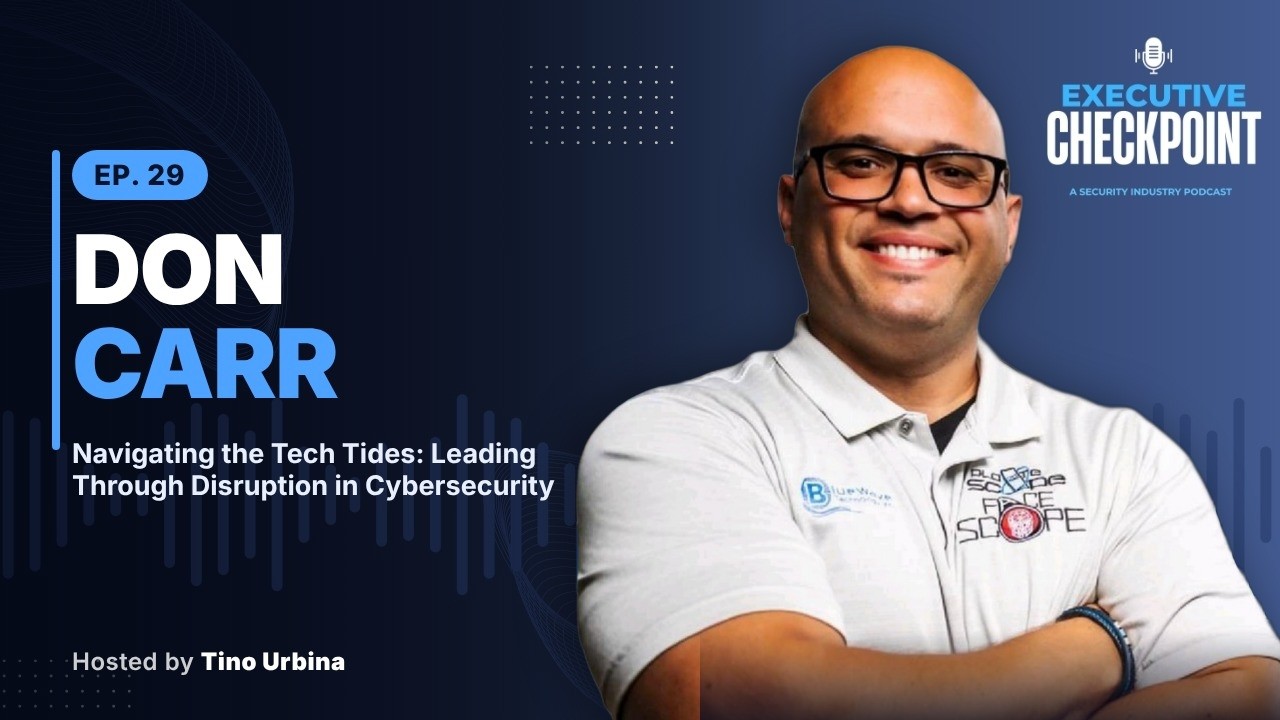
Don Carr, CTO of BlueWave Technologies, built a facial recognition platform that generates law-enforcement-ready evidence for retailers and hotels. His system uses race- and gender-agnostic AI matching and connects a global network where businesses share bad-actor databases. Carr predicts that in four to five years, shared intelligence will make it nearly impossible for criminals to evade detection.
Chapters
Welcome to Executive Checkpoint, the live podcast for security professionals. Each week, we explore industry trends, challenges, and insights with leading experts. This is your insider access to the minds driving change in our industry.
Welcome to Executive Checkpoint, where security professionals gather insights to navigate the dynamic and ever-evolving world of physical and cybersecurity. I'm your host, Tino Urbina, and today I have the pleasure to bring to you Don Carr, CTO of Blue Web Technologies and the host of CitySafe podcast. He's a seasoned technology leader whose journey through evolving tech has been exemplary lesson for anyone in the security industry. We're excited to have you, Don. Welcome to the show. And there you are. How are you, sir?
Good. Thanks for having me.
Worlds apart today, right? I was telling Don I'm in São Paulo in Brazil for an event. And, you know, it's always fun to, to be able to do this, whatever we take our professional lives. How are you, Don?
I'm good. I'm good. Thanks for having me, Tino.
Nice seeing you. Hey, so I'm sure because of your podcast, a lot of people know about you. But since we're learning about your journey, tell us a little bit about your background, how you get started in technology. Is there first technology and then security, or it's been kind of conjoined?
Well, um, that's, that's good, right? Because on the podcast, we really just kind of talk about the technology. All right, we don't really go into my background or my co-host's background, right?
My— there you go.
My co-host is a retired FBI OIG investigator, um, and I come from— I've always been into tech, and then for years I was into physical boots-on-the-ground security.
Oh, there you go.
I bring a little different perspective, um, to the industry than probably most, only because years ago I struggled with addiction myself and homelessness and being on the streets and theft to support addiction, right? So I really understand things. From the other side, right? So when I had the opportunity to partner with my partner, our, our main partner with Blue Wave and Hotelligence, uh, Stephen Pelez, he's a retired chief of police, right? So now you've got a guy that has the perspective that I have, kind of from the inside out, coupled with the perspective a retired chief of police has. Mm-hmm. My technology background, his evidence and results-oriented background—the two came together in a pretty powerful way. Right? We were able to build something that gets exceptional results just from having those two. kind of polar opposite perspectives.
Sure. You're covering the perception of what you're offering as a professional from both sides of the aisle. So what was the, what was the flip between you being in that situation to move into the professional side and the security and technology side? What was that moment where you have a pivot to move on? Was it someone that Make that change, or do you eventually—
Well, the moment was being sick and tired of being sick and tired, right? Um, there comes a point where you get sick and tired of being sick and tired, and you're either gonna continue down the same pattern and run that pattern for the next 20 years, or we draw a line in the sand and do something different. Right? Um, that was years ago now, but you know, I've been in recovery for lots of years now, and I live with a purpose today, right? So, um, I have a purpose in my personal life, and I also have a purpose in my professional life. Because, you know, what we do with fighting crime, um, is really my way of giving back, right? It's my way to help build our communities back up, right?
And have an understanding, right, from, from that perspective of being in that situation, that it really wasn't— it was out of, you know, necessity in some, in some instances, right? So what path did you take to become an expert in your field? What was that?
So what was kind of the catalyst, Tino, was I had a private security guard company in Seattle for years, and I think we all can agree Seattle is on the rougher side of things when it comes to crime, especially in the city limits, right? Um, All— and violence. I mean, it's not just crime. I mean, there's all kinds of stuff that happened in places like San Francisco and Seattle and Los Angeles and New York. It's one of those cities, right? Right. Um, and we guarded a lot of, uh, luxury-type buildings, whether they were commercial buildings or, uh, apartment complexes that were, you know, high-rise.
This is more on the guard side, not on the technology side, right?
This is on the guard side, which, which was the catalyst for the technology, right? Because what, what we found was, um, our clients did not want all the transient activity around their properties, right? And their, their tenants didn't want it either. Their tenants didn't feel safe. And when we were able to get SPD, Seattle Police Department, dispatched out The first thing they always asked us was, you know, have you trespassed this person in the past? Can you show me some documentation that you've formally trespassed them, and then I can, I can do something from there? And, and we had, but it was a paper process, and that paper was probably in the back of a patrol car somewhere or wet with rain. Like, who knows, right?
Right.
So, you know, our word doesn't cut it for evidence, right? So the officer needs to see something tangible to show that we legally and lawfully have trespassed this person previously.
It's procedural, right?
Procedural, right? Gotta have it, otherwise their hands are kind of tied insofar as taking action. So what that led to was me looking for some type of app that I could use that would leverage feature matching or facial recognition, um, to have a platform in the hands of a security officer to where they could just scan the face and put the incident If the face was scanned again and there was a possible match, it would generate the full incident history for that person, which could then be turned over to the officer to show the documented history and the trail, right? And I couldn't find anything in the marketplace that did that in a mobile platform. So I created it.
Scratching your head going, how is this possible, right? It happens often enough in the commercial side of things that, you know, it's almost— but, you know, a lot of companies, a lot of security still sort of falls back to the older technology, and some companies probably still do it by hand, which is where you guys find a problem and create a solution. So this is the birth of your current BlueWave?
That was the birth of the current BlueWave. Yeah, just Created something out of necessity for our company. Got amazing results with it, and then eventually started thinking, you know, if we ran this software on an entry camera to a retailer, and that person showed up to that property again, and we could get a notification saying, "Hey, this person's back," could make contact with that person before they. got 100 feet into the store, you could essentially stop a crime before it happened, right? Which is kind of on the preventative side of things versus the traditional reactive side of things, right?
So what was the take from the police? Were they surprised? And there was— it's like, okay, here's a new tool, here's all the information.
They loved it, and they still love it. Detectives love it because what it does is Once you have somebody in the database, you can generate an evidence package.
Right.
And that's really where having Steven Pelez, our co-founder, being a retired police chief, came in, like—
Formatting that to the like of law enforcement.
Yeah, right? Because he knew what law enforcement needed to see in order to turn something over to a prosecutor. So when we built that evidence package within the software, we built it to meet all 5 elements of a crime, right? So now when that evidence package is generated, you're handing a detective a nice little box with a bow wrapped around it, right?
Yes. So what are the challenges to build a technology company?
Well, the challenges today are different than they were 4 or 5 years ago when this was developed, right? So 4 or 5 years ago, I think everybody in the industry can agree that, um, you know, face— you said the word facial rec or feature, like, you know, right? Uh, I think everybody knows the Rite Aid story, right?
And we like freedom, but we don't wanna fake it, you know? Which is, you know, it's so funny. It's, it's, to me, it's almost like we did the wrong branding in the security industry because everywhere, everywhere else in the world people understand and it's not taking your identity as much as it is connecting, you know, the math of your face as an algorithm, right? And that's what makes your face unique. But, um, uh, you know, you see it. I mean, traveling, like I said, I'm in South America, in São Paulo. Uh, here it's very common. Everywhere you go, every single apartment complex, everywhere you go, that it has a, you know, camera, facial recognition.
Yeah.
So I think, uh, I know what you mean. So years ago, and I think it's evolving, but still a stigma attached to it, especially in the US, right?
It is evolving. And, you know, the problem is you still have companies out there that are tying race and gender to their algorithm. And that's, and that's just silly, right? Like, if you have somebody's face, gender doesn't matter, race doesn't matter, none of that matters. So when we built this, we built it to be race and gender agnostic. We don't care. We have your face.
If I recall, maybe there was a point where the technology still was a little on the not recognizing certain patterns, and it was mainly, I think it's like a 61 or 65-year-old Black woman.
Right.
And now that's moved. The technology has evolved enough that now the the path that it's having a hard time recognizing someone is male, uh, um, 12 to 25, uh, you know, uh, that age gap is an age gap that is like almost too close. So it's getting better. So is that the primary source for you guys to, to build a, a package or a case?
Yeah, so there— yeah, so there is a, a distinction, right, between facial recognition And feature matching. Facial recognition in its traditional form does account for race and gender to recognize somebody, whereas feature matching doesn't care. It's triangulating measurements from eyebrow to nose to ears, right?
I sound correct.
Yeah, uh, no, you— it's, it's a fine line, and, and most don't know that nuance, right? Because it's very nuanced.
Sure.
Because it achieves the same result, but how it achieves it, there's a twist, right?
Right.
Um, so yeah, so we, um, what was your last question, Tino?
Well, we're talking about the, the challenges, so the journey of building a technology company. So, uh, obviously this is— are you guys utilizing, uh, AI at some, some point?
Uh, oh no, it's all, it's all based on AI, right? So it gets better and better. So, you know, but 5 years ago, just we've constantly heard from retailers like, oh, you know, too early, the market's not ready. They were still spooked from Rite Aid back in 2017, 2018. So really nobody wanted anything to do with it here in the US because they were spooked. And, um, I'll tell you what though, in the past 8 or 9 months, there's been a massive change in sentiment. Okay, um, and I think part of it is like, now we know that just to travel throughout our country, you know, TSA is utilizing this at 85 airports. It's slated to be used at all 400+ airports within the next 24 months. It's like, all right, well, they're going to scan our face just to travel throughout our country. Maybe it's not so bad to fight crime, right?
Right.
You know, so I think that has been kind of a catalyst in moving things forward with just the perspective, yeah, it's here and it's probably here to stay. And I think also, you know, time has healed from everybody being kind of scared off 2017, 2018. And like, to your point, you know, the technology has gotten better and fairer and more accurate. And I think the most important thing, and something we did from the get-go, is we always kept the human in the loop, right? We learned from the mistakes of others, right, that didn't keep the human in the loop, that rushed to judgment and action. Whereas, you know, that human-in-the-loop piece is critical. Like, you know, we, we can't rely on technology to have empathy and understanding and reasoning. And, you know, there's just some things that it doesn't do right, um, or doesn't do well. So that, that human piece, you know, we can't take the human out of it, right? The human just needs to be augmented.
Augmented. You know what, I was talking, uh, in the podcast not too long ago, one of the guests, about, um, you know, we talked about physical security. You took up, you know, IT and cybersecurity. And sometimes we forget that although they obviously connect and technology is, you know, still a tool, as the component that we always miss is the human element, right?
Yeah.
Especially I hear it from guard companies when we talk about AI and robotics coming in and they're thinking they're gonna lose, uh, some, uh, traction in the marketplace. But to me, the reality is this should just you know, like you said, augment themselves with better technology and be ahead of the competition. Otherwise, they'll disappear.
Absolutely.
What's the stack of your technology other than the software, or you're agnostic to surrounding cameras or anything else?
Yeah, so we're hardware agnostic, right? So we can— legacy systems, you know, most of your surveillance systems in retail or hotels these days They're running legacy systems, right? They're running analog cameras plugged into an NVR, which allows them to pull the RTSP, the real-time stream, right? Um, so—
Does that impact your ability to recognize someone?
Well, no, because we can lay our software, we can plug it in, we can actually pull the RTSP from their old analog cameras, analyze it in real time. So whether they're using a legacy analog system with RTSP, we can tap into that. Whether they're using FTP, which is a file transfer protocol— they have a newer, a newer technology with IP cameras— we can tap into that. Or also SFTP, which is secure file transfer protocol. Cool. So those are basically your 3: RTSP, FTP, and SFTP. And we can tap into all 3 of those protocols regardless of the existing hardware.
Right. And I feel like you guys connect to potentially a master security plan for, you know, uh, any city that has a level of criminality like you're describing Seattle, right? You see it all the time. Or LA, you know, unfortunately you see a lot of, uh, vandalism and, uh, things like that.
Have you had any interaction with those cities at that level, or Not at that level because we've really just started to take off in the past 8 months, right? We're, I mean, we're at the point where we have retailers and hotels asking for this, right? Um, and I think the biggest differentiator is this global data network. So we've built this global, global data network. So if you have 2 competing hotels and you have 2 competing convenience stores or 2 competing retailers, they can opt into the global data network, which shares their database with every other company in the area, throughout the world for that matter, that has also opted into the global data network. So this sharing effect of bad actors Is a big deal. Yeah, right.
Especially in a regional, uh, perspective, right? One hotel gets the same guy and goes to another hotel nearby and tries to, you know, do the same thing. Correct. So in that instance, for example, uh, would police look at trespassing in one property and then seeing trespassing another one? Will that still qualify for them to go after them? Is it an arrestable offense?
It is, right? It, it is. But, but the, the power in the trespass is in multitudes, like you said, right? That second trespass. And really, most jurisdictions have a third trespass rule where that third trespass can be enhanced, some places to a felony, a lot of places to a higher-class misdemeanor.
Um, removal more than anything, right? It's unfortunate. I think it does have also an impact, economic, and the economics of the location, right? Some people might not want to go to a destination just because they see someone that might not look safe, right? They might not go to the store and spend money, call a gas station or some location.
Right.
So it does have some very practical and economic impact on your users. Um, let me ask you, now that you've been in this role as a CTO, uh, what's the market, or what do you see out there that is, um, catching your eye as far as technology, aside from what you guys do? Obviously, as a CTO, you're looking at different types of technology potentially to enhance your own offering and your own company, but in general, what, what do you see out there that you're like, you know what, that's gonna, that's gonna be an interesting proposition in the security world?
Well, I think everybody's kind of doing it, right? I think everybody is that's in this space anyway is on the forefront, right? Um, which ones are going to win out in the end, we don't know. Um, but with this space, there's enough room for everybody, right? Um, without a doubt, there's enough room for everybody. So, you know, our perspective isn't really competition, it's more like coopertition, right? Like, how, how can we come together to fight this, you know, unified mission. Um, but you have, you know, AI with regard to like behavior recognition, right, where that, you know, a theft can be detected based on the movements and concealment. Um, so that, that's a big piece, right? You have companies that are very good at detecting a possible theft, um, that they can overlay that software onto existing cameras at retailers. Um, and then you have companies that are really good at the feature match or facial rec piece of it, right, that have been doing it for years and years. And then you have companies that are very good at the evidence piece of it, right, providing a software to loss prevention personnel and security staff to compile all these different elements into an evidence package essentially that can be used for prosecution. But what we've kind of hung our hat on is doing that from end to end in one unified platform.
I see. Okay. It's interesting you broke it down and on how it usually is pieced together in the industry. Well, I'm sure your leadership perception and perspective has evolved over time.
Sure.
What do you see in yourself from when you guys started the company and today? How has that leadership view of where you are as a company, where you are with your team, has evolved over time?
I mean, we always knew we could never do this alone, but just in the recent months with some partnerships with an AI company that detects theft, Right. So like you add that element into our feature, like now you're really like from the detection of it itself to the prosecution of it, to that person comes back onto the property and they've already been trespassed. So that's kind of like a whole piece, right? Um, so like a partnership there, um, and then like a partnership with a company that does the panic buttons for like hotel staff, housekeepers. They have panic buttons integrating that into our software platform to where is have one unified solution that covers proactive and reactive should something happen. So I think where we're at today versus where we were a few years ago is we're really getting traction with these partnerships for unified solutions, and we are really seeing the power of having those partnerships today.
So it's building a platform where you guys— is that I, uh, IP, or is it an integration that you do with some of these partners, or—
Yeah, an integration, right? So usually just like an API or SDK.
Okay.
Sometimes just a webhook.
That's what it is.
Depends on the tech.
Very interesting. So, um, you know, thinking back in your early, uh, days with, you know, um, in your career compared to now, Obviously. What advice would you give to yourself? The reason I like to ask is because a lot of, you know, young professionals coming into the industry, maybe, you know, eventually want to have a position like a CTO in a company. What do you know now that helped you get to where you are today? And what advice would you give to yourself, the younger self?
That's a good one. And it makes me a little emotional. Right? Because over the past 5 or 6 years, there were so many times where it would have been easy to throw in the towel, right? I mean, just, you know, I mean, you got to keep this, you know, to keep software alive, it's not cheap, right?
Right.
And there's been times where it's just been, you know, keeping it alive has been on a personal American Express every month. After month after month after month after year after year after year. But had we thrown in the towel, it would have been a wrap, right? But because we kept it alive and kept iterating and kept rolling out new features even though we didn't have any customers, right? When everything shifted eight or nine months ago, we were ready for it. Right? Ready to go. Turnkey. This is what we do. Let's do this. Right? So just you know the grit, right? Just just being willing to stick it out and know that it's not always a sprint. It's not always a six-month deal or a one-year deal. A deal. You know sometimes it's years and years and. years before something happens, right? Before something meaningful actually takes place. Um, but you got to be willing to stick it out. And, and if you don't have a passion for it, right, if it's not something that you believe in wholeheartedly, um, to your core, you're not going to have the wherewithal to stick it out. But if it's something that you really believe in and that excites you, and you just, you know that you have something, you just gotta wait, you know, be there when that opportunity presents itself. Um, it gives you the fortitude to stick it out, right? But just, you know, having the grit to, uh, carry on when it's easy not to carry on anymore.
Challenges are preparation for greatness, right?
Yeah.
And so, well, I hear you, and I think that people will appreciate that because it's, it's so easy to quit, right? It's hard to stick it up. Well, what do you see in the coming years, the next 4 or 5 years, technology-wise, that you, you think is the next big shift for the industry?
Uh, next big shift, 4 or 5 years, it's just going to be massive intelligence, uh, in our opinion, Tino, right? Uh, it's, it's like, uh, you know, you're not going to be able to go anywhere as a bad actor and probably not be able to be recognized as a bad actor, right? Especially when you have these companies that are willing to share their database with other companies. Um, so when you did something over at X property and now you want to go do it at Y, because we all know, right? Like, These, these criminal networks seem to be very big because it seems to be omnipresent, but in reality, they're actually very small circles, right? These circles are not very big at all, but they just wreak havoc from place to place to place to place to place, right? Because it's so easy to go to different places.
Right.
Whether it's a different state, different city, different region, different store, different brand, it's easy to switch it up. It's not going to be so easy in a few years to switch it up. Because, you know, it's gonna— you're gonna be able to be tied to those previous incidents in seconds.
Right. Well, I think in such a fast-moving part of our industry, technology, how do you keep up, stay sharp, continue learning? What's your advice for that part of your—
You know, I follow people in the industry that have been in the industry a long time. I love tech, so I'm always reading the articles, right? I'm always exploring new opportunities, always looking for partnership opportunities where there's alignment. You know, and that's just, you know, I'm not, and we're not all like that, right? Like we have some partners that are not like that, but me personally, um, I love the tech side of things. So I'm just, you know, I like to stay informed, uh, with regard to everything in the tech space. So, you know, everybody that I follow on LinkedIn is pretty much in this space in one form or another, right? And you get to see kind of their progress and their journey. So. Um, I keep close tabs on the industry.
Absolutely. And, you know, um, time flies. I— every time we do this or have these conversations, it feels like we should expand them for an hour long. But, uh, you know, to keep people interested, we gotta just give them a taste. So I, I will welcome you to, uh, come back some other time and continue to, you know, share with, uh, our audience your journey. Uh, it's been insightful. and, um, very inspiring. Thank you for sharing your personal story. And, uh, you can find Don in their podcast. Remind us again the name of the podcast and when you guys usually do your podcast.
Yeah, and we'd love to have you on it too. You know, it's the City Safe Podcast, and you can get that on Spotify, Apple, or YouTube.
Excellent. Fantastic. Well, there is, uh, uh, uh, another show that you should, uh, listen to if you're in the industry. And we thank you for listening to our show today. Until the next time, stay informed and stay secure, and we'll see you in the next Check Point.
Check Point.
More from Tino


EPS 37 Security Is a Human Business Leadership Risk and Resilience Lee Oughton





Eps 33 It’s Not in the Manual: Real-World Leadership for Security and Risk Professionals

Episode 32 Security, Converged: Why AI Needs People, Process, and Purpose Kasia Hanson

