Episode 16: Achieving Indie Publishing Success with Bestselling Thriller Author Kiersten Modglin
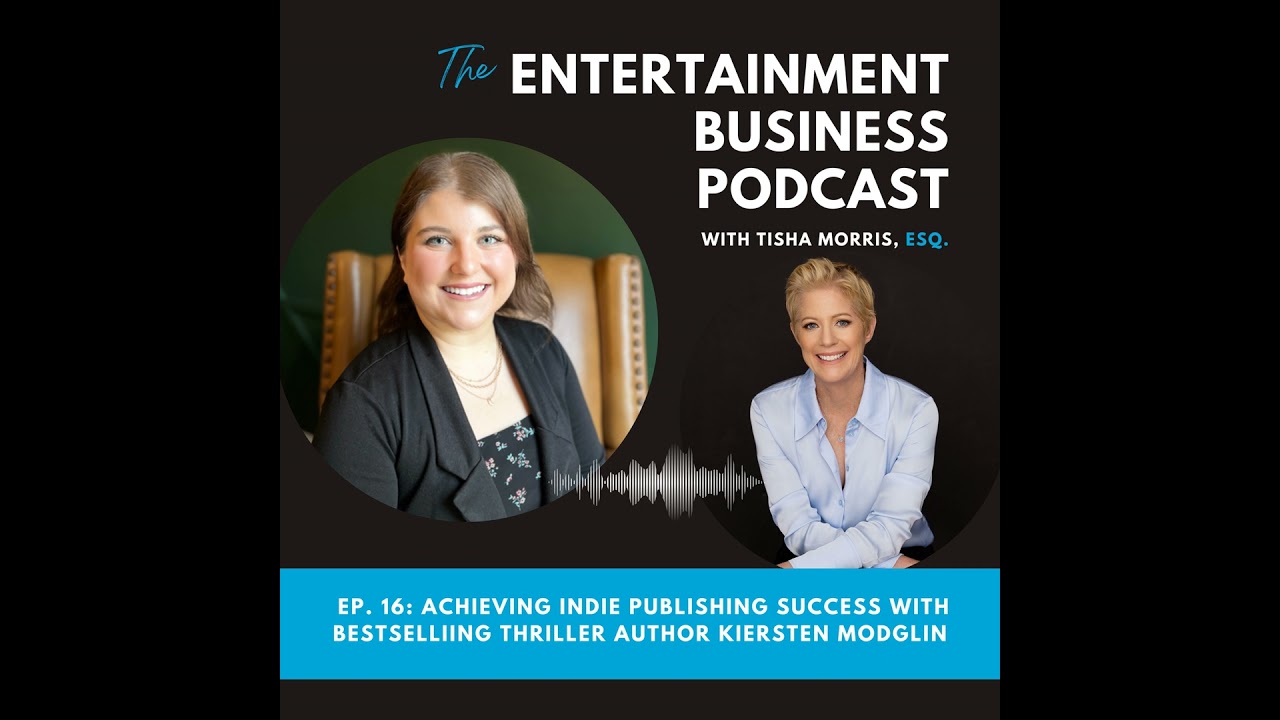
In this Entertainment Business Podcast episode, host Tisha Morris interviews bestselling indie thriller author Kirsten Modglin (KMod) about her path from traditional publishing to a thriving self‑publishing career. Modglin recounts her early 3‑book deal with a boutique press that sold only a handful of copies, her pivot to indie publishing, and how she now owns the rights to 48 of her 50 books, having sold over 1.5 million copies. She describes the daily grind of writing 6–8 hours a day, allocating roughly 80 % of her time to writing/editing and the remainder to marketing, admin, and business tasks. The conversation delves into her creative rituals—using specific songs and candles to set mood, maintaining lists of titles, character names, and ideas on her phone—and her cinematic, dialogue‑heavy storytelling style. Modglin outlines her marketing ecosystem: Amazon/KDP, Kindle, audio narrations, newsletters, TikTok, Instagram, Facebook, and occasional Amazon ads that run on autopilot. She shares how she balanced a banking day job, family life, and homeschooling her daughter while writing, eventually retiring her husband to focus on the business. Advice for aspiring indie authors includes self‑education via YouTube/Google, disciplined writing habits, early title selection, and building a loyal reader tribe. Finally, she expresses a strong desire to see her books adapted for screen, citing her “female Harlan Coben” ambition, and mentions ongoing efforts to secure an entertainment attorney.
Chapters
Welcome to season 2 of the Entertainment Business Podcast. I'm your host, Tisha Morris. Join me as we go into the business of entertainment, publishing, music, and all things creative. We'll get inspirational interviews, informative trends, and practical tips. And with that, let's get on with the show. Hello and welcome to the podcast. This is your host, Tisha Morris, and thank you so much for joining me. I'm really excited about today's episode because I'm returning what I'd say back to my roots. Uh, my guest is from my hometown of Nashville, Tennessee, and we're gonna be talking about writing and publishing, which is my, I feel like it's my home within the entertainment industry. I, I feel like I say this every episode where this is, uh, my favorite thing. I say that about music. I say that about the film and TV. And now of course books is where it all started with me. And then the book goes to screen and adds good music to it. Then it covers all of my favorite things. My guest today is Kirsten Modglin. She is a number one bestselling indie author of psychological thrillers, of which she has sold over a million and a half copies. She is the recipient of awards such as the KDP Select All-Star, Thriller Fix's Best Psychological Thriller Award, and Suspense Magazine's Best Book of The Year. You may know her as KMod. That's the name her readers across the world call her. Kirsten lives in Nashville, Tennessee with her family and joins us today to discuss the life and business of being an independent author. Welcome, Kirsten.
Hi, thanks for having me. I'm so excited to be here.
I'm excited too, because you are living out secretly my dream. And I think a lot of people's dreams, and I want to, we're going to get into that if it lives up to this notion of The writer's life, but I actually have a, uh, my perhaps third career will be a, will be a novelist, particularly with thrillers as well. So anyway, I'm so intrigued by your work and by your books and by your life and all of it. So I, I thank you and thank you for taking time out cuz you're super busy, probably on your like 60th book. How many books do you have now?
I'm actually in edits of my book, of book 50.
Okay. Book 50. All right. You're 50, a different sort of 50th anniversary.
Exactly.
I want to set the stage for folks to give them a sense of how I came about you and how I met you. It was at the Writer's Fest conference in Nashville this last fall, and you were in a panel and you were being interviewed by Margaret Riley King, who, for people who don't know who Margaret Riley King, she's probably the biggest agent in the industry. And you're being interviewed by this agent who would love to sign you for everything you've ever created, which is pretty much every writer's dream is to be, is to be signed by Margaret Rowley King. And so my interest was super piqued. And, and that's when I went down the rabbit hole of, of your work and wanted to have you on the podcast because you are an independent author, an indie author, and you run your, all your own publishing, unless that's changed since last fall. And you are really paving, not paving the path, but you are laying down a path that so many people are interested in who are writers and don't want to go to the traditional publishing route. So tell us how you got started as an indie author. And, and where you are now with it.
Yeah. So when I first started writing, I actually didn't know being an indie author was a thing. I came into this very traditionally. I was querying agents and publishers, and I ended up doing a 3-book deal with a really small, like boutique publisher. And I remember thinking like, 3 books, I'm gonna be the next Gillian Flynn. Like my life's about to change. And I sold like 8 copies to people I knew and that was it. And so I was like, that wasn't exactly what I had planned, but okay. And so I was like, this is a lot of work and I'm still having to do most of my own marketing and I'm not really making hardly anything off of my books. And so through that publisher, I met other authors who were publishing on their own and that really piqued my interest. And I was like, oh, if, if you can do that and you're not going through like a vanity press where you're paying them thousands of dollars and they're giving you really crappy work, if you can do it all on your own and I can hire editors that I know will do well and I can hire cover designers. And I can do what a publisher is doing, just it's me and it's my investment. Maybe I'll try that. And so it was like an experiment. Let's see if I can do any better on my own. And I put out my fourth book and it ended up outselling the, the three that were with the publisher pretty quickly. And I made, I didn't, I was still like not breaking even, but I was selling more than those books were. And so I ended up at this point in my career, I have those rights back. And so now I have, my books are all owned by me except for 2 that I later did a traditional deal with back in 2021, but 48 of my books are mine. And so yeah, it was one of those things where I was learning as I go and there was a lot of time on YouTube and Google just looking up how do you upload a book? How do you find cover designers? How do you find editors? But I was just, I'm, I've always been someone who I'll put, I'll put all the work in if it means getting what I want. And I was like, let's just see. And luckily several books later it all paid off and I'm very happy doing what I'm doing. That's awesome.
There's a, uh, so I ran a self-publishing company for a little while and, and have done self-publishing and traditional publishing of my own books. And I came across this quote that the best thing about self-publishing is that you make all the decisions and the worst part of it is that you make all the decisions.
100%. Yeah.
Um, at this point of having had so much control over the creative and business side of it. Does that, is that something that seems scary to, that to let go of? Or is there a world in which at some point that would be freeing?
No, I think it would be terrifying. I, I love having control. I love feeling like my stories are ultimately mine. Like I said, I, I did a two-book deal midway. I was at like 26 books at that point through my career thinking maybe like this publisher's a little bigger, maybe it'll be something different. And I, what I learned about myself was that no, I just, I like to be able to have final say. I don't, I love my editor. I've been with my editor since book 5. I've been with my proofreader since book 12. I love them. I trust them. But I like being able to, if they're trying to push a decision, I like being able to have final say and no, we're not doing that. Or yes, we are. And so while I want it to always feel like a collaborative thing, I still, at the end of the day, wanna feel like my product is mine and my books are mine. And I think that at least for me, like having that control and knowing the COVID design is my decision, how much we price our books at, that's my decision, where they're being sold, that's my decision. Setting up signings, all of that is in my control. It's just really special and I think it takes a certain, you know, type of person to want to do that. It's definitely not easy. It's, I'm working way more than I've ever worked in my life. It's several full-time jobs, but it'll be really hard for me to ever give it up and know that I didn't have final say in things anymore, especially having built what I've built. And it would just, yeah.
Yeah. It's clearly worked. As I mentioned in your introduction, you've sold over 1.5 million copies. Clearly you've got your finger on the pulse of what works. And that does take wearing several different hats. You're obviously a writer and then you're a marketer, but also you're a business, you're an entrepreneur. So all those pieces come together. I have I used to do book coaching as well, and, and also teaching people in the publishing industry. And the publishing industry is a whole industry of business. And is this an area that you saw yourself going into from an early age, being a writer? And obviously we didn't think about that as in our younger years before self-publishing existed, but have you always been drawn to the book market?
Yeah, I've always wanted to be a writer. I have written since I was very young, short stories and poems and novels. And I was writing what I considered to be books in about 4th grade and writing novels every year by the time I was in high school, going home over the summer and writing a book. So that was always something that, that as soon as I realized it was a job, I was like, I wanna do that. I wanna tell stories. And not necessarily just books. I, I think that writing film could be really interesting. I just wanna be a storyteller, however that worked out. Books have always been my first love and I'm a huge reader. And so that just made sense. And so that kind of worked out. But the business side of things, I had no idea. I, I was 22 when I published my first book. I was straight out of high school, had no idea what I was doing. And like I said, I was Googling and YouTubing my way through figuring it all out. And I still very much to this day am, am doing that. And it's strange, I think sometimes to think of myself as a business owner. I'm coming into that more. I just turned 31, so I'm like, now I'm owning it a little bit. But yeah, you start out and you're so young and you come into this industry that you know nothing about. And I think it's easy for people to underestimate you and also you to underestimate yourself. And so I'm coming into more of, I'm a business owner. I, I know what I'm doing now, but everything changes. What you know today could be totally different next week.
That's true. What percentage do you think of your day or month or year do you, would you apportion to writing versus marketing and then the business part?
Yeah, I would say writing is 80%, so the rest is kind of over that 20%.
Okay.
I, I structure my day around the writing or the editing. If I have edits that are due, then the writing of the next book takes a backseat and I do edits. But writing slash editing is 80% of my day. I build my whole day around that. And then if I happen to finish earlier, that just gives me more time to do the admin side of things, to respond to emails, to update my website or set up a newsletter or podcast interview. Yeah, do podcast interviews, that sort of thing. So it, it gives me more time. It depends on where I'm at in the book, how quickly I'm writing, that sort of thing. But at the end of the day, everything has to go around the writing cuz otherwise there's no product.
There's nothing to sell. I love that. I think that's a real, that's a really important takeaway of for anyone with anything they do, like really centering their day around The part, not only that they love the most, but that it's the meat of the whole thing. Yeah. Speaking of your typical day, tell us about your typical day as a writer and what process you use.
So I write typically like 6 to 8 hours a day is my, it's a full work day for me. I tend to write better in the morning, so I'm up and in my office by 8:00 AM most days, and I need at least 4 hours to get my word count or my chapter goal in for the day. But sometimes it, like I said, takes me the full day. I, as far as habits or ways that I write, I, I have on my website, I have a list of songs and scents for every book.
Yes, I was gonna ask you about that. That is the coolest thing ever. Thank you. Um, yeah, so yeah, keep talking. I won't interrupt. I won't interrupt you.
You're fine. I, um, so I've done that since I started writing and it never, it was never anything I talked about. It was just something I did. So I listen to one song or just a few songs, like some books have more than one, but basically just over and over the entire time I write until they base, they become like white noise. I'm not hearing them anymore, so they're not distracting me, but it gets me in the world of the story. And I also burn candles, like I burn one specific candle for each book. And like I said, I'd been doing it forever and then I mentioned it years into my career on a live with my readers. And by the time I got off the, the um, live, I had 30 emails saying, what, what song, what scent was this book? And so rather than trying to answer all those, I was like, let me just make a list. I'm gonna put it on my website. And so I keep it updated now. And so like the songs or the scents might not necessarily even fit the book, especially in the beginning cuz it was just for me. Now I try to fit songs and scents to the actual story so that I know people are gonna be looking at it. But yeah, I try to do stuff like that to help get me in the zone quicker. But yeah, I, like I said, I structure my whole day around that. I tend to like answer emails like right away, first thing. And then I get into the writing and then anything else, like I said, ads, newsletters, those are all done in the evening. So those are once my daughter's in bed, I'll schedule a newsletter. Ads, I tend to do ads like when I first launch a book, I'll start an ad and then I'm very much, don't ask me to teach an ads course. I'm like a set it and forget it. And as long as it's making me money, I don't really look at it. I might check that once a week and just make sure nothing crazy has happened, but The rest of it, every day looks a little bit different, but that's my typical day.
So for, obviously when you first started, I imagine you weren't spending 8 hours writing cuz you probably had a job and a family or kids and the whole thing. What, how did you find the time or maybe, or was it discipline or in the beginning to, to crank out that first or second book?
Yeah, definitely. I had, I had a day job. I worked in banking at the time and former employer would probably not like my My advice, but what I did was I would take a notebook. I wrote in my notebook at the time and I would write like on my lunch break or in between customers. And then when I got told I couldn't write in between customers in my note— I started, I would type out an email to myself every day, like between customers, I'd type chapters in an email and then I would just send it to myself and then I would copy and paste that into the, the document that I was working on at home. Those— so I was always finding creative ways to like And I, I've been doing that my whole life in class. I was scribbling down stories and so I did that. I would, I usually didn't have time in the mornings. I, like I said, I worked in banking, so I would get up about 6. I would take my daughter to daycare and then I would work all day and write it, write as much as I could, even if it was just 500 words extra that I could squeeze in on my lunch break in between customers. And I would come home, do like dinner, bath, and bed. And then after my daughter was asleep, I'd write until 2 or 3 in the morning most mornings and then go about it. To sleep, get up at 6. And so it was, I don't know if it was discipline or chaos, but it was, I always believed, and my daughter was really young, she was born right after my first book came out. I always believed that if I could push really hard when she was young, that she would never remember the years that it was chaos like that. And then I was like, hopefully like it'll take off and by the time that she's able to remember it, I'll be able to do all this fun stuff and we'll give her this beautiful life and Luckily it worked out. She was about, I think, 4 or 5 when everything took off in 2020 for us. So I guess 4. And so the only life she knows is, is this one where she gets, we get to travel and signings and, and do all this fun. And me and my husband are both home with her all day long. We homeschool her, so she gets to travel with us. And so, yeah, so she's, so my plan worked out, but it was just chaos there for about 4 years.
I, that's, I love that plan and I love that you executed it. Now in your interview in Nashville, you mentioned that you've retired your husband and he gets to be at home and help out with the kiddos, I imagine. How many kids do you have?
We just have one.
One. Okay. All right. All right. All right. Is she showing signs of being a writer one day?
She is just very recently. She's starting to get more into books and reading in general. And she's never really understood what I did. I remember one time she came in, I was like signing books and she said, why are you writing in books? What, what is happening? But she's finally starting to get to an age where she understands it. And she was just telling us the other day that she wants to be an author when she grows up. And she wrote me a book for Christmas and I ended up turning it into a book for her, like a hardcover book. And so I gave it to her as a gift. And so now she's like, at your next signing, I'm gonna take these books and I'm gonna sell 'em with you and I'm gonna sign my books. So that's really cool. I, I didn't grow up surrounded by people who had chased their dreams. And so it was When I was like, I wanna be an author, everyone was like, you need a backup plan. That's a tough job to do. Yeah.
Yeah.
Banking. Exactly. And so it's really nice to be able to tell her you can do anything. You just have to try and work hard.
You're, the way you connect with your audience, and obviously you write great stories, the way that you connect with your audience, I, I see everything through a business lens. So through a business lens, I'm very impressed with with how you have created a tribe and the fact that you even have your own name, that they call you KMod. Yeah. And if you, for listeners, go to kirstenmoglenauthor.com, it's in the show notes, and check out her website and sign up for her newsletter, which I love your branding, Love, Lies, Alibis. It's so brilliant. But you can see a list of all of her books. And if you're not familiar with her work, then it's your like lucky day because now you have 50 thrillers waiting for you. If for someone who, who's new to your work, where do, uh, which book do you recommend them starting with?
Oh, so I, I always recommend the newest just because I feel like that's gonna show off the strongest version of my writing. I like to think that I get better with every book, so I feel like it's, that's the best, um, reflection of where I am.
Mm-hmm.
But I will say if you start at the beginning, I have a ton of little Easter eggs that I've left for my readers, characters that show up from several books past. And so if you read them in order, then you're more likely to, to catch those. So that's, so I would love for you to read them in order if you're gonna read them all, but maybe read my newest book and make sure that you like my writing before you jump back into the oldest version of me.
I wanna, I want you to expound a little more on your writing gets better. I've noticed that with myself as a writer. I have written more nonfiction than fiction, and I can definitely see a huge improvement in my writing. So even 50 books in, you can still, you still notice that within yourself?
I do. Yeah. I always feel a little bit more. Now, I'm not gonna lie, I still hit a point in every book where I'm like, this is the worst thing you've ever written. This is gonna end your career. This is awful. But every book when it's at a publishable point, I'm like, this is the best thing that you've written so far. And I feel that way about every story. I feel so proud of it. But I think it, first of all, it's practice. It's something I'm doing every day, 5 days a week for at least 4 hours, if not more. So it's like practice makes perfect. What's the, the thing about you have to put 10,000 hours in to become an expert at something? And so I'm putting in my hours and I'm, I'm continuing to work. I'm also reading more and I'm learning new rules and I'm, I'm seeing how other people do things that I find really interesting. My idea is I feel like I'm finding new ways to do— there's no original stories, so new ways to tell old stories. And yeah, I think you, you're just learning. And then I'm also getting older, like I've had more life experience now. And, um, so yeah, I think all of that just compounds and I think and hope that each new book just has a little bit of a stronger, mm-hmm, you know, sense of writing in there.
Where do you get your ideas from, particularly for character? Are they, are you always watching people in restaurants and things or?
Yeah, I'm a big time people watcher. I also, my, my family does not enjoy going on vacation with me because while they enjoy places that we go, I'm constantly turning them into thrillers. I'm like, this could happen here and this could happen. They're like, can we just enjoy where we are? We went to a cabin. I, I live in Nashville and we live, we went to a cabin in East Tennessee and one whole wall was like glass and it was all windows. And so you could just see out into the woods and my whole family's, oh, it's so beautiful. You can just see, you can look out all day. And I'm like, you guys know there's definitely someone out in the woods like watching us and waiting to kill us. This is not my version of, of peace right here. And so I turned that into a book and yeah, so I turn a lot of our, our like vacations or into stories, but I'm always plotting. My brain doesn't turn off. And so I have an ongoing list in my phone of new ideas that I'm constantly adding to.
We definitely would never be, be good to go on vacation together because we would be too much alike. Cuz as an attorney, I'm always thinking of what can go wrong.
So, yeah, exactly. There's too many possibilities. Too many possibilities.
That's right. So yeah, so you keep ideas in your phone. That's a really good tip. Do you use the Notes app or what?
Yeah.
Yeah.
Yeah. I use the Notes app. I also have a list of character names. So anytime I hear an interesting name or read or see an interesting name, jot it down on my phone and then when I'm, it comes time to write a new story, I go through that list and pick the one that I'm excited about.
So I, I do that for book titles when a book title comes that I'm obsessed over book, like nonfiction book titles cuz there's such an art and science to it. Although I imagine I haven't, I feel like fiction titles, I don't, I have a list of those too. Do you keep a list of those or, or what, at what point do you usually title a book?
Yeah, I do. It, so it's only happened a few times, but anytime I come up with a title, it goes in my idea list.
Okay.
And I'll just put what the title is and then beside of it, title, so that I know that was something else. I also randomly will get cover design ideas and so those go in there as well. So that it's just like a big mashup of every idea. And as far as when I titled, typically it's before I write the book. I've written a lot of books around title ideas. Mm-hmm. Really cool idea. I wonder what book I could write about that. Very rarely do I title at the end, and I don't like to title at the end because I like to work my title into the story somehow.
Mm-hmm.
And so if I do decide on the title at the end, then I have to go in and figure out how it's gonna fit with the story if it didn't already perfectly fit. So I like to pick it at the beginning or very early on, but every once in a while it eludes me and I'm, I get to the end and I'm like, I still don't know what we're calling this. So here's book 50/50 to my editor. So.
So have any of your books gone to screen yet?
So none yet.
Not yet.
I want a lot of them.
Yeah. I can't wait till that hits. I feel, I see for you the female Harlan Corbin.
Oh, thank you. I hope so.
I share for you.
That's, that would be a dream. I really hope. I have so much material to work with, you know? Yes. So I'm very much hoping that happens soon.
Yeah. It's gonna, when it hits, it's, they're gonna want all of them. So get ready. Yeah. I know a good entertainment attorney to represent you, just FYI.
Oh, yay. Thanks. I'll be calling you up.
Um, yeah, books to screen is like my favorite thing. And when I have written, when I have written fiction, uh, I haven't had any published yet, but I always see it as scenes, like movie scenes. Do you visualize things when you write or is it—
Yeah.
Yeah.
I'm a very, I try to be a very cinematic writer. So my books, I'm not, I'm not very, description heavy. My books tend to be very dialogue heavy, very quick, fast-paced. I always, I'm like, I don't care what the house looks like. I wanna know what's going on inside the house. And so I, I write very much with the story in mind. It's all playing out. I can hear the voices. I'm not super visual, so I don't always see the scene playing out, but I can just feel it and I can hear it. And as I read, that's how books that I enjoy, but also my books are, I feel like they're little movies on paper. Yep.
Yeah. The more, yeah, they have to move fast these days to keep up with our Crazy Brains.
Yeah.
Do you have a favorite book or maybe it's a favorite character? And, and I think you have a few recurring character books, correct?
Yeah, I have two series. They were both started, they both started as standalones and my readers were like, what's next? And so I eventually turned them into series. As far as favorite books, I have like three favorite, I have three favorites and an honorable mention. So The Missing is, I can, I call it Lost meets Lord of the Flies, so it's 5 strangers trapped on an island. I just love that premise. I love reading or watching it, so I was really excited to write that. And then The Reunion, which is set at a class reunion where someone died on prom night and it was never solved. And so they, the main character, she's an author and she goes back to this hotel where their prom was held for their class reunion and creepy things start happening to help her figure out what happened basically back then. And then the third one is Hemlock, which is one of my only romantic thrillers. Typically I have the straight thrillers, but every once in a while I throw in some romance and that one is a love triangle where a girl is living in a potentially haunted house. And she ran away from that town years ago because she has a big secret. And that one's a lot of fun and just super special to me cuz that was an idea I'd had for years. And because it was romantic, I refused to write it cuz I didn't think my readers would enjoy. And so that was a big leap of faith and my readers really caught me on that one. So I love it. And then the, the honorable mention is The Dream Job, which is one of my quietest stories. No one ever talks about it, but the readers who have read it, it's some of their favorites and it's one of my, I, it has a really deep meaning to me and so it's just extra special. But it's about a group of people who are competing for this dream job that's a huge salary and they all have different reasons for wanting it. But they're, they have to go stay in a cabin and they have to use code names and they have to give up all their technology and they're competing. In different competitions in order to get this job. And it's a lot of fun and very different. It's always really special. That's cool. Yeah.
Caverns creep me out too. I'm with you.
They do. There's just something about them, especially you're always so isolated.
Exactly. TishaMorris.com. Go to her website, join her newsletter. You can from there link to her books. Do you, what, what platform do you mostly sell your books from? Amazon?
Yeah. Yeah. Amazon's a big one for me, for sure.
And do you have them in audio? Um, I do.
Yeah. Yeah.
Yeah. And Kindle. Yep. Yep. So all formats. So yes, go look through the books, see which ones you wanna get. I would imagine I'm gonna get some on audio. Those sounds like, that sounds like a lot of fun to listen, uh, to on audio. Do you do your own narration or do you hire someone?
No, I hire someone. I've been really lucky to work with some amazing narrators. I don't think I've reused on any of my books, maybe one or two. So they're very different voices on all of them. And yeah, I think they turned out great. I'm super excited about the way that all of them have, have been received.
Wonderful. I feel like I could pick your brain on the business part of all this, like all day long, but I'm going to let you go write instead. Again, kirstenmoglenauthor.com and follow her on Instagram and Facebook. Any other ways, uh, the way you, that you connect with people or other?
No, that's perfect. My newsletter and then I'm also on TikTok aside from Instagram and Facebook.
Oh, great. TikTok. Yes, I love TikTok.
Yeah.
Awesome. Thank you so much, Kirsten. This has been really fun.
Thanks for having me. This was—
Thank you so much for listening to today's episode. If you like the podcast, please like, subscribe, maybe even share to your friends. And for more information about my services, visit my website at tishamorris.com. That's T-I-S-H-A M-O-R-R-I-S. Well, that concludes today's episode, and I wish you all the best. Until next time, keep creating and please take care.
More from Tisha


PSA for Authors Using AI #contentcreators #writers #authors #creativecontentcreator



THE SCREEN PLAYBOOK 🚀A Writer’s Guide to Negotiating Creative Rights Like a Pro





Unlocking Actor Potential with LA Acting Coach Murisa Harba on The Entertainment Business Podcast

Episode 19: Unraveling Foreign Rights in Publishing with Agent Marleen Seegers