Episode 5: Creating Women’s Empowerment Through Podcasting with Liz Svatek
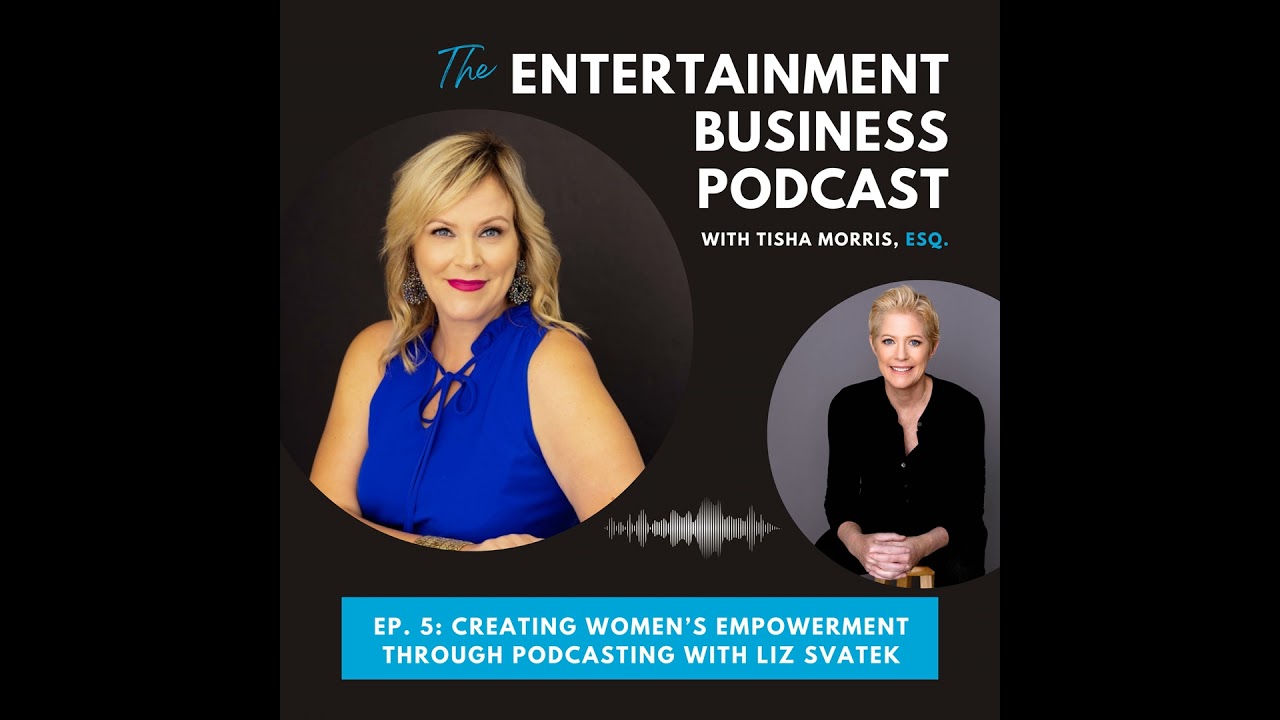
In this Entertainment Business Podcast episode, host Tisha Morris explores the rapidly expanding podcast industry—now a $23 billion market projected to reach $100 billion by decade’s end—and its particular resonance with women listeners. She welcomes Liz Svatek, creator of the award‑winning "Conversations with Warrior Women" and founder of Warrior Women Podcasting, a coaching business that helps women launch their own shows. Liz recounts how she first learned about podcasts, the moment she decided to start one, and how hearing her own voice sparked personal empowerment. She shares practical advice for newcomers: jump in, practice mock interviews, and shift the mindset from perfection to play, emphasizing that technical hurdles are secondary to confidence. The conversation then moves to how Liz’s coaching practice and podcast feed each other, creating a feedback loop of growth. Liz introduces her new podcast series, "The New Era of Midlife," which addresses the unique challenges and opportunities for women over 40, reframing midlife as a purposeful calling rather than a crisis. She also explains her certification in Rapid Transformational Therapy (RTT), a hybrid of hypnotherapy and coaching that delivers fast, lasting change, and provides a URL for listeners to learn more. Throughout, both hosts stress the ripple effect of women’s storytelling—how sharing authentic experiences reshapes culture, empowers listeners, and creates a legacy for future generations. The episode closes with calls to action for Liz’s website and social channels, as well as Tisha’s own services.
Chapters
Welcome to the Entertainment Business Podcast. I'm your host, Tisha Morris. Join me as we go inside the entertainment industry of film, TV, books, music, and all content creation, where we'll weave together the creative and business of entertainment with practical tips, inspirational interviews, and insider information of all the latest trends. And with that, let's get on with the show. Hello everyone, and welcome to today's podcast. I'm your host, Tisha Morris, and today I'm so excited to take a deep dive into a topic that is pretty near and dear to my current heart right now, and that's about podcasting. Podcasting as a form of entertainment, a form of creative expression, all of the above. Not to mention, it is now an over $23 billion industry. And expected to grow to $100 billion before the end of this decade. So the popularity of podcasting is going up, up, and up. There are approximately 464 million podcast listeners worldwide, and it's projected to reach over 500 million by the end of this year. And so I just want to take a moment to thank my listeners for listening to this podcast among the many and many podcasts out there. And so today, to take kind of a deeper dive into this form of expression and communication and information sharing, I have who I consider to be the queen of podcasting, Liz Swatek. Liz is the host of the award-winning podcast Conversations with Warrior Women, and it's globally rated in the top 1.5% uh, in the, in the world, and her podcast company Warrior Women Podcasting has helped other women use their voice and grow their business by launching their own podcast. In addition to hosting, Liz is a rapid transformation coach for Wise Women and the founder of Warrior Women, a personal growth business dedicated to women's evolution, growth, and legacy, offering life-changing mastermind groups, workshops, and retreats, along with her signature program called Limitless. It's been called a game changer for personal growth. And not to mention, more importantly, Liz is a friend, former neighbor, and someone who I treasure, um, having in my life. So welcome, Liz.
I mean, that was the nicest introduction I've ever received. I would like to come onto your show every day and just hear that. So thank you.
That means the world to me because I'm in my 5th episode of the podcast and you've done about a gazillion episodes in your podcast. So I am bowing down to the most warrior woman in podcasting.
So you're doing amazing and I feel like you're— this is really a good niche for you. I love hearing your voice.
Ah, thank you, Liz. Well, I want to kind of go back in chronology And I want to hear what was the kind of the moment, moment-ish when you decided to start a podcast? What was that deciding factor for you?
Well, truthfully, people had told me that I should have a podcast and I didn't even know what one was. So that's the hilarious part of all of this. I literally said, where is it? Like, is it on your phone? Like, I didn't even understand like really what it was. And I kept hearing that and still I wasn't going to do it. But then I met this woman at a women's conference and I said, "Well, what do you do?" And she said, "I launch podcasts for women." And I thought, "Well, this is ridiculous." Like, what are the chances that I'm talking to this one woman and that's her actual job? So I thought, you know what, this might be like a fun creative outlet for me. You know, I said, "Reach out to me in January." You know, it was like October. I said, "Reach out to me in January." I'll do it. And boy, January 1st, she was like, "Hi, it's me again." I was like, "Oh damn, did I even say that?" So, uh, it was great actually. So I went on this journey with her. I did not realize it could be so life-changing. I didn't understand how hearing your own voice— because most of us, I mean, I don't even want to hear my voice on an answering machine from back in the '80s, you know? I'm like, most of us are not over here going, "You know what I really want to hear? My own voice. That's what I really want to listen to all day long." So It was really interesting when I started hearing my own voice or giving myself the power to use my voice and to kind of stop criticizing myself or analyzing myself and instead sink into the woman I was interviewing, focus on what I was really wanting to know, because then I felt like I— suddenly I felt empowered and I felt like, oh wow, using my voice is powerful and I get to interview these women on Conversations with Warrior Women that fascinate me. Right? That's really what I wanted to do it. Why I wanted to do it. I wanted to interview women. I wanted to know how do they come to where they are now? What kind of triumphs and tragedies have they been through? How did they make it? What happened? So I think when I was focused on what I most wanted to know versus my own voice, that really was the thing. So it really, I kind of just fell down the rabbit hole. And then of course, here comes COVID and everybody's miserable and washing their bags of Doritos. And I instead am interviewing women feeling like, wow, this is the greatest time of my whole life. So thank you, podcasting, is all I wanna say. I'm unbelievably grateful to this medium and what it does for women in particular.
Yeah, it has a way, I mean, I have learned so much from podcasts that you, you know, you can't, you can't get from other places because of experts and everything like that. Now you do have a background with microphones. Um, you had, haven't you done some standup? Definitely speaking, like the microphone has been your friend for a while.
Yes. No, I do enjoy, I had a Donnie and Marie microphone when I was a child and I used to basically electrocute my lips. Because it had a big antenna at the end. So yes, Tisha, I have always loved a microphone. Thank you for calling me out. But this felt different for some reason. I felt like, you know, when you're speaking in a group or if I'm, you know, using the microphone even in stand-up, I know the people that are there. This felt like, "Who? I don't even know who's listening." I mean, when I started seeing all these international listeners too, I was like, "They know me in Britain?" Like, I just was like, my mind— "They're listening to me in Italy?" Like, I just never thought that could be possible. And I think there was a little bit of a fear there of like, who is listening to this? And like, I don't even know these people. But now I feel like I know them. Right now, it's been almost 200 episodes. I feel like I know, I know, you know, I know my people. But it is kind of— I don't know, it felt different. It felt bigger.
Yeah.
Yeah, it felt bigger.
Yeah, it is worldwide. Bigger than your bedroom in your childhood home.
Yes.
Yes. Now you have a business that helps women start a podcast. What would you, for those who are not as, didn't practice with their microphone growing up, actually asking for a friend, people who are a little more on the quiet side, what advice would you give them where the microphone isn't maybe such their, you know, their go-to medium of expression? You know, I'm, you know, writing is how I've always used my expression, but, having a microphone is a little intimidating for me. So what advice would you give for folks such as that?
Well, first of all, I would say just do it. Just jump in and do it. Like, we can overanalyze this. I mean, you're not— you know, I always say to women, you know, you have to begin before you're ready. There's no world that we— women want to check every damn box. We're like, okay, no, wait, hold on, there's 25 things I have to do. I only did 24, so I will not launch this podcast yet, right? And instead, we need to just be like, no, I'm gonna just try this. I'm just going to record something, see what I think, right? Practicing, making it more familiar and taking it out of the discomfort zone and moving it into the comfort zone by just literally the sheer act of doing it. Because it's almost like the buildup to doing it could kill you. So you almost have to kind of like— I like to, when I work with women, have them kind of practice, do mock interviews, just kind of get comfortable with it ahead of time because it's really got— you got to rip that Band-Aid off. There's no amount of preparation that's going to prepare you for what this this really feels like. So I think it's more about, you know, giving yourself the grace and space to just practice with it and be imperfect and be stumbling and say the wrong thing and, you know, right? Like all those things so that you can get to what you actually want it to be.
That's great, great advice. Just do it. Yeah, yeah. Um, I can quickly see how you being a coach really overlaps with you guiding people to start podcasts? Because I imagine the emotional, mental hurdles are, you know, it's easy to focus on the tech and what do I need for, you know, the check the boxes. But how much does the mental, emotional blocks kind of get in the way for these types of things?
I mean, it's, that's, I mean, that's almost the whole thing. Like, let's be real. I mean, the tech is, listen, the tech can be overwhelming. You know, and I feel like even women like over 50, we're a little bit like, "What? Like, don't change the Zoom thing again. I just learned the new Zoom. Don't update it again, Zoom. No!" You know, like it's hysterical. So I think there's some fear around the tech part, but really it is, it's the mindset is really the whole thing. That's the whole game. And when I lead women through this experience, I make it really fun. I make it really creative. Like, I don't let them get into the muck and mire. Of their minds. I more ask them to go on kind of a creative journey with me. And for some of them, that might be a long time since they kind of flex that because they're going to, you know, do the podcast for their business or they're going to expand their brand. But I really let them sink into creativity and I have a little format and a way that I guide them through so they get out of their head and it's more like a place to play, like a place to have fun and play and really like be yourself within this medium, right? Because really, as you know, that's what sets you apart in podcasting. Doing it like everyone else is not going to get you anything. But being yourself, really showing up as you, like what lights you up? What kind of conversations do you like? What kind of interviews do you like? Or what are you already listening to that just makes you go crazy? You love it so much. What's your take on that? So getting into the creative part, I think, really helps with that mindset.
Yeah. Yeah, so for you— which was the chicken and the egg, the coaching business or the podcast? How did they kind of evolve?
That's, that's so funny. It really was the podcast because once I had the podcast, I interviewed a woman who's now my mentor coach, and she basically called me up and was like, you're a coach. And I did not want to be a coach. I was like, there are 1 billion life coaches. I cannot be this person. This can't be me. God Almighty, no. But I realized that that's who I'd been all along. I'd been coaching people forever. They didn't pay me, but I was coaching people, right? I've been leading communities forever. I've been guiding women forever. It really was what I had already been doing. I just didn't like the word coach, right? I didn't like that. But once I saw what the programs and the kind of tools that I have do for women, now it's like I have to do it because I'm not gonna not share these things with women. If it's changed my entire life, in my husband's life, in my kids' life, I will tell everybody. I don't care if I'm at a bus stop, I will be like, "Have you heard the good news?" Like, you know, I just, I can't, because I just want women to ultimately be in their legacy. I want them to rise up to who they're really supposed to be, their purpose, their meaning, and I'm so passionate about that, it kind of overrides this like, "Well, there's a million coaches," mindset that I have now let go of. But the podcast came first, absolutely.
So how does— right, so now you're obviously kind of a well-oiled machine with your business. How does, for you personally and your growth edge, how does your coaching business inform your podcast and your podcast inform your coaching business? In other words, how do they integrate for your growth?
Yeah, I mean, I think— and you've been in this podcast space, you kind of are already probably getting this. The podcast, when you meet a different person, sometimes it calls you up to something else. So I remember I met this one woman and she said, "You know, you really need to do a solo cast, like just you speaking." And I remember being like, "What? No, like I'm not doing that," right? So even though I had already become a top 1.5% podcaster and, you know, I won an award, there was still growth within this medium for me, like knowing that I could do a solo podcast. Do I even, and do I wanna do that? And like, what am I really gonna talk about when it's just me? And I think in my coaching it's the same. Like, I, I have groups of women— when people have been with me long enough, they've done enough of my programs, then I have to rise to a new level because they're like, what's next?
Yeah.
And then I have to be like, well, shit, what is next? Like, you know, like, I have to look at myself. And for me, that was like— that's gone over and over again, just like the podcast. There's always these new levels. Like, I wanted to become a rapid transformational therapist because I saw that modality and what it was helping, I thought that would dovetail into my business. You know, like I thought I started doing solo casts because I started realizing I had something to say. Like, you know, you just start that growth, like it goes back and forth, I feel like, from the coaching business to this podcast. And I take things and I've also— now here's my new thing, and I haven't said it this to anyone, so I'll just say it here first, but I've been feeling called to coach people on the podcast live because there's something really magical that happens in the room when I'm with a woman, and I feel like, my God, I would love— I, as a listener, would love to hear the perspective shifts that some of these women are getting. Like, that would be meaningful to me. So I'm thinking that would be great to share.
Yeah, I love that. Yeah. Well, I would also say, like, I would imagine with the solo, um, the solo cast, um, that in and of itself, like, expands you. I mean, you do keynote speaking, and what a great kind of practice area, and a solo cast could, could help with that. And by the way, so anyone listening, Liz does amazing keynote if you're needing one for, for an event or something. Liz is an amazing speaker among her other things. So whether it's one-on-one coaching with, with big groups She kind of checks all of those off. Now, you just ran a— speaking of expanding and new ways of doing podcasting, you just expanded into a podcast series on your podcast. Again, her podcast is Conversations with Warrior Women. Go and run and listen and follow and subscribe. But you have a whole new podcast series within your podcast called The New Era of Midlife. So tell me about this series. And how this came about.
Well, it came about because I realized that the common denominator of every woman I work with is they're over 40. Like, I really— people— I have younger ones that work with me, but really my zone is like 40 and up. And there is, as you can tell, kind of a midlife kind of renaissance going on right now where we're starting to realize that the way we've been doing things is ridiculous. Why is there no information about menopause? Why have we not studied menopause? Why are we just letting women suffer? Why, you know, why are women feeling so lost in midlife? Like, what, what is all of this, right? And so I started realizing that we are in a new era of midlife. This is not, this is not your mother's midlife. This is not your grandmother's midlife. And just if you think back to a few short years ago, I was riding around in my father's car with no seatbelt, laying in the wheel well. There was a cigarette lighter that I would push in and out. We have evolved, Tisha. We have evolved. And so midlife has not. You know, we need to evolve what is midlife. And I have really realized through my own journey, because it was at 49 I hit a wall and I was like, what is this? I don't even— I don't like anything in my life. I'm not happy. And I had everything that someone would consider happiness. You know, like I had a house and a relationship and I had some great kids and I had a lot of great things. I had a job that paid me well. I had all these things. And yet I was really not happy. And I felt like, is this it? There's got to be more. And so if I'm feeling that way, I know a lot of other women are feeling that way, and I started to really explore that. And that started with the podcast and the coaching and all the things. But now I have realized that, that your midlife is not a crisis, it's a calling.
Hmm.
This is the moment of your life where finally you get to take the reins back and say, hold on, I've been giving my life to this career, to this business, to this partner, to my kids, whatever it is, hold on. What, what do I want my legacy to be? What do I want my life to really be from here on? Like, women really want more meaning and purpose. They're sick of— they don't care about the money. I mean, they need the money, we want the money, but we don't care about doing it for money's sake anymore. We want it to feel good. We want to feel like we're expanding and growing. And so that's what I'm feeling called to kind of message out to people. And I did these 6 episodes about kind of— I also talk about why women are so emotional with money and historically how money has been used to basically abuse us through history, through the patriarchy. Like, there's so many layers to why women have need to break through into this new era and that we need to start looking at it differently. That it's not a bad thing. It's not terrible. It's not the wor— Your life is not over. This is a new beginning.
Yeah, oh my gosh, wow, whoo, I have chills. Amazing. You know, it's because of all— all research has all been geared towards men, whether it's health or wellness or whatever. And so honestly, it's through these anecdotal stories that women share with each other, whether it's their own stories or an expert sharing their expertise, through podcasts, like I was saying earlier, I have learned more about my own health through podcasts than you're going to find in any journal. And this is like, it's not only the new era of midlife, it's the new era of communication for women, I believe. And that is, it's not coincidental that women do make up the, a larger proportion of podcast listening than men. When I did my podcast statistic research, I found that. And this is probably a big reason why, is because, you know, even in entertainment, in the entertainment sector, and, you know, in Hollywood, so many of the protagonists are men, and the storyline is driven by men. And this is a space where women can really take up space and talk about issues and stories that are important to us. For someone thinking about starting a podcast, what would you say the first step would be? Is it the mindset or is it more of the, you know, getting your message right? What would you say the first place to start would be?
I think the first start is looking at podcasts, listening to a ton of podcasts and just saying, what do I like about this? Like really picking it apart. Like, oh, I like this person's voice, you know, or I like the kind of interview style this person has, or I love that this is lighter, it's more humorous, or I love this subject matter, or I love that it's short, I love that it's 10 minutes, or I love that it's 45 minutes because they really get into it. Like, just kind of seeing, you know, what is it that you are really feeling called towards? And then from there saying, well, what would be— what would be like if, if I had all the resources, time, everything, what would be the podcast I would love to do? Like, where do I feel like I would really stand out and I would like have something to say, right? That's maybe different than what's out there. But I think it really starts with kind of going down the rabbit hole a little bit and saying, well, what do I, you know, not just, okay, these are my favorite podcasts, which we all have, but like, why? What is it about these? You know, I really love listening to Ed Mylett's podcast, and that's a very masculine podcast. Why? Because he gives tangibles. He gives tangibles. He never lets a podcast— I want tangibles. I want to know, okay, what can I take and learn and use, right? I love that. And he keeps that simple to that fact. And I really— that keeps me kind of where I want to be listening to him and going, yes, that's— I love the tangibles. And so just knowing that, knowing like, what do you like in that space?
That's a great, great point. Finding the right format for you. There's so many formats available. I mean, I prefer the, you know, the interview format. Some people prefer the solo cast, but for even like actors and entertainers, like doing a one-woman show breaking down into 10-minute episodes would be amazing. Or maybe— anyway, there's just so many possibilities with this medium. I want to go back to your, your coaching. And so you are a certified rapid transformational therapist. What is that? What does that mean? Can I get therapy? Yeah, what is that?
What does that mean? You know, I I think you and I and everyone we know knows the old story of, you know, therapist, therapy is wonderful. It has amazing benefits, but we all know people who have gone to therapy for years and we're like, you still going? How's that going with that thing that you're doing, right? In the therapy. And I was seeing women that were kind of feeling frustrated, like I'm going to therapy, I'm not getting anywhere. You know, I think therapy has a great place, but I also think coaching, right, moves women along a little bit further. And so I was almost looking for something that married those two. I was like, well, how do I marry, like, coaching is not therapy and therapy is not coaching. But I was like, I need something that marries this and also the work I do, which is with the subconscious mind and neuro identity evolution. And when I started researching, this came up. And it is a, I like to tell people, that it is like marrying 5 years of therapy with hypnotherapy.
Oh wow.
So when you go to hypnotherapy, like, you don't want to smoke anymore, right? So it's like, okay, Tisha, you don't like smoking, you don't even care about that cigarette, you don't care, right? So that's sort of how hypnotherapy goes. But with Rapid Transformational Therapy, not only do we— do I hypnotize you, but while you're under I ask you the questions that will lead you to know what is the reason. Like, why are you really smoking? Like, what is the root cause? And we have these specific questions, and you actually help me form these questions. And then when, when we go and we look at that, we find out, oh my gosh, you're smoking because your grandmother smoked, and because you loved her so much and you weren't as close to your own mother You felt like that smoking means love to you. That means connection. And so it's not for you just quitting cigarettes. You would have to quit love and connection. So who wants to do that, right? So then we find out that's the root cause, and then we rewire that. You see in this process, wow, that is what I was linking it to. That makes so much sense, right? But then in order to make that kind of pers— that perception now change and see stick, I give you a 21-day recording where you listen to this new recording with kind of these new beliefs and this new perspective. And after 21 days, you know, you have this change. And most people really, in the first session, I had many people fear of flying, fear of— I had a woman, you know, just fear of the world right now. She's Jewish, she feels very afraid of what's going on in the world, rightfully so, but she couldn't sleep, couldn't, couldn't do anything, was afraid every time her kid would text her, freaking out, right? So we did a session and she came out and immediately she's like, oh my God, it's like you took a piano off my chest. So that's why I say it is rapid transformation. So you get an immediate result, but then the— how— what locks it in is this 21-day recording. Listen to that afterwards.
Oh wow. Okay. All right. So if for people who might be interested in that, how— where should they go to get more information or to even sign up?— or for a session, how do we do that?
Yeah, so you would— my website is lizswadek.com, but there's one that's lizswadek.com/rtt, and I can give it to you to put in your show notes. And also, you know, they're welcome to also just like, you know, contact me and we can do a call first so I can tell them more, because that's a big kind of thing to jump into. I understand some people want to kind of discuss it first, but the way it works is we have, you know, even before we do the session, we do a kind of an intake and figure out like, what is it that you really feel you'd like to change or needs, you know, needs some— needs a perspective shift. But yes, so lizswadek.com/RTT.
Okay, and it's called Rapid Transformational Therapy. Um, this sounds amazing. I, I'm gonna maybe be giving you a call.
It really is truly— I, I have to say, in all the work that I do, even my programs, you know, I have all these great tools. When I see a woman that even with all the tools, there's something they're hanging on to This every time is the thing that breaks it out and breaks it free. And to me, I just want free women walking around. That's my goal. Like, free women! I just want free women! Because I think the world would be an incredible place with a bunch of free women living in their fullest expression walking around.
Absolutely. Yeah. How does— as you say that, what struck me is the mother in you. You have a daughter and a son, um, who are both just so angelic, um, and I imagine as you say that, more, more free women in the world, you can't help but think about your daughter, and of course your son, um, but your daughter, um, and her into the world. So in some ways you are really trailblazing, um, a path for more freedom for the younger generations coming up. Does that part of— does that inform your mission with regards to all the work you're doing in the world?
Oh, 100%. I, I think, and you know this too, I mean, healing is a ripple effect. When one person in the family, one person in the partnership, one person in the community decides to go on a healing journey, to fix— to really like make sure that something that's weighing on them is removed so they can move forward, it affects every single person they meet, right? They say we come into contact with 150,000 people in our lives. 150,000 people that you're coming— your dry cleaner, you're the guy at the Gelson's, right? When you're walking around, a person who's on a healing journey and you're feeling that freedom, then when you see this guy at Gelson's that you normally don't talk to because you're in a hurry and a rush and Suddenly you look at that person and go, "Hey, how are you?" And they look up and know you mean it, and you have an exchange. It just puts you in the world in a different place. And for my kids, the more healing I do, the more I know, like, what I can give to them and how— where they need healing, right? Because I didn't— I'm not doing everything right over here. Nobody is. Um, so it's really just an opportunity for them. The more I heal myself, the more I feel like I have availability to whatever they're going through and more space and more calm in my body to handle all the teen, the teen things that land in our laps. So absolutely, it's a ripple effect. And, and I tell women that all the time, like, if you're worried about something else or someone else in your family, focus on you, watch what happens.
Right. And that is really where the path is getting paved for women is because you mentioned, you know, most of the people you work with are over 40. And yet that we are paving a new way for, for these topics to be talking about all these empowering women topics. So it does have that ripple effect that you are speaking of. Liz, thank you so much. Speaking of ripple effect, you're having a positive ripple effect on my podcast, and I cannot thank you more. Just as a reminder to get in touch with Liz, It's Liz Svatik, that's S-V-A-T-I-K dot com. This will be in the show notes, of course. Her Instagram is also her name, Liz.Svatik, and her podcast is Conversations with Warrior Women. Go there now, listen, subscribe. And anything else that I might have missed?
No, you— and let me just say, this has been such a pleasure. You are such a adept and deep interviewer. Oh, you're really good at this. Like, I'm just like over here witnessing you. Like, this is really like one of the best interviews I've ever had. I'm like, I really have enjoyed this. So thank you for giving me that experience, honestly.
Oh, well, it's easy because you are a pro, and I so honor, um, your work and have deep, deep respect. So thank you.
Thank you. Thank you so much.
Thank you so much for listening to today's episode. If you like the podcast, please like, subscribe, maybe even share to your friends. And for more information about my services, visit my website at tishamorris.com. That's T-I-S-H-A M-O-R-R-I-S. Well, that concludes today's episode, and I wish you all the best. Until next time, keep creating and please take care.
More from Tisha


PSA for Authors Using AI #contentcreators #writers #authors #creativecontentcreator



THE SCREEN PLAYBOOK 🚀A Writer’s Guide to Negotiating Creative Rights Like a Pro





Unlocking Actor Potential with LA Acting Coach Murisa Harba on The Entertainment Business Podcast

Episode 19: Unraveling Foreign Rights in Publishing with Agent Marleen Seegers