Episode 6: Navigating Stardom to Self Care with Music Artist Tatiana “Tajci” Cameron
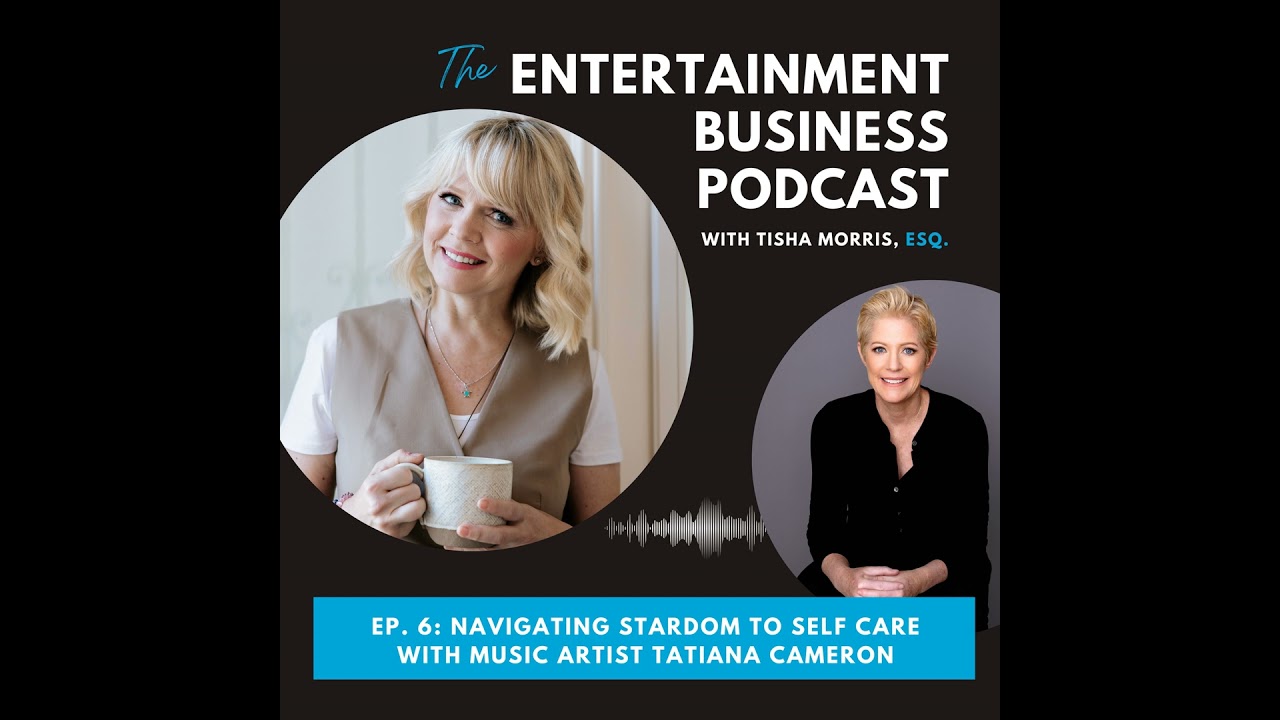
Croatian artist Tajci Cameron went from teenage pop stardom and Eurovision to a three-decade career spanning music, theater, and authorship. Relentless touring damaged her mental health, so she became a holistic life coach for artists and now runs wellness cruises in Croatia. She breaks down red flags in music contracts and why touring musicians need to prioritize sleep and nutrition.
Chapters
Welcome to The Entertainment Business Podcast. I'm your host, Tisha Morris. Join me as we go inside the entertainment industry of film, TV, books, music, and all content creation, where we'll weave together the creative and business of entertainment with practical tips, inspirational interviews, and insider information of all the latest trends. And with that, let's get on with the show. Hello and welcome to today's show. I am so excited for my guest, Tatjana Kameran, also known as Tajci. She is an accomplished musician, songwriter, published author, and a certified wellness and holistic life coach. Tajci's journey began as a teenage pop sensation in Croatia, and as a platinum-selling recording artist, her fame included the creation of a Barbie doll in her likeness. Despite her success, Tajci made a remarkable choice to leave her label and embark on a journey of self-discovery in New York City, studying musical musical theater. Over the past 3 decades— that's 30 years— she has performed at Madison Square Garden and Carnegie Hall, produced live shows across the United States, and toured with her music all across the world. Her career includes the release of 7 albums, the creation and production of a full-length musical, co-founding a children's theater, producing the TV show Waking Up in America, and authoring 5 multimedia books. Not to mention, she's also co-authored the song Windows in the Wall recorded by Olivia Newton-John. More recently, Taichi collaborated with Grammy-winning songwriter Steve Leslie and Grammy-winning arranger Jim Gray to create the hit single Holding Out My Hand, which she performed alongside a symphony orchestra in Croatia. Taichi offers a range of online courses as a coach and hosts transformational immersive cruises in Croatia. She now resides in my hometown of Nashville, Tennessee, where she provides mentorship at the Tennessee State Prison for Women. And somehow amongst all of this, she has found time to raise 3 remarkable sons, all of whom are also uber talented. Tatiana, thank you so much and welcome.
Thank you. Thank you for inviting me. I'm honored to be here.
Oh my gosh. So you've been— not surprisingly based on your bio, you have been really busy this summer. You've been touring all over Croatia mainly, correct? You just got back to Nashville?
Yes, yes. And, you know, funny, when you read the bio, it's like, I feel like, wow, that's a lot. Like, it sounds like so much, but it is a long time and over a period of a long time. And when you are a creative, you know, as a creative, I think we're able to do a lot in small pockets of time. Even though it might sound crazy and chaotic, it's really not. It's, you know, instead of like watching TV, I raise children. No, I mean, not really, but you know what I mean? It's like instead of watching TV, I write something and then it becomes a book. That's the beauty of being creative. I remember when I was very young, somebody said, you really have to like just pick one thing and go after it. And I said, one, I don't want to have one thing because I have so much inside that I want to explore and be curious about. So yeah, that's how I still, you know, although this, this wellness coaching piece comes as my own need, as a result of my own need to take care of myself, to, you know, you do come after, after 3 decades of touring, of being a musician, right? You come to a point where you're like, okay, my body needs a little bit of extra self, self-care and nutrition and rest. And so I became certified life coach to pretty much help my, my touring self first and then others.
Yeah, I was gonna ask you about the coaching. And I recently attended the Music Business Conference in Nashville, and a big, big theme, um, is mental health. Um, I mean, obviously not only in the music industry but specific to the music industry, and the same You've, you've, you've, because you are a career musician, you've known the importance of one's well-being. So let's, yeah, so let's go ahead and dive into how your wellness coaching plays into your career as an artist, but also helping others.
Yeah, absolutely. Thank you for bringing that up. So, you know, I, I became, so I've been in the music business since I was 4. Literally, like, I started at 4 performing at this beautiful events, music events with symphony orchestra, Philharmonic Orchestras. And then I started doing my music conservatory, and, you know, just to—
it—
my path unfolded with me being 19 years old and experiencing this amazing fame, this superstardom, this like blowing up. I, I won a contest which was kind of like American Idol, but it would But on steroids, like, you know, it was just everybody's— because it qualified me to perform at Eurovision Song Contest. And I don't know if you all know here in America, but Eurovision's big, huge. I was just in Sweden. Yeah, I was just in Sweden for this year's Eurovision because I was invited by my fans to do an after-party. And it's such a tight-knit community, it's huge. So it creates that kind of, you know, fame and, um, a lot of love. You experience, you receive a lot of love from the fans, and you're constantly on the verge of your— constantly like your adrenaline is up so high, you're constantly on a high. And being 19, as I was at that time, nobody told me— this was again, you know, in '90s, early '90s, we didn't talk about mental health. We didn't talk about the importance of meditation, the importance of boundaries, the importance of self-awareness, you know, needs. And so, and this happens to a lot of musicians and a lot of creatives, a lot of people who are in passion work, right, that we don't stop to rest. We don't know how to get down from that high, right? And so unprocessed, unprocessed joy, unprocessed exuberance, unprocessed amount of incredible intense energy leaves a mark, right? So I crashed so badly when, you know, 30 years ago I was 19 years old, super famous, constantly crashing and asking myself, what's wrong with me? I am. And then, and then, you know, like everything that we heard, you know, insecurity. Well, you're just not cut out for this, right? You should be stronger. You should be this. You're lazy. You're not resilient. You're too sensitive. You know, man up, woman up, whatever, right? And so all of that creates even more insecurity, even more confusion, and we break, um, you know, or we start drinking, taking, uh, you know, um, just leaning on anything else that can kind of numb that pain, distract us from— because it's painful, right? So yeah, so that was, that was really— mental health was kind of, you know, the absence of support for mental health was what left me in a place where I I didn't protect myself from my contract, from my producing team, setting healthy boundaries, and actually set me on this journey. I left. I literally ran away from that pressure, from that fame, from just this place where I didn't know how to help myself. And that's really where I am now. You know, I want to share from my personal experience and the tools that I've learned as a coach to help artists to not have to do that.
Yeah, you know, I guess I haven't thought about it in such a focused way as now, how important that is. Like you said, the highs, like, I don't really, like, my day, I don't, this is about as high as my day gets, which is with interviewing you is a great high. But being a mom, you know, in front of thousands of people and hearing that applause and coming down from that. I've actually thought about that in terms of Taylor Swift, this with her huge tour going nonstop and like how she's going to come down from that. It's an extreme example, but it's true for all artists. And when it's, when it's just your living room and it's quiet, which is really what you kind of probably need for recharging, but how do you handle that quiet?
Yeah. And what fills that quiet? You know, are we— do we have the self-awareness to know that we are not— my identity is not who I am when I perform. I am still a loving, a lovable person when I just sit in that quiet room, right? When I don't have my makeup on, when I'm not a superstar. Right? When I wake up in the morning all crumbled up and tired, I'm still lovable.
Wow. How many decades has it taken for you to get to that point?
Ah, many. Yeah, it was actually around my 40th birthday that I finally had hit that turning point where I, you know, because, and I write this a little bit in my book Unbroken, about this process of, you know, running from a continent to a continent, just because I came from Croatia to New York, and then when I hit that place where, okay, I'm— it's just again, like, I don't— I want to jump out of my skin, right? I just packed my bags and I went to Los Angeles, and the same from Los Angeles to Cincinnati. And then I was in a marriage that I was just not— again, like, I just wanted to jump out of my skin, but I had children, and I realized I'm going to run out of continents if I keep running. So let me go on a different journey and just turn inward and find who I am in that silence, in the quiet.
So, you know, in reading your bio, I, you know, I know you pretty well, and we met during the pandemic, which, you know, for everyone was finding a new level of self-awareness. And I know we kind of have a trauma bond because it was a difficult time of life for both of us. So I would consider that period as kind of a period of reinvention. But in reading your bio, you've had a lot of those periods or stages. Talk about how important it is as an artist specifically to— we use the word reinvention, but I think what it is is just finding new aspects of yourself creatively and personally, which you just kind of touched on. But talk about how that is for an artist of, of finding, or what we think of as reinvention, but I think it's probably more than just reinvention.
Yeah, for me, it, I guess to me that says, um, meeting the parts of you that you haven't met before, or meeting the parts of you that maybe you suppressed before, or maybe you were a little bit uncomfortable with, or maybe you just didn't know was there. You know, it doesn't have to be always stuff that's uncomfortable. It could just also be something that we didn't even know was there. I was just talking to somebody, a process where I was saying, but how do I— they were saying, well, you should have known. But how do I know what I don't know, right? So just take it with compassion and just being open and curious about all those parts that you— that are there. That will show up. And I think for us, the pandemic was— for me, it was such a difficult time because, as you know, Nashville shut down. And it wasn't just coming to, you know, dealing with my own loss of my tour, my work. And my husband had died just, you know, a few years before that. So I was just getting back on my feet. And I should say my husband was my business partner. He was my booking agent and manager. And so it was, it was, it was shocking, but more so seeing the trucks, actually seeing the physical trucks being parked, you know, running into so many musicians and creatives who were without work. The whole industry, the support part of the industry was even more horrifying. And it was the first time that the music stopped, right? Like the music didn't stop, but the truck stopped. Yeah. And I do have to say, Tisha Morris Morris, that I'm so grateful that I ran into you and what you provided at the moment was so, so beautiful. Just how you guided us through, because I attended your, your writing groups. How you guided us through that reinvention was really beautiful. And I want to encourage all your podcast listeners, be in contact and check out all your stuff because it's really, really, really, really amazing.
Oh, well, thank you. So that time, I mean, yeah, not performing and talk about the quiet. The quiet was really quiet. You found ways of doing, you know, concerts online, but I think you found that deeper gear level within yourself. Until we've had certain life experiences, do we have the opportunity to have new aspects of ourselves.
Yeah, I do want to read you a quote. This is, this is, this is what— this just opened up my eyes and, and kind of like, it speaks to what we're talking about now. Okay. And my middle son, I have 3 sons, the oldest Dante is 24, working for a VR agency. The youngest is a filmmaker, a freshman at SCAD. And my Evan Amadeus, who is my middle son, he just graduated SCAD with a degree in UX design. And so he was asked to make his portfolio, and he wrote, "To define myself, for now, I've decided not to." I'd rather the edges of my brand be rough while the soles of my shoes become worn. And so I wanted to share this quote because this is exactly reinventing, allowing yourself not to brand yourself so tightly, but actually just allow your soles of your shoes to become worn until that moment, right? Until you wore out your journey. You are constantly reinventing yourself. You allow yourself to be curious about who you are, how you can create as a musician throughout genres for me, because I sing jazz and pop and country and inspirational music and write as a writer. And even like, in one of my books, Unbroken, I include my own doodles. I'm not a visual artist, but why not? Be curious, be free.
Ah, yes, yes, yes. All right, so let's talk a little business. Um, you've been in the career for a very long time.
Yes, child.
Um, you've seen, you've seen and had some good deals and some bad deals, and you've obviously learned what you, you now can see the red flags. Tell us some of those red flags you've learned.
Well, first let me say that, you know, as, as we just had this beautiful, you know, um, spiritual, uh, music, right, right. This is a kind of a place where when you are feeling in this creative, just amazing, passionate, fulfilling place, you don't wanna, you don't wanna read any or sign anything. Like, that's the time when you just want to say, okay, you know what, let me— when I come down, right, when I get out of my high, I'm gonna call my lawyer, my attorney. Always have— there's always Legal Aid Society, there's always ways to get an attorney. You don't ever, ever have to sign anything without somebody looking it over. Okay, so that for me, I just want to say that because I made that mistake. Um, and when I was— so when I won this competition in Croatia, I was on the super high. I mean, I was not even like— I think legally I was not like— if I really like— it was 2024, and I bet if I went to a court, I— they'd say, yeah, she was— it's like I was drunk or drugged, right? Because— and because my manager literally caught me in that high and said, now you have to sign. They have to— he said, now sign because this is going to protect you from all the bad guys out there, right? So you feel vulnerable, you feel emotional, you got your— like, you want— you love what you want, what you do. And I signed, and I, I literally signed my life away. It was such a bad contract. They still talk about, like, I'm in Croatia, I go back like, oh yeah, yours is like one of the worst contracts ever.
In the Museum of Bad Contracts, yours is framed.
Yeah, so the red flags is, you know, first of all, is are the, are the people who you're signing with, are they encouraging you to get, get an attorney, to get legal advice? If not, run away. Okay. And second of all, I always, I learned to look for exit clauses. Like everything's great when everything's great, all the contracts are, you know, everything's great. But really when things go wrong, how easy it is to leave. Yeah, right. If there's no exit clause, I would be like, I'm not sure I want to sign this.
Great advice. I couldn't agree more.
Well, it's just from personal experience, unfortunately.
Unfortunately, I spend a lot of my day thinking about things that can go wrong, um, and you know, that's what good attorneys do. Um, but I also am optimistic that things will go well. And what are some of the things you look for when you feel that? What are some, like, whether it's intuitive or practical, of when you, when you are partnering with someone, when it, when it works out really well? What are those?
Well, I mean, it's, it's, uh, collaboration is a beautiful thing. And for me, the best experience is when everything was communicated and is communicated ahead of time. When there's no, you know, awkwardness, when there— everything's put on a table, there's, there's— and, and, you know, again, everything that is known is put on a table because obviously everything's changing all the time. But when you have that level of communication, then you, of course, you create that trust. And in that trust, you can, you can bring up all kinds of situations, whatever comes in. You know that you can trust because— and you have open communication, that solution can be found. Yeah, because things happen, life happens, you know. You might, might get an opportunity, right, that you didn't think about, and now you have to split the money, you have to split, you know, the cut might be different, you know. You, you might be— if you're collaborating with somebody and you are the one that's placed the, the work, and you feel like, well, maybe I contribute a little bit more How do you communicate that? And if you're afraid to communicate, that's a red flag. Yeah.
Yeah. So much about expectations. And yeah, and I love what you're saying. Communication, open communication.
Yeah, absolutely. Yeah.
Any advice for young artists that may be below the age of where they are when they are relying on their parents or manager?
You know, it's a challenging question because I look at my own sons and what do I give them? What advice do I give them? And I find myself just saying, you know, be curious, stay open to the opportunities. You know, don't be— that's it. You know, just be curious and be open to the opportunities. And then have somebody watch your back. Because if we're always, if we feel we're alone, especially young people, right, you're always gonna, you're gonna bring that caution, that anxiety in, that fear, which might narrow down your path, right? You're always gonna be like on the lookout of who's after you, who's after you. Hurting me or taking part of me. And that's just not a good place to be as a creative. So have somebody who is watching your back, whether it's a, you know, could be a parent, but could be also somebody from the industry. Um, I would, I mean, I, again, you know, I am a coach now, but I know that if I had a coach when I was at the height of my career when I was 19, things would have been differently.
Different.
Yeah, you know, I would have been able to then calm myself and get into that good place, mind— in my mind and emotional, mentally and emotionally, from which then I could seek, uh, you know, legal help and, and professional help.
As a coach, what do you see some of the What are some of the bigger blocks that you work with? I assume you coach not only artists but all kinds of creatives.
Yeah, I think, you know, the most— the biggest problem right now, biggest challenge is really how to stay healthy, physically healthy, especially if you're a touring musician, especially any kind of passion work. You get to— you start working, you know, and before you know it, it's 8 hours later and your neck hurts, your stomach hurts because you're hungry, and then you eat something that you're not supposed to eat or you eat, you know, unbalanced diet. And the food that we consume these days, it's really not that great. I was just in Europe for 6 weeks and I have to say I came back to America and I was like, what is happening? How can we eat this poorly, right? When I, when I cook at home, it's a different situation. But if you're out on the road, it's really hard. So I would say really taking care of your physical body as a creative, that's huge. 'Cause I think that's creatives often, again, like you're, you know, you feel that high, you're driven by adrenaline. It's difficult for us to stop, to interrupt that flow, right? And say, oh, let me go make some nice little meal, healthy meal, right? Or let me go work out. And I understand, 'cause when the inspiration hits you and it's there, you just take it, right?
Right. And probably sleep also comes into a factor. I don't know. Is it true or a myth that creatives, like creatives, particularly musicians, like to work at night?
Well, I don't know that we like as much as, you know, if you think about it, like, I, um, I like to go to bed, let's say 10:30, now that I'm, you know, aware of what my body needs, right? But if I have a concert that starts at 8 and it's, it's ends at 9:30, 9:45. By the time I do my VIPs and meet and greets, it's 10:30, 11. By the time I get home, it's midnight. I'm on such high that it's impossible for me to calm down in, in 15 minutes. So there you go. There's— it's already 1 AM.
Yeah.
Right. And we all know that sleep is about regular pattern. So that is very difficult for musicians. My, um, one of my health and wellness teachers at the Chopra Center, because that's where I got my most recent, um, certification, she said, now, yes, the sleep regularity of the sleep is hugely important. However, if you are doing something that it is a part of your purpose, you know, it's not as bad, but still, like, then when you're, when you're off tour, try to, try to get, you know, stabilized.
Yeah, yeah, yeah. Great advice. One of the cures for, uh, wellness is, uh, what you're— you have a cruise in Croatia coming up. You do these somewhat regularly, regularly now.
Um, yeah, so I, I still have 3 cabins. So now it's— we're talking in June. I have 3 cabins. The, the— this year's cruise is September 28th till October 5th. So it's 7 days on this beautiful yacht in Croatia. And yes, I do it, do them every year. I obviously took a few, few years off during— because of the pandemic, but now we're back on a yearly schedule. So anytime that you're going to go to Croatia with a local Croatian, you— it will be health and wellness experience because just the lifestyle is so different. You will reset. You will remember what life is about, just how life comes with ease. The food in Croatia is exceptional. I mean, we also have junk food in Croatia, but if you eat, you know, the Again, if you go with a local who knows, who will guide you to get the good stuff, you know, the air, the, the, this, our Adriatic Sea is one of the, just got recognized as one of the cleanest seas, body of water in salt water in, in the world. The, the way that the, the sea is and the air is is really medicinal. Like, people actually go to certain places in Croatia to be— for benefits from— for many lung disease diseases. So, but then on top of that, on my cruise, we have meditations in the morning, we have a wellness team, the yoga that we do, yoga sessions and deep tissue massages and sound baths. And then we have music every night. We stop in different fishing villages. They're tiny little places where you can't, you know, they say, people say, oh yeah, I went on a cruise to Croatia on the big cruiser. But yes, then you just visited two ports and you just missed the whole thing. And each night we gather around the table at a local tavern that I picked. It's not like, you know, necessarily where the tourists go., and we have this beautiful experience of just sharing food and, and music because food and music go together.
Oh my gosh. That sounds amazing.
Yeah.
So, um, if you're listening, check it out, um, tatianacameron.com and all the information on the cruise, you can find it there. If, if someone, um, wants to kind of an entry point into your music and experience some of your music, where would you, um, what would you suggest, or is there a certain album that's kind of like one of your favorites?
Or, uh, well, I mean, if you, if you land on my website, tatianakameron.com, I have, you know, I have links to Spotify and YouTube and everywhere. So because of the algorithms, of course you're going to get a lot of stuff from, from the '90s because, you know, as I'm touring Croatia again, this is like now a big revival of my, uh, hits from 30 years ago. The new generations are finding it and everything's retro now. So I'm right. I'm like really hot in the retro.
I love it.
I'm not that old, people. I just really started super young, but I love it. And, um, so you're going to hear some of that, but you know, also on my YouTube channel, you can see some of my new stuff. I do have to say that I have not, I'm working on a new, uh, new material now. Um, so I don't have a lot of new stuff. I enjoy doing covers at the moment, but like, you know, you mentioned Holding Out My Hand. That's my, most recent song that I recorded. It's, it's really gorgeous. It has such a beautiful message. I'm not— I'm only saying this with totally being humbled by it because, as my co-writer Steve Leslie said, you know, some songs we write, some songs we write down, and this song we wrote down. It was just there. We just wrote it down.
Mm, I love it. Oh my gosh. Um, yeah, your Instagram, Tai Chi Cameron, um, is your Instagram handle. Um, you have concert footage on there. Um, uh, and I get to follow you all over the world. Um, so check out that again, tatianacameron.com, uh, Tai Chi Cameron for Instagram. Um, thank you so much for— I know you have like such a busy—
Absolutely. If I can be of any help to any of your listeners, you know, find me on Instagram. I also, I'm also on Patreon, and there we have, um, I, I'm a captain for Professional Musicians A Club, where this is another great source for support, especially for musicians. A lot of great support we get. Um, so yeah, don't, don't be alone. There's my dog, sorry. Yeah, don't be alone.
Yes. All right. All right. Well, thank you so much. Check out Tatiana's Patreon, and thank you so much.
Thank you, Tisha. Thank you.
Thank you so much for listening to today's episode. If you If you like the podcast, please like, subscribe, maybe even share to your friends. And for more information about my services, visit my website at tishamorris.com. That's T-I-S-H-A M-O-R-R-I-S. Well, that concludes today's episode, and I wish you all the best. Until next time, keep creating and please take care.
More from Tisha


PSA for Authors Using AI #contentcreators #writers #authors #creativecontentcreator



THE SCREEN PLAYBOOK 🚀A Writer’s Guide to Negotiating Creative Rights Like a Pro





Unlocking Actor Potential with LA Acting Coach Murisa Harba on The Entertainment Business Podcast

Episode 19: Unraveling Foreign Rights in Publishing with Agent Marleen Seegers