Episode 8: The Art of Human Storytelling with Award-Winning Narrator Julia Whelan
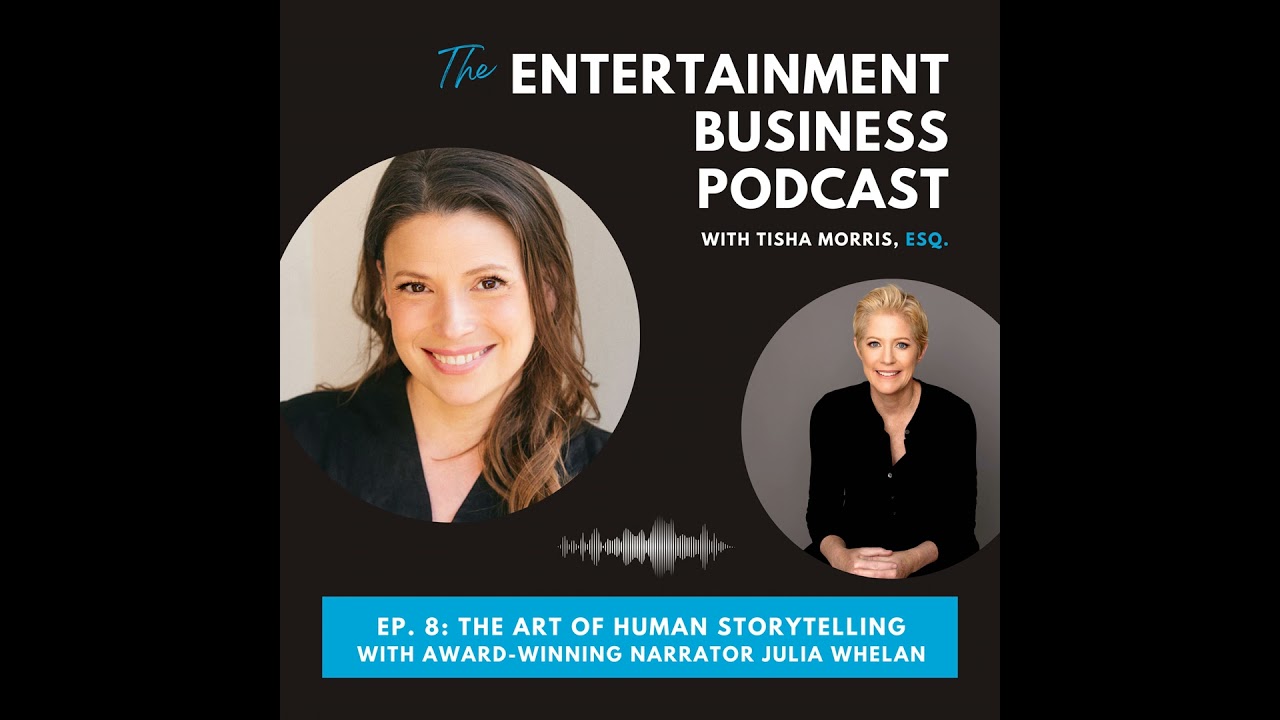
In this Entertainment Business Podcast episode, host Tisha Morris interviews Julia Whelan—award‑winning audiobook narrator, author, screenwriter, and founder of the ethical audio publishing platform Audiobrary. The conversation explores the overlooked role of narrators in the booming audiobook market, exposing how current royalty structures, union contracts, and distributor fees leave narrators underpaid despite the industry's $2 billion annual revenue. Whelan outlines the threat posed by AI‑generated synthetic voices, arguing that human storytelling offers an irreplaceable emotional connection and should be protected through ethical distribution and royalty models. She details Audiobrary’s mission: a narrator‑centric publishing house that offers royalty shares, wider revenue distribution, and a direct‑to‑consumer app that avoids the 60‑75 % cuts taken by major platforms. The interview also covers practical aspects of narration workflow (a 4:1 time‑to‑finished‑hour ratio), unionization under SAG‑AFTRA, challenges of rights ownership, and the importance of preserving authentic voices for children’s content. Light‑hearted personal moments about tea, baking, and Whelan’s background as a child actor round out the discussion, while she shares contact channels for Audiobrary and her own social media.
Chapters
Welcome to the Entertainment Business Podcast. I'm your host, Tisha Morris. Join me as we go inside the entertainment industry of film, TV, books, music, and all content creation, where we'll weave together the creative and business of entertainment with practical tips, inspirational interviews, and insider information of all the latest trends. And with that, let's get on with the show. One of the reasons I started this podcast cast was to explore all the different forms of entertainment and discuss the business and creative sides of all the mediums now available. Today I'm focusing on an area that doesn't get talked about too much, unless you count the fact that it's a multi-billion dollar industry that continues to, continues to grow around 9% each year just in the United States alone. I'm talking about audiobooks. But the audiobook industry is usually discussed in terms of the author and publisher. Not from the perspective of the most important part of audiobooks, the narrator. This has been an overlooked aspect of the industry. That is until now. My guest today has been called the Adele of audiobooks by The New Yorker. She is an author, screenwriter, lifelong actor, and if you listen to audiobooks at all, then you know her voice as the acclaimed audiobook narrator of over 600 titles. Her recent novel, Thank You for Listening, was a best of the year pick at Amazon, Audible, and NPR. She's the founder of Audiobrary, a new audio publishing company and app, and her latest books, the 8-part romance audio series Casanova LLC, debuted exclusively on Audiobrary. She is also a Grammy-nominated audiobook director, a half-decent amateur baker, which I'm happy to, uh, come to the conclusion about that. And she is a certified tea sommelier. Welcome the one and only Julia Whalen.
Thank you so much. That was lovely. Thank you.
Thank you. Well, I have, I want to start with a quick little story. So in 2013, um, I moved from Nashville to LA and, um, I drove cross-country on I-40 and the audiobook that I listened to, you can probably guess.
Was it Gone Girl?
It was Gone Girl. Hey, it was Gone Girl. That's about right, the right time. Yep. And what that audiobook did for me is it spoiled me and I could only, from that, from that audiobook on, could only listen to audiobooks narrated by this woman, Julia Whelan. Oh, and so, um, seriously, I'm like, have such a finicky ear for audiobooks and I would only listen to books that you narrated. And, um, so last year when I got to meet you in person, it was a total fangirl moment. Um, we met in, uh, Nashville at the Writers Conference, and you, um, are as lovely in person as you are, um, on audio and your voice.
Well, thank you.
It's a pleasure. Um, so you've started this, uh, company Audiobrary. Tell us, um, tell us about it and what you hope to change about the audiobook industry.
Sure. Thank you for giving me the opportunity also to talk about Audiobrary. I feel like I'm just kind of on like a message tour right now to explain the industry, how it's broken, and how I'm trying to fix it. So I, you would think my pitch would actually be a little stronger. It's not. I keep, I keep honing it each time I talk about it, but here's what I was coming up against. There were two things that I could see happening in audio that were not making me happy. One is obviously like so many jobs, this shift, this encroachment of, of AI. And we have an industry where they will say statistically that something like 96% of books actually don't have an audio version. That's misleading because some of those books are unadaptable to audio. They're, they're visuals, they're graphs, they're things like that, right? But There is a definitely, um, it's underserved and there is an accessibility issue with this as well. You wanna have as much content books as possible on audio for people. And I'm not anti-AI in that I, I can see the purpose it could potentially serve. I am however, very protective of human storytelling. And to understand that any sort of text-to-speech model is going to be an inferior product, and they are not the same, and you can't just swap them out. And consumers are savvy, and they, as you said in your lovely introduction, they have a certain affection for the voices that are— that come into their heads, and they are picky. And what I could see happening is that, as often happens with an industry, that grabbing for the low-hanging fruit of, oh well, this will fix all of the audio production problems that we have. We will just start using synthetic voice. And I don't think that's fair to listeners. It's certainly obviously not fair to audiobook narrators, and it's not fair to authors who are real people with human intelligence who wrote books, who deserve to have real people record them and care about them the way that Narrators do. So part of this is shoring up the future of human storytelling where when I think a lot of the larger conglomerates are going to shift to a text-to-speech model because it's cheaper, I want Audiobrary to be a refuge for the people who still care about that, whether it's authors, narrators, or listeners. But part of that making a sustainable future has to do with the fact that the money in this industry is so broken and is so bad. To your point, we have had massive growth over the last decade. Traditional publishers made $2 billion in audio last year. It's really pretty much the only part of publishing that's reliably in the black right now. Our rates have certainly not gone up in a commensurate manner with that. Union rates for audiobook narration are about, I don't wanna, I can't be specific about this, but it's, I'm gonna say, let's say on average maybe $250 per finished hour. So we're not getting a lot to begin with. To be a middle-class narrator, you've got to do— I was doing 70 books a year when I was doing it at that rate, because that's what it costs to support myself in Los Angeles, right? The biggest problem is that we have no backend. We do not get royalties the way authors do, obviously the way publishers do. And as someone who spent my— I was a child actor. I've been in Hollywood for 30 years. This idea was always just so ridiculous to me. Like, I get royalties, I get residuals on Lifetime movies I did when I was 12, and you're telling me that I get nothing for Gone Girl? So that's the other part of this, that we have built a narrator royalty into the business model.
Wow.
Let's stop there for a minute.
Yeah.
So there's a lot more, but that's— That's really it. If I— it's to me, it's like, if we're gonna— if this existing system is going to burn down, then I, instead of everybody pulling out their hair and feeling they're not— they can't stop it, I, I really want to say we could reimagine the future of this. We could just do it. We could build different structures. That's where I'm at. Yeah.
I mean, we are at an inflection point in in all industries because of AI. And it is, it is a moment, and it's a very, very quick moment that we have right now of reimagining these structures. I mean, there is the— that we're now coming into the high touch, the high human touch, which is in this case, you know, your actual voice reading, you know, narrating. And you have then the high tech, which is just, um, you know, a machine reading. Um, and those should be, um— so now I think the more, the more tech we go, the more valuable that high-tech human touch is going to be.
See, that's my gamble about I mean, I look, I could be totally wrong. I could be betting the whole farm and like no one's actually gonna care. And at the end of the day, I'm gonna get wiped off the board. It's very possible. But I am betting on a historical precedent that says when electricity was invented, candles didn't go away. We give candles as gifts now. It's a bespoke thing. It's a human connection thing. It's, it's something elemental. And I don't think there's anything more elemental than human storytelling.
Yeah, I mean, I don't think we're— I mean, I hope we don't get to the point where we just hear a mechanical voice and just take it as it is. I mean, there's such energy in your— there's such an energy in the energy conveyance that happens when you— when you— yeah. And look, their model—
the models are going to get better. Like, the one thing they're going to obviously do is improve. I think we can bet on that. They're already pretty good and they're going to get better. And there may come a point where you really can't tell the difference, but you can know the difference.
Yeah.
And for certain people, I think that's going to, that's, that's what I'm, that's who I'm talking to.
Yeah. So Audible obviously has your, um, your, tell us about your, your 8-part, the Casanova LLC. I did listen, um, to the excerpt on the site and oh yeah, it's so good. Oh my gosh.
Um, so yeah, this was okay. So my second book, as you've mentioned, was Thank You for Listening and it was a rom-com set in the audiobook world and it's about two two narrators who fall in love while recording an audiobook. And the premise for that book that they were recording started as a joke. I didn't even need it to be sexy, I just wanted it to be funny for the purposes of this rom-com and to give these two characters something to bond over. So I came up with the most ridiculous romance novel premise that I possibly could, and it was a second chance romance, um, with a gigolo. Who happened to be descended from Casanova. But somehow in the writing process of Thank You for Listening, this book within a book took on an element of depth that I wasn't expecting, and I could not let these characters go. And it was suddenly, like, very important to me, and I couldn't not move on from it. So I wrote it, and I wrote it the way that it was intended to be in, um, in Thank You. It's an 8-episode audio series. I'm releasing the ebook, um, actually on August 2nd, which is the second anniversary of Thank You. But, um, that was just— the people just were asking for it, so I decided to do it. The main point was for the audio series.
Nice.
And I used it to launch, uh, Audiobrary.
You obviously would have— I would think, all right, as you're writing, the voices are obviously talking to you, I imagine. So you already have these the voices created in your head for when it comes to deliver the audiobook version. How does that work when it's other people's characters? Do they kind of audition their voices for you in your head, or they just kind of drop in? How do you channel these voices?
Sometimes they're very clear to me. Sometimes it's just those characters speak to me when I'm doing my prep read. Sometimes if I feel they're maybe a little contradictory or I don't quite have my finger— I haven't quite pinned them down, I will ask the author often, like, if they had an actor in mind when they were writing, something that just kind of helps me zero in on it. And, you know, I get a lot out of repetitive reading, so if I don't quite have it, I will just go back to the text and keep reading it again and compare scenes and see if I can find some kind of throughline.
That brings me to more of a business question. And, um, you mentioned before the, um, the finished hour. That's very different than the actual hour. So for a, let's say, a 10-hour audiobook, or it takes 10 hours to read or in the, in the, or listen to, for every hour, how long does it take on your end?
Totally depends on the book. Some books are more research-intensive than others. Obviously, some books are just harder in the booth to do than others. But on average, I would say it's about a 4-to-1 ratio because I have to read the book obviously ahead of time. And what— and that's a slow read because I'm making notes as I go. I'm keeping a character list, I'm keeping a word list. Then I'm reaching out to the producer or the author and getting answers to any questions that I have. And then the recording process is about 2 to 1. So yeah, total it's about, it would be about 40 hours of work for a 10-hour book, which is why that union minimum gets cut down a lot when you're factoring that in.
Right. So yeah, audiobook narrators can become SAG members or it falls under the jurisdiction of the Screen Actors Guild. So. Bernice?
Yeah, we actually, I mean, this was so fun. I just feel like we finally like got our head above water and then AI came and like slapped us in the face because we spent 10 years ago where there was a very concerted effort to finally unionize this part of the business and to bring it in. 'Cause so many narrators were actors, we were already SAG members, right? So we were like, why doesn't this work count toward our health and retirement? And then the unions merged and so it became SAG-AFTRA and it, we just, we were able to pull all of these audio companies under union contracts. So yes, at least that, at least it is counting toward health and retirement. But that was a very concerted organizing effort and we had, it was a fight. It was a fight.
With AI, I mean, I would imagine you have concern about your own voice and how to protect it in the, upcoming climate?
I mean, I think the thing is like that the toothpaste is out of the tube on this because part of what I think we're seeing this with authors— authors have finally understood that probably their, um, their material was used to train these models. And with audiobook narrators, it's even worse because we're not rights holders, so we have no control over the content. There's no one for us to sue. There is all of our work has been put into a blender and we have been teaching the machines how to act for years. And there comes a point with especially voice cloning or something like that where people are allowed to do impressions of people. We will see this in car commercials, right? And you would have a disclaimer saying, you know, this isn't— but as long as they're not saying your name, they can do it. And I think, again, this is a— this is all a Wild West sort of thing. This is all this new frontier. And I just— I have a hard time worrying about it because it's going to happen. And I've been arguing this for years that we need to be focused on what we're doing, what we are doing and how we're taking care of ourselves and what we are building to— now there's two products, right? Like, it's a comparison now. Before, there was like one mode of production, and now it's not. And so what are we doing to shore up our industry? I can't worry about that side of it. I really can't.
This is a big, big, big issue. It's a big, big industry. Yeah. Or it's gonna— it's becoming more of an industry, and, and there's gonna be more companies coming on board to to scour and prevent the thievery. Right.
It's the thievery that's the thing. I mean, consent and compensation is, as you know, that's what we're talking about. And the thievery is just particularly thorny in a narrator's case because, like I said, we're not rights holders. So when we do a project, we literally sign it away to the publisher. And it's really the publisher's job to go and fight that battle.
Yep. Right.
And they're fighting other battles right now.
Yeah. So let's say, yeah, so like all roads are leading back to Audible, um, and it's really the model, um, not only for, for, um, for rights and, and actual royalties that you deserve, but also preserving it being a safe place for, for voice artists. Um, so tell us how it works. It's an app. App-based, correct?
Right. So the other part of this, so everything we're talking about could be achieved, um, just by being an audio publishing company. And that is what we are. We definitely do that. We are acquiring titles and we are producing them and we are doing at this point, um, about a title a month. Um, and hopefully that will just increase, but we are also a direct-to-consumer distribution, uh, channel. So you can go to the Audiobury website, purchase the product on the website, and it will be delivered to the app. Just kind of like Audible, especially old-school Audible, the way that that used to work. Um, and I had to do this because the other part of the industry that is broken is the fact that distributors on audio particularly— this is not true of ebook— But on audio takes such an exorbitant amount of revenue. In, for Audible, we are talking about anywhere from 60 to 75% of any revenue coming in on audio off the top is gone to the distributor. So this affects publishers. It obviously trickles down to authors. And if narrators got royalties, it would affect us too, but it doesn't. So, um, we will be distributing wide. On all of these other channels because I, again, this accessibility is important to me. I'm not trying to do what Audible does, which is just have exclusive titles and originals that no one can access unless you're on Audible. I think going wide is fair and it feels ethical to me, but the more we can drive people to Audiobrary, the more revenue that authors are getting and narrators are getting by a factor of about 4 times.
And like you said, the, the important, the increasing importance that the audio is delivered in with integrity.
Well, and that's the other thing. I mean, I had people, you know, right at the beginning, we launched January 1st, Casanova, the first episode of Casanova dropped on Valentine's Day. And in the month of January was when Findaway updated their terms and conditions to basically say like, you upload your stuff to our site, we can use it to train. Language models. And everyone went, whoa, whoa, whoa, whoa, wait, what? You're just a distributor. Like, are you kidding? The overreach was just unbelievable. And I had a lot of people reach out and say, can we just put it on Audiobrary? And I, first of all, we did not have the bandwidth to do that. I also don't foresee the platform as being audible. I really want like a curated collection and our originals. That's how I'm envisioning this. But You can see this, this need for some kind of like ethical distribution model that is— what is out there right now is really scaring people. And the overreach is just, as I said, just insane.
Yeah. And that's happening in all sectors. Adobe, their terms of service changed and anything you create is—
can be—
they can use and like you can't— you have to click in if you're going to use their product like overnight. You can't just switch.
How you creators create, um, uh, on, on, uh, no, we had this, we had this moment where, I mean, this was like right in the, the belly of the beast of like getting this thing launched and no sleep and like making sure the company— I looked at my husband, who's my co-founder, and I was like, okay, here's an idea. We could just be a distribution platform and we could just do that. And then like people would give us their stuff and everyone would be happy and we wouldn't need to do this, like this amount of work. How does that sound? Um, but yeah, I, I mean, you have to believe at some point somebody like this is gonna get reined in. Um, but I also just stopped trusting that corporations have a conscience. So I don't know. I don't know.
Yeah. So it's people having a conscience and then, I mean, I would think even like, I'm just thinking like parents with like children's books, like I would want my children to listen to real voices. Um, right. Yes.
And we're actually looking at children's programming right now, and this is a very— that's some of the discussions we've been having is how to, um, create a human connection, particularly for kids, uh, through, through the app.
Yeah. Great. Well, speaking of children, I want to go back to your pen, to your past. For a child actor. Um, when did you— I mean, so obviously you're, you're talking and using your voice and acting, but at what point did you realize your voice was, was going to be an important tool for you?
I, I don't, I don't think I ever had that moment of realization. I, um, I have extensive theatrical vocal training, so like I've always had that. I developed that as a As a kid, I was part of the Lesac method, particularly was the basis of a lot of my acting training. And so I knew I had a good voice that had a lot of range and I could, um, but to me I was just applying that to whatever character I was playing. It wasn't necessarily, necessarily a thing that I knew. I like, oh, I've got this great voice. It was just like, no, I have, I have a good instrument that I can use for the purposes of all of the other stuff that I do. And so, you know, I think I was probably 5 or 6 years into narrating audiobooks before it occurred to me that— I think a turning point actually, okay, so sorry, I'm just putting this together in my head because I haven't thought I've been asked this question before. I started narrating journalism in January of 2018 for an app called Autumn, which has now been I actually became head of production there. I was the first hire there. And I, so I've been, I've done this like tech startup thing before and promised I'd never do it again, but now I'm doing it. But I started recording journalism and I think that that was the first time where I wasn't acting, I wasn't doing a full cast of characters and it was just reading the news to people and the response was so like, "You just sound so trustworthy, and you are the voice of Susan Glasser in my head," or whatever. And I think that might have been the first moment where I just thought, "Oh, actually, it's not just about acting and performance." You sound good just reading the phone book.
Right. I get that a lot.
Or like takeout menus. You could read a CVS receipt.
Now, have you done any animations?
No, I haven't. Part of, part of the thing about audiobooks is, like I said when I was talking about volume, the volume just prevents you from doing anything else. I've never felt that it was worth the time that it would take to get into animation, to get into commercial video. I just never had the time to do it.
All right, well, I'm just putting it out there.
I had a great— I did audition because I was recording a book once at a studio and they happened to do a lot of animation. And the owner of the studio said, you know, we're having a session this afternoon. You should just like come in and take a shot. I was like, oh, okay. So I went in and I did it. And the woman who— the producer asked me, it was kind of an anime sort of situation. She asked me, she said, do you have a woodland creature voice? And I was like, oh, uh, yeah, sure. Let me just get my badger voice out of my, like, these are things you have to have when you do this job. So yeah, it was, uh, and I'm sitting there behind a mic being like, eh, kaboom, baby, like, oh God, it was a nightmare.
Oh my gosh. Yeah, I guess you're more akin to doing people than animals and plants.
That is true.
That's true. Well, you're still young. You've got plenty of time.
Yeah, I know, I could do it. Have that goal, yeah, when all of this— although I don't know, every part of voiceover feels imperiled right now. And I think actually audiobooks are probably going to be— like maybe animation, but I think audiobooks are going to be the last thing to go because synthetic voice is a lot easier to take when it's just one line of, you know, like, This Memorial Day weekend sale, 11 hours of text-to-speech is rough.
So yeah. Well, what I'm seeing in— well, one of the positive aspects I'm seeing in AI in the entertainment industry at least is that how it can be used as a kind of an editing tool or ways that it can kind of fast-track some more menial tasks and perhaps in the editing phase of the— and whether it's audiobooks or in film, it's, you know, film editing or, um, so maybe there's a world in which it could be positive.
I don't know.
I'm just trying to be— just trying to have a—
yeah, I mean, look, I, I think one of the things that I remember talking to a narrator when this was really starting to like, you know, be a thing we couldn't hide anymore, we couldn't hide from anymore. And they said, do you think it could do our pickups for us? And the answer is absolutely, because it could go in and see the mistakes you've made and just, you know, replicate the voice enough for like one sentence to just fill in your pickups, and you could never have to do pickups again. You know, and that's the, that's the thing that I think everyone is just infuriated over. It's that meme that came out, or like that tweet or whatever, that went viral during the writer's strike, which was like Do we— does all— does AI have to write all the screenplays, or could some of it pick plastic out of the ocean right now?
Right.
That's like, that's the thing. Like, why did we go to the very first thing was like, let's replace the people as opposed to using it to help make the people's jobs easier.
Yeah. Just, yeah. 100%. Um, I do think, and I've been seeing this for a while that, that the more machines being used, the more we will have a draw toward the human connection. And I think we're, we're already starting to see this even in like with sports being, um, it's definitely in the, in the grabbing right now of like which of streaming rights and the entertainment industry. But like, of course, the Olympics are playing right now. Yeah, but like sports being an example, that's the one place where you do have to be human. Um, it is in the moment where you have real emotions. Um, and so I'm not gonna throw reality TV into that palette either because that's very staged. Um, but these real, real stories in which you, you, you mentioned the human storytelling and these, these aspects of, of the being human, the, which is the really the emotional, uh, aspects I think are gonna really, um, become become more valued than they ever have been.
That's my— that's what I'm betting on. Like I said, just by virtue of paradox. That's really it. Like, just by virtue of— it's what happened, actually. It's why audiobooks boomed at the beginning of the pandemic, which I did not see coming. You know, when everything shut down in March of 2020, I literally thought, well, we've had a good run. Audiobooks are over now. No, now that no one will be commuting, we're done going to the gym. And it was the opposite because people were spending so much time on a screen now that at the end of the day, they wanted to, like, work on a puzzle, or they wanted to just cook, and they wanted to have something in their ears, human voice in their ears while they were doing that. And it was kind of revelatory for me That's when I first went, oh, we are not— which is also why I feel like we've just been sold a bill of goods about audiobooks in general, because it's like we were told the whole time that we were just an alternative to the physical book that people who needed to multitask used. You had no value beyond just being the thing that someone could, you know, they were running behind for their book club and so they just needed to listen. They had to listen to the audio. That was the only choice available. And it was like we saw people opting into it as entertainment the way you would go watch a TV show on your streamer. Like it was, it was a viable form of entertainment suddenly.
Mm-hmm. Yeah. I will say, I will plug my entertainment lawness in that, um, anytime I'm negotiating a publishing contract, um, I always pull out those audiobook rights to make sure the publisher's gonna, what, to see what the publisher's gonna do with them. That's so important. That's a very important subsidiary right for authors to know that it's not just automatically the publisher's right. So it is negotiable.
Yes. And I think having them, I mean, I've been having, obviously now being on the other side of it, right? Being the person who is now acquiring rights, I have had a little bit more of a glimpse into the other side and I come in saying, I don't just— if I don't— it's not that I respond or don't respond to your material. I need to have a vision for who the narrator is going to be, how we're going to position it, how we're going to market it, whether I think there's— whether this could be an, a standalone audio project. And I feel like there's a lot of audio publishers that just say, well, this book has some money behind it. I'm going to— I'll swoop up audio rights with like no thought. To how it's actually gonna be produced or the product you're gonna create. You can't just graft off of the, the physical book.
Yep. Any, you know, so speaking of human storytelling and the human effect, there's no better way, uh, to connect with an overt tea. So I wanna hear about your, uh, oh, you're right.
Maybe it is all connected. You're right.
You're right. Baking bread and drinking tea. So what's your favorite, your go-to teas?
I will usually have a bowl of matcha every day. I love a lapsang souchong in the afternoon, like a real smoky, the equivalent of like an Islay Scotch in a teacup. I just, yeah, I love, I love all tea, but this, this came from— I didn't drink coffee until I was about 30, and when I was living in England, I, um, I like finally, like, I found my people. Like, I found my tribe, you know? Everything is the presumption of tea. Like, would you walk into a house and the kettle goes on? And, you know, and then I got back here and I would just go to a restaurant and ask for tea, and they'd bring me like a microwaved you know, a cup of water and a tea bag on the side, like it was IKEA or something. And I was like, why are we so bad at this in this country? And so I got, I got my certification with the view of, um, starting a, like, a consulting service for teaching restaurants and designing tea menus and tea training staff for restaurants in how to make it, uh, And then audiobooks took off. And so, well, you need to— now I just drink the tea.
When you come up to Ojai, you're gonna have to check out Magic Hour Tea. Yeah, love it. Called Community.
Um, oh, see, so many puns too. You can do so much with tea.
And she was in publishing. She used to be at Simon Schuster. So there's that.
There is a Venn diagram. I have noticed this because I made some— I made tea blends for both of my books that I sent out as promotions, um, because they like included flavors from the— that I talked about in like other capacities in the book, whether it was drinks or alcohol or whatever. And so I made tea blends and would send them out and, uh, man, yeah. Book, book and tea people are the same people.
Yep. Yeah. Awesome. All right. So, um, before I forget how to, um, connect with Julia, um, her Instagram is @justjuliawhalen and also check out, um, the also on Instagram, My Audiobrary. Um, and then audiobrary.com. Yeah, thank you. Other ways of—
that's where I, that's where I think I'm most active. Um, I— both, both Audiobrary and me are on TikTok, Facebook, X, but I think Instagram is where we're most active. But definitely go to audiobrary.com and sign up for our newsletter because I— again, another, another system I don't trust is social media. And I'm pretty sure eventually we're gonna have to just pay to access any of our followers. And at that point I will be out. So please sign up for the newsletter.
This has been so much fun, Julia, and I am such a fan of everything you're doing and it gives me some great hope. And, uh, I want, I want you guys to get some royalties too.
Thank you. Thank you. Yeah. Well, I paid my first royalty check to, um, two of our narrators on, on, uh, on projects and Oh, that felt real good.
And the talk. Yes. Yeah. Awesome. Well, thank you so much.
Thank you. Thank you.
And I can't wait to hear your voice very soon in my earbuds.
Oh, you will.
Thank you so much for listening to today's episode. Episode. If you like the podcast, please like, subscribe, maybe even share to your friends. And for more information about my services, visit my website at tishamorris.com. That's T-I-S-H-A M-O-R-R-I-S. Well, that concludes today's episode, and I wish you all the best. Until next time, keep creating and please take care.
More from Tisha


PSA for Authors Using AI #contentcreators #writers #authors #creativecontentcreator



THE SCREEN PLAYBOOK 🚀A Writer’s Guide to Negotiating Creative Rights Like a Pro





Unlocking Actor Potential with LA Acting Coach Murisa Harba on The Entertainment Business Podcast

Episode 19: Unraveling Foreign Rights in Publishing with Agent Marleen Seegers