A-Lister Training (Foundations)
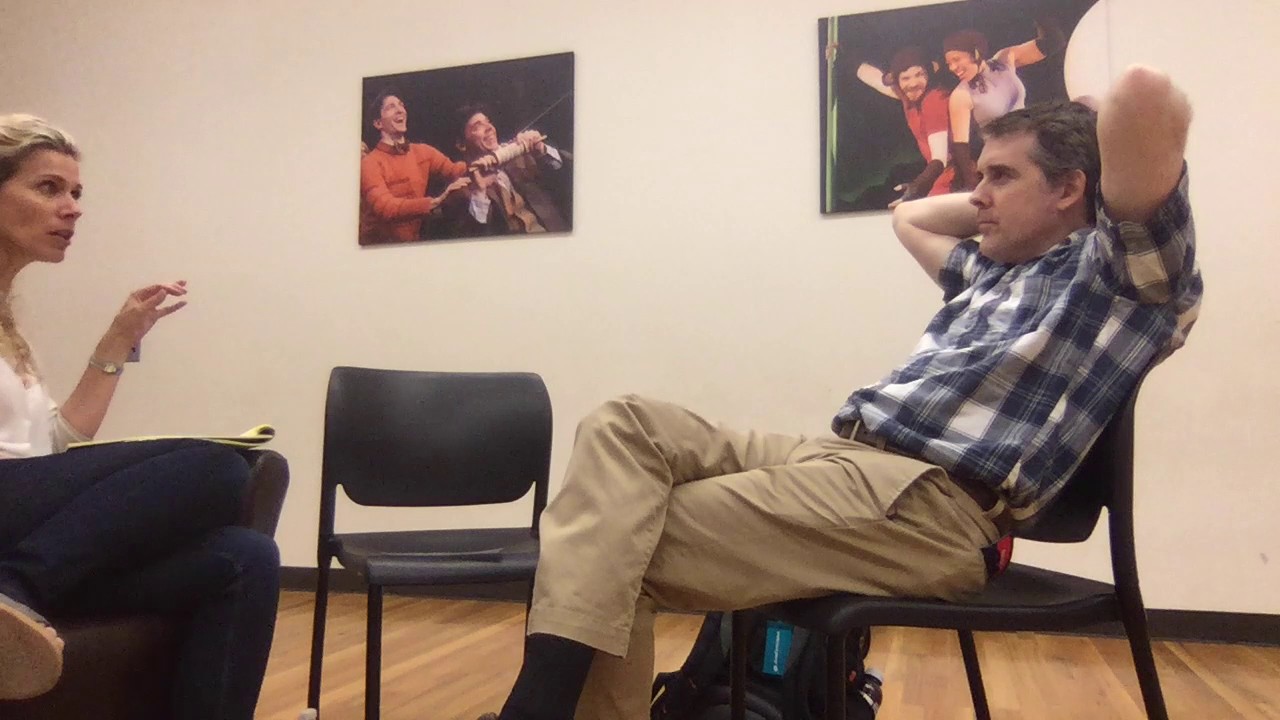
Amy coaches a speaker who shifted from inspirational keynotes to tactical workshops, creating a fee mismatch. They develop his core idea: a "third way" that balances productivity, technology, and human presence instead of choosing between "do more" or "disconnect." The session covers building a keynote foundation with a clear promise, vivid world-building, and specific outcomes.
Chapters
So what did we work on with Michael?
Um, I gotta turn this off, otherwise I'll be staring at it. We worked on performance. So we worked on a small segment of the gray cup thing that you saw earlier.
Gray cup?
Gray— the gray cup.
The gray cup. Sorry.
Can I do it again?
Did you work on it in the master class yesterday?
No.
You did your opening piece.
Yes, with Michael.
Why am I not thinking of it as gray cup?
It is gray, the color gray, cup. What are you hearing?
I'm hearing gray cup. I just don't remember hearing you do it before.
Oh yeah, no. Oh, well, I did it in this group in here, in the 4-minute thing.
The football thing.
Yeah, yeah. And you all said the what? And I, in my head, I'm like, I say that fine. What is wrong with these people's hearing? Yeah. What I would love to accomplish with you is more of this.
Oh yeah.
So I have, uh, when I first started keynoting, I was keynoting. I was getting main stages and a lot of it. And I don't know what's become different in terms of my content. I feel that what's happened is that— no, not feel, I know— what's happened is that my material has become more tactical in nature because I now work on this stuff day to day with the agency, with clients. That has its benefits, having real-world examples. I don't know if you're using Zappos, but we use our own examples. That's great. But as I've become more tactical in my material, I've noticed that I am now shifting to to the sessionals position. However, my fee hasn't changed. So my fee is still low-level keynote fee, but my material has become workshoppy and tactical. So I'm getting interest from the tactical people who want me, but I suspect they're saying, "Well, we don't pay that for a workshop guy." I think that's what's happening with the bureaus, I think. So I make—
Yes.
Dramatically. Yeah, there's still lots of interest, right? But I'm not actually booking it. And for a variety of reasons, some of which being ego, I would like to be back keen on it, right? But also I feel like I can make more of a difference. So I need more of the foundational— I don't know how we got into this.
This was the spine.
Oh, it was the spine, that's right.
The spine. The big idea is the spine. It's not like the forearm is—
It's not the Italian, "Yuh-woo!" Yeah, so I feel like I need work on that. Okay. When I was talking to one of the agents that I book with regularly, 3 or 4 years ago, I said, "What are people booking these days? What is the need? What are you hearing lots of and you don't have people on the ready to go send out to do them?" One of the things he said is, "Lots of people want humanity. How do you bring more humanity?" business. And I felt that because I love that topic, and it's kind of what we do with our clients anyway. We try to bring humanity back into business. And, you know, the business world has become increasingly automated. You know, everything is now— you've got— you have these now bots that will give you counseling through Facebook messages, literally. So how— and my message is like, I'm not, I'm not the snake oil sales guy who's gonna say stop doing technology. I'm not that guy. I'm the, like, let's use it, let's harness this and become more human. So I heard that, and I'm like, great, people want that. So I wrote a book. Yeah, that's what you do, right? You know, that's the book. Got a publisher and it went out there.
Crickets.
And I don't know that I've given a single speech with that topic. And I think this was the topic of the book. Yeah, touch, 5 factors to growing and leading a human organization. And I think it's because A, I wasn't an expert in it, in that particular topic. I was trying to shoehorn myself in through, I'm gonna thought leadership myself in, instead of actually being a thought leader. So I want to find topics that resonate, you know, like when a meeting planner is looking through 6, I want them to see topics that resonate, but that are true to the expertise that I genuinely hold.
Yes, I will tell you, I have never heard of a good outcome from somebody saying, okay, what are people— what's in demand? What are people booking? What are they asking for? Okay, I'll do that. I have never heard a success story out of that. So let me ask you this, what are you passionate about?
I am passionate about humanity, and in all aspects of our life. Like, I feel it when I call the cable company, you know, or the credit card company. Like, I feel like a widget. I feel like I'm just— I feel like I'm a number in their spreadsheet. They don't give a shit about me. And it could be done so much better with just like little tiny changes. And I feel like if we start there with business, then maybe that'll grow to other aspects of our life, and maybe we'll just become more and maybe we'll just be better to each other.
And how is that different from what you did in the book?
It's not dramatically different than what's in the book. I feel like the book just didn't get out there as much as it could have. But it also wasn't things that I was doing day to day, so it wasn't a full— I didn't have the chops.
Mm-hmm.
I was doing like what you said earlier. It was like, here's a— you know, it's marketing, right? It's the way that I always work with business. Like, here's a need, I can fill that need, marketing. And it doesn't work.
So let's brainstorm a little bit. What else are you passionate about?
Mental health, addictions. I'm passionate about people, uh, um, uh, feeling— about people living lives where they don't feel the need to who drink and drug. I have personal stories and expertise there and did a lot of keynoting around that. And then that was kind of also a different problem too because like I was being signed to mental health conferences and I did like 2 or 3 years of lots of those and that was great and I loved telling my story. But then people were like, "I thought you was a digital marketing guy?" And then, you know, then I'm like, I don't want to be like the, "Well, he'll fucking do anything." Yeah, yeah. I don't want to be that guy. So, like, what I'm passionate about, what it comes down to me is, like, I feel like there are very small changes that we can all make to be more human. And businesses, I think, I think they feel the need to bring in this huge process and consult with everyone. And I feel like it's small little things, like, that we could be doing to make big differences.
Okay, so I'm hearing a couple of themes start to pop out. I don't hear those two things as being that different. When you're talking about mental health and addictions and how to be more human in the marketplace, those naturally work together. You can be teaching on, on how to be in the digital marketplace in a sane way. How to be in the digital marketplace in a way that improves our humanity rather than drives us to extremes. Yeah. I suspect that the more we explore, okay, well, what else here? That you're gonna find your own very specialized niche. They're not disconnected.
Aren't they? Because I've always presented them separately. Maybe you're right. You're probably right. I've just always seen them as—
So what drives us to drink and drug?
Dissatisfaction and impatience. I mean, aside from the biological factors, but not comfortable being in the moment is one of the key things. Not able to feel good about being present. If you sit and just be, I'll do this very briefly. This is one of the stories that I tell, so I'll do the abbreviated version. And all of it's mostly a lie, of course, but it's an interesting analogy. There's some truth to it. Almost of it's a lie.
It's a complete lie, but there's some truth to it.
Well, I don't set it up that way on the podium, but I'm allowed to embellish. Oh yeah? So When I was first dating my wife, we went camping, and I hate camping. And then the joke is, "No, that's not true. I actually love camping. I just prefer to camp at the Fairmont." And so she'll go out, and I woke up one morning, and it was 5:30 in the morning, and she was out just sitting out there staring off into the lake, just looking at it, not moving, just staring at it. And I came out and I'm like, "What's wrong?" She's like, "Nothing, I'm just enjoying." So I grabbed a pair of binoculars and I'm like, "What is it? What do you see? What is it?" And there's truth in that's the way I feel. You know, like, it's foreign— it was foreign to me to just sit and be in the moment. And you know, that's what these things do to us. That's what this thing that's vibrating 12 times since I sat down here do to us, right?
Did you just weave the two together?
Yeah. Yeah.
Yeah.
Yeah. Yeah. What audiences like that?
See, now you're worrying about marketing.
I am.
I am. I think we need to find what it is first. I'm not worried about there being an audience. Audience for you. You know, there are lots of people out there saying, "Get off your phones! Be in the moment more!" Yeah. I think you have a— to the point where we're like, "We know, we know, we should be on our phones less." We tell our kids that too. Right? But you have a different slant on it. There's a— I'm hearing something different and something unique here that is both about how do we maximize how well we use this in a way that's integrated to being as human as we can possibly be. How does that make both better?
Yeah, yeah, yeah, yeah.
How does that make us better humans and also better better at our businesses.
I feel like I could come up with that in an afternoon. Like, I feel like it's already there. I've got it all. Like, I— that sounds really arrogant, but I feel like I've got the stories and the experience ready to go because I've done them in two separate chunks. And I'm having a hard time not jumping immediately to the, "All right, let's package this shit." Like, how do I get it, you know? Like, I feel like I'm losing the type. You know? You know that part of the planning, right? It's like, I just need—
Where's the alliteration?
Yeah! Yeah, like, I feel like I just— yeah. But that's it, like, I mean, I— 'cause you're so fucking right. Like, I've heard two types of business speakers. There's the, "Let's all work, let's all get on board, let's automate everything!" You know, the Henry Ford model of grab your shovel. And then I've heard the, you know, the tall, just like, It's just like every Friday nobody do email, which is bullshit. You know, like every Tuesday at 3, or all those models. And I don't believe in either of those models. Like, I genuinely don't believe in them. The book was all about that. It was like, like, business has to happen. You can turn off your emails on Friday if you want, but your competitors are not. Like, it's completely irrational these days. But how do we live our lives so that it's— Yeah.
What you're saying right now is the seeds of your opening. Here's what we hear.
Yeah.
Work more, do more, go to the grindstone, blah blah blah. And turn off your phone, connect, be more human. What do we do with these messages? What do we do with the fact that there's value in both of them, but perhaps something much more powerful when we integrate? I don't know, you're going to see how this goes. But one of the first things we look at in a foundation is how do we demonstrate to the audience that we know what the world looks like to them around this topic. You have great opportunities for humor in the story with your wife who has no problem being at one with the lake, and the other side of it being, no, I wanna drive, I wanna work, I wanna blah, blah, blah. No, it's Saturday and I'm on email. You have room for humor there in a way that demonstrates to your audience, I know you've heard this. But then it's okay, where could it go? What could it be? What if we weren't looking at do more, do more, do less, do less? What's the third option?
Mm. Fuck, maybe that's the title too, The Third Option. Or something like that, yeah. I'm going back to Tai Chi. So I was like, yeah, I love that. You're right, you're right. How do I get away from my natural instinct to now be like, all right, I gotta pack tactics into this, right? Because that's where, that's what I've evolved to is the tactics.
Tactics aren't a problem. Yeah. Right, keynote, we're very often looking at the why.
Yeah.
Why? Think about any Seth Godin book. Take Tribes, right? You're not going to leave that talk knowing how to build a tribe. You're just going to leave going, "I want a tribe!
I want a tribe!" Right?
That's a typical why. But plenty of keynotes are— Tamsyn talks about the why into the what now. Great, so spend some time on the why and then give us some tactics. Give us some what now.
Where you get workshoppy is when it's all "what now" into "how." That's interesting because in the mental health version of this, that's exactly what I do, right down to my slides fading out, me not saying a word, and the words "what now" comes up on the screen.
That's wild.
Like, I mean, literally, it's that literal. And then I, you know, do the "here's 5 things." to do.
Yeah, I don't think, hearing the background of this talk, I don't think it's going to be an all-whys speech.
No.
Because you can set up this problem, but if you don't give us some what now, we're going, okay, well, you know, we— okay, we're dissatisfied. What is that third option? What is the third way?
The third way, yeah.
How do we navigate that? How do we navigate these, the dichotomy of the messages we're getting all the time.
Like, I want to hear that, you know? So, yeah. Like, I want to go to a conference and have someone tell me.
And that's a conference that could be a marketing conference, or it could be a mental health conference, or it could be a—
could be—
working with teens and young adults. I mean, there's— there isn't— I don't see many people in today's world who benefit from this one. You can slant it to a business perspective, you can slant it to a mental health perspective, but I think what you need to develop in this moment is what is that third way? What is that wómen?
Yeah. It never occurred to me to put that moment together, but it is, it's so integrated.
Yeah. And then that's true to you and what's important to you, not just what are people asking for when they don't know what they want. What to ask for. So here are the backbone questions. You're going to come up with, well, what is the big idea?
Yeah.
Second, are you recording this?
Yeah, that's right. I was just making sure that you can hear it.
Second is, what do you promise the audience? If they're going to give you their time, their attention, their money, what do they get out of that hour? They need to know that. How do you demonstrate to them what the world— that you know what the world looks like to them around this topic? And that you also demonstrate to them what it could look like. It's the— so imagine if you didn't feel guilt when you were working and dissatisfaction when you were trying to meditate. Imagine if you didn't always feel like you were doing too much or too less, too little. What could it be like? Imagine what it would be like to feel like you had— I don't know if it's a balance, I don't know. You're going to come up with an idea around this, right? But paint a picture for them of what's possible.
Yeah.
So the big idea, the promise, what the world looks like, what it could look like, what are the ramifications if they Dopamine challenges.
Yeah, yeah.
You know, is it that you get to the end of your life and people say, "What do you wish you'd done differently?" You say, "I wish I'd spent more time in the moment. I wish I'd spent more time with my family. I wish I found things I enjoyed other than being on my computer." Or the other end of the extreme, right? "I wish I'd done more with my life. I wish I'd been more active rather than just sitting by a lake. I wish I'd accomplished more and had more impact." What are the ramifications of being at an extreme? Or penduluming from one extreme to the other? The people who live the corporate life, they bust their ass in New York, they burn themselves out, they move to the country, they build a log cabin, they homestead, they go, "What the fuck am I doing?" They go back to the— right? This penduluming that happens.
Yeah, yeah.
Then look at What's the effect I want to have on my audience in 3 ways? What do I want them to think? What do I want them to feel? And as a result, what do I want them to do differently? Because you're asking your audience to change. If it's a keynote, you're asking them to change in some way, change what they think, to change what they feel, change what they do. Work through as you're building your content. Don't get stuck on this foundational stuff. 'cause you have content built.
If you find yourself getting stuck on, "I don't know what the promise is, I don't know what the promise is," don't let that stop you.
Build the content. It's percolating there for you.
Yeah, it's there, yeah.
Right?
Yeah.
But then do keep coming back and going, "Okay, well, now am I clear about what the promise is?" Yeah.
And this structure is so helpful though, Amy. Like, I mean, just mapping it out in terms of, you know, what do I want them to feel and what does the world look differently?
Yeah.
Like all the great, all the like incredible of the most incredible keynotes that I've heard mapped out that way. But yeah.
Yeah, any great speech. It's— it's MLK. I have a dream. It wasn't a new dream. It wasn't something that had never been articulated by anybody else. But my God, you know, that expression of I have a dream that all men and women could be equal. Like, I have a dream that what's in the Constitution could actually manifest. What could the world look like? It has all the same elements.
And that's all Steve Jobs did too, right? Here's what it could be, here's what we're building, here's what it could be, here's what we're building. Yeah. Yeah, yeah, yeah, yeah, yeah, yeah. Huh. And the third way. It's funny too, because it's like, what's been so frustrating isn't that I— It's been that, like, I know, like, I've got this message. I don't know how to, like— and I tried packaging it in a book. It didn't feel right when we were writing it. Yeah.
As we're talking about it, does it feel right?
Yeah. It feels like something. Yes.
Yes.
It feels like a something.
So it may well be that we're having this conversation, we're exploring, we're doing the work, and that 3 days from now you're like, you know what, it's actually this.
Yeah, yeah.
But this is— these are the questions to ask. This is the dive to take.
Yeah.
To then get to, okay, so what is— what is that? If it's not the third way, and how do we not pendulum, and what is— then where does that take me? And I think it is super helpful to keep coming back to What am I really passionate about? What am I really passionate about? What do I want to hear a speech on? What do I want to hear a keynote on? What matters to me? What do I need help with?
The only fear I have, and I think I can pull it off without doing this, but I don't want to be one of those motivational speakers.
I'm not worried about that with you.
Okay.
You don't have that tendency.
Okay, I don't, but I worry about that. Yeah, okay.
Very often the things we worry about are the things that we are so far from that we don't need to worry about at all. It's like when— it's like, um— it's— I'm trying to avoid the political examples, but it's like if Donald Trump came to us and said, "I'm really worried that I'm going to come across as being too compassionate." You go, "That's not your issue." Right? Or the thing that we very often see is people say, "Well, I'm trying to sell something, but I don't want to come across as smarmy." And we say, "Well, are you smarmy?" They're like, "No, no, no, that's not part of my personality at all, and I don't want it to be." We're like, "Then don't worry, it's not going to come across as smarmy if that's not already who you are." So you're not— he's not the motivational speaker guy. You're not the—
Rah, rah!
You could be great! I don't hear that shit from you at all.
Okay, good, good.
You are the tactical.
Yeah.
So let's look at how we can expand from that without— again, we'll pull you back if you go too far.
Mm-hmm. Yeah, I love it. I love it. Because I've been hopping around from tactic to tactic following where the agency's work is. You know, social engagement, and viral marketing, and they're great, and people like them, and they get value, but I don't have, like, I need, like, you know, like Scott's, like, the contrarian guy, contrarian marketing guy, and Juan is the funny branding guy, you know, like everyone's got, like, they're this, and I used to be, I used to have one of those, and I think I've lost it over time through my own fault, so, like, I want to get something where it's like, if I can own, like, He's the pro-tech, pro-living guy, you know.
I like it.
I like it.
You know, this is a great opportunity to sit down with a thesaurus.
Yeah.
And go like, okay, what words of that resonate for me? Yeah.
Thank you. Yeah. So much like Rita, I swear to God.
I mean, my brain's like starting to explore, and this is just, you do this brainstorming. You know this as a content creator. Is it, you know, computing without the crazy? Is it, you know, what is— what's that combination?
Yeah, like avoid the pendulum.
Yeah, I see what you mean. Yeah, just start playing.
Yep. Are we done?
We are.
Thank you.
We should head upstairs. We're doing group close. Good work. You know, maybe just because it was on my mind and you said it to me, but you know, you could have said other people, you're totally judging yourself negatively about the— you're judging your journey.
Am I?
Yeah, about how you did it to yourself and you lost your way. You're on your way, you're on your path. You've never not been on your path. Look at it that way. I mean, seriously, like, every master's was a disaster, right? You know, and you're teaching what you needed to learn at one point, and now you're going learning even better because you're going to integrate it with yourself and you're going to teach others. That's the only thing I would say about that.
Thank you. Yes. Yeah.
One other thing I would say is your audience, another audience for you is in education.
More from Tod




Ten times Canada helped the U.S. with its wildfires, instead of whining about the smoke. 





