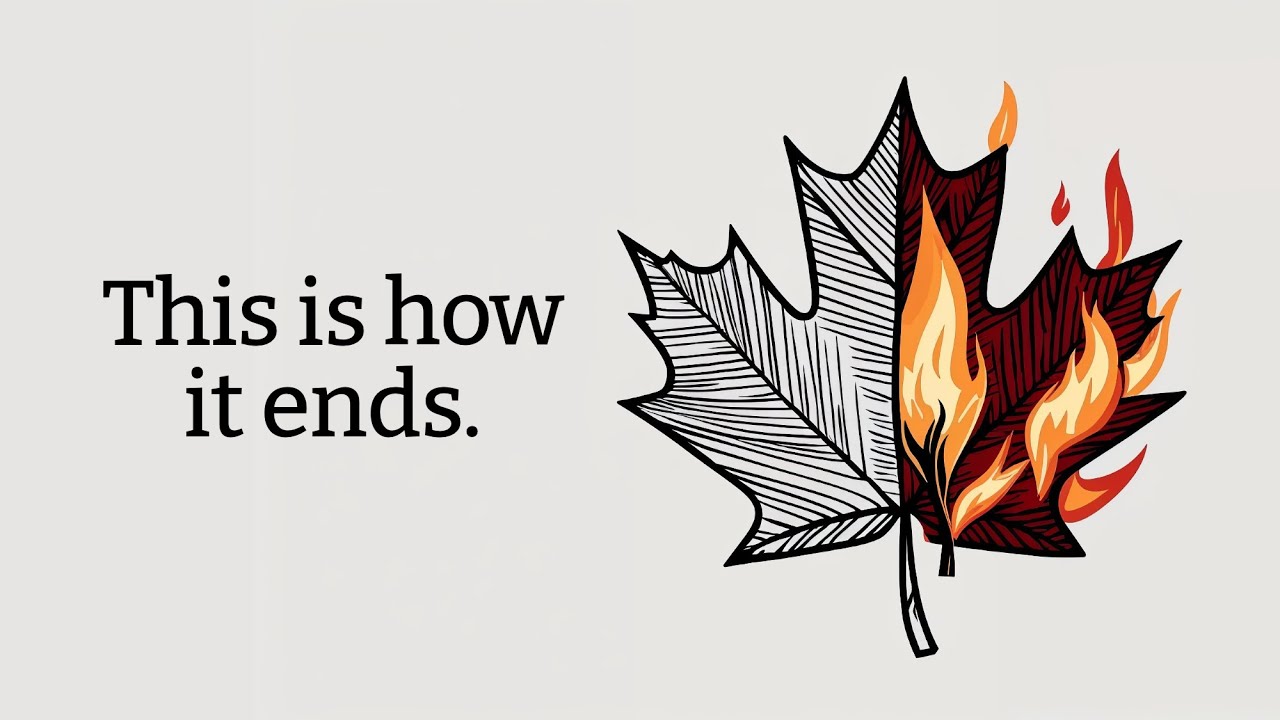
The video presents a sweeping narrative of Canada’s past and two speculative futures, using a single‑speaker, persuasive storytelling style. It begins with the geological formation of the Canadian Shield and the millennia‑long presence of Indigenous peoples, then moves through European contact, colonisation, the Treaty of Paris (1763), rebellions, Confederation (1867), westward expansion, and the nation’s role in the World Wars. Post‑war developments such as the adoption of a new flag, Charter, Medicare, multiculturalism, same‑sex marriage, and the apology for residential schools are highlighted. The narrative then splits into two divergent paths starting in 2025: 1. A Conservative‑led “resource‑revival” scenario where carbon taxes are removed, industrial zones expand, oil production rebounds, immigration is capped, and healthcare is privatized. This leads to short‑term economic growth but rapid emissions rise, climate‑driven disasters (wildfires, floods, storms), collapsing insurance, rationing, and ultimately the physical disappearance of Canada by 2193 due to climate collapse. 2. A Liberal‑led “climate‑action” scenario where carbon pricing triples, fossil fuel extraction ends, renewable energy expands, public transit becomes free, universal programs (pharmacare, dental, guaranteed income) grow, and immigration rises for climate resettlement. Emissions fall, Canada becomes a global climate leader, but the economy slows, and climate impacts still force massive relocation northward, straining infrastructure. By 2293 the last Prime Minister records a message that melts, symbolising the end of the nation. The speaker frames these futures as choices rooted in Canada’s historical values—recognition of Indigenous title, constitutional patriotism, peacekeeping, universal healthcare, and participation in world wars—emphasising that the country’s destiny is still unwritten and rests on collective political decisions at the ballot box.
Chapters
And now, a brief history of Canada. 4 billion years ago, the Creator was forming the Canadian Shield, the geological heart of what would one day become Canada. Then humans arrived. The First Peoples built cultures, trade routes, and sophisticated societies, and this went on for thousands of years before a single European ever touched our shores. Then the ships came. The flags. The disease. Cartier shows up in 1535, hears an Indigenous word for "village," and thinks it's the name of the entire country. Just like that, Canada is born. Champlain founds Quebec City, New France takes shape, and the British decide that they want in too. A century of imperial tug-of-war ends with the Treaty of Paris in 1763 when France hands Canada to Britain like it's settling a bar tab. The French are still here, of course, but they're no longer in charge and they smoke more. Then, the rebellions. Mackenzie in Upper Canada, Papineau in Lower Canada. The British Empire takes note. Maybe, they think, we give these colonies a little more say before they burn the place down. And the seeds of government are planted. By 1867, Confederation is official. 4 provinces become the Dominion of Canada, more provinces and territories follow. The railway is built, the west is colonized, the north is— mostly ignored. And all of it, every spike, every treaty, every new border happens on land that already belonged to indigenous people. Louis Riel leads 2 resistances, he's executed for one of them, The West is secured, but at a cost Canada's still reckoning with. Then come the World Wars, Canal du Nord, Vimy Ridge, Juno Beach. By the time World War II ends, Canada isn't just a colony playing soldier, it's earned global respect, though at a steep cost: the lives of 105,000 Canadian soldiers. Quietly, steadily, we take control of our foreign policy, our Constitution, our future. We adopt a new flag, a new anthem, a new Charter. We expand Medicare, we honour multiculturalism in law, we say no to joining the US in Iraq, we legalize same-sex marriage. We apologize for residential schools, a start with much more healing to be done. In 2020, a global pandemic kills 52,000 Canadians, the population of Fredericton, New Brunswick. And in 2025, Canadians elect a Conservative government. Their leader announces a new era in economic revival, national pride, and fewer government roadblocks. The carbon tax is dismantled. In its place, industrial investment zones, incentives for domestic production, and a regulatory bonfire. Projects that once took years are approved in weeks. Pipelines, housing, highways. Oil rebounds. Canada becomes a global supplier again, filling the void left by collapsed autocracies. The economy surges, unemployment drops, but emissions dramatically rise. Critics call it short-sighted. International praise starts to turn to scrutiny. Canada becomes a climate outlier. On immigration, intake is capped. Refugees face tighter screenings. Integration is prioritized over diversity. Public sentiment splits. Cities pull left, rural regions pull right. But the system works— until healthcare is privatized. Wait times shrink for a moment, but equality falters. Rural care suffers. Within a year, companies are selling ER passes as a kind of insurance. $5,000 a year gets you guaranteed to the front of the triage line regardless of who's behind you and how close to death they are. Most Canadians, of course, are unaware this happened because the CBC was defunded and major media left without support. In the vacuum of this attention, the courts shift. National identity gets rewritten. Patriotism becomes policy. Critics call it a culture war, supporters call it unity. Then the fires. Summer 2047, the West burns for 3 months straight. Entire towns vanish. The government responds with military firefighting units, water pipelines, new dams. It works, but briefly. The fires return. Then the floods. Then the storms. Faced with millions of claims, Canada's entire insurance industry collapses. Border conflicts erupt. The government nationalizes food distribution. Water's rationed, civil liberties suspended, and still People vote to keep the government in place, not out of loyalty, but because change feels more dangerous than the status quo. By 2090, the climate system is no longer responsive to policy. Permafrost belches methane. Oceans acidify. Even the most resilient infrastructure buckles. In 2128, Toronto is abandoned. Vancouver is underwater. Winnipeg becomes the capital. And in 2193, Canada— ceases to exist. Not by vote. Not by war. Just heat. Steadfast, rising, until the land can no longer hold. And in 2025, Canadians elect a Liberal government. This future begins with urgency. A generation raised on climate anxiety and housing crises expect a complete remake of the country from the ground up. Carbon pricing has tripled, oil exploration halts. Within a decade, fossil fuels are phased out. Solar Solar farms line the highways, wind turbines dominate the coastlines. The oil sector shrinks, and painfully, whole towns depopulate. Transition's hard. Some never recover. But emissions do plummet. Canada becomes a global climate leader. Public transit becomes free, car ownership declines. A cultural shift takes root. Less consumption, more community. Quality of life rises, but the GDP slows to dangerous levels. Immigration increases, not just for labour, but for climate resettlement. Newcomers rebuild small towns. Universal programs have to expand: pharmacare, dental care, guaranteed income. Poverty shrinks, but taxes climb, some years dramatically. And in this future too, the wildfires. The government launches a national resilience strategy, moving populations north. It works for a while. Cities like Iqaluit and Yellowknife explode in population, and the strain starts to show. Infrastructure cracks. Old-growth forests are harvested to build housing. Environmental groups protest, of course, but the government says It has no choice. Outside, it's 62 degrees in the shade. In 2293, the final Prime Minister records a message on a 180-gram reinforced vinyl platter. Not for citizens—there aren't many left—but for whatever might come next. It plays once, then immediately melts. These two paths aren't forecasts. At least they don't have to be. Canada was built on choices. To recognize Indigenous title, to patriot a constitution, to establish peacekeeping as doctrine, to adopt universal healthcare, to participate in world wars. Choices built on the hope that they bring something better. Our future is not hopeless. It's just unwritten. And we still hold the pencil. If we want a future beyond collapse, a country that endures and evolves, we must choose it. Together. At the ballot box.