CBC Calgary
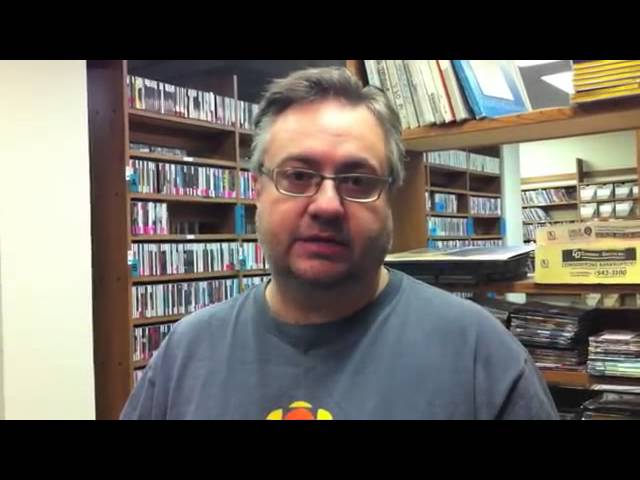
Tod Maffin tours CBC Calgary's studios with Daybreak host Russell Bowers, showing the TV news control room, weather green screen, radio studios, and the music library's color-coded CDs. Bowers explains the station's Canadian content requirements and his path from Newfoundland to Calgary in 2008.
Chapters
Hi, I'm Tod Maffin. Thanks for participating on the CBC Facebook fan page. By the way, if you don't know, the fan page is completely unofficial, nothing really to do with the CBC. It's just our little hobby. Anyway, I'm here with Russell Bowers. Hi, Russell.
Hi, Tod.
Russell is the host and brainchild behind the morning show on the weekends across Alberta on CBC Radio. Can you give me a little 15 seconds of what it is?
Sure, it's Daybreak, and we do arts and entertainment for the province of Alberta. It's both musicians and artists that are here and also musicians and artists and authors that come through the province.
And you're sporting the retro—
You know, I figured for this video today we'd sport the flag.
So there we are.
And so this is circa, I think, 1984, 1982, something like that. Nice, nice.
So we're going to do a tour of the radio set, of TV, all over CBC Calgary.
Absolutely.
Cool.
This is the TV news studio. So this is where CBC News Calgary is based out of. Nirmala Naidoo is our anchor on the weeknights. She also works with Danielle Savoni, and she's our weather person. And Doug Dirks handles sports for us here in Calgary. And of course, we broadcast to southern Alberta, not just the Calgary area. So this is where Nirmala would normally stand.
And she does what?
And she is our anchor on CBC News.
It's such a tiny— really? That's such a tiny little—
I know.
It's funny, you know, on TV everyone says things look so much bigger, and then you get into the actual studio and they're tiny little things.
Absolutely. So this is the space where she works, and also Kirk Heuser, who anchors our late night newscast after The National, also comes from this desk.
So what's on the desk? Like, what's actually behind it? I'm always fascinated to see what they get.
Well, we've got a bin.
Yeah, garbage.
Paper scripts.
That's it.
That's it. And you'll see like the autocue out here in front. They keep her microphone here and she has a laptop also as backup for anything that she happens to— But there's nothing else.
Like there's kind of—
It's pretty low-tech from that point of view.
And this is interesting. They've got, so you've got the cameras that you, that you obviously would expect to see, but then you've got this kind of freestanding kind of weird science looking robotish clock.
I believe it is hooked up to the National Atomic Clock that does the little pips there.
Oh, that's cool.
Across the country, but yeah, it is down to the second. It's pretty precise stuff.
So this is where your anchor sits for TV news.
Yes.
And yet there's this gorgeous, much larger kind of set over here. Who gets to sit behind the god desk over here?
This is where Danielle Savoni gets set up and all her weather apparatus and everything that she needs for forecasting the weather. It looks very impressive.
It does.
In fact, Danielle actually has 2 different sets. So she'll sit here.
Yeah.
And do sort of the establishment of what's happening in the weather that night for Calgary and Southern Alberta. But then—
Ah, here comes the big secret that everyone knows about.
The green screen.
Yeah.
And obviously we won't be able to see her graphics here today, but this exists for her. And then she also has 2 monitors to either side. And this helps her envision herself and the graphics, of course, that she's interacting with in front.
Because she stands in front of this and then they digitally replace the green color with the background. So that's why you see like a big map and everything. So she were to just turn around and look back—
In Calgary today, it was 5 degrees, although it hasn't been 5 degrees for a while. And then of course she'll paint the picture of the province and the country as well.
And so what is this? This is like the emergency path out or something?
I think so, yes.
It goes like into— it just goes into this black void.
Yeah, this is—
In case of cancellation.
Yeah, basically if you— are unlucky enough to be let go from the CBC, this is where they lead you.
Yes, exactly. That's how you get told. Um, back when I was on air, I remember this, this set was News World. News World used to have a large presence in Calgary as well. Now it's gone.
This is my second go-around with Calgary. I was here from 1995 to 1999, and I moved to Newfoundland and spent 4 years there.
Oh, cool.
And then spent 4 years in British Columbia in the lovely town of Prince Rupert. And so I moved to Calgary in 2008, initially as a producer, and now in early 2009, they moved me over to be the host of Daybreak.
Speaking of which, can we go see the little stand-up cardboard cutout of you?
Sure.
Alright, let's do that. Before we get to the cardboard cutout—
Well, one of the interesting things about the CBC, of course, we get a lot of people, guests, here at the studio from time to time, and this is our green room slash lunch room.
And we should explain, a green room, for people who don't know, is sort of where you stuff the guests that are not quite on the air yet. It's the holding pen.
It's a holding pen for us. And so over the years we've had several people visit us here at CBC Television, and from time to time we've actually asked them to come in and sign our wall.
Oh man.
And we've had all kinds of different people do that over the course of, well, however many years the station's been here.
Let's point out some famous ones.
Yeah, well, let's see. We got Stu and Owen Hart. From the infamous Hart family, of course.
Oh wait, wait, wait, Switchback! Oh!
Ian and Keith from Switchback.
Click like right now if you remember Switchback on CBC.
We got Jan Arden.
Oh yeah.
She signed when she was a guest, but of course she also is putting together her own CBC radio show for the summer.
What, really?
Yeah, she's gonna be on air this summer. Well, she's back. She had a show last summer, but now she's got a new one called Being Jan, so she'll be back. Robert Bateman. The great photographer. He signed— or painter, sorry. He signed in 1985. Who else we got? Oh, Phyllis Diller.
No.
Yes. Where is she? Uh, she's up here somewhere. Well, there she is. Oh, she was here in 1983.
That's actually remarkably simple and legible signature for a star.
Here's another one, a little fancier. Leona Boyd. Yeah, also from 1983. Randy Bachman, the ubiquitous Randy Bachman. Ted from Switchcat. I don't know what that is. Oh, here I think is the best one on the whole wall. 1985, Bob Denver, Gilligan, or Maynard G. Ferguson. There he is, from 1985. Fantastic, eh? Well, I hope you've enjoyed your time at CBC Calgary.
No, dude, we've done the goodbye already. We've done the goodbye? Yeah, they'll see it later.
They will?
Yeah, we shot the goodbye upstairs in the newsroom, so just do like the— this is the Cardboard. You're screwing up my script!
Start again!
Alright.
I had this beautiful establishment— Hi. Now, as you know, we here at the CBC are committed to public service, and the last thing on earth we'd ever really think about is what it means to us as broadcasters. What's in it for us, really? You know, we're committed to you, the listening public. Never let it be said that those of us here at the CBC are concerned with our ego.
No.
No, we're not. We're only concerned with you, the public broadcaster. We would never really— oh, hello.
Wow.
I didn't know that was there.
You clean up all right. Oh, that's computer-generated, isn't it?
Yeah, it is. All right, now another aspect of television, of course, is a control room, and this is one of the ones that we have, and as you see here, It's all kinds of setup for directors and producers to shout directions at people who also sit down here adjusting the switchers and audio and so forth. It's a little bit dead today because obviously we're here on a Saturday, but if there was a big newscast, of course, coming out of here, all this stuff is lit up and in operation. In fact, this board is quite the Christmas tree here already.
Ooh, this is pretty. Oh yeah, I want this in my house.
Absolutely. And what's a national broadcaster, of course, without a giant Canadian flag up in the window?
We have that as well. Excellent. So now, you know what surprises me about this room is it's actually relatively small compared to the way these used to be.
Exactly, and in fact there's even more streamlining going on because of improved technology and the need to always find efficiencies. Some of these rooms have shrunk because you can do more with less technology. In fact, one of the things that used to happen was there was a radio master control for each location across the country, whether it was Calgary, Vancouver, Montreal. But now all that stuff is going to be centralized in Toronto.
And so the Borg continues to assimilate.
Yeah, that's right. Resistance is futile.
And you know what's funny is that, you know, with all of this technology and beautiful sliders, and, you know, sometimes there's still some really manual stuff, like an old, you know, like patch— they call this a patch bay, but it's kind of like an old-fashioned switchboard operator, like Exactly.
You want to make one thing talk to something else and it isn't normally hooked up, this is how you would do it. You would actually take ordinary analog wires and cables and attach from one thing to another to make that sort of thing work.
Low-tech, but it works.
It does.
And then, and then no fancy timers here because there's just a regular old stopwatch at the end. I've seen them do this in Vancouver as well, where it's a— there's a person whose job it is to literally time with a stopwatch, and then every 3 or 4 minutes they announced to the director whether the show is heavy or light, meaning it's running a little bit over, a little bit behind.
Sometimes it can't be always managed to the actual second. There are variables like people speaking, which sometimes do create some tenseness in a room like this.
And you can control some of it. Most people don't realize this, but of course Ian Hanomansing about 4 years ago was replaced by a digital Ian Hanomansing. Really? Yeah, so he's just an animatron now, so they can absolutely control his speech.
You shouldn't tell people things like that.
So here's an old-school elevator, dumbwaiter. And oh, you're even— and so what is this usually?
Shuttle.
I haven't pointed down yet. So this is meant for like videotapes, I guess.
And nothing quite that fancy, I don't think.
No, because it's used for returning dishes to the cafeteria from time to time.
One of the interesting things about this particular plant, and I haven't been to all the CBCs across the country, but One of the things that we do here in Calgary is we have a lot of artwork on the wall, and you've got some examples that we can show you. For example, there's work here from David Blackwood, and this one is of Captain Jesse Windsor. This is etching on paper done in 1977, and David Blackwood is one of Newfoundland's greatest artists. And so this one, one that I kind of reminds me of, he's really well known for some of his work with the fishermen who worked out on the ice fields.
Oh.
This is Asuna Pitsalak, a drawing from Asuna. Hunter with caribou head from 1917.
Oh no, but you know what? So one of the things that may not be immediately apparent on the video is that you'll notice that there's sort of a mustachey kind of thing coming out of the nostrils.
Uh-oh.
It's not actually on the painting. Someone, if I kind of show it from this angle, someone has like No, that's perma ink, dude. Someone had— oh, there you go.
Let's fix this.
Yeah, right now. Someone has added a little bit of glue.
Let's just address this.
Yeah, all right, good job, never happened.
And then of course Marian Nicoll, a painting called January from 1977. We have Joe Fafard paintings in here. It's really quite an interesting little aspect of walking the halls around the CBC in Calgary. This is one of my favourite rooms. I get a lot of use out of a room like this. This is our music library.
Oh geez, that's a heavy door and it just smacked me.
Yes, it's well protected in here.
Yeah.
So I'll show you this one first. This is our Alberta wall, and so everything that we've got in the library right now from Alberta artists is located here.
And so, and some of these, now if this is the same way that it's done in Vancouver, the coloured tags represent specific content. So a blue tag would be provincial content.
Yes, blue tag for us is provincial content. So you've got everything from, of course, the Corblund Band, old favourites there. You've also got Oscar Lopez, one of the greats, and of course the pride of Consort, Alberta, Miss Katie Lang. So we do a lot of, I do a lot of checking of this wall to find stuff and ideas for songs that I play on my own show.
I'm kind of— I mean, are some people surprised that this isn't all digitized? Because when you do your show, you're like, you literally come here, you get a big stack of CDs, you walk down with a pile of them into the studio, and you play them off the CDs.
It is a mix.
Oh, okay.
When I do my show, it's a mix of things that I pull off my iPod.
Live? You do play it live off the iPod?
Yeah, I've got an iPod dock in my control room, and I plug my iPod in and hit play.
Oh my God, I would never do that. What happens if someone like Facebooks and then you get on air, you get the—
I turn off the notifications and the other stuff. But I also have like an actual iPod, not just my iPhone, but my iPod that has just music on it and doesn't have all those other functionalities. So I just plunk that in, find the track I want, and I have a little remote control on the desk that I can just hit play.
Wow.
Works like a charm.
Wow.
So I use my iPod I use actual physical CDs, and I use, of course, digital files, MP3s, or the digital files that the CBC creates.
So we're getting there. It's not like, you know, most commercial stations these days, everything is digitized.
Yes.
Yeah, Radio 3 is like that as well, where it's, you know, it's all sort of preloaded in, it's got little stops where they go.
Well, on my show, for example, I play probably about 20-25 tracks per weekend.
Right.
And because I'm not necessarily programmed from an outside source, I'm programming the music myself, so it's coming from a variety of sources. If this was more along the lines of a Radio 3 or a commercial radio station, there is a set playlist that they're drawing from. It isn't necessarily left up to the whims or tastes of an individual host. In my case, I'm still pretty lucky that I get to pick my own music, which is a combination of stuff that is either musicians that are in the news coming through town or just stuff I like.
And there is obviously in Canada Canadian content requirements, and there's CanCon in the industry, and so is there provincial requirement for audience? Like, you have to hit a certain number of provincial artists in the week?
Nothing formalized, but I mean, it does sort of shake out that if we play, for example, 60 to 70% Canadian content on my show, easily half of that will be Alberta artists. We're an Alberta show, we're broadcasting to the province of Alberta. The idea is to familiarize our audience with artists that are local, and so We also familiarize our audience or re-familiarize them with artists that are classics, for example, like your Ian Tysons, like your KD Langs. You want to remind people about all the great music that's already come out of this province in addition to telling them about the stuff that's up and coming.
Cool. So, like enormous racks of CDs here behind too.
Indeed, and we have them all arranged in various ways. This is all male vocal.
What is Pink? CanCon?
Pink would be CanCon, yes. And the white labels just indicate generic. Let's turn on one more light here. And so you've got another group here, you got vocal groups here and female vocal artists, more vocal groups here. Down the back wall you've got your jazz and classical.
This is really well organized.
Oh yeah, it's amazing.
It's amazing.
It's sort of double organized in terms of alphabetical and also numerical.
All right, so, but most importantly Where are the show tunes?
Show tunes? Well, you've got folk, world, shows.
Shows! Oh, there is a show tune section.
Yes, there is.
That is fantastic.
Yep. Let's see what we got here. So, this is Studio E in Calgary, and it used to be someone's office. Oh, really? And therefore, it has a lovely view of the outside. Of course, it also has windows that certainly bounce the sound back at you.
Oh!
So it's an interesting little studio.
And they're not even angled like most radio studios are.
No, because this wasn't built to be a radio studio. Right. It was converted later.
So does that affect the sound?
It's not too bad. Sometimes if you close these curtains or these blinds, I've also put up some baffling on the walls that kind of deaden the sound in here a little bit, so it's very much an improvised space. And I was telling you earlier about the iPod dock.
Oh yeah, right.
So I have it here. So for example, if I wanted to find a tune to play on the radio, let's do that.
Ba ba ba.
So we'll pop that in the dock.
Oh, and it's just like the standard Apple, and then it comes up on the—
Yep.
Yeah, there's no way I would do this on air. That's just— I would just— I don't know, even shutting off the notifications, I would just think that there'd be some weird-ass thing that, you know, Steve Jobs has back-programmed into it, and all of a sudden it just starts screeching.
Normally what I do is I put an ordinary iPod in there as opposed to the phone. I don't trust the phone, obviously, because it could ring, for example, during a song. And then all of a sudden, you know, in the middle of— Has that happened yet? That has not happened.
Oh, and alright, I'm gonna give away one of the secrets here. Not all radio hosts know the frequencies off by heart. They have cheat sheets.
Absolutely. This here, I took this actually from our little frequency guide, the little small thing that you get. It's about the size of that iPhone actually, but they're quite small. So I— we have a lot of frequencies through Alberta, not as many as some provinces, but certainly quite a lot. So the main ones, obviously Calgary, Edmonton, I get to know fairly well, right? Uh, just so I can talk about different communities and reflect the province, because obviously people like to hear their community name said on the radio. I keep these frequencies handy, and so I'll often do obviously Calgary and perhaps a smaller center, or Edmonton and a smaller center. This has never been used live in here, but I have pulled tracks from it. No way! This is presentation now. Remove the big plastic cover.
Yeah.
And so yeah, so this is a Technics turntable. This would have been an industry standard for so many years. I think when I started out in campus radio, 1987, this would have been the standard stereo and the turntable that I would have used.
And I need to back up just to kind of show it in all of its horror. It's like, it's this enormous block. And even this down start, this part down here is part of it as well.
Like, yes, it's the amplifier. Uh, it actually has. I'll just pop this—
Oh, you brought records!
I brought records. So— Oh, it's an RCA Red Seal.
You were telling me just before we started shooting this segment that, um, you had someone who'd never actually used a turntable.
Yes, we have someone on staff who has not had the pleasure of actually owning or operating a piece of vinyl.
So did you have to explain to this person how it worked? Like, how to actually put the— needle on the record.
And all that stuff had to be approached. I think they just thought it was just the most magical thing, which I suppose in some respects it kind of is. And, uh, this thing here, let's see if it gives me any sound.
God, it's like, it's like something from that you expect the president would push to start the nuclear weapons, you know.
And one of the things about this turntable that's fantastic is that you can actually—
Oh, I know what you're gonna do.
You can actually cue up.
Yeah.
So there we are.
Yeah, it's hard to hear, probably, but so what you've done is you've found the exact point where the song starts.
Yes.
Physically, and then you back cue it about like a quarter turn. Yeah, about a quarter turn. And that's why, that's because because the motor—
And then you can fire it. I don't know if we can fire it from this board. It might not be set up for it. But basically all you do is hit start.
And that little quarter turn gives the motor time to kind of get up to speed. Exactly. Yeah. And back in the day, you'd actually— DJs, one of their skill sets was you had to kind of get a feel for how much extra time you had to give from the point at which you pushed the start button until the music actually got up to speed and kicked in.
Absolutely. And some turntables were a little bit more responsive than others. Some required just a quarter turn, some a half turn really to get up to speed. And you had to adjust for those kinds things. What was another, I guess, thing that you had to be aware of back in the day when you played a lot of vinyl, especially with 45s, remember the smaller 7-inch? They came in as singles, and of course it was, if it was a big hit record, you played it a lot. And what would happen with some 45s is that you get what's something called cue burn. So right at the very beginning of a track, you'd start to you'd hear it get really scratchy, really, really fuzzy. So obviously the first second or so of a song that you'd play would have this blah blah blah blah, you know, that kind of thing. So that was one of the other side effects of the good old days.
And you couldn't fix that, like you can't take that out in post-production or anything.
In fact, what a lot of radio stations did, especially in the late '80s, early '90s, is they switched to something called carts. Now they look very much like 8-tracks.
Yeah.
And they have about 5 minutes worth of tape on each cart, as we called them. And so when a new single came in, you immediately took it from its pristine vinyl state and put it onto this cassette tape cart, and you just played that over and over because obviously cassette or tape doesn't deteriorate as much as vinyl does. So that was one way of making sure that you had a single that you could play over and over. Over, and obviously it avoided the nasty mess of having to queue up a record.
Right.
So, this is the heart of CBC Radio.
With the dramatic pause.
Well, I just— before you have a look at the heart of CBC Radio, you can see that it's empty.
Yeah, it kind of is. Although, to be fair, it's like noon on a Saturday.
It is. Yeah. And I gotta tell you, the heart of CBC Radio isn't in Current Affairs on a Saturday.
No.
But having said that, we do have people who populate this area Monday to Friday who are absolutely fabulous at what they do.
And so when you say Current Affairs, you're talking like the regional shows and—
Yes, well, we're talking about the daily shows that you'd hear, for example, in Calgary, it's the Calgary Eye Opener, Alberta at Noon, and the Homestretch, which cover pretty much your morning drive, your afternoon drive, and your midday check-in with the news. And so a lot of that happens in this particular area.
Oh, and is this the radio green room?
This is a radio green room.
Yeah, see, radio doesn't— this is typical, hey? Radio gets shafted. It doesn't even get its own room. Just kind of—
area.
It's just kind of an area in the big huge— yeah.
Yeah.
Not that I'm bitter.
Turn on some lights back here.
Oh, here we go.
So this is our control room for radio, and our technicians sit here and push buttons and tell stupid hosts what to do. And this is where some of the stupid hosts sit.
It's always amazing how heavy these doors are.
They are.
Yeah.
So we have some great people who sit in this room, actually. We have Jim Brown, who does Calgary I/O opener, and for national listeners or viewers, he also shows up on The Current from time to time as a fill-in for Anna Maria. And Donna McKelloggat, who's one of the best journalists in the country, she does our noon program, and David Gray does the Homestretch, our afternoon show. So this is a nice little area that we've got set up. Again, giant clock so that hosts know when to stop things, and it looks out here onto Memorial Drive.
Nice.
Which is quite a nice little area, especially once it starts to green up in the summertime.
So can you walk us through kind of all the little accoutrements that are here?
Sure. So what happens is this is a control box for the host, and basically it allows them to turn their microphone on or off. If they're in the middle of a conversation with someone, they can also push this button. It's called a cough button, and the cough button allows them to kill the mics so that if they have to cough or do something, that's what that's for. TB stands for talkback, and that allows them to kill this mic and talk to the technician on the other side of the glass.
Not on air.
Not on air. You shouldn't be able to hear it on air. And of course these buttons here allow the host to control whether or not their guest mic is on or off. Of course there's then this main microphone here that they speak into. They've got a master clock. We have two types of clocks at the CBC. There's this analog version, and that's hooked up to the atomic clock in Ottawa, wherever it is. And then of course we've got digital clocks as well. And then you've got your basic computer, that screen that obviously—
Okay, what's with the gambling wheel in the, uh—
You know, sometimes you have to augment your pay from the CBC.
Right.
So every now and then we do a lot of things in here that are not strictly legal.
Ah, I know what this is. This is the swag room.
This is the swag room, and this is where we keep—
Do you have mugs in here?
Coveted CBC mugs.
Are these all mugs?
These are all mugs. Your tax dollars at work, ladies and gentlemen.
People go crazy for CBC mugs.
They do, because here's the thing, is that it's a wonderful way to give back to the audience, because obviously we get a deal on these things, and the joy of having these things is that you can have contests on the radio, get people involved in your show. And I do a thing called the Daybreak DJ, and people write in and tell me about songs they'd like to hear on the radio, and then I call them up, interview them for a couple minutes, and then they— then we play their song. And for that purpose, they get their very own CBC Radio One.
That's actually a really nice mug. Now I want it. You know what, can I just have this? Look, come on. Give it to me.
This is the public broadcast.
Look, you've got plenty of these. Alright, fine. I'll pay you for it. I'll give this away.
Shall we give one away to one of the lovely people that are watching on this?
Yes. Yes, exactly. If you click like on the video, I will track you. As long as I can message you, make sure that your privacy settings aren't set on Facebook so that I can't message you, but click like. No, better yet, share it on your wall. Share this video on your wall, and I'll track down the people who shared it.
And this one is—
And you will win this.
It's kind of generic too, because it doesn't have an actual frequency on it, so it's good for anywhere in the country. Except, well, you know, at least you'll know anywhere in the country that Daybreak Alberta is on the air. He's a smart-looking mug. This here is something you'll see in just about every CBC newsroom, TV or radio. This happens to be the board for Calgary Eye Opener, which is our morning show, daily, 5:30 to 8:30. And what happens up here is that this gives the producer and the people who work on the show a chance to get an overview of what's on the program, some of the story ideas and subjects that they're going to be talking about. Now, for example, this is the Thursday lineup from April 28th, and on the show they talked about CBC's 75th birthday. This is their mailbag feature where they read some of the emails.
I love the exclamation point. It's not just the mailbag section. It's the mailbag section!
Mailbag! We got mail! Family Cop, a little less excitable. Yeah. Hospice Chat. Wild Rose Pack. This is something about the election. McLachlan is—
And pack is usually like a collection of tape and mix.
Some folks might know it as documentary. It's kind of like a 5-minute package of audio that's been put together on a particular story. In this case, the Wild Rose Riding in Calgary. McLachlan is— he's one of our columnists who sums up the week in provincial politics. Petty, I don't know what that is. The book sale— Kathleen Petty. It could be Kathleen Petty. It could— this is the book sale talkback. This is about a book sale that we organize in Calgary every year to raise money. Lukaszik is the employment minister for Alberta, so he was on the show.
And all of these represent like 7-minute blocks of time roughly, or 3, or—
Yeah, give or take. And so this would be, you know, 5, 6 minutes. This would be a couple minutes, so on and so on. So basically it just gives the people who work on the show a map of what's going to be on the radio when they get in that day or the next morning.
Cool.
Hi.
Hi.
This is the world of TV and radio news. So this is a little bit different from a lot of other CBC locations that perhaps you've been to.
It's pretty.
It's very pretty up here. They're freshly painted in red and blue.
Yeah.
The official corporate colours, for anyone who's wondered. And so up here, our news department sits, and that includes both TV and radio news, online, and I believe our French journalists and French shows are also based up here as well. So we've got a variety of different things going on up here.
The words on these pillars— CBC's sort of internal jargon occasionally will refer to pillars as like foundations of things, so, you know, like these are our standards of—
Yeah, that's right. Core values. That kind of stuff that, uh, that we rely on.
And so in the case of Calgary, you've literally painted the words on actual pillars. Um, so, so there's this sort of large area where obviously the journalists and producers sit, and there's this sort of elevated area up here. What's this?
Yes, in CBC jargon, we refer to this as the bridge.
Oh, oh, really? Oh, maybe that's different. I always thought this was called the nest.
Uh, in our case, we It used to be called the bridge.
Oh, alright. I like bridge better.
The bridge is where assignment producers and other editors will sit, and it's their job to know what all these folks are doing and to know who gets to be assigned and where and when. And so there'll be people who assign for TV, people who assign for radio, people who assign for online, people who assign for the various newscasts that happen during the course of the day.
Which is important because in a lot of cases it used to be the— there used to be these sort of silos where the news division would break a story and radio didn't get access to it, and web. And so now it's kind of all integrated. Is that an actual police scanner right here?
That is an actual police—
really? Look at that.
Huh.
Good. Yeah, I always thought those were scrambled.
Apparently we can hear them, and it's It has come in handy from time to time, because sometimes you want to know what is happening in the city, and that's one excellent way to find out.
So obviously, the kind of the important behind-the-scenes stuff, we are in Calgary, cowboy hat.
It is important, it is actually a municipal law. I don't know if a lot of people realize this, but you must be no further than 15 feet from a cowboy hat at all times in Calgary.
That's true, I've heard that.
And so, because you never know, as I said, sometimes it's not just journalists who are here on on a day-to-day basis, sometimes we have visitors come through, like your good selves, and so it's very important to have said hat ready to welcome people to Alberta, and because we're all about letting people know exactly what we're all about.
I do think there is something missing from your ensemble though. What's that? I think you've got most of it, but what it really needs is the pink bullhorn.
Yes, apparently pink is the word, and we're told to pass it on. So for those of you that are here today on the CBC tour, thanks for coming by. And of course, if the CBC is nothing else, it's about context and being unpredictable. So just show this part to friends and see if they can figure out what's going on.
Awesome, thanks for the tour.
Hey, my pleasure.
Yeah, excellent.
Mau!
Mau!
More from Tod




Ten times Canada helped the U.S. with its wildfires, instead of whining about the smoke. 





