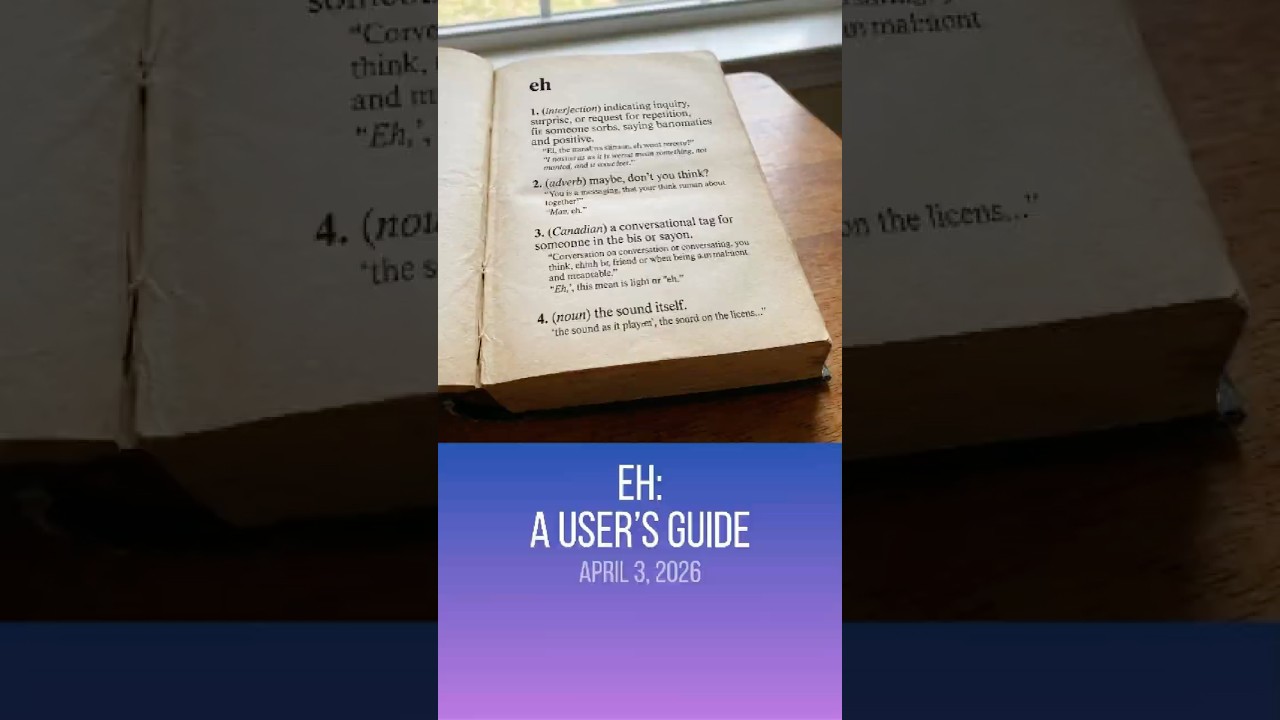
In this spoken monologue, the presenter debunks the stereotypical American caricature of the Canadian "eh" and demonstrates that the single‑syllable interjection is a highly versatile grammatical tool in Canadian English. Six core pragmatic functions are outlined with explanations and examples: (1) verification interrogative, seeking listener confirmation; (2) deprecative interrogative, softening criticism or lowering speaker status; (3) narrative continuer, acting as a storytelling beat that checks listener attention; (4) imperative mitigation, turning commands into polite requests; (5) exclamatory intensifier, amplifying emotion without expecting a response; and (6) conspiratorial adjunct, inviting shared, often gossip‑like judgments. The speaker frames "eh" as a social Swiss‑army‑knife, embedded in everyday Canadian discourse since Confederation, and highlights its role in politeness, collaboration, and subtle social signaling.
Chapters
Every few months, some American comedian does a Canadian impression. It goes like this: "Hockey, maple leaf, sorry!" And then bolted at the end of every sentence, like a tail someone glued on wrong: "Eh?" Too loud, wrong place, wrong intonation. And every Canadian watching winces, because that is not what "eh" does. That's not even close to what "eh" does. "Eh" is one of the most grammatically versatile words in Canadian English. It does at least half a dozen distinct jobs depending on information, context, what came before it, and so on. Americans hear the sound, they think it's like a verbal tic, like we forgot how to end sentences. We didn't. We're doing something sophisticated. You're just not listening. There is, of course, the verification interrogative: "That was a great game, eh?" So this seeks confirmation of a shared observation. The speaker already believes the statement is true. The "eh" just invites the listener to agree. It's collaborative. Think of it like a handshake at the end of a sentence. The deprecative interrogative: "I'm no expert, eh, but that looks wrong to me." It lowers the speaker's status. Just enough to make the criticism land a little softer. Canadians deploy this constantly in meetings, letters to the editor, and in conversations where they are in fact the expert. The interlocutive narrative continuer. So I'm driving down the road, eh, this moose just walks out. So now here, eh is not at the end, it's in the middle. It functions as a storytelling beat. It's checking in with the listener that the listener is still with you before you deliver the good part. It's like a You with me? You know, keeps the story alive. There is the imperative mitigation: "Pass the ketchup chips, eh?" So now this turns a command into a request. The "eh" does not ask for permission exactly, but it smooths the edges off the demand. We Canadians also use this constantly, and often we don't notice that we're doing it. It is politeness encoded into grammar. There is the exclamatory intensifier: "It's cold out, eh?" Now this is not a question at all, even though it has the raised intonation, it has genuine feeling. The "eh" just amplifies amplifies the emotion rather than seeking a response. It's closer to like, "Wow," than to "Right?" No one is waiting for you to confirm that it's cold. Then there is the conspiratorial adjunct, "Not the best idea he's ever had, eh?" This is almost always muttered, usually while the subject is nearby. It invites the listener into a shared private judgment without anyone having to say anything out loud that could cause a scene. It is gossip with deniability, which is a cornerstone of Canadian social life. So there you go, American friends. A is a precision instrument, a social Swiss Army knife, possibly the most efficient syllable in the English language. You've been mocking it for 50 years, we've been defusing entire family dinners with it since Confederation. One of us made the right call, eh?