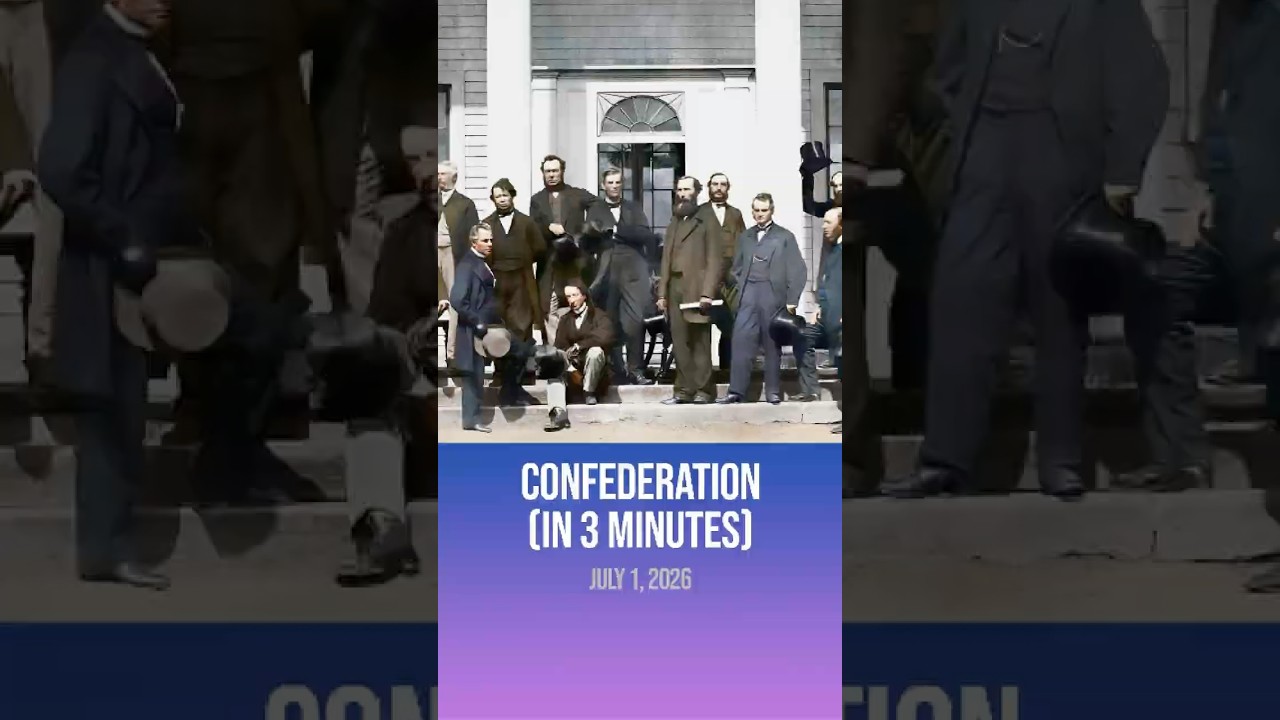
Before 1867, Canada was six separate British colonies. Fear of American expansion after the Civil War, Irish raids, and the need for a transcontinental railway pushed them to unite. On July 1, 1867, the British North America Act created the Dominion of Canada with four provinces, though Indigenous nations were excluded from the entire process.
Chapters
Well, it is Canada Day, but do you know exactly what we're celebrating? Welcome to Confederation in 3 Minutes. Now, before 1867, what we now call Canada was actually just a ragtag handful of separate British colonies, each with their own governments and laws. The main players were the Province of Canada—that's basically present-day Ontario and Quebec—Nova Scotia, New Brunswick, PEI, Newfoundland, and out west, British Columbia and Vancouver Island, although those latter 4 would only join later. They did not always get along. They traded a bit, they bickered a lot. So why did they decide to group up? A few things. First, the United States had just finished its Civil War and had a massive battle-hardened army. Some Americans had ideas about expanding northward. Sound familiar? The colonies were nervous. There were also Irish-American veterans who staged armed raids into Canada in the 1860s hoping to pressure Britain into withdrawing from Ireland. And you know, Britain was getting tired of spending money to defend these far-flung colonies. The colonies needed to be more self-sufficient. A union made economic and military sense. Oh, and the railway! Everyone wanted a railway. You couldn't build a national one, well, without a nation. So how did it actually happen? Politicians from the colonies met at a series of conferences: Charlottetown and Quebec in 1864, London a couple years later. They hammered out the terms, and the British Parliament passed the British North America Act on July 1st, 1867. On that date, Canada became a country. At the start though, there were only 4 provinces: Ontario, Québec, Nova Scotia, and New Brunswick. The others joined later. Manitoba in 1870, then BC, PEI, Alberta, Saskatchewan, Newfoundland didn't join till 1949. And not everyone was enthusiastic about the whole thing. Nova Scotia was somehow so pissed about it that they actually created a party called the Anti-Confederation Party that won in a landslide a couple of months later. They tried to get the whole deal cancelled, but it didn't work. Of course, this country was only new on paper and to the colonizers. Indigenous nations had sovereign governments and trade networks and diplomatic relationships across this land for thousands of years before any of this. Confederation did not include them. Or even ask them. As for the word Dominion in Dominion of Canada, the Fathers of Confederation actually wanted to call the new country the Kingdom of Canada, but the British feared that the imperial-sounding name would offend the Americans, so they made Canada pick something else. The term actually comes from the Bible, Psalm 72. He shall have dominion also from sea to sea, and from the river unto the ends of the earth. From sea to sea is also Canada's national motto, although in Latin. Canada wasn't born complete. It was born possible. And every July 1st, we celebrate what we started, knowing full well we haven't finished it yet. To some nations, that would be a flaw in the design. To Canada, That is the design.