Hope (and Sanity) in the Age of Collapse
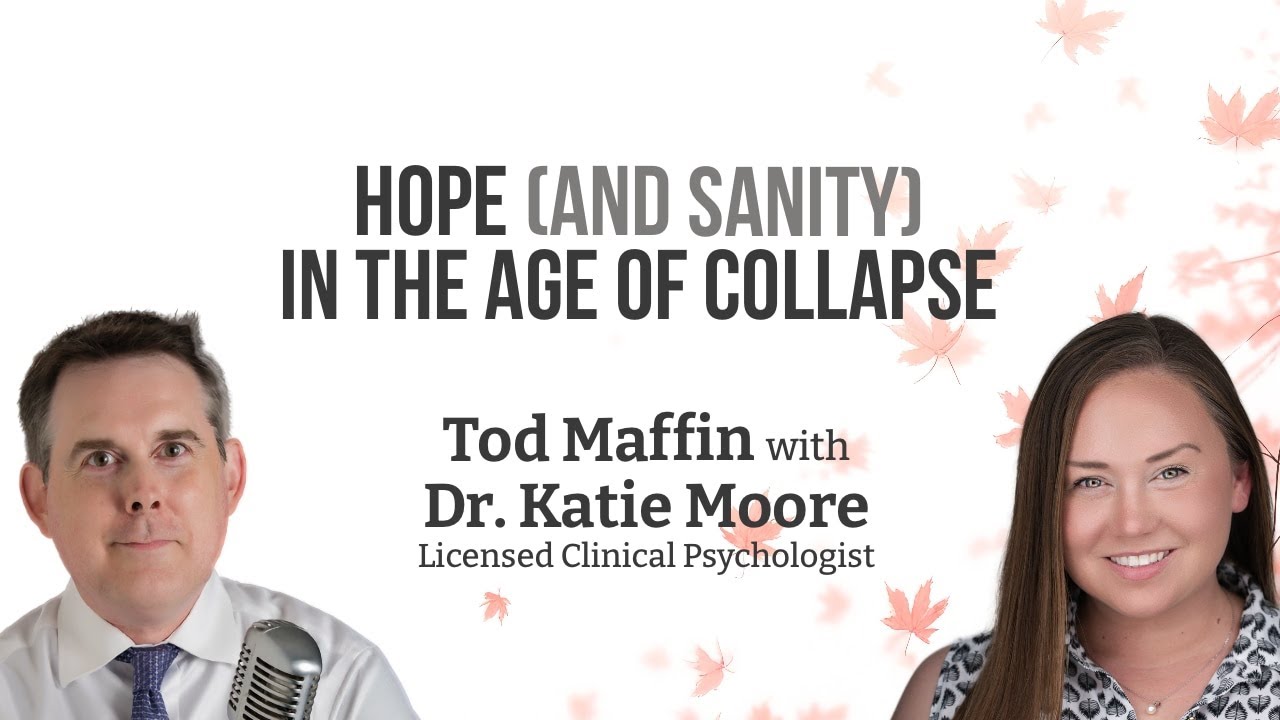
In this live YouTube show hosted by Tod Maffin, licensed psychologist Dr. Katie Moore joins to discuss how people can stay informed about world events without becoming overwhelmed by doomscrolling and anxiety. The conversation begins with a definition of trauma, emphasizing both large‑scale events and cumulative relational trauma, and how emotions manifest as physical sensations. Tod shares his personal experience as a recovering alcoholic and landlord dealing with a drug‑den tenant, illustrating how trauma can surface in everyday life. Dr. Moore offers practical advice for managing news consumption: limit exposure to headlines, read only a few reputable sources, and avoid repetitive exposure to the same story. She introduces “bloomscrolling,” an intentional practice of seeking positive content on social media or through searches. When anxiety spikes, she recommends grounding techniques such as the 5‑4‑3‑2‑1 sensory method, deep breathing, nature exposure, and music. The dialogue also explores the resilience of the LGBTQ community, framing its historical survival as a “super‑power” that can foster hope. Community connection and hobbies are highlighted as protective factors, with suggestions like Meetup.com and virtual groups, while acknowledging that in‑person interaction may be preferable for some. Dr. Moore warns against media sensationalism and worst‑case‑only narratives, encouraging balanced consumption. She explains her professional setup: two practices—Theracue (low‑fee, California‑based, virtual) and Affirming Psychological Services (private, insurance‑accepting, both virtual and in‑person). The episode concludes with a reminder that coping strategies are personal, that ignorance can be a short‑term safety mechanism, and that viewers should seek supportive resources.
Chapters
Hello friends, it's Tod. I'm sorry about the late start. Um, thank you for joining me on this live show. Um, you know, some people through this whole chaos that we've been experiencing, um, whether it's the politics in the US or the threats of annexation up here in Canada, um, have asked me to bring some light to how we can cope and deal with the same— deal with the information, still have a sense of what's going on in the news without just becoming absorbed by it. I do not have any expertise on that because God knows I am still trying, and that is why I brought Dr. Katie Mori in from— you're in Los Angeles, are you not?
I'm in Orange County. So close. Is that Los Angeles? Right next door to Los Angeles.
Katie has been very patient while I screwed up the live broadcast and And so please thank her very much. Can you start by telling us who you are, what your expertise is, and then I have a bunch of questions that I think people in here will probably have some questions as well.
Okay. Yeah. So I'm Dr. Katie Moore. I'm a licensed psychologist. I work with trauma and my main specialty area is working with LGBT folks. So I have a specialized practice that that is our primary population that we work with. So I have been talking daily, sometimes, most times, multiple times a day about kind of the feelings we're all having about what's going on and the doom scrolling and all of that. So, so I think that's why probably you have me on here.
Definitely, definitely. I feel like we hear the word trauma a lot, but can you describe it? What is trauma?
So trauma can be a lot of things. We think of like the big things, like, you know, somebody who's gone to war, somebody who's had some kind of attack. It can be those things, but it can also be little things that happen that kind of add up over time. So it can be relational trauma where maybe we didn't feel safe with somebody or we didn't feel heard with somebody. And that can happen over and over and over again and can cause trauma, which will impact the way that we interact with ourselves and with the world around us, potentially long term.
Um, I've shared this before on the channel, so a lot of the folks, um, on the channel probably already know this of me, uh, but I'm a recovering alcoholic. I have about 15 years clean or so. I went to residential treatment— some people call that rehab— uh, for several months. It was a, it was a long-term program, and I learned all about trauma. And one of the things that I thought was very interesting is that trauma, at least the way that I came to understand it, was that it was a feeling and less, less like stuff that gets processed up here. Can, can, can that explain, like, is there a parallel? And I want to get into like the news of the world going around us, but does that somehow explain why this doom feeling is such a real physical feeling sometimes?
Yeah, absolutely. A lot of our emotions we feel in our body. So even if we think about the emotions that we want to feel more of, right, like falling in love, being really excited. There is a physical feeling that's associated with that. And so just like the happy feelings, the not so happy feelings also often will have physical feelings that are associated with them. So we may feel a tingling or a kind of nauseous feeling or a heaviness somewhere. That's really normal. All of our emotions are typically tied to some physical feeling. In fact, Knowing that that physical feeling exists and knowing what that physical feeling, what emotion that physical feeling is tied to, can actually help us in situations where we're triggered. We may know what's happening physically before we really kind of catch up mentally to what we're doing.
If you're just joining me, Katie Moore is a licensed— how would I describe you? Clinical counselor? There's so many different words. What do you, what do you prefer?
I'm a licensed psychologist.
Licensed psychologist. Excellent. Um, all right, so I'm in Canada. A lot of the people who watch my, my stuff, uh, are also in Canada. Um, we are observing— I wouldn't say from afar, but we're certainly observing, you know, what's going down there in the US. Um, I feel like— and I'm just going to speak for myself— I have found it very difficult. I want to stay up on the news partially because I'm a I'm a former journalist and it's kind of in my blood. I want to stay up on the news. So I read, I go to my phone, I read stuff on my phone, I get pissed off or scared and I delete the app or apps. And then the next morning I feel like I need to be in touch with the world again. I reinstall it. Is that healthy? It feels very unhealthy, but is there something good in that somehow?
I mean, there is something good in that somehow. You know, I don't know that there is a particularly wonderful way to consume terrible news. It's terrible news. It's just— it's going to feel terrible. However, limiting your consumption so that you're not kind of spiraling with it, that is extremely healthy. So there's some kind of healthy but also unhealthy in there, right? So trying to figure out where that line is for each individual person, I think, is important. And also trying to figure out how can I still get the news that I need to have, because it's important to just know what's going on in the world without getting to the point where I'm spiraling and it's now becoming not healthy for me.
So how? Give us practical steps. How do we do that?
Okay, so one of the best ways to do it is just start with just the headlines. Um, if it's a headline that's a story that you already know super well, you probably don't need to read that story again, right? So we don't need to put ourselves back in a really bad place for ourselves by reading the exact same information over and over again. So maybe read 2 news stories, 3 tops. If there's no new information once you've gotten to the end of the second or third news story, there's probably no new information. We probably don't need to read 10 different sources to tell us the same thing if there's no new information. Again, you make sure you're getting things from reputable sources, um, but once you get to the end of the second or third article, if there's nothing new, there just might not be anything new. And we're sometimes tempted to search out for like more and more articles because we feel like Surely there has to be something good here, right? Surely I eventually I'm going to read something that's going to make me feel better about this. But there just might not be anything right now that makes you feel better about that thing. And so reading bad thing after bad thing after bad thing is not helpful.
It's funny too, because we get caught in this loop, don't we, where it's like, you know, I think you're right. I think it's sort of like eventually I will get to something that will negate all of this bad that I've been reading about. There'll be some gem at the bottom or there'll be some YouTuber who, you know, takes a light or a thoughtful tone on something. And there just isn't— like, I'm, I'm especially aware of the fact that today is Trans Visibility Day. Yeah. And to, to a lesser extent in Canada, much more so in the US, trans people, LGBTQ people as a whole, but trans people as a general group are— I don't think it would be an overestimate to say under attack. Right now. Is there something unique to that community? If there's someone who is inside the LGBTQ community, is there something unique to that community? Do they have a superpower that we don't have of some kind that can lift them out of all of the doom specific to that sector of doom, or whatever we're calling these things?
So I, Yes and no. I'm trying to cultivate that superpower with my clients. And so one thing that we talk about is, as a community, the LGBT community in the United States, at least, we have been through very similar things like this before. And if we just focus on here we are again, then we're not using our superpower. But if instead we focus on we've been through this and we got through this, right? That second part has to be there. And we've— we got through it, and here's how we got through it. That gives us hope. That gives us resiliency, knowing that we've been through it and we've seen the other side of it. We got through it, right? That can help us to keep that hope, um, and to not just kind of fall into that despair.
When I went to rehab, the rehab facility was here on Vancouver Island where I live. By coincidence, I happened years later to move to that city. After having lived here for a while, my wife and I had a— we have a tenant suite in our house and we just had a tenant go horribly bad. They were bringing— they had basically turned the basement of our house into a drug den. In. Um, and it was affecting me not only in the way that, like, a brand new quote-unquote landlord— although, you know, we bought the house with the tenant suite knowing there was a housing crisis and wanting to help— but also from the point of view of a recovering addict, um, and having just that energy in the house. I remember going to the rehab facility because their rule— it's called Edgewood, by the way, if anyone wants to know— um, and their rule is as long as you complete the program. If you bail out early, no, you don't get any of this. But as long as you complete, you can come back anytime you need to. And I've only ever called on that that one time. And I went in and I sat down, and the counselors had got my binder from like 10 years prior, and they said, how are you doing with your sobriety? And I said, I'm trying. And they stopped me like mid-sentence and they said, you're not trying, You're doing it. And that, it made me think of what you were saying about we've been through this before and we've come out the other side. It feels very much like that to me. No.
Mm-hmm. Yeah, I think so. And I think, you know, some of the things that are happening for LGBT folks down in the United States right now, and some of the things that have been happening for the last handful of years, they can remind us of specific things that we see in history, right? So if somebody is not aware of the community's history, even somebody within the community may not be totally aware of some pieces of history, then yeah, this probably feels like there is no hope. Yeah, right. But if we know these things and we can kind of see Well, what happened after this terrible thing happened, you know, in the 1930s or the 1950s or whenever it was, right? What happened to get people to the other side of that? And we can hold on to that piece. And I think also just looking intentionally for things that are going well. And that's not to say to ignore the things that aren't going well. We need to be aware of those things. We can't just stick our head in the sand, right? But being intentional about allowing yourself to have some peace or some joy by looking for things, not just looking at things, but looking for things that are good in the world right now.
Can you tell me about bloomscrolling?
Yes. I cannot— I can't imagine I'm the first person to ever come up with this, but I hadn't heard it before. And I was in session and talking about doomscrolling. Scrolling. And I said, you know, we need to be intentional about looking for positive things when we're on social media. And so let's call it bloom scrolling. And so that's what I've been calling it with my clients ever since that session. Um, and what it is, is really intentionally looking for positive things when you're on social media. So yes, we're going to see the bad things too, but put in your search bar happy news or things that you want to see that are positive in whatever demographic you want to see that in. Maybe it's somebody literally planting flowers and things blooming, or maybe it's seeing somebody who's doing some kind of activism work and fighting for somebody's rights, or maybe it's people being excited about something in their life, right? But intentionally looking for the blooms rather than just the doom.
So like, intentionally, you mean like not, not just hope we stumble across it, but like literally do a Google search for good news or something like that?
Yes, absolutely. Or if you're on social media, do a search, you know, in your search bar on social media for it. But be intentional about going out and finding the good, because the good— the bad will find us. Right? The bad will find us very easily. Sometimes it's hard to find the good. So sometimes we have to be a little bit more intentional with that, especially if we're on social media and we have an algorithm that might be working against us a little bit. We may need to be intentional with that.
If you are watching live right now, Monday, March 31st, and you'd like to put in a question, by all means, please do. We have this comment. I don't know why it went over there. Hang on a second. Technical problems continue. There we go. Yeah, but I'll drop it on you now. I'll put it in the middle. There we go. Professional broadcaster. My American cousin says they're overwhelmed and they have now chosen ignorance as a defense to their mentality. I understand this. Like, I understand this deeply. Is there something to be said for this?
I think we do what we need to do to protect ourselves, and sometimes that's long-term not very healthy, and sometimes it's long-term perfectly healthy, um, but we always will do what we need to do to find safety. And so if this person feels like what they need to do to find safety is ignorance, then that's what they're going to do. It may not be the best thing for them, but it's what they're going to do in order to feel some sense of safety.
Can I ask you, what is the best practice for someone to bring themselves back down if they have gotten— if bloomscrolling hasn't worked, if just reading the headlines hasn't worked, and they are in the midst of— I mean, the phrase panic attack is thrown out around a lot, and sometimes it's legitimate, and sometimes I think it's just not. But if someone is feeling very panicked, let's say that, and, you know, my wife has a name for this, the rabbit. She's on here. Jocelyn, what the hell do you call them? The weasels. The weasels. She calls them the weasels.
Ah, yes. The brain weasels.
The brain weasels, right? Like if it's gone to that level and the weasels have shown up and they're really yelling and you're really feeling it. Give us some practical steps. What do we do? Where do we go? What do we smell? What do we touch? What do we look at? What actual actions do we take to break that?
Yeah, so something that you kind of insinuated, what do I touch? What do I smell? That's one technique that is really commonly known. It's the 5-4-3-2-1 technique. You have 5 senses. Assign a number to each of those senses, and you're going to pick out 5 things. Maybe it's that you can see, Seeing is a lot, you know, pretty easy for a lot of folks to see 5 things, 4 things that maybe you can touch, 3 things that maybe you can hear. It doesn't really matter what sense what number is applied to. The goal is that you're grounding, so you're bringing yourself back to the here and now, recognizing your environment, recognizing that although you don't currently feel safe, you physically are safe in this moment, in this environment. So that can help. Getting yourself to a place that feels good to you as often as you can. So maybe nature feels good to you. Getting yourself into nature on your days off or your days out of school, that is, I think, really important if that's something that's important to you. Allowing yourself to kind of give yourself the kindness that you need, I think is important. And then, you know, the normal grounding things, the deep breathing, the listening to music, all of those things. But relying on your senses and knowing kind of the here and now, I think is a good grounding technique.
I always feel I'm bad at this. You know, I feel that like I'm— I see so many people, maybe this is just imposter syndrome working against me, but I feel so many people out there, especially like the voices that I listen to, which are, you know, these days largely political analysts and things like that, and they're so on top of stuff and nothing seems to faze them. And like the most horrible stuff is happening on the news and they're just talking it through just like they're discussing what is happening for lunch. Are they all faking it? Like, why am I—
I don't know, I'm not one of them.
Yeah, like, like really, like how many of those people are actually out there like legitimately it doesn't doesn't faze them, or are there way more people like us who are like kind of secretly managing it not well?
I think there's a chance for both of those things to be true, right? So I think that there's a chance that for some people this is their job, and so they tuck their own opinions away and they go do the job, right? Um, and I think there's also room for desensitization. So it's possible maybe they've desensitized because they're hearing this all day, every day, and they're talking about this all day, every day, and maybe they don't feel as sensitive because they're overloaded with it, right?
Mm-hmm. Um, some good suggestions are coming through here. If you have other hobbies, look for videos or groups that do what you like to do.
Absolutely. Yeah. Find community. Community is so important. It's always important, but it's especially important during difficult times. So absolutely find community.
Do you find in your practice a lot of people have hobbies? I'm finding it hard to pick a hobby.
Um, I find that people have hobbies. I find that sometimes they have difficulty sharing their hobbies. Um, so for example, one of my hobbies, I love to crochet. Um, I might find it difficult to find a crocheting group. That wants to get together and crochet, right? Maybe I wouldn't, but somebody may have a difficult time finding somebody who will do their hobby with them. Um, so I do find that that is something that people have difficulty with is finding that community. Um, there's, I don't know if they have this website in Canada. There's a website in the US called meetup.com. It's a great place to find groups of people who like to do similar things. I recommend that pretty frequently to clients for this exact reason, just because it's hard to find community sometimes.
Is it okay to have that community virtually? Like, in other words, if you are in, you know, if you're in a, I don't know, a watercolor group, if you're all kind of on a Zoom call, you're sort of friends, you've never really met in person, or should we like make an effort to be actually physically with people in person? Does that make a difference?
I mean, it can make a difference to some people and it doesn't make a difference to others. So I think if you are feeling satisfied by the online group and it's not negatively impacting other areas of your life, then absolutely. Um, if you're not feeling fulfilled by that, right, if you join a Zoom group and you've gone maybe the first time, you're not going to feel that fulfilled because it's awkward going somewhere the first time, right? But maybe you try it a times and it's just not hitting the spot, then maybe you do need to be in, you know, physical relationship with people in the same room, right?
Can I ask how long you've been in practice?
Uh, so I started in 2015. Uh, I was under supervision back then, but yeah, so a decade.
A decade, about that.
Yeah.
How has How in that time, in 10 years, how have people's relationship to the doom of the world changed? And I assume it's gotten worse just because of the— I'm not talking about the— I'm not talking about the volume of it as much as the caliber or the flavor of it. Does that question make any sense to you?
I think so. I think what I'm hearing is not the amount of things that people are worried about or the amount of people who are worried, but how significant a role it plays in their life. Is that what you mean?
Yeah, sure. Yeah.
Yeah. So I think it definitely— my, just my personal observations, not, you know, I haven't done any research on it, but just personal observations. Yeah, I think definitely it's, it's impacting people more, um, in the last few years than I think it, it was 10 years ago.
I'm gonna ask you a really dumb question. Does going back to childhood comforts help adults, specifically in this kind of a doom-filled world? I'm thinking about— well, The Friendly Giant will mean nothing to you, sadly. The Friendly Giant was a very popular TV show in Canada. I happen to be working on a video about it. Um, it was a children's TV show, and, and the theme music will send adults of a certain age back immediately into their childhood in a very feel-good form, but to translate it to something more global, building a blanket fort in your living room. Does that have any real benefit, like actual benefit to someone, the way someone is feeling, or is that just kind of something we see on TV?
It can. If that particular thing felt comforting and isn't tied to any other kind of trauma, then yeah, it totally can.
So cheesies and ice cream, I want to eat more of that, that makes me feel good, that I should, that's probably a good thing, I have a doctor's recommendation, I can eat more, yes?
Well, I'm not that kind of doctor, and I'm not your doctor.
That's true, we should have, we should have led with the, with the disclaimer.
We probably should have. I am a psychologist, I am not your psychologist.
That's right, this is, this is information and not, and not medical advice. For you. Yes. Dr. Moore, is there anything I haven't asked that you think when we close this you're gonna think, why didn't he ask this? Is there anything I've missed that is relevant to this whole discussion?
No, I think really wanting to make sure that we're limiting our time online. Oh, you know what, maybe just kind of talking about, um, where we're getting our news from and, um, really spotting sensationalism. Sensationalism, I think, especially in my younger clients, that's something that I'm seeing they're having a difficult time with.
What do you mean by that? Like sensationalism?
I mean, they're paying attention to news that is intentionally sensationalized.
Okay, right.
And so obviously, there's, there's media bias in all different directions, right? But some of the kind of doom and gloom that I'm hearing from younger people, um, really involves a lot of only worst-case scenario. And I'm not saying we can't prepare ourselves for a worst-case scenario. That's probably, to some degree, is healthy. Um, but if we are only looking at the worst-case scenario and no other options, and we are only seeking information from places that are highly sensationalized, that's not going to be good for us.
It's a very fractured world, isn't it? It's a very— it's so, I don't know, divisive. It doesn't seem like the right word, but just so polarized. You know, you and I, I asked you last week to do what in the media industry we call a pre-interview, which is basically I get you on, we do this, and I talk and I see if— well, frankly, I see if you know your shit. And if you knew your shit, then I invite you on. And you knew your shit. But one of the things that I thought was also very telling was that you also were interested sort of checking me as well, and you'd done a bit of research on me to see, like, is this guy actually going to trap me on some right-wing chaos? Yes. It just— I don't have a question there. I'm just so— I'm just so deeply sad that we've gotten to a place in the world where, where you— where that's a consideration for someone in your role.
I think it's a consideration Generally, I mean, I, I am not the only person who does what I do that I'm in contact with, right? I know other therapists who do what I do. I know psychiatrists, I know medical providers who provide care to the population I provide care for. And I think a lot of times we're kind of bracing like, okay, what's gonna happen next? Who's gonna come knocking at our door, right? So I think that's just unfortunate. I wish we weren't there, but I think that's where we're at right now.
Yeah. Dr. Katie Moore, thank you so much for your time. I know you just got out of a, of a session with a client. You have to race back and do notes. I assume that's what I think happens afterwards.
Go home to my wife and kid and have dinner, and then I'll do notes later.
And then do notes afterwards. Tell us again the practice, the specialty that you are, and then do you do virtual? Like, if people are not in Orange County, can they still work with you and reach out to you?
Yes, but they have to be in California.
That's a licensing thing?
That's a licensing thing.
Okay, assuming they are in California, then?
If they're in California, we have two practices. I have two practices. One is a nonprofit. It's called Theracue. It's just Theracue, T-H-E-R-A-Q dot org. And that provides low-fee services starting at $20 and going up from there. We also take some insurances. And then we have Affirming Psychological Services, which is a private practice. It's just AffirmingPsychologicalServices.com. Both practices provide both virtual— well, both practices provide virtual. Affirming provides in-person as well. And Affirming takes most insurances.
Gotcha. All right. Thank you so much. I really do appreciate your time. This has been— this has helped me personally. You know, all this whole video essentially was a way for me to get help. And if other people are going to eavesdrop, that's great. And you've certainly done a yo person's effort, and I appreciate it.
Absolutely. I'm glad to have been on. Thank you for having me.
Not at all. I'm gonna send you back to the green room. Stick around, I'll come back to you in about 60 seconds. And thank you all very much for coming and being with me. It's— this is, you know, we're in such a weird time right now. I've done a couple of videos. If you're in a really low mood right now, I wouldn't recommend you watch my most recent recent video that I put up this morning. Um, I'm very proud of it. It is quite doomy and gloomy, um, and talks about the importance of voting. But tonight I am putting up a video that compares the current political, uh, stuff in Canada to the Friendly Giant. I would not tease that and, uh, and let you go without it. So thank you again. I don't know what's coming next week, but I'm gonna try and do one of these every week. If you are not signed up to the newsletter, it's far and wide news. Thank you all so much, and I'll see you again soon.
More from Tod




Ten times Canada helped the U.S. with its wildfires, instead of whining about the smoke. 





