Moving to Canada: A Guide for Americans
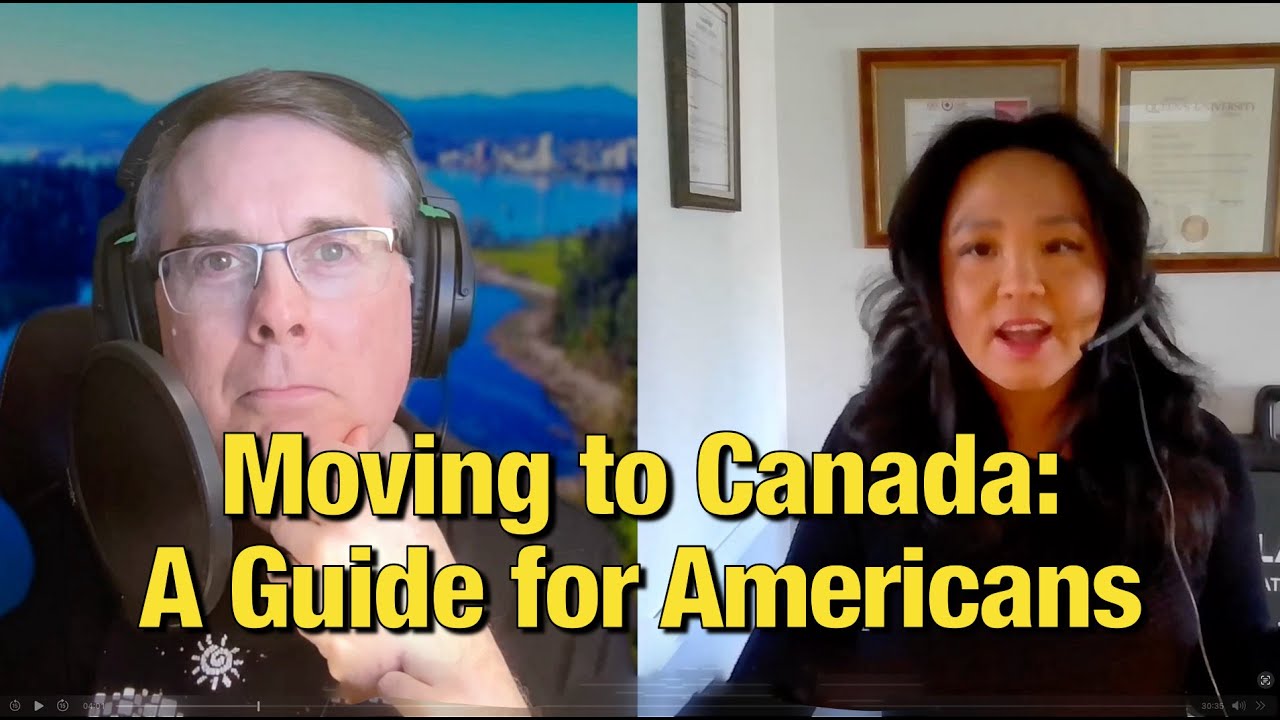
Laura Tsai, a Canadian immigration consultant, walks through how Americans can move to Canada through visitor visas, work permits, or permanent residence. The Express Entry system uses a points-based ranking across three streams, provincial nominations matter, and you need proof of funds. Criminal records and medical issues can make you inadmissible, but rehabilitation is possible.
Chapters
So you want to come to Canada, maybe move here, maybe study here, maybe work here. Well, this is the video for you. I have Laura Tsai with me. She is a regulated Canadian immigration consultant at MacLanders Immigration Consulting in Nanaimo. Her website is maclanders.com. Hello, Laura.
Hello.
So I have a whole bunch of questions for you, uh, 5 or 6, and I just thought we would kind of rapid-fire our way through them. Um, first of all, if people are American and they're coming up to Canada, How long can they stay as a visitor?
So as a visitor, in general, you can stay up to 6 months, and you can apply to stay longer depending on your situation and your proof of funds to convince IRCC to let you stay longer.
Oh, interesting. So you have to have— you have to have like a bank account full of money or assets, or what does that mean?
Yeah, like a cash flow. Like if you have a car, your property in the States, that doesn't really count. You have to have like a bank account to show that you have enough money. For you to stay in Canada without getting into the Canadian labor market as a visitor.
Right. Can someone come to Canada if they have a criminal record or a DUI?
So it depends on the crime committed, it depends on how long ago was it, and it depends on when you complete the punishment, either it's time served, probation, a fine. So for Things like DUI is considered serious crime in Canada, so it may render you inadmissible to Canada, but it depends on how long ago was it, and you may still have a chance to apply for rehabilitation or a temporary residence permit to come to Canada.
And is that a decision made at the border by border guards? Like, can you just drive up and say, listen, it was 30 years ago, I shoplifted, it was a felony, Is that a decision they can make, or do you have to apply to the federal government somehow first before you come to get that waived?
So if you know ahead that you need to apply for something, say rehabilitation or the Temporary Residence Permit, um, I suggest that you apply ahead to IRCC before you come to the border. CBSA at the border, they can make decision, but you, you at that time, for, for the time frame, I would say like it's better to be well prepared and do it beforehand.
Okay, how do people move to Canada?
So for moving, we, uh, we are talking about either temporary or permanent, and a lot of temporary ways can lead to permanent, such as being a student and being a worker. So if you graduate from a Canadian post-secondary institution meeting certain requirements, you may get up to 3 years of work permit. After you graduate, so you can gain some work experience here. And, uh, uh, as a worker, you gain work experience, and that will help for your future permanent applications in Canada. So for permanent, um, there's Express Entry. That's a score-based system that IRCC developed, and everybody— like, if you meet the requirement, you get scored by your age, your education, your language.
By your age?
Yes, yes.
So do they favor younger people or older people?
They definitely favor younger people.
But you say it's a point system, so basically, like, do you know what all of the different elements— can you walk us through those?
So, uh, first of all is age, and, uh, if you're under 30, you had the highest points. And then the education, um, we do recognize education in foreign countries, but if you had Canadian post-secondary education, you also get great points. And work experience Again, we recognize foreign work experience, but if you also have Canadian work experience, that increases points. And if you have a spouse, your spouse also has high language points, work experiences in Canada, like that will help increase the overall points. And even though, let's say your first language is English, you still have to undergo the English or French test because English and French they are, you know, official languages in Canada.
Do we know how many points is the maximum number and how many points you need to qualify and what the weightings are for each of those things? Like, how many points do they apply for age? Do we know those numbers?
Well, so, uh, so for each category they have maximum points. For Express Entry itself, uh, the full points is 1,200. And that comes down to what I want to talk about, provincial nomination, because provincial nomination is each province has its own program. And if you get that nomination from the province that you are going to go, you get 600 points added to your Express Entry. Okay, so, so, uh, but you don't necessarily need that if your points are high enough. And I wouldn't say I'll give you a minimum or a set point because the federal government, IRCC, they do draws often depending on—
Like random draws?
Um, at this point I would say random because we can never predict it at this point. So if you meet— so let's say they decide to do Canadian experience category And if you fall under that category and you— your score meets the cutoff score of that draw, then you are invited to submit your permanent residence application. So this is not a done deal. You still have to submit your application and go through all the tests, and they determine if you are going to be a permanent resident.
Laura, before you and I started recording, I said that I wanted to keep this to under 10 minutes, and I'm— forget I said that. We're just going to keep on blasting through because this is really good information. Okay, and I don't think we can do it in 10 minutes.
Okay.
Um, all right, so can we talk specifically about this Express Entry program? You've mentioned it a couple of times. What is it?
So Express Entry, like I said, is a point-based system, and under that it has 3 streams. Um, so You just need to meet requirements of one of those streams, then you are able to get into this big selection pool of—
what are those streams?
So, uh, we have Canadian experience, we have foreign skilled worker— sorry, federal skilled worker— and then, uh, skilled trade. So you If you meet the requirement, you can meet just one of the streams, or you meet two out of the three streams, or you can meet all the streams. It doesn't matter. So what—
so the more streams you, you meet, the more of those three streams you meet, you, the, the more points you get?
Uh, no, it's just more chances to get selected because the government do the draws by streams.
Can we talk about each of those? So you said Canadian experience, federal skilled workers, and skilled trade. Do I have that right?
Yes.
All right, let's talk about each of those because I think this is the detail that a lot of people sort of want to get into, right? What is— what do you mean by Canadian experience?
So Canadian experience, well, before we get to that, uh, we need to understand the concept called NOC. It's N-O-C, and it's a National Occupation Code. I don't remember. So every job in Canada is given a code, a NOC code, and there's defined responsibilities, duties, job duties under each job. And for some jobs, it also requires certain education levels that you have to meet. So when, let's say, you are hired to do this job, let's say you are a physician, and in Canada you're a foreign physician, get your credentials checked, you come to Canada, you work as a doctor, then you are given a NOC code. So the NOC code has tier, so basically it's level of how skilled your job is. It starts from 0, 0 being the highest skill, all the way to 5.
0 is the highest?
0 is the highest skill. So, or I would say, for under Canadian immigration context, 0 1, 2, 3, they are considered high skilled.
Okay.
And 4 and 5 are lower skilled.
And what kind of jobs are we talking about? Like, what would be a 0 skill job and what would be a 5 skill job?
So let's say if you are working at a senior government role, that will be 0.
Like in the US, you're working at—
well, no, well, it can be equivalent to.
Okay.
So all your foreign work experience can be made equivalent to, oh, what is this in Canada? Right, right. Right, so let's say like a sales manager can be 0.
Really?
Yeah.
Wow.
But you have to like demonstrate that you meet all your work, all your duties, meet the duties and responsibilities under that specific job.
And the 0s and the 1s, like the really good scores, those are because we need those roles in the country? Like there's an absence of people who have those jobs in the country?
I would say in general, IRCC or the Canadian immigration, they would want more higher skilled person coming to Canada. So, uh, we talk about NOC. So if your job is in a higher skill, then you are— and depending on your work experience, right? So for Canadian Express— sorry, Canadian Experience— that means you have, uh, uh a certain Canadian length of Canadian experience working in a high-skilled job. Okay, so for a federal skilled worker, um, you have again at least 1 year continuous employment in a high-skilled job, and that can be either foreign or in Canada.
And give me some examples of high-skilled jobs.
Uh, high school, say, accountant, But an administrative assistant is also a high-skilled job under the NOC, under the NOC. So I suggest if, you know, viewers are interested, just, you know, explore what your job is under the NOC.
What does someone do if they are American, they want to move to Canada, and they are on disability? They're retired, is there a path for them to immigrate to Canada?
Well, I would say it's kind of difficult, so depending on what your disability is. So are you still working and what do you do, right? And your disability may be inadmissible, like medical inadmissible to Canada.
What kind of disabilities would be inadmissible?
I can't say for sure because medical inadmissibility, one is is, uh, it will cause harm. It was— it's dangerous to public health.
So, um, untreated schizophrenia perhaps.
Yeah, that could be. And, uh, but it's all very case by case. And the second one is, um, the treatment— the money to spend on your treatment exceeds the level of what the government is willing to pay for you. Right, right.
So because, because we have universal healthcare, so correct, the costs if you're, if you're in the US and you're, you're bearing the cost of your own medical treatment there. When you, if you move to Canada, the government will bear the cost of your— so, so if you have an expensive-to-treat condition, that may make you ineligible?
Yeah, it will make you inadmissible to Canada. Right. But that, that's, that's certain conditions for under some applications like that is waived.
Like, what kind of conditions would get that waived?
Let's say, um, uh, um, under family sponsorship.
Ah, okay.
All right, right, right. But, but I will be cautious about this because you still want to get treatment, and if you— if the government cannot pay for you, you still need to be paying for yourself. So I would be very conscious about it.
I have more questions for you about, about what if someone is trans, can they claim refugee status, is healthcare free if you're here. I've got a bunch of other questions, but you, you, you touched briefly on family sponsorship. Can we talk about that?
Sure.
If you're an American and you live in America and you want to move to Canada and you have family in Canada, what family qualifies? Like, does your third removed cousin from 8 generations ago qualify? Does it have to be a direct parent? Like, what family can sponsor you?
Um, so the most common family sponsorship is a spouse or common-law partner. So that's the most— well, the most cases that we see.
Or do they have to be a citizen, or can they just be a permanent resident?
They can— they can be either. So a Canadian permanent resident can sponsor you. Yeah. And, uh, or parents sponsoring their child, but the child usually is under 22 years old, right? And we also have the parents-grandparents sponsorship, but, um, the government's still taking the application from the pool submitted in 2020, and right now it's 2025. They are still selecting people from the same pool submitted 5 years ago. So When will they open another pool? We don't know.
And is this just for family sponsorship? Are we talking about everything?
Um, the parents, grandparents? Okay, only the pool. Yes.
So if you want to be— if you want to come in under a family sponsorship, you might be 5 years out before your case is heard?
Um, before you even get selected to be invited to apply. So But that's— I'm talking about parents, grandparents though, right? Right. But, but if your spouse common law, and when you meet the requirements, you can submit the application at any time. But processing time right now, I would say, is quite long. So you have to like plan ahead.
Like, that makes sense. Um, do you get penalized if you have a big family? Like, let's say that you are in a highly skilled job, you've got lots of assets, but you have 6 children that you want to come with you. Is there a penalty for that?
No, absolutely not. But you do have either enough proof of funds to show that you are capable to raise your family in Canada with that, how many people you are bringing, or under Express Entry, um, a job But again, like, proof of funds is pretty important. It depends on the family size, right?
And is there a number they're looking for, like half a million, $2 million, $20,000?
Um, it goes by the, um, the, the low income cutoff each year, but for family, um, they raise a certain percentage.
Let's talk about, about healthcare workers. Because there are a lot of nurses that, that I've spoken to in our Discord, um, that want to come up, and maybe doctors and maybe medical office assistants, you know, that are sort of on the periphery of healthcare. Um, how does someone— let's just start with nurses. If you're a nurse, you want to move to Canada, we need nurses, provinces are competing for nurses. Let's say you want to move to BC as a nurse. What do you do? Where do you go? How does it work?
Um, so as nurses, um, because it's a licensed profession in Canada, first you need to get your license, get your credentials. Say you're nurses, if you are RN, right, registered nurses, you need to get it recognized in Canada first. So, uh, the BC government has its own organization and the Job Match to help foreign-trained nurses and physicians. First is to help you match to see if there's any job opportunities for you. And I would say there's always job opportunities.
Yeah, there's got to be plenty.
Yeah, yeah, totally. And then the second, they will help you to get your credentials, um, recognized in Canada. And you may, you may need to go— sorry, you may need to go through certain tests and something like that.
Okay, so they don't transfer automatically, or they transfer but you have to prove your competency in them?
That depends on the organization, and as far as I'm concerned, that, uh, they, they— there's some checks and balances there, and it's not automatic. And then the government has its own, uh, internal team to help you immigrate to Canada if that's your purpose, right?
And that's, that's easily found usually on the website. I can certainly link them, right? Um, what about people that support healthcare workers in the US? So I'm thinking about, uh, medical office assistants, or the people who take the blood from you— I forget the name— phlebotomists, maybe something like that, you know, that aren't nurses or doctors, but they are also in healthcare and they're working in a different tier.
Well, so for that, I would have to check first, are they also licensed in Canada? So any occupation, if it's licensed and regulated in Canada, then everyone has to go through that to have your credentials recognized first so that you can practice the same occupation here. And, um, and it takes time. So, uh, my vet, she was working in a car dealership before getting her credentials recognized in Canada. So, so I see.
So she moved first?
Yes. Then—
oh, interesting. Okay, I didn't know you could do that.
Well, I don't know the whole situation. Maybe she came with her spouse that, that, you know, she's on a spouse work permit, maybe something like that, right? Like, I would— I didn't— I don't know the whole situation, but, but it takes time. What I'm trying to say is it takes time.
And I know you are not an expert in or represent the College of Physicians and Surgeons or anything like that, um, but to the extent that you can as a registered immigration consultant in Canada, Is there retraining required? Like if, if you are a registered nurse or an LPN or a surgeon or a whatever, and you come over here, is it just like a waiting period for them to check? Like, okay, that's what our certification looks like. Our licensing looks like that's what the American licensing looks like. They match, you come right in. Or are there other steps other than them just comparing to make sure the licenses are similar?
Well, I, I wouldn't say that I know for sure of the answer to your question. Yeah, because I'm just not, not an expert in that.
Okay. Yeah. All right. No problem. Fair enough. Let's talk about disadvantaged and marginalized groups in the US. Obviously, right now, trans people are, I think, fair to say, under attack. The LGBTQ community as a whole, immigrants, Black people. There's, uh, you know, people of color of all types. I'm just going to use trans people as an example, but I kind of mean it for everyone. But if you're trans and you're in— God help you— Texas right now, can you move? Can you claim asylum in Canada based on the fact that your class, your group of people, are currently under attack in the U.S.?
First of all, I will be very careful when I answer this question. So if you think that, that if you think that you are being attacked and the country cannot provide you protection, you can claim asylum. But would that be approved? That's another question. So US is a democratic country. And it's not in all states that these people, these groups are being against. So speaking from a technical point, you can claim it as you wish, but will that be approved? That might be pretty hard.
I had heard that currently, and you would know way better than I did, I probably just read it on some random blog or something, but I had heard that Canada is not accepting asylum claims from people unless they believe their personal life is in jeopardy, as opposed to what is currently in jeopardy as we speak right now, mid-March of 2025, which is, you know, there are laws being passed that would make it a crime for them to misrepresent, quote unquote, misrepresent their gender. That's not a— that doesn't threaten their, their life. It certainly threatens their enjoyment of life. Like, where is the boundary, I guess, is what I'm asking here. Um, so when is it enough to be oppressed?
I would have to say though, like, back to what I was saying earlier, like, it's not everywhere in the States. And I'm not saying that, well, what you say, uh, that's not— that is not validated. It's not what I'm saying is there are places inside of United States that you can have a better enjoyment of life. Yeah, because of that, we call it internal flight alternative. So if it is found, then your claim may be rejected. So if there's a possibility for you to move there, then your claim could be rejected. Rejected.
If you move to a state which is— this is probably unfair, forgive me, Americans, but I'm going to say I'm going to use Texas and Washington State as an example. Texas being probably quite anti-trans right now. Washington State being a fairly liberal state.
Or California.
Yeah. Or California or Oregon or whatever.
Yeah.
You know, Vermont, any of those. So if you move, if you're in Texas right now and let's say you have a trans kid, and you move to Washington State to get out of the hellscape, does that reduce your chances of being able to claim asylum?
Well, because you already found protection there and because it's already—
you're no longer in imminent danger because you've made that move to a safer place in the US.
Correct. Correct.
Is there a list of the unsafe places right now? Well, I maintained—
I wouldn't say that myself. There's—
no, no, I'm not asking for you. But like, does the government have like an— like, is there a list of like like, you know, Florida and Texas get right in, South Dakota depends on the week. Like, does that exist? I can't imagine it does.
There is a bunch of documents on the IRB, the Immigration Refugee Board of Canada, that, that is a country conditions, and anyone can go look it up of how we analyze the country. So does it— do they have a list? I have to look it up first.
Okay, yeah, sure, sure. If someone comes to the border and claims asylum because they are a person of color or an immigrant or a trans person or whatever, and they get rejected, how does that affect their chances to, A, immigrate in the future, or B, claim asylum again in the future down the road?
If they are rejected on their first asylum claim, that will certainly be a concern. But I mean, new danger could happen again, right? It doesn't have to be the same reason. And, uh, but don't forget, like, between US and Canada there's also a STCA, a Safe Third Country Agreement, between these two countries. So, um, I don't want to speak into the details of it. So, so, so basically it's, it's an agreement between US and Canada. And, and I'm talking about not US citizens, I'm talking about like like, like foreign nationals that go to the US first and then crossing the border to Canada to claim asylum. And Canada, uh, would not take all of them depending on, you know, there's certain conditions that they need to meet because they went to US first, and vice versa, because we are two democratic countries and we are supposed to be able to provide protection. So basically we're saying there's no point you go to U.S. and then you cross the border to Canada. Why don't you claim asylum first in U.S.?
Right, right, right. Yeah, it's all very complicated, isn't it?
It is. Immigration is a very complicated matter. Yeah, yeah. And everyone's situation is different.
Of course, of course. Um, could we talk a bit about what you do? Um, those are the questions that I have. But so you are, uh, your company is called MacLander's Immigration Consulting. You're in Nanaimo, BC, which is is where I am as well. Your website is maclanders.ca. If you move away, we can see your sign so that people can see. There it is, Mac Landers. What do you guys do? How do you help people?
So I'm a regulated Canadian immigration consultant. So I, I focus on individual applications. Say like you are coming to here, you want to study, to work, to visit, permanent education, permanent applications, say Express Entry, provincial nomination, and family sponsorship. And I also assess if you are already a citizen, because, you know, Canadian— Canada, U.S. here— Canada and U.S. has a long history of communications, and there's so many marriages happening between these two countries, right?
Okay.
And a lot of people, sometimes they don't realize that I might be a Canadian citizen because actually my parent was born in Canada and moved to the US some time ago. I, I didn't know about that, right? Like, I, I could be the first generation born abroad, or I could be the second generation born abroad. And there's, there's actually an, an interim measure right now, like just today, about second generation born abroad. If they can claim and what kind of conditions that they need to meet to claim Canadian citizenship.
Can you help people who are in the healthcare field, or, or let's forget, forget healthcare, they just have a job in the U.S. and they want to move to Canada to get away from the U.S.? So is that who you work with?
Right. So everyone's condition is different. I invite them first, we start with a consultation. So at that point that I look Well, basically I would like a resume so that I understand your life stories, right? And then understand what you do. And then we talk about the possibilities, like my assessments based on, you know, the possibility and what you need to work on if you really are being serious thinking to come to Canada. And yeah, and family sponsorship too. And same thing, like if two people, uh, I wanna sponsor my common-law partner then how, how do we go about this? The process of it.
Yeah.
Yeah.
And then can you help people who want to claim asylum, or is that outside of the scope of an immigration consultant?
I can do it, but that's not my expertise.
Are there people who are registered?
I can direct them. I can direct them.
Okay. Okay.
Yeah.
So there are people out there that can help in that as well?
Yeah. Yeah. I mean, I'm licensed to do it, but that's just not my practice area at the moment.
Sure, yeah, no, that makes sense. Is there anything I haven't asked, Laura, that you think is really important for people who are currently in the US who, because of the turmoil happening there, want to move to Canada? Did I miss anything?
No, not really, but I, I do want to say that, that if you are really being serious and thinking, okay, this is my next move, I'm going to Canada, then it's always good to talk to either an RCIC like me or a Canadian immigration lawyer. It's just there are so much, you know, like, information out there, and— but policy can change, like, very fast, and you don't want to confuse yourself. Also, immigration is a very complicated matter, so talk to a professional to make sure that you are not doing anything wrong.
Makes sense. Laura, thank you so much for this.
More from Tod




Ten times Canada helped the U.S. with its wildfires, instead of whining about the smoke. 





