Relentless Decency: Tod Maffin Keynote Speech
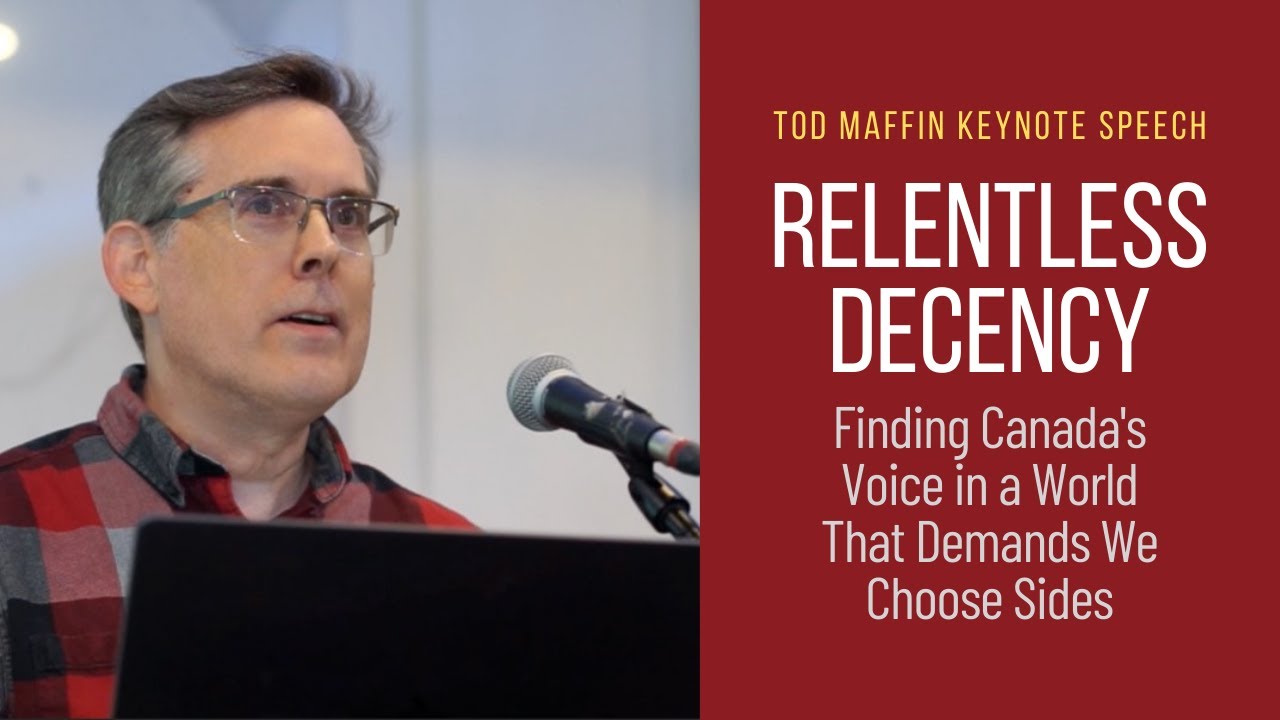
In this keynote, former CBC host Tod Maffin weaves personal anecdotes, pop‑culture references, and historical stories to articulate a vision of Canadian identity rooted in pragmatic decency and quiet, persistent help‑giving. He uses the 1970s‑80s TV series The Littlest Hobo as a central metaphor, breaking down the show’s seven “dog‑personas” to illustrate different ways Canadians can show up for one another. Maffin contrasts Canadian cultural touchstones (The Friendly Giant, The Tragically Hip, Degrassi) with American media, highlighting how Canada’s self‑definition often comes from what it is not. He recounts concrete examples of Canadian compassion – the Dutch royal birth in Ottawa, the annual Tulip Festival, the 50‑year “Whiskey War” over Hans Island, and historic labour solidarity – to demonstrate a pattern of quiet problem‑solving rather than loud conquest. He then describes modern, low‑key protest traditions (Bridgette Dupay’s silent sign, Elijah Harper’s feather) and showcases his own grassroots mobilization: a viral video inviting Americans to “buy Canadian” and later to visit Vancouver Island, which evolved into a Discord‑based recruitment hub that attracted hundreds of U.S. healthcare workers to British Columbia. Throughout, he warns against importing U.S. culture‑war polarization, urging Canadians to retain their “metronome” role of steady, reasonable cooperation. The talk culminates in a call to action, inviting the audience to adopt one of the seven Hobo‑personas in their own communities and offering a commemorative pin designed by a Ukrainian refugee artist as a tangible symbol of “relentless decency.”
Chapters
So with us this evening is Tod Maffin. He is a former national CBC radio host and producer, and he's a YouTube and TikTok star in the making. No, he's huge already. So Tod, I'll turn the floor over to you. Thank you. Woo-hoo! I'm keeping my coffee with me because I'm from BC and it is still a morning there, I think. Anyway, uh, well, I'm going to start with the great philosopher Bernicli, uh, who once said, this is me in grade 9, baby. I'm not going to ask for a show of hands, but I will say that some of you will, will remember this. If you grew up in, in, in the '80s, at some point you were left alone with a box of crap in it. A rotary phone that could have a cable that could reach every room in the house, and a television that only got 3 channels. Don't say "yuck" so loud, they'll know how old you are. There are young people here who do not understand this. And on one of those channels, on a Tuesday afternoon, You met the Littlest Hobo. Yeah! Woo! Littlest Hobo, if you're pretending that you're too young to understand what I'm talking about, Littlest Hobo was a super smart German Shepherd, very friendly German Shepherd. It was a TV show. And he didn't have an owner. He just kind of wandered from place to place. And everywhere he went, the whole point of the show is he found people that needed help. A lost child, or a broken family, or a trapped animal, or a small injustice. And every time, he stepped in, fixed what he could, and disappeared before anyone could thank him. But that was it. That was the whole show. Came in, fixed what he needed to, and left. To Canadians, though— and I've never really been under— I've never understood how to articulate this to Americans, but to To Canadians, he wasn't a TV show. Littlest Tobo was a feeling, like a moment of, a feeling of safety in a world that, you know, back in the '80s and late '70s did not always feel safe. And so the idea was that if things got bad, if your bike got stole, or your friend got lost, or your family was fighting, that somehow a steady, silent presence would arrive fix what was broken, and then leave before anyone asked any questions. That dog was part of our national DNA back then. The Littlest Hobo showed up on the Trailer Park Boys. Hi, Daddy! Hey, Trim, what are you doing outside? It, uh, he got a shout out on Corner Gas. I think I just met the Littlest Hobo. How tall was he? Did he ask you for money? No, no, no, from the TV show. You know, Canada's Lassie, there's a voice keeps on calling me. A hobo is calling you? No, a hobo's a dog. A dog is calling you? No, a voice is calling the dog. The dog hears voices? The interesting thing I always thought about The Littlest Hobo was it broke every TV rule. It was very different than most TV shows. You know, most TV shows are about like a dad, right, or a precocious kid or something like that, or at least the recurring cast. Littlest Hobo had none of that. There was no recurring cast. There was no precocious kid. There was no dad. The hobo was the only recurring star. Put your hands up if you grew up with The Littlest Hobo. Good. Because now I'm about to ruin it for you. Are you ready? No. There were 7. What? There were 7. Make it stop. And each were a good thing, right? Each one— no one dog was good at any one thing, right? So number 1 was good at carrying things. Number 2 was good at protecting people and pretending like he would be fierce and everything. Number 3 was really good at mechanical things like operating a latch. He was really good with his mouth so he could operate— like if it needed you to open a gate, he would be good at that. Number 4 was good at looking like he was listening. Playing my spirit animal. This one was a happy one. If they just needed a dog to like jump around and act like happy and celebratory, they would bring this one in. Number 6 was really good with kids. If there was a scene where you needed to make kids feel like they were being comforted. And Number 7, who was the actual star, the one that you actually saw on the opening on the commercials, was actually Number 7, and his job was to stand there and look cool. They all had names, by the way, not just numbers. Toro, Wax, Lithlum, Venus, Aurora, and Lambent. But I'll show this one dog. A dog that never even got a backstory. Other than he was on a train at some point, and then he was. That's all we ever learned about his history. But every episode would end the exact same way. They want to give him an award, they noticed he was gone, That would confuse them. Then some sage wise person would give a little speech about, "Oh, the hobo just wants to keep on truckin' and now he's probably happy being on his own and doesn't want any recognition." And then they'd cut to the hobo walking away and then the hobo would stop and look back and look wistful. Then we'd cut back to the wise person who'd be like, "Well, friend, maybe we'll see each other down the road up there." And then the hobo would turn around, walk off the road into the credits every goddamn time. They never, never left this formula. Every And do you remember Scooby-Doo? Remember the end of every Scooby-Doo episode? I would have gotten away with it if it weren't for those kids and that damn dog. Every episode. Show up, figure out how to help, and then leave. I've been thinking about that show a lot lately with everything going on in the US, here, and so on. About why, about what it is about this show that cuts so deep for Canadians. Because on the surface it's more— it's just a showboat, a dog. But, you know, in reality it's more about us, and it's about, I think, how we want to be seen in this country as a nation, and about how we are seen. In many ways, Canada has always struggled to define an identity for ourselves. Often we define ourselves by what we are not more than by what we are. We are not British, we're not European, We're not American, and yet somehow we're all of those things. Somewhere, I think, the Americans forget that we are not them. Back in the '80s and '90s, Chevrolet used to run these taglines for their cars. "The heartbeat of America," it would put a B in. It was always over Texas flatties and cowboys and things. <LYRICS>Oh, heartbeat of America, share the love, not to be, share the joy.</LYRICS> The heartbeat of America. And then they tried importing it. Canada? Exactly the same ad. Exactly the same ad. Except at the end they put "the heartbeat of Canada." And nobody up here had any clue what the hell they were trying to say. Because we just don't talk like that, right? They just tried to move from one— it was kind of like a whole point, a whole part of the country was like as if someone had farted in a library. You see the ad and everyone was like, What the fresh hell is that? That ad campaign was scrubbed within days. You can barely find anything about it online. When we don't talk like that, it's not that we're not patriotic, it's just that we don't feel the need to hire a marching band. Remember when Target tried to set up shop here? They lasted for an hour and a half. It was one of the fastest major retail failures in Canadian history. 133 stores, an hour and a half, $7 billion flushed down the toilet because of American overconfidence. And, and more than that, miswrite culture. I think part of the distinction between what makes us Canadian versus just Northern Americans is that we, from childhood, we get a different set of priorities Show on the bus. Things were simpler. TV shows, kids' TV shows were simpler. How do you think the Friendly Giant would go over today as a kids' show in the US? I might remind you, the Friendly Giant, for those of you still pretending that you're not your age, the entire show is a giant in medieval tights playing music with a rooster and a giraffe. That was the show. Now I can see who the real young people are because they're like, are you serious? Serious? The rest of you guys are just like, yeah, right? But it's comfort food, right? I actually, during this last election cycle, I actually found the Friendly Giant, all TV shows for me, for kids in Canada, but the Friendly Giant was definitely kind of a really interesting lens to view the election with, right? Mark Carney was the Friendly Giant in a blazer, calm voice, towering presence. Kind of a Ben Times story approach to leadership. Boring as hell, but you know, the real Fred Figgyrein of course never had to battle a trade crisis. His biggest challenge was looking interested while Rusty the Rooster went on another goddamn harp solo. And tell me this isn't true, Pierre Polyev is Rusty the Rooster, always popping out of that bag with hot takes, squawking about gatekeepers or whatever the CBC did to him that day, looking around every corner just to Case reporters are there. Jagmeet was— Rusty was Jerome the Giraffe. Jerome was the heart of the show. He was curious, he was kind, he'd ask big questions, challenge assumptions, but like Jagmeet, never really ran the show. They even had the Colliers of the Green Party on that show. You remember them? Two cats. Their names on the show were Elizabeth May and the other guy. But that was the election. A well-dressed giant who means well but talks too slow, an uptight rooster with a megaphone and a persecution complex, and a giraffe looking at the camera with ISS-free. Is this seriously the show? Sometimes the way to check Canadian identity is to, uh, it is is to see how people respond to the question, "How are you doing?" Like, if you ask an American, "How are you doing?" you will get, "Amazing! Crushing it!" Very masculine, very definitive. You ask a Canadian and you get, "Well, it's, you know, it's okay considering. I mean, this is complicated." And they'll want 5 digits. You know that saying, "As American as blank"? What is the answer to that? As American as— Apple pie. Apple pie. Which is a little awkward because the apple pie was actually invented as Birkin, but we're just gonna let the Americans pretend that it's theirs. Years ago, as a host on CBC, one of my favorite things that the Hunter Corp did in my time was that one of the shows did a contest to try to pick a unified answer to the statement, "As Canadian as blank." The winner managed to capture one hallmark of being Canadian, which is knowing how to perform under not ideal circumstances. When something is not working, We, as a people, as a nation, we don't "dabba-dabba" as a people. We adapt. Or we compromise. Or we "kibbit." Not because we're weak, but because we're sane. America builds a $1 billion spaceship, cancels the project, and then says, "We're gonna build 2 more, and this time we're putting eagles on 'em! Fuck yeah!" And Canada were like, "How about we just send you guys a really cool robot arm?" That's not laziness, that's efficiency. That is understanding that sometimes the juice is not worth the squeeze. And we are open-handed with that. It's not that we're uncomplicated, I think it's just that we're reasonable. And in a world full of chaos, maybe that's the identity that we should be proud of, Steppelos. A nation of reasonable people doing their best together under imperfect conditions. And so the CBC decided to ask Canadians what phrase best captures our identity. The winner was "as Canadian as possible under the circumstances," which is perfect, right? Pragmatic, polite, a little unsure. But we're trying. We're not the heartbeat of the world. We're the metronome. Our job is to keep everyone else in time. When you think about it, the way that other countries think our identity is, is often the way that we think of the littlest popo. The people who step in where we're needed, help where we can, and then quietly move on to the next people that need our help. I do not have to tell you that Canada's labour history is that story. Chinese labourers blasting through the Rockies. Cape Breton miners carrying coal from the cliffs. Québécois shipbuilders, nurses in northern outposts, Indigenous trappers. And when the factories and springs sprang up, workers stood together not to make things— not to make headlines, but to make things fair. Your history. Our history is full of those stories. Show up, find people in need, help, and move on. This is my stepfather Hans. He died a few years ago, but when he was a child, he and his Dutch town were liberated by the Americans. We did that. After landing in France on D-Day, our troops pushed north, fighting through mud and fire and blood to reach the Netherlands. We cleared big waterways that blocked Allied supplies. We launched offensives that broke the German grip on Dutch cities. Meanwhile, the Dutch royal family fled to Canada. This is the Crown Princess Juliana. She was pregnant at the time, but being born as a child, being born on foreign soil, would have prevented her child from one day inheriting a throne. So Canada declared the maternity ward of the hospital that she gave birth at extraterritorial for one day. Legally, that day, in that one room, at that one hospice, was Dutch Rand, not Canadian. So that Birgitta could be born a citizen of the Netherlands. That baby is Princess Marguerite, and she still visits De Santis. After her birth, the Dutch flag flew from the Peace Tower. That is still to this day the only time that a foreign flag has blown— tuei, is it over here?— has flown by itself. Meanwhile, back in Europe, our troops were clearing house to house, freeing millions and About 80 years ago, German forces in the Netherlands surrendered. The cost was 7,600 Canadian soldier flies. Today their sacrifice is taught in schools there. Canadian flags fly in the cities all over the country. Families adopt the graves of Canadian soldiers and care for them. They consider it a doobie. Passed down from generation to generation. When the war was at its worst, the Dutch who ran out of food ate tulip bulbs because that's all they had. After the war, the Netherlands sent 100,000 tulips to Canada as an act of gratitude, and they have been doing it every year since. So when you see the Tulip Festival here in Ottawa, that's what that means. That's where the tulips come from. So if you ever wonder what we do as a country matters, look to the faces of the veterans embraced by new generations in the cities they once saved. Show up. Find people in need, help, and move on. You know, Donald Trump says a lot of stupid things. He said that Canada's military is different, and he's actually not wrong about that. Canada's military is different. Ours doesn't fight because we must. We fight because we choose to. Compassion, not conquest. And sure, the US military is big and shiny and loud, but you don't need to shout when history speaks for you. In fact, one of our most famous disputes was fought in Near-Sinos. It was a 50-year standoff that Canada had over a cold, barren, uninhabitable chunk of limestone in the middle of nowhere called Hans Island. Starting in the '70s when Denmark and Canada were drawing maritime borders between Greenland and Canada, they breezed through 1,400 miles of water lines, but they got hung up on this rock. Both sides said it was theirs. Both sides had half-decent reasons for the claim too. But instead of solving it like your average superpower with guns and tanks, they decided to just leave it blank. And for 50 years, this uninhabited island, about the size of downtown Whitehorse, just sat there. And then in 1984, shake down reel. Canada, we be the tourists. We climbed the flag, put down a bottle of whiskey, and left. Denmark comes by the following year, pulls our flag down, plants their own, drops off their own bottle. We come back, erase everything they did, left a bit of whiskey. They come back, erase everything we did, left some whiskey. This baptism for went on for decades. Each time, a visit, a flag, a bottle of booze. People still call this the Whiskey War for that reason. But it wasn't all jokes and giggles. Both countries actually care about this. They both had historical claims. There was Maritime law, they thought maritime law was on their side. They brought in Inuit communities to consult who'd used the island, owned the island for kainamoria, probably thinking the whole whisky thing was ridiculous. Can you imagine their perspective? Like two dads fighting over who gets to name the ice hole? And then just a few years ago, after 17 years of negotiation, years of negotiation, It was over. A deal signed in the most rational way possible. We split the island right down the middle, like two elderly church ladies splitting the last butter tart on the tray. Politely, but with a little take of judgment. The funniest part is that there was already a line right down the middle of the rock. The whole time there was a line, a natural crack that ran right down the middle of it. 50 years of this, and they finally were like, Well, what if we make the Nuuulapaaq the divide? And then we sealed the deal with one last "Boohoo, Slogans." It's my hope that decades from now, when kids in Nuulapaaq learn about Hans Island, they won't learn about war. They'll learn about wisdom. They'll learn about two nations that shared a past. Saw a future and made a decision to build a border that did not divide people. It united them without a single threat or a single shout. This is my point. We're not loud. We're not a nation of shouters. The Littlest Hobo solved problems and couldn't even speak. Some of the most effective protests in this country have been completely silenced. June 2011, the Senate was in session for the House Speech. Prime Minister Stephen Harper, lots of protests in the streets about everything, climate change, muzzling scientists, that sort of thing. And in the middle of the Throne Speech, one of the pages there, a 21-year-old named Bridgette Dupay, stood up, a page for member, stood up, walked right to the middle of the room, reached under her dress, and pulled out this sign. And didn't say a word. She just stood there. We don't have video for it because the cameras only allowed to shoot the main show. But you could feel the gasps. You can hear the audio of it. By parliamentary standards, hell, by Canadian standards, this was an act of bureaucratic terrorism. She stood there 20 seconds before the sergeant-at-arms escorted her out. She was fired, of course, but for those 20 seconds, the most controlled room in Canada was completely off script. And this was not storm the energy, storm the Capitol energy. This was excuse me, I brought visual aids energy. And still it made the evening news in Three High Ages for months. The Speaker of the House said it was contempt. One of the cabinet ministers at the time called her a lefty kook, which she actually started to use to introduce herself, which I thought was kind of a great little F-you. But that one act of rebellion in which not a single not a single word was spoken, not a single barricade erected. That act started a national debate. Most Canadians of a certain age remember this. They probably cannot tell you a single policy from that throne speech, but millions of people in this country remember this saw sign. People started making stickers, putting them everywhere. So much so that some political scientists said these stickers might actually have swayed the election. This was not the first time that silence tore through the noise in our country. In 1999, the government was trying to push through the Meech Lake Accord, constitutional changes, trying to bring Quebec into the, fully into the Quebec, into the Canadian family, but it needed unanimous provincial consent. One Cree politician from Manitoba named Elijah Harper refused to agree because they had not consulted Indigenous people for the negotiations, and each time the vote came, he held an eagle feather and said no. Every vote. This is my nikkiwesli. I have to wonder when he's grown and he's a grandfather how he will describe Canada's history. Because remember, history then will be where we are right now. Today we are living in what he will refer to as history. And what kind of history will we have been? Well, the textbooks talk about how divided we became after America fell apart. Will keynote speakers 80 years from now stand up at conferences like this and talk about how we lost universal healthcare because we let the American culture wars flood our social media feeds? Will our descendants ask why we knew about economic inequality but spent more time in committees studying problems than fixing them? Will future therapists wonder, what, what were we thinking back then? Letting anxiety algorithms profit from our children's attention. Maybe. But we are in control of that today. And I would argue you are in control of that in your Kirkner goal as well. You don't have to do everything. Just one part of it. Remember, there were 7. Each one played a different role. Each one took the story in a different direction. Which one will you be? Are you going to be the one that's good at listening? Maybe you start a program that captures the oral history of your union's early days. Or will you be the one that's good at protecting people, even if that means sitting in the lobby of an Anki's constituency office until they see you about workers' safety? Or will you be the one that carries things, like a little bit of extra hope for someone else? I sometimes have this fantasy that we can make this like a nationwide project and call it— I'm sure the Littlest Hope of People, I'm sure they still own rights to that, but we'll call it the Non-native German Shepherd Project. We'll figure out a way around it. And then we'd all get pins, right? We'd all get pins like this. Real things, right? That we could wear. And it would be like a little symbol that we were on Project Change History too. You don't have to be good at everything. I am good at exactly two things: making videos and being an attention whore. And then one day I thought, because this is around the tariffs time, I thought maybe, maybe I'll make a video. I'll go to the, my local grocery store and I'll make a video about how to buy Canadian. Now that the illegal trade war is on, let me teach you how to buy Canadian at the grocery store. It is harder than it looks. Let's start with prepared in Canada. To legally say this, the product has to have undergone preparation entirely in Canada, but the individual ingredients could come from anywhere. It's kind of like this one: made in Canada from domestic and imported ingredients. And there is a difference between made in Canada and product of Canada. A big difference. That video went massively viral, millions of views. What I didn't expect was so many Americans in the comments saying, we support your boycott, Canada. We want to support your economy. How can we do it? So I was bored after I was reading through some of those comments of Americans saying how much they wanted to help us. I was waiting for an Xbox game to install, I think, and I made this video. Hey Americans who support Canadians, I have an idea. What if we picked a day in like a month and a half or so where all of you come up here to Vancouver Island? I'm not kidding, hear me out. If we do this, the city would like give you Literal keys. They would be so excited. We have incredible outdoor activities here. We have hiking. We have some of the best brew pubs in the world. We just pick a day and all of you show up and I can like host an event. Should we do this? Now before you make up your mind, a few things about Canada you should probably know. Uh, first of all, we rather like LGBTQ people. Our streets are clean. We don't really have mass shootings. And best of all, our dollar is worth like nothing right now. Your dollar would go so far. You know how much it would cost you to buy like a meal? Probably like 20 cents US. Should we do this? Comment below if you'd actually show up! And if enough of you do it we'll pick a date— We will fucking do this thing!" The original version was I mentioned weed stores and TikTok took it down immediately so I have a strike on all my channels because I mention legal products in this country. I put that video out; went to wash dishes in kitchen and started hearing phone ringings "Ding ding ding." Comments, comments, comments, comments. So many, I did an update 2 hours later. Earlier tonight I made a video inviting Americans to come up to Nanaimo, where I live, sometime in April to, you know, just kind of hang out. What if we picked a day in like a month and a half or so where all of you come up here to Vancouver Island? Um, guys? So I thought I'd put up a web form just to collect more information to see how many people were really interested. Um, guys? Hundreds and hundreds— within 72 hours, 2,000 people had registered! Had said I am interested and I'm serious. The form said don't fill this out if you're just trying to get updates; only fill this form out if you think you might actually come. And then more people started signing up... "I told ya they were coming!" Two coming from Belton, Texas! Tew komin froum Sampointe Idaho! From Olympia, Washington. We have 4 from Marysville, Washington. 2 from Kirkland, Washington. Just me, Sarah, from Indiana. 2 registered from Everett, Washington. Hey, this is Alan and Liz Cohen from near Portland, Oregon. Serbi, 2 of us, and we are coming from Oregon. We're coming from Spokane, there's 2 of us. 2 registered from Blackwood, New Jersey. Murphina, you're coming to the NIMO from Port Angeles, Washington. 2 from Seattle plus a miniature schnauzer. I'm coming, I booked my flight and my accommodation, just 1 person. I'm from California. One registered from Portland, Oregon. I'm coming by myself and I'm from California. One person, two beagles. There's about 12 to 14, maybe even 20 of us. We had people from, we had people from Texas. We had two different groups from Texas. One of the groups drove up from Texas, picked people up in Los Angeles, and carried— we had people from New Jersey, we had people from Florida, we had two different groups from Australia. In the end, hundreds of them came out. One of the things that I had not expected though was that American healthcare workers, Americans would use this as a chance to come up and see what Canada was like as a possible escape route. These Texas nurses felt Canada was a safer place to be than home. I could actually hold her hand and not be afraid. And it's so accepted here, and it's a beautiful thing that you don't always see in America. They're thinking of moving to B.C., a province in dire need of healthcare workers. They're here now. I knew I would get emotional on that slide because they're working. So this is Rachel on the left. She starts in our ER department tomorrow. More than a dozen nurses, doctors, psychologists came to check us out. So my wife and I took the original Nanaimo Infusion website, which was just to come up and visit us, and repurposed it to become the Nanaimo Healthcare Infusion. The idea was that if we could get lots and lots of eyeballs on Vancouver Island and BC, that we could do it again. We could do it again, and this time get doctors and nurses out of it, purpose-built. And it started to work. We have a Discord server now which has 12 American healthcare workers in it. They are exchanging information about immigration paths and schools for their kids and available rentals and job opportunities. We have separate channels for different types of healthcare workers. We have local practitioners in there to help walk them through what it looks like on the ground. We have recruiters from our health authority. We have the head of recruiting for BC Ambulance Service in there. We have the head nurse of the ER department of our local hospital in there. All we had to do was ask. We have channels for each local community, mini ambassadors for each town in there talking about their local clinics or what their medical needs are or the hiking trails or singing groups. We have channels so people can find friends before they even arrive. Video gamers, knitters, parents, queer folks, seniors. I didn't have time to put it in the slide deck, but as I was sitting here just minutes ago, my wife texted me a photo of— she's at a board game store. With 3 of them, 3 different ones. But that's what we do in this country. We connect people when they need connection. We help when people are oppressed. I do fear though that the one thing that can stop Canada from playing that role, which obviously the world needs desperately right now, and that is the threat of the culture wars down south. The last election worried me. It felt to me like Canadian politics was beginning to copy the rhetoric and the talking points of the US. Dangerous talking points. Blatantly false talking points, but a willingness to accept them anyway. For the longest time, Canadians treated neighbours as neighbours. We were the people who lent a snow shovel to you. When someone else's broke mid-blizzard, the people who took your neighbor's garbage bin in when you were out of town, not because you voted the same way, but because it was garbage day. And also raccoons. But somewhere along the line, we started drawing battle lines down the middle of cul-de-sacs. We started muting family chats, blocking old friends because they voted blue or red. Or orange or green. If we keep copying the partisan warfare of the unraveling republic to our south, we risk more than gridlock. We risk becoming indistinguishable, a nation where political identity trumps everything else, every conversation a loyalty test. Every disagreement a threat. If we keep going, we won't just resemble America, we will be its 51st state in all but law. Echo chambers, not communities. That's not Canada. At least it didn't used to be. Or more than our politics, for the people who nodded each other in the elevator, who wave cars through at four-way stops, We show up for each other again and again, even in the worst times. Because after every moment, after every contract negotiation, after every mediation, after every election, after every ballot is counted and the last sign removed, we will all still be here side by side, protesting or celebrating or shoveling snow, complaining about the passport lineups. Sharing driveways. I think every Canadian can name a Tragically Hip song. Am I right about this? We can all name at least one, right? It's the law. Ahead by a century, New Orleans is sinking. My favorite is Courage. Courage is a great song, by the way. But until this chaos lately, I had not really fully understood the song. The chorus in particular. I've always thought it's so damn depressing. Like, like, what is he trying to say? What is Gord Downie trying to say? And I think in the chaos of everything these days, I think I, I think I finally understand it. Courage does not always look like what we think it is. Going to look like. You know, in the movies, courage comes with fanfare. There's big emotional revelations, there's a parade after. Courage is shown in movies as the thing that kickstarts action. The courage comes first, and then once you've got courage, then you can take action. But maybe what Canada can lend the world is this: Sometimes courage is just staying. Staying when it would be easier to leave. Taking to the streets when it would be easier to post on Facebook. Like what's happening as we speak tonight all over the US, here at home with the No Kings, rallies. They call them the No Tyrants rallies in Canada because— this is a little awkward— uh, guys, we have a king. So they had to rename them. But showing up, showing up again and again and again when everything around you says why bother. If we are ever to claim an identity as Canadians, let us be the people who do not show— who do not wait for courage to show up. It didn't come. It doesn't matter. The song's name is not Courage, by the way. It's actually Courage for Hugh MacLennan. Hugh MacLennan was not a war hero or a political giant. He was a guy that wrote novels, wrote novels about Canada at a time when everyone told him that he shouldn't because Canada was too small. It was pointless. No one would care. Canada was too quiet. And Gord Downie, as the story goes, was on tour and reading one of MacLennan's novels, The Watch That Ends the Night, which is about a lot, a lot of different things, but mostly it is about what I think a lot of people, certainly in the US and, and also here, are feeling right now, which is about the weight of carrying on when there is no clear path. He wrote it in the worst time. Right after his wife died. This chaos we live in with every hour a new headline, every day a new obstacle, every month a new tariff. Who can blame us for choosing inertia? But here is something that I have learned from the labor movement in this country, and that is that action doesn't always spring from strength. Sometimes just carrying on, just believing in each other, sometimes that is enough to get us through a moment. Cancer took Gord Downie from us years ago, so we can't ask him what he meant, but I like to think that he left the answer behind. Yes, it is overwhelming sometimes, but we are not broken. We can meet the chaos on our terms. Because the thing about Canada is that we are not and have never been a nation that came together because we all saw the world the same way, We came together because we had no choice but to find a way. That's our superpower, I think. Not sameness, not certainty, not even consensus. Our strength is doing what you folks at your organizations have always done, the difficult task of sticking together when everything seems to be pulling us apart. We didn't always come out the other side because things got better, We came out because we stayed together, even when it hurt. Like the October Crisis in 1970, armed soldiers patrolling the streets, the Prime Minister invoking the War Measures Act. People who lived through that time, they're in their 70s and 80s now, they'll tell you it was terrifying. A country divided between civil liberties and state power, between Quebec and the rest of Canada. But we got through it. We didn't break, and Québec didn't leave. Or the constitutional wranglings of the 1980s. The patriation of the Constitution was a full conflict where it divided provinces. It sidelined Québec. It was messy, and it was painful, but we emerged with the Charter of Freedom and Rights. A Charter of Rights and Freedoms, and that is now the envy of the world. We didn't get it all right, not even in that document, but we got things better than they were. The Kanesatake resistance in 1990, sometimes the media calls this the Oka Crisis, a dispute over land for a golf course that escalated into a full military crisis. It shook us as a country. It revealed the fractures in the story that we told ourselves about the relationship we have with the Indigenous peoples whose land we took. And while reconciliation is far from complete, it forced us to start confronting our past. Painful? Yes. Progress? Also yes. Division is not new to us. What is uniquely Canadian, something I think our friends to the south wish that they had more of, is that we do not give up on each each other here. The work that you do in your offices is perhaps one of the more clearest examples of that. Canada is a country formed by improbable bargains and impossible compromises, a place where French and English agreed to live together without becoming the same, where oil-rich provinces and car manufacturing provinces figure out a way to share a budget, where the coldest parts of the planet are somehow home to the warmest hearts, where we keep showing up for each other, even when we disagree about how. Let us not mistake the noise for collapse. Don't let the chaos convince you that we're coming apart. We're not. We have shouted and slammed doors and stood our ground, but we have never stopped believing in this place. Canada is a country that survives because of our differences. So here's what I want for us in this room. Us, all of us, including myself. I want us to choose what role we will play in shaping history, which we are in today. Any part of history, any part you can control on your block, in your union, at your kids' school, whatever. Because we get to choose that, and we don't need to wait for courage to show up. History remembers the ones that lower the drawbridge and make room and say, "Come in, let me pull up a rocking chair. There is space for you." History reminds us that you do not need a big plan to make a difference. You don't need to be permissioned to be kind, you just need to notice the need and show up. And in the end, that's what these shows were about: relentless decency and a belief, however fragile, that our country can still be made better one person, one local, one union, one small gesture at a time. 7 of them. Each one a different role. Each one taking the story in a different direction. Which one will you be? One more thing. I mentioned this idea that I had, this fantasy world that I had, that we would have We would all have these little hobo pins as like an insider signal to each other that we were in on this. Well, the pin is real. And I have one for each of you. This is the work of a young Ukrainian artist who came here to Ottawa as a refugee. This is her design. And I wanna leave you with something a little fun, 'cause that was a little depressing in parts, I will admit. So one of the things that my wife and I wanted to do as part of this try to attract healthcare people was to attract a lot of eyeballs on a video that we could then use to promote. So I'm gonna show you a video that I put out a couple of weeks ago. Some of you may have already seen it. This is the first part. The second part, which you will not see, goes on to talk about how great Vancouver Island is. But this was my idea on how maybe I could get other people to see a video about BC and Vancouver Island. I am the very model of a modern-day Canadian. I watch each CBC debate like I'm their ombudsmanian. I cheered for I listened to the Quebec Nordiques and watched them get betrayed again. I keep the U in neighbor like a linguistic contrarian. I practice doing all of Celine Dion's choreography. Collected every part of the Tragically Hip's discography. I mapped the rise of Bob and Doug like cultural geography. I charted the Degrassi Kids' most likely genealogy. I charted the Degrassi Kids' most likely genealogy. I charted the Degrassi Kids' most likely genealogy. I charted the Degrassi Kids' most likely genealogy. I know to keep my distance from the Roughriders and all their fans. I tell my friends I'm NDP, but vote the Liberals in again. I know the goddamn difference between Casey and Finnegan, and if you don't, then brace your neck for a little handshake showin' again. For me, pepper, I put it on my plate. I learned to spell Saskatchewan, but really just phonetically. I know the full Heritage Minute catalog pathetically. I bargained over double doubles jaywalking in Montreal, left shivering in a tukwul shouting, "This is not that cold at all!" I spent my childhood building Building forts with Chesterfields and moose head cans. I'm watching shows with a giraffe and a small rooster in a bag and knew the taste of driveway gravel from a thousand games of tag. I smelled the fermentation of my sister's unwashed hockey bag. I smelled the fermentation of my sister's unwashed hockey bag. I smelled the fermentation of my sister's unwashed hockey bag. I smelled the fermentation of my sister's unwashed hockey bag. I offered land acknowledgement from someone else's land. I ran, I clapped, I beat it, I powwowed and bowed like I was in Japan. I bought a drum from Amazon and played it like a frying pan. I said, "I really honor this." —then mix it up with Burning Man. He bought a truck from Amazon and painted it like a bike, and he's actually a really, really, really, really stupid man. Those aren't the lyrics. In short, we're proud to be sovereign, and we don't deport immigrants. We don't dream up crises to start another futile war again. Our kids dodge homework, not live rounds. Our health care's not barbarian. We are the very model of the modern-day Canadians. Our kids dodge homework, not live rounds. Our health care's not barbarian. We are the very model of the modern-day Canadians. Modern fit for data! Thank you for having me. Don't forget your pin. Thanks.
More from Tod




Ten times Canada helped the U.S. with its wildfires, instead of whining about the smoke. 





