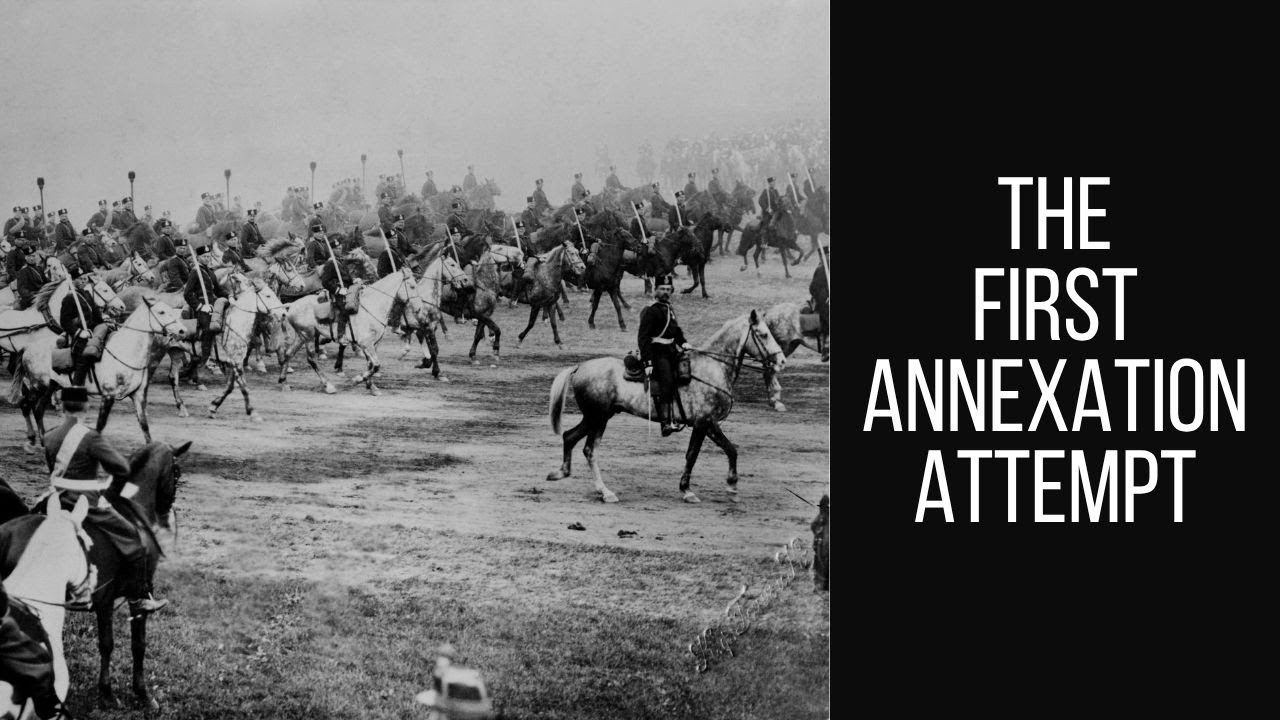
The video recounts the 1898 crisis when the United States nearly annexed the Canadian Yukon during the Klondike Gold Rush. After George Carmack’s 1896 gold discovery, thousands of prospectors—predominantly Americans—flooded the region, swelling Dawson City’s population to about 30,000 and outnumbering Canadians. This demographic surge, combined with an unresolved Alaska‑Yukon border and the prevailing American belief in Manifest Destiny, alarmed Canadian officials who feared a de‑facto takeover. In response, the Canadian government dispatched the 203‑man Yukon Field Force on March 1, 1898, stationing troops in Fort Selkirk and Dawson City to guard banks and gold shipments. Simultaneously, the Yukon Territory Act was passed, formally establishing Yukon as a Canadian territory with Dawson City as its capital. The border dispute was later settled diplomatically, but the British representative’s siding with the United States was viewed as a betrayal by Canadians. The video highlights how this little‑known episode was pivotal in preserving Canada’s northern borders and shaping its national identity.
Chapters
Back in 1898, Canada nearly lost a chunk of its territory to the United States. The Yukon, home to breathtaking wilderness and spectacular northern lights, almost became American soil. It all started with gold. In 1896, George Carmack and his Tagish First Nation family members discovered gold on a Klondike River tributary. News spread fast, and by 1897, thousands of people, mostly Americans, were rushing north with dollar signs in their eyes. The situation got intense real quick. Dawson City's population exploded to around 30,000 people during the height of the gold rush, with Americans making up the majority. This demographic shift was a serious problem for Canadian authorities. Think about it—thousands of Americans suddenly outnumbering Canadians on what was technically Canadian land. Making matters worse, the exact border between Yukon and Alaska, which the US had purchased from Russia in 1867, was still being disputed. Plus, some Americans still believed in Manifest Destiny, the idea that the US should control the entire North American continent. Canada's government was legitimately worried. The Minister of the Interior didn't mince words when he expressed concern that the Canadian authority in the region could be, quote, "overridden, being destroyed, and the government of that district being theoretically, if not actually, taken out of our hands." The fear wasn't just paranoia. The US had a pattern of expanding its territory and was actively trying to annex Hawaii during the same period. Canadian officials worried that the Americans in the Yukon might establish their own government and then call in US military support. So, Canada took action. On March 1st, 1898, the Canadian government ordered a military force to the Yukon. This Yukon Field Force consisted of 203 men equipped with rifles, machine guns, and field artillery pieces. These soldiers embarked on a difficult journey, even attaching bayonets to long poles to spear salmon when their food ran low. The force split up, with half stationed at Fort Selkirk, another half in Dawson City, where they guarded banks and gold shipments. They never actually fought any battles, but their presence probably discouraged any American takeover attempts. At about the same time, Canadian authorities passed the Yukon Territory Act, officially creating Yukon as a separate Canadian territory with its capital at Dawson City. This established firm Canadian control over the region. The border dispute with the US was eventually settled through diplomatic channels, although Canada wasn't thrilled with the outcome. The British representative on the resolution board sided with the Americans, something Canadians viewed as a betrayal for many years afterwards. It is a little crazy to think how different North America might look today if Canada hadn't acted so decisively. This almost annexation doesn't get a lot of attention in history books, but it was a pretty crucial moment that helped shape Canada as we know it.