The Future of Payment 2017 Keynote Speech by @TodMaffin
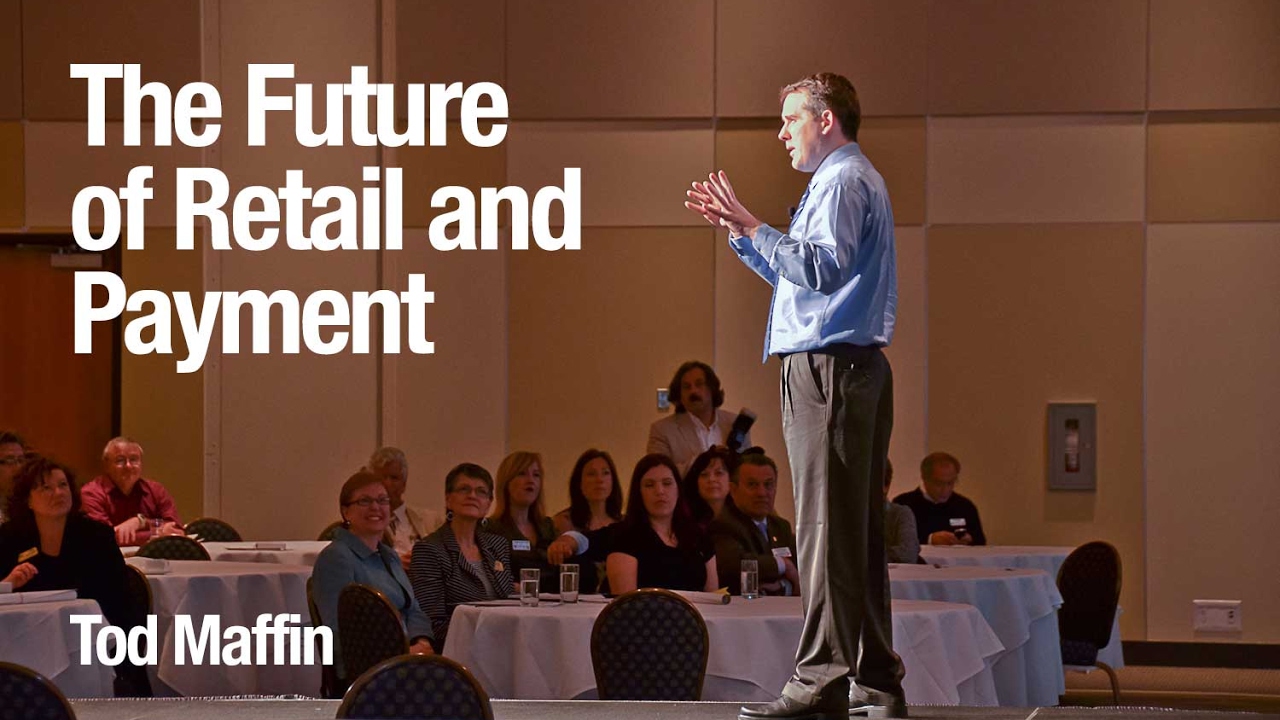
In this 2017 keynote, Tod Maffin shares a personal, self‑deprecating story about his own inability to remember to pay bills, then pivots to a sweeping overview of how payment and commerce are being reshaped by technology. He traces the history of payment from coins and the original Diners Club charge card to today’s mobile, social, and biometric systems. Maffin outlines eight emerging pillars that will define the next decade of commerce: financial abstraction (illustrated by video‑game micro‑transactions), biometrics and big‑data analytics, hacker/maker culture, social buying, conversational commerce (chatbots and messaging), hyper‑local marketing (beacons), augmented reality in stores, and the Internet of Things (voice assistants, smart buttons). He backs each pillar with concrete examples – M‑Pesa’s impact on Kenya’s GDP, China’s $2.35 trillion mobile‑payment volume, Disney’s wristband wallet, Chime’s round‑up savings, Tappy payment rings, and Amazon’s Dash buttons. He also discusses the role of open data, the value of embracing hackers, and the strategic imperative for payment processors to become trusted advisors who help retailers navigate these changes. The talk ends with a call to action: payment companies must shift from selling hardware to providing integrated, data‑driven solutions if they want to dominate the next decade.
Chapters
Look, I— one of the things that you may have noticed when I first came out, when you heard the introduction, is I'm not an expert in payment. In fact, I'm bad at payment. I'll put it that way. I'm really bad at it. I have a bad memory. I don't— I might be your best customer, in fact, in that regard. Certainly fraud detection, anyway. But I have no memory. My first real encounter of this in the business world came a number of years ago, in about the year 2000, and I was setting up a dot-com company. And the idea for the dot-com company is that we were building this artificial intelligence engine that would rank the subjective mood of public opinion over the internet. So it would troll through chat rooms and closed captioning of TV newscasts and web forums and so on. It would look for the words that people were using. And this is sort of— this is the actual napkin when I drew it out, the initial idea. The idea was it was going to have television and web and chat rooms, and all that content was going to come on down into this artificial intelligence engine. And we'll talk a bit about AI and its— relation to commerce and payment in a moment. And then it was going to feed all that into this— some sort of analytic tool that I had some buddies that we came on board and we decided to program it. It was all going to rank it on a tone of— on a scale of tone and severity, -4 to +4. So "Maffin" and "idiot" would have ranked about a -1. "Maffin" and "bankrupt," and if it saw the phrase "running from creditors," you know, things like that, it would rank it about a -4. And it worked. We actually built it. We raised some money. We went— we raised about $3 million. We started out in the back of a little ISP shop because they threw in free internet. That's me on the right. You can tell it's the '90s because of the glasses. And we built it up into a company. We eventually moved into big offices. We called it MindfulEye. Our tagline was, "The world talks. We listen." And, you know, it was great. We were actually— we ended up, as I mentioned, taking it public. And one of the sort of strange things that happened with it is that two of my partners in it, Tod Kusfula and Matt Sybil, both super smart guys, and every Friday we'd go out for drinks. And every goddamn Friday, this would happen. The bill would come, and they would go, "Oh, shit. Sorry, Tod. Do you mind covering this week? I forgot my wallet." And I have no memory. Like, I'm not even certain what city I'm in right now. I'm really bad at memory. And so I go, "Yeah, yeah, no problem." Of course, they've done this week after week. The next week comes, the exact same thing happens. Bill comes, "Oh, Tod, do you mind paying?" Over and over again for a year. This is how bad I am at payment. And just last year, I emailed the other Tod, Tod Kousoul, to ask him like, "OK, level with me here. How much money did we actually end up—?" getting off of poor Tod Maffin. And this was his email. So we don't speak anymore. And— But, you know, it all used to be simple. And this is one of the interesting things that I find about payment and commerce. And I work in the retail space. I work— I run a digital marketing agency. We work with lots of retail customers. So we work with your customers. We help a lot of shopping centers. We help a lot of retail organizations. We've worked with Mountain Equipment Co-op. And so on. And so our view of payment and commerce comes from the view that your customers are seeing. And that's why, as I hope in this, in the sort of the comments that I've got, we talk a bit about that most important part here, which is going to be solving. The other two will fall out of it. And your role as the ability to be the trusted advisor through this crazy digital world is going to be so important. Because technology will change everything. Technology will change and continues to change the very nature of payment. This was the very first credit card, in fact, at the consumer level anyway. There were some oil and gas things, and it wasn't a card at all. It was a coin. And they would literally take the coin, and they would rub it on the sales slip. And this had problems. Notably, there's no name on it, and it wasn't cheap to produce. So technology adapted, and it ended up being— this is what— this is the original charge card, was literally a metal card. They called it the charger plate. And it was a little bit better, you know, because it had a name on it and so on. But it was not cheap to produce. And so the consumer demand that that changed as well, and it did. And it changed mostly because of this guy, Frank McNamara. He was out for wallet— out for dinner and he'd forgotten his wallet in New York City. And like Matt and Tod, although he actually did forget his wallet. And he was very embarrassed. He was humiliated, in fact. And he was saying to the guy, "Look, I'll wash your dishes. I'm so sorry." And his wife eventually paid and bailed him out. But he came back a month later to that restaurant with two things: with a business plan and a partner. And the idea was Diners Club. And that was the invention of the Diners Club. It was initially meant just for restaurants. It was literally a club for diners. And it balloons so incredibly quickly. And of course, it's like, you know, typewritten. Wouldn't that be awesome if this were the way it was still today? Can I just say something? I hope this isn't offensive. Like, because I'm from Vancouver, right? So we all have weed, right? I mean, like, let's just— dudes, I'm a little high right now. No, no, I'm not. I am, but on Sudafed, not on anything bad. And I have to tell you, like, I went to the weed store. I have no interest in weed. I've smoked weed twice in my life. Both were negative experiences. One I don't really remember. The second I happened to be in Toronto and I spent 3 hours walking up and down Yonge Street looking for bananas. Still don't know why. Don't even know if I found them. So in Vancouver now it's kind of legal basically. There are more weed stores in Vancouver than there are Starbucks. That is actually factually true. There are more weed stores in Vancouver than there are Starbucks in Vancouver. And so I went and I got their card. Which is kind of like this. It looks like something you make at science fair, you know, in grade 8. It's the craziest little thing. And they put it through this cheap little Staples laminating card. "There you go." Like, "That's it?" Anyway, we're off topic already. We're gonna be here forever. So after they started that, 42,000 people in the first year, 42,000 people had signed up for it, which back then, of course, in the '30s was pretty amazing. And yet, Technology still needed to change. And of course, we've come a long way since then. We've got cards. We've got augmented reality. We have social payment. We have e-transfer. We're going to walk through a lot of those things that your customers are seeing today. Of course, as you know, Africa has been one of the huge leaders in there. This platform here, M-Pesa, is responsible for a third of Kenya's overall GDP alone. Just this one platform. A third. So very close to Vancouver's weed revenues in terms of the GDP. Mobile payment transactions in China hit $2.35 trillion. Trillion dollars in 2015. That's, by the way, that's 10 times more than the U.S. So we're kind of behind the ways. In some ways, we're still catching up. And I have to say that not everyone believes that it's still going to get there. About 15 years ago, I gave a speech to a federal agency on the future of mobile commerce. And I put this slide up. And people laughed. They thought I was kidding. Only it's not funny, 'cause it's here, right? It looks a little bit differently, it looks like this now, but it's here. And it will affect every aspect of how you do business. Your job in the next decade is gonna be to master that first one. The solve the problems, be the trusted provider for everything, because technology is changing everything. MasterCard says half of all digital orders are done on smartphones. Now, we're talking web— we're talking things like the former, you know, website orders and so on. Even those website orders, half of them are being done on a smartphone. I don't know if you've ever tried to order anything on a smartphone from a website. It's horrible for the most part, but it's getting better. It's getting better really quickly. This is payments moment. I truly believe this. I don't have any money, but if I were to invest in money, you bet I'll be investing in two areas. One is payment and the other is batteries. Batteries and power bars. Trust me, when you see all these things— like, I have the Alexa at home, which I'm sure some of you have seen. We'll talk about it in a moment as well. Of course, the Alexa is connected to the door unlocker, which is connected to the camera in our house, which is connected to— every light bulb has a Wi-Fi chip in it and everything. We run like so many power bars to get all this thing working. I think BC Hydro must check on us every week. Like, "Are you sure there's not a grow-op in there?" Is that the third weed reference? Am I just like reinforcing all the Vancouver stereotypes? What's happening here? So what I want to do is I want to bring you up to speed on the changes that are happening in the stores of your customers. Not just the Canadian Tires of the world, but also the small businesses. You know, as you heard Rob said earlier, it's going to be those small and medium-sized businesses that— where the change is really going to happen in the next world— in the next little while. So I want to bring you up to speed on what those changes are, because then you will be better positioned to meet those payment demands, but you'll also, as a salesperson, be better positioned to just be able to explain it. So we will be tackling this together in 8 ways, and here they are: financial abstraction, biometrics and big data, hacker culture, social buying, conversational commerce, sometimes called chatbots, hyperlocal marketing—that's the Beacons of the world—augmented reality in stores, and this crazy Internet of Things. So let us begin with the first, which is financial abstraction. Is anyone here a big video game player? Okay, Xbox? Put your hands up if you're an Xbox player. Yeah? Really? OK, so this is my gamer tag. Add me. I have no friends. For a while, I was playing this game called Plants vs Zombies: Garden Warfare, which is this multiplayer shooter. And you're basically a plant or you're a zombie and you're shooting. And the idea behind the game is that you're in this room with like 24— or this room— this area with like 24 other people. And they're really, really, really good. And you're supposed to have this chat system where you can hear other ones. For the first couple of months, EA, the developer, that chat system was broken. And so I just thought, these guys are good, man. I'd get my little cactus out and I'd just I would try to snipe, and a peashooter would hit me right in the head, and I was getting pissed off. Like, I rage quit sometimes. And then all of a sudden one day, they turned the chat on. They're all 8 years old. They're all 8, and they're like, "Haha, I got the peashooter!" I'm like, "Are you kidding me?" So I switched to more grown-up games. One of my favorites is this game called Watch Dogs. And Watch Dogs is a great game. Hacker game. This is the first version of Watch Dogs, which I like better than the first one. One of the modes in Watch Dogs is this area where you go into free roam, and you basically just do whatever the hell you want with no consequence. It's— you can throw bombs on things, and you know, you get cars in the game, but you basically— you're a hacker, so you just unlock them with your smartphone. You just steal the car. And so you get in this lobby with a bunch of people, and kids mostly. And you run up and you stand on top of their car and you get your little bazooka out and you're like, "I'm going to shoot your car." And they go, "Go for it." And it's fun. I'm 46 years old. But there's no consequence, right? There's no real consequence to this because it's not real money. And if your car gets blown up, you just go steal another car, you buy another car with the in-game money or something like that. And this is one example of the financial abstraction that young people today are living with, right? They have become disconnected from real money and the role of real money. And in a moment, we'll see how that affects payment, which it does in some pretty drastic ways. This financial abstraction in video games carries through for most video games, but not all. And the one exception is GTA V. I keep looking to my video game friend now for validation. GTA V, which you will notice looks a lot like Watch Dogs, but has a slight difference. So this is playing a game, and I'm just doing my regular mayhem again in a group of a whole bunch of people, and I start throwing bombs, throwing these bombs on cars, and this little kid runs up to me in his character, because you can hear them all, and says, "Please don't blow up my car." Well, not only did I blow it up, I also— it was such an explosion that the fire department apparently showed up. So I blew up his car, and the kid burst into tears. And then his mom came on the headset. I recorded that. I'm now going to play you— no, I didn't record it. I'm just kidding. Boy, everyone's on the edge of their seats there, though, aren't they? They're like, "I can't wait to hear this shit." You're all sick people! But he was absolutely distraught, because unlike Watch Dogs, and unlike a lot of other video games, in fact most video games, there is a real cost to this. It's not that you necessarily have to play with real money, but when you see a car in GTA V, you can just go steal one, or you can buy yourself a nicer one. Now, there's two ways to earn money in this financially abstract world. The first is to play it in-game, You're always just sort of playing the game, you're doing missions, you get a mission, you kill some people, it's worth $80 or something like that, but it takes a lot. It takes a lot to get there. The other way, of course, as I'm sure we all know, is paying with real money. And so you go to EA and you buy a card. A card with 1.2 million in-game dollars costs $25 in real money. I added up how much money I spent on Plants vs. Zombies after I paid for the game. It was $212. I'm not proud of that. So this kid either— this poor kid whose car I blew up, and there's no undo, there's no like restore save. His car was gone. So he either paid with his actual allowance Shut up. I didn't know, okay? Look, I came from Watch Dogs. What do you want from me? There's no user manual. Or he— or, or, the alternative is he did it in-game, which is great, right? I calculated how many hours it would have taken him to have earned that car in-game, and it was 82 hours. But it was his fault, really, because he had failed to buy insurance for his car, which is something you should do in case dicks like me show up in your game. This is actually true. One of the things that you could do— because he started to cry, and he's like, "I didn't have insurance for it!" I'm like, "What are you talking about?" In the game, you can buy insurance in case dicks like me show up or you wreck your car, right? So there's a little bit more— there's a little less abstraction here, but for the most part, the young people today are playing without— and not just playing, but also using devices without a clear sense of the direct connection to money. That impacts payment and commerce in amazing ways. We see this every week in the news, don't we? You know, kids are buying in-game currency without understanding that it's real money that they're dealing with. Those lines are more than blurred now, they're practically invisible. And some brands are exploiting this. Disney invested $1 billion in what they call the magical wristband. It's your hotel key, it's your park pass, but most importantly, it's your wallet, because it's connected directly to your credit card. And I should tell you, this kind of experimentation with payment is not just a flight of fancy. It is built into the ethos of Disney, of that corporation. When you look at what Walt Disney was trying to do when he initially announced EPCOT Center, it was to be the world of the future. The whole positioning around it was come in and see the future. And in many ways, you'll probably recognize this model from the cruise ships, right? This is the exact same thing. Your card is your ID to get back on the boat. It's your wallet, 'cause it's connected to your credit card. It's your room key, and so forth. But again, these, these trends are all beginning to come into place now, where the act of transferring money, whether even an NFC tap to actual cash, even those things are becoming even more blurred and even more invisible. This sense of financial abstraction is going to change dramatically the way people buy. And how is it going to change it? They're going to buy more. Dun Bradstreet already says that 12 to 18% spend more money when they use cards than when they use cash, which, you know, makes sense. If you think about you, right? I mean, it's like, it's different with a card. You're sort of tapping it. You shop at Shoppers Drug Mart, you got to pay with cash. You're like, "Really? $3 for eggnog? Where have I been?" You know, on a card, you just don't think about it that way. And so, as this abstraction gets even more and more blurred, this is good news, I suppose, for payment processors, good news for retailers, bad news for people with student loans and so on, consumer debt. But interestingly, though, I think, is this lack of connection between the money, the payment, and the results actually is bringing some really interesting new models to town. This is a great little app that will connect to your main bank account. And every day, it trickles a little bit of money into your savings account without you knowing about it. So every day, it takes 45 cents, buck 20. Wouldn't that be great? Like, I don't know how you save right now. Ours is like every month, it takes every— at the end of every month, it takes a chunk out. And boy, we feel that chunk, don't we? But this, it just trickles it out. And how does it know the amount of trickling? It spends the first 4 weeks. Monitoring your spending habits. And it understands, how do I get these people on the line between just the right amount of savings and not being able to survive? And it lets you adjust it accordingly. And because of financial abstraction, people don't even realize it's happening. The app communicates with the user through another trend we'll cover in just a moment, conversational commerce. In this case, Facebook Messenger. The bot can do all sorts of things. It can report things to you. It's even smart enough to say random things. If you say awesome, it'll reply with a GIF that says, "You're awesome." And these bots are beginning to personalize the relationship in a very human way, ironically. When was the last time your bank said, "You're awesome," to you? Like, I don't know about your bank, But this is how my bank communicates with me. I would rather have your awesome, frankly. This is part of the reason that some financial players are now playing into this space as well. This is Chime. It's essentially a bank. You get regular savings account, but what's neat about their credit card here is that every single purchase it makes, it rounds up to the nearest dollar, takes that money, and dumps it in your savings account. And then at the end of every week, it adds up all of those roundups that you've done, the total of those, and gives you 10% of it in cash. Well, not in cash, but in money in your account. It's genius. It's genius. This is the direction the banks will be going because they have to, because they're going to get their butt eaten alive by these little players like this. They're going to steal these ideas, you watch. A year from now, all the major banks will have something like this. This is some video from just a couple of weeks ago. At CES, the big nerd conference down in the US, one of the most— no, no, I wear nerd like the badge of honor. It is. I'm an Alpha Greek. This is one of the most talked about spaces, one of the most talked about products in your space. Does anyone recognize it? Tappy? Tappy is, brace yourselves, a payment-enabled wedding band. Insert joke here. Of course, it's not just a wedding band, right? It's any kind of band. It's ceramic, so it doesn't interfere with Wi-Fi. But my point is that these devices are being put everywhere. The ability to pay is being put everywhere. This is a massive opportunity for you. Maybe not for your spouse, God help us all, in the case of Tappy. But one thing is clear, that the more devices we have that enable payment, the less connect our relationship to payment has, which is part of the reason the big companies have been investing in biometrics. And we are beginning to see the trickle-down of big data, which had been sort of initially just sort of used for the large, large players, being used for the smaller ones as well. And I have to say, big data is a complicated thing, and business has never been good at explaining complicated procedures.
Here at Rockwell Automation's world headquarters, research has been proceeding to develop a line of automation products that establishes new standards for quality, technological leadership, and operating excellence. The original machine had a baseplate of pre-famulated amulite surmounted by a malleable logarithmic casing in such a way that the two spurving bearings were in a direct line with a panametric fan. The lineup consisted simply of 6 hydrocoptic marzel veins so fitted to the ambifacient lunar wane shaft that side fumbling was effectively prevented. The main winding was of the normal lotus-o-deltoid type placed in panendermic semi-boloid slots of the stator, every 7th conductor being connected by a non-reversible tremie pipe to the differential girdle spring on the up end of the gram meters.
I love the thumbs up he does too at the end. Like, I know he's saying "the up end," but doesn't it look like the actor's like, Fucking nailed that line. Yeah. Nailed it. This is page 1 of the 2,000-page user manual for the TurboEncabulator, which I am happy to report to you is not a real thing, but in fact just a bit of a running joke between engineers. If you go on the— I just about said on the YouTube. If you go on the tweeters. If you go on YouTube, every major industry, GE, Honeywell, and so on have got their own version of that. And part of what makes it funny is that it's true, right? I mean, you have probably gotten into this discussion with your customers about tokenization. I have tried to learn about tokenization. I'm an idiot. Right? And so that ability to, again, solve that problem. The problem isn't the technology that they're having. The problem is they want to get their money faster. The problem is they want returns to go smoother. They want fraud detection to be easier. Right? It's that ability. That part of where that is going to come in, at least from their end, And you'll have a role to play in here, because think about all the data points that you as payment processors have on their customers. Perhaps more than they do, to be perfectly honest. And your ability to use that biometric data— and excuse me, that big data— as it relates to biometrics is gonna be one of the major, major assets that you will have that no other organization will have. Big data, of course, is not as complicated as it sounds. I would like to explain it by showing this horribly embarrassing photo of me. When I was 10 years old, I was really— I was kind of a bouncy kid. I don't know if you can tell. I was kind of a bouncy kid. I bounced around a lot. And I got diagnosed with what was then called hyperactivity. Today it's ADD or ADHD or something, and I'd be on meds. But my mom decided that she would go to the internet of the day, which I understand were called libraries, to research Like maybe this is a food allergy. Maybe Tod's just bouncing off the walls because of a food allergy. And she came across this diet called the Feingold Diet, written by a Dr. Feingold. Now this diet has since been completely debunked. It's kind of the anti-vaxx of the nutrition movement. But this diet had one very important part. It would eliminate from your diet all additives, all preservatives, all salicylates, all the bad things you think, but it would also eliminate all sugar. From your diet. And the idea was if your kid goes without sugar, they will calm down. I have to say it worked actually. I kind of became a different kid. Problem is my mom decided to implement the Feingold diet on October 31st. Halloween. So I was— I would go and collect my— the way that it would work is I'd still go out and trick-or-treat. I'd still collect all the candy. But I'm kind of a data nerd, I always was, so I would exchange it for the stuff I could eat. So all the sugared stuff I exchanged for sugar-free. All the chocolate I exchanged for carob. Has anyone here had carob? Has anyone tried carob? Yeah. Carob, in case this is a well-protected industry secret, carob is actually manufactured from sawdust and wood stain. That's not true, please don't sue me. Shouldn't taste like it though. And so I would try to group all of these things into different piles. That's how I had my entertainment for Halloween, sadly. Was I would try and group it. I'd put all the ingredients stuff together in buckets, and then I'd dump them all out, and I'd arrange it by color, and I'd dump them all— I had a lot of time on my hands. I'm an only child. What can I tell you? And really, when you think about big data, that's basically all big data is. It's taking all these different buckets and dumping them out and mixing them up and seeing what different patterns you can come up with. Here's the great news about you in the next decade. You control a whole lot of buckets. You already have the buckets that most of your customers are going to need. You might have, as I mentioned, more than they do. So let's talk about some easy buckets to acquire in the case of, like, a furniture store or a clothing store, right? I mean, this is stuff that they've already got at the customer level. They've got the account status, you know, payment. They know what past purchases they've, they've bought. They know your home postal code and so on. And then there's this sort of second group, which is also structured data, but it's a little tougher to get. Because it might be in different places, right? It may not be in the store itself. I'm thinking about things like visits to the website. They're running Google Analytics. It's still in a database somewhere, all that data, but it's offsite. It's down in the US. Or responses to the satisfaction survey might be in PollDaddy or something like that. Or engagement level with emails, right? Be it GetResponse or MailChimp or your own internal email processor. It's all still structured data. You can still export it as a CSV or an Excel spreadsheet if you want. And then there's also these sort of random, completely unstructured events, right? Random ideas. On the phone, the customer service rep is on the phone with one of their customers and their customer says, "You should do such and such." Well, where does that idea go? Most of the cases, it just gets written on a Post-it note and then forgot about, right? Or other little things like that, like the meta-tagging that's existing. Take a photograph of, let's say, a community event. Let's say Lululemon decides to go do a community event, right? Photos of those check-ins all contain metadata. If there's text attached to it, we can understand the sentiment attached to it. That's what my company MindfulEye helped develop was that sentiment analysis. All big data is really is you take these 3 categories of buckets: the stuff that's on-site that's already structured, the stuff that's off-site that's already structured, and the stuff that's not structured and is kind of random. We take all of that stuff and we put it in one big bucket. And then we begin to ask the bucket some questions. Like, for instance, how many customers who attend our community events are unhappy? We get the attendance event from check-ins. We get the happiness level from the sentiment analysis on emails, for instance. Or what outdoor wear SKUs are our happiest high net worth customers already likely to be interested? Remember, you as Moneros already control some of this data. You've already got a sense of high net worth. You've already got a sense of spending patterns. That data is going to be so critically important, and lucky for you, you're already positioned there. All that stuff comes from various sites. Big data is also helping a whole range of other organizations. UPS, for instance. Here's something fun to do. Follow a UPS truck. For like an hour. Or 5. Just go— like, don't leave right now. Don't do it right now, but— like, just spend an afternoon. Just find a UPS truck and follow it. Now, they'll call the police, so don't tell them this idea came from me, because it will creep them out. But one thing you will notice about UPS trucks is that they never make left turns. UPS trucks do not make left turns. And the reason for that is that they discovered that if they take all of that big data, right, they took all of those different buckets, they took traffic conditions, weather patterns, accident reports, fleet management, fuel consumption, satisfaction level of the drivers, all of these buckets, they put them together and they realized You know what, guys? If you actually make 3 rights, it's better than making 1 left. What happens on the left? Well, you're sitting in that lane for about an hour and a half, right? Until you go left. There's a much stronger increased chance of people running and accidents. It's safer. They burn less gas and so on. So big data is coming up with some really amazing things. But it's not just going to be that. It's going to be some of the technology that we're starting to see our customers use on the retail side., and that is biometrics. Police departments have used biometrics and terrorist hunting organizations for ages now. We know, for instance, that if we're able to identify someone's face, and for instance, the heat mapping on their face, we'll be able to tell what kind of emotion that they're experiencing. This is just beginning to trickle down onto the marketing side of this, right? So how does this play out, let's say, for a resort? Let's say a resort in Costa Rica, right? And maybe the Costa Rica resort has got a timeshare booth, because they all do, don't they? You know, and you can't get to the elevator without the, "Can I help you find anything?" "We're not interested." You know, like I was giving a speech last month in the Dominican Republic. I think 30 people called to offer my wife and I the welcome package. "Have you picked up your welcome kit yet?" I don't want the welcome kit.. And so how does this play out right now? Well, they just bug you. But imagine a world where they're using biometrics to identify people likely to buy. They have cameras, and this, by the way, is already in use in some markets. Dallas and Denver are the two primary markets where this has been the end of last year where they started to experiment with this, right? So they put the lot— they put these heat registry cameras, infrared cameras and so on, looking through the lobby, looking to identify facial heat and pattern recognition, which we'll talk about in a moment, to identify people that fit into one of four criteria: relaxed, curious, happy, or bored. Because if you are either relaxed, curious, happy, or bored, you are much more likely to buy a timeshare than I am. Because when you call me from my welcome kit, I am none of these emotions. Incredibly powerful. Incredibly powerful. And as I mentioned, it's not just biometrics in terms of facial. It's the way that people move through a store is being analyzed now. You think about casinos, right? We all have all been to a casino. You know that they've got those little cameras, those little circular cameras. And I think people believe that in the casino, like, if you've watched too much Ocean's Eleven or something, that there's this, like, massive room with 100 people all staring at these cameras. That's not what these security rooms look like. All the cameras are being watched. But they're being watched by software. And they're being watched for specific patterns. They have hundreds of walking patterns built into the software itself. And just to break it down at an incredibly simplistic level, there are two patterns when someone walks into a casino: someone who's just there to play a game and someone who's there to do harm. Now, within those two categories, there are hundreds and thousands of combinations. But here is what it looks like for someone who is just normal, like me, right? You walk into a casino, Normal speed, you sit down at the first— roulette's my vice, I don't know anyone else. Sit down at the first roulette table. Roulette I like because it's the simplest game. You can literally just take your chips and throw them on the board and like that's a bet. That means something. And people next to you will go, "Oh, you split the 5 and 9, very clever." And I'm like, "Yes, I split the 5 and 9." Does the chip in your drink mean anything? Sorry about that. So I play a few rounds, you know, and I get up and I get the free drink from the girl, the free drink girl, and I, you know, go away and I play and I lose all my money and I go to the snack bar and I drown my sorrows in chow mein. That's my pattern. That might be registered positive pattern 134. Now this is what a negative pattern looks like to the casinos. First of all, it happens right as soon as someone comes in, because people who intend to do harm to a casino, to a retail store, Someone with nefarious things on their mind, it has been shown that those people walk on average 25% faster than people who do not. So right away, the fact that you're moving quicker puts you on alert. Now it hasn't escalated it up to a human being yet, but now the cameras are really watching. Now that software is watching. And do you sit down at the first roulette table? You do not, 'cause you're looking for a mark. So you kind of look around. No, these people aren't drunk enough. You stand over here. Now the cameras are really watching, right? Maybe at this point it's noticed that you walked in fast, it went to 3 or 4 tables, waited 30 seconds at each. Maybe at this point the software has escalated it to one of these humans you're used to seeing, right? And so then I sit down. And I say to the person next to me, "Do you mind if I tap your chip for good luck? I'm having kind of a bad day on the other table." And they're like, "Yeah, no problem." You take your glass. And you tap their chip for good luck, and you're like, "Ah, thanks, buddy," and you maybe sit there for a little bit and then you leave. And what the person doesn't realize is that you've just stolen $100 from them, because on the bottom of your glass was double-sided duct tape. And so when you tap their chips, you sucked up one of the chips. So this kind of technology, right, using big data, using some of the buckets that you already have at Moneris, which will become so incredibly valuable for your customers and, of course, for you, combining with biometrics, the way people walk, pattern recognition, all of this is radically gonna change. And your ability to communicate this to your customers is gonna help, right? It's part— it's that solving equation. They're gonna be hearing about it. They're going to retail conferences. I'm at those retail conferences. I'm telling them all this stuff too. Right? So they're already getting a sense of that. They already desperately want to be out there using it. So let's talk a bit about something that no one wants to talk about at these events, and that is the role of hackers. But I don't want to talk about the security side of things— excuse me— because I actually think hackers are good for you. And to be fair, what we're really talking about here is not hacker culture as much as maker culture. People who want to extend the things that they love. Maybe they love your brand. Maybe they love your payment app. They will build upon it. And when you send lawyers after them, it just goes to hell. Take this example. This is a guy, José Álvarez. He's a student in Tempe, Arizona. And like most students, he was completely broke. So what did he do? As you can see, went out to the dumpster and got FedEx boxes and made furniture out of them. And built all sorts of furniture. Now, before we talk about how FedEx responded, what does this say about FedEx's products? Yeah, right? Doesn't it? That's what it says to me. Sturdy as hell. FedEx didn't think so, and they sent him a cease and desist. Here is the important thing. When people love what you do, the apps you create, the service you provide, they're going to want to build on it, and you should embrace this. When it happens, it's going to happen to you. In fact, it may have already happened. Municipalities are quite far ahead in this. This is the City of Vancouver's list of accessible databases where it's— now, some are— it's not real-time. Some are CSVs, some are Excel spreadsheets. But you can download any of these lists and use them any way you want. It's open data, right? There are some downright depressing lists like this list of dead animals. Updated hourly. It's horrible. Some are useful. This is every call to Vancouver's 311. How would someone in an app use this? I don't know. I don't know. But you should encourage this. Not only because they might be good at finding security flaws for you, but they might be building new ideas. That's why the big players, like IBM Security, are publishing actual step-by-step tutorials on YouTube showing people how to hack mobile payment apps. This is a YouTube video that is on the website, is on the YouTube channel of IBM Security. Look at this. Clutch Mobile Banking. There it is. It's cracked. Sorry to all the security folks in the room. Hackers, makers, whatever you want to call them, are being taught. This is part of the culture today, right? Decrypting this technology, getting in there, see how it works, see how— what it doesn't work. It's going to happen to you no matter what. And in fact, one of the more popular gatherings these days are these things called hackathons, where people gather for 24 hours, powered by pizza and energy drinks, and companies turn their source code of their apps and websites over to these people, who are not really hackers. I mean, they have hacking skills, but they're not really bad hackers, to see what they can make from them. The one in Vancouver, look at these big-name sponsors. Microsoft was a sponsor of a hackathon. Most notably— excuse me— two law firms were sponsors of an event dedicated to people hacking TELUS's software. They went after TELUS's software with TELUS's permission and money. Hacking incredibly strong there. Out of hackathons have come products like GroupMe, which was so successful that Skype bought it A year later, stock image company Shutterstock found it so helpful, it's now an annual event. And a lot of what gets created at these hackathons turns into real products. When the hackers come for you, my friends, you should embrace them. You should be having your own hackathons. All the brands you see here and hundreds more have hackathons. The Amazon Go store, right? The one where it's all NFC, the one you just walk out— I'm sure you've heard about this. Came out of a hackathon idea. You are going to be hacked, hopefully in the best way possible, and you should embrace these. Because some of these things might come up with some great things. I mean, think— through a maker's eye, and with the open APIs that you provide, we might see a whole new different type of payment process where customers can choose from any number of combination of wallets. You've got some room left on your Visa? Throw it in there. Oh, you got some Facebook credits kicking around? Done. I've got a bit of cash in my PayPal account,, and I think Amex owes me some loyalty points. All that to build. I mean, it's kind of the way it's sort of happening right now. I mean, like, I fly WestJet. You can pay with cash, or you can pay with the WestJet Dollars that are sort of bumping up. All of these things will be coming out, probably hackers first, if you're not there first. And either way, embrace them. So let's move out of the foundational type of stuff onto some of the social buying. You'll see a lot in social buying, of course, in conversational commerce. ECommerce has been around since, I guess, really '91. '91 is when the internet opened up sort of to commercial activity. And so, people have been buying things online forever. This is a t-shirt I bought for my wife in the middle. I really did buy her. To the huge players like Amazon, of course, we know everything from there. Parallel to the eCommerce world, as the eCommerce world has been sort of growing, the social world, as you know, has been going phenomenally strong. Facebook is up to 1.8 billion monthly active users. 1.8 billion. It's amazing. Social buying is simply the intersection of those two. So let's talk a little bit about that. Some of this stuff you probably already know. Some of it's really quite interesting. Pinterest has actually been one of the big leaders here. Pinterest got this new buyable pins button where it connects directly to and through other shops, right? It connects through through a lot of the BigCommerce and the engines like that, Shopify and so on. Interestingly enough, by the way, Pinterest doesn't take a cut. It's an interesting model. That surprised me. So they're disrupting that sort of traditional purchase path, right? Because it's not— it used to be where these pins would bounce over to the retailer's website and you'd buy it on the retailer's website. Well, now that buying functionality is happening right inside the app itself. Some are doing this really well, some are not. Twitter had this, and 2 days ago Twitter announced they were killing it. They're not going to do the buyable tweets anymore. They're just pulling out of it for some reason. So it's changing all the time. So here's a real-world case study. This is a company called Shop Hearts. They're a clothing boutique, sells kind of chic dresses and so on, certainly already a popular category on Pinterest. And they already had a pretty popular presence, 4,700 pins. But over the holidays, they enabled payment on those pins, meaning people could buy right from within Pinterest. Itself and not have to go to a store, not have to go to the website. Those buyable pins drove 15% of sales, the actual pin button themselves. And perhaps even more important for this company, 90% of those customers were new. So trust me when I say that your customers, especially the retailers, are taking this very seriously. They are getting hit from all corners, from the Pinterest, the Facebooks of the world, and so on. In fact, Pinterest customers, even better, were spending 30% more than people in store or on the website. And this trend toward deep learning and big data is built right into this itself. What backs this— you probably have heard a lot about the Bible pins in the past, but you probably haven't heard about all the rich algorithms behind here based on data that you already have. Right? Crazy world. This is the power of that social graph that is so incredibly important. The power of recommendation. And this is where Facebook became so successful. I speak to a lot of realtors. I sometimes show them this slide, which is the average monthly number of searches for the phrase "real estate Toronto" in Google. This is in Google. And they're surprised by this, because they always think, "I kind of thought it would be more. Didn't that number look low to you?" It's like, "I hope he's not going to say that's a big number, because that kind of looks low to me." For the last 10 years, the number of searches for the phrase "real estate Toronto" has steadily declined year over year over year. Here's a different chart. Guess what chart this is a search term for? Realtor reviews. So the difference here is really clear. It used to be we just go online, and find anything that looked good and buy. And increasingly this recommendation engine, right? Yelp and so on, Google reviews, Facebook now has reviews. All of that stuff is really, really important. The granddaddy of course is Facebook, so little surprise they're getting into it as well. There's— people are even starting to call it F-commerce instead of E-commerce because of the influence it'll wield. And here's a part of the reason why Facebook will be a pretty major player in this space. Their user interface, especially on mobile, is outstanding. It's fluid, it's frictionless. And if you think people will be hesitant to use this technology to give Facebook their credit card, think about Apple. And one of the most genius things that Apple did was to convince people to give up their credit card number, even for a free app. It's like, "Well, we're not going to charge your card, but just give us your credit card number." So now Apple has billions of credit card numbers there, which makes getting apps as easy as buying that blue "Get" button, no matter what you're buying. I'm not here to judge. Another thing that your customers are increasingly experimenting with, to some level of success and others not, is conversational commerce. This is sometimes known as chatbots in the industry. The first chatbot was invented by this guy who had a bot called ELIZA back in the '60s. It was like a computer science experiment. ELIZA was painfully stupid. This is Joseph Weizenbaum. Here's a conversation I had with ELIZA. "Me, my slides aren't very pretty." Your slides aren't very pretty? No, they aren't. Are you just saying no to be negative? It's kind of like a conversation with my wife, actually, now that I think about it. "No, they really truly suck." Why no? So you see what happens here is all it's doing is it's looking for one or two keywords and it's spitting it back. And we're a little bit better than this today in terms of conversational commerce, but not much. We're a little bit better, but not much. Bots didn't really come into the world consciousness until this happened. Open the pod bay doors. Open the pod bay doors, HAL. I'm sorry, Dave. I'm sorry, Dave. I'm afraid I can't. I'm afraid I can't do that. Right? And now I present to you the stupidest slide I have ever made in my 20-year career of keynoting. We are somewhere in between these two. The people who sell bots will tell you that we are at the HAL level, and we are not. But we're close. We're close. Bots are already taking reservations at restaurants. They're selling everything from clothing to takeout food. The space is moving incredibly fast. In February of this year— I guess of last year now, February of last year— there were no bots on Facebook Messenger. 5 months later, there were 18,000. And just by comparison, it took Apple about 8 months to get to 18,000 apps on their store. So soon we will not be hearing there is an app for that, we will soon be hearing there's a bot for that, driven by enormous growth in chat apps. In fact, this might surprise you, more people use messaging apps today than social network apps. I'm gonna say that again 'cause it's so incredibly important to where the future of commerce is going. More people use the messaging apps, We're talking Facebook Messenger, WeChat, Kik, Telegram, Snapchat even, although that's more of a publishing platform, but more people are using those messaging apps than are using the Facebook app, the Twitter app, and so on. In the first 3 weeks of KLM's boarding pass bot being live, they delivered 50,000 boarding passes that way. We've built some of these for some of our clients, by the way. One of our clients, anyone here from Winnipeg? Anyone? Anyone? One guy? In the discount seats too? Why do you accept this? So you know Killdonan Place? Killdonan Place is one of our clients. And so they have their whole thing is shop happy. And so all of their messaging is sort of around happy things and so forth. So we manage all their social media for them. We manage all their digital marketing. And I don't know if you've seen this, but actually in the mall they have a bot. But it's a real bot. And his name is Happy Bot. Huh? What? Where am I? Hi there, nice to see ya. Special coupon for a special customer. Almost ready. Just need one more second. See you later, alligator. Well, my job's done here. He just basically gives you a choice of one of two coupons. He's not that bright. But there's a lineup to use him. It's really amazing. Isn't the voice great? The voice is just like from one of their ad agencies. It's like one of their guys there. So we built a Messenger bot that reflects that, right? We built this for them that has, you'll notice, the same kind of language. Any way, how can I help you? And so these bots are fairly active. Choose from one of these things. It'll understand words, so you don't have to select with buttons. It'll understand specific things. You could type in, for instance, "food court," and it'll understand those sorts of things. At the back end of this, you may have noticed that HappyBot spent a little bit of time typing. That was fake. 'Cause these engines now will simulate human behavior to the point that it will even put a fake "I'm typing" message. The little 3 dots that you see when someone's typing, it'll fake that. We have actually noticed that people are willing to engage more with it when they see that. Paradoxically, when they're told to wait a little bit, because it feel— they know it's a bot, right? Right away he says it's a bot. But for some reason, instead of it just blasting stuff out. And so we program into it any number, hundreds of potential replies. These are the real-world bot responses for Kildon and Place. You know, returns, refunds. You'll notice that these are kind of stupid, right? They're not that bright. And this is sort of the level that we're at with conversational commerce. Is it kind of, you know, there's like, "Tell me a joke," for instance. So it knows some things, you know. It knows to randomize. So if you say any of these things like, "Hi," "Hello," "How are you?" or so on, it has one of four options. It's going to spit out one of those things for you. If you ask it for a joke, and how do we find the robot jokes? We literally Googled "bad robot jokes" and punched them in. But sometimes emergencies, right? So it will understand these phrases. Police, fire, stabbing. It'll understand different types of emergencies. But it's imperfect because it might understand "puke"— sorry for that analogy— but it won't necessarily understand "I just puked." I'm going to have to pick a different example, I think, next time. But these sorts of things are incredibly powerful. They are becoming more and more, and these will develop even more so, especially especially now that more people are using these messenger apps. On my own website, I published a whole bunch of chat— of the most common chatbot responses that we've programmed into HappyBot. It's had 10,000 downloads. It has been up for 3 weeks. The demand is there. But the real marketing power for your customers is not necessarily gonna be in the responses. It's in the ability to reach out to people afterwards. As Rob was talking about retargeting, these bots will have retargeting built in as well. And you can have it under certain conditions. If they've chatted through Facebook, Facebook already knows everything about them. It knows their gender, it knows their age, it knows what time zone they're in. And so, one day after, if you chatted about sweaters and you're a woman and you're in your 20s, it can automatically push something back out into messaging for you. Like he was saying, you know, that's— it's that warming up of the channels that's gonna be so incredibly powerful. Another app that's sort of more in the saving space, right? Understanding language. So it's an expense report essentially. Automatically sort of calculates stuff. Incredibly strong. I put beacons in here because certainly it's going to be pretty enormously popular. I'm sure a lot of you are already in that space and know quite a bit about beacons, but I do want to talk about the— the outlier that's here that no one seems to talk about? And that is the iPhone headphone jack. The whole— if you ask Apple why they removed the headphone jack, do you know the word that they use for it? Courage. Swear to God, that's what they say. Why did we remove it? Because courage. Like, are you running for president too? Like, no. The real reason that they did this was to to force the adoption of beacon technology. Until now, it's been hard to get beacons out in the real world. Beacons, of course, are these little devices that sort of hang on walls in this very tight geolocational space that marketers are using, retailers are using in store to identify where people are in a store, give them opportunities and offers based on that. But it's been reliant on the technology of Bluetooth. And most people have their Bluetooth turned off on their phone. You probably have it turned off on your phone too, 'cause you've read one of those 40 million web articles that says, "Is your iPhone draining power all the time? Turn off Bluetooth!" Right? Haven't we all done this? So we're all like, "Hell yeah, I want 6 more minutes out of my iPhone. I'll turn off Bluetooth." So really what this is about is less about audio and more about driving the technology of beacons, because you bet Apple is in this space. Apple and Google competing very heavily for it. So they're forcing people to leave Bluetooth on, which of course has great opportunities. For the beacons of the world. As soon as they come into a store, the retailers are gonna be able to target them with all sorts of messaging opportunities and so on. Another space that I think you're gonna wanna watch is augmented reality. Augmented reality has actually been around since the '60s. It really only became popular, God help us, when Pokémon Go came on the scene. Did anyone here play Pokémon Go? Come on! Yeah, for like an hour, right? Yeah, exactly. Pokémon Go was enormously— and this guy can't even catch a goddamn Zubat. Like, honestly, those are the easiest things to catch in the world. Look at this idiot. Oh, it stopped. I could have watched that forever. Zubats, come on, buddy. These things were incredibly popular. The Pokémon Go apps, it was actually— now we're going to find out who the real nerds in the audience are, okay? Did anyone actually play Ingress? Oh, 2 people. Yay, my people are here. Ingress was the app that Pokémon Go was based on. It was a much better app, and they just basically reskinned it to make Pokémon Go. But this had enormous impact for those of you who remember during the 12 minutes Pokémon Go was popular. Enormously popular. So much so that I had to put out an emergency email to all of our shopping center clients with the headline, "Holy Christ, what the hell is going on?" Because all of a sudden they were getting swarmed with people. Playing Pokémon Go. And about 2 weeks after I sent this out, the whole thing died. But the interest in augmented reality has stuck around. And what Pokémon Go did was introduce people to using it through their— to using augmented reality through their phones, and is training a new shopping experience. That spike there that you see, the red line is the previous interest, in augmented reality. This is a search for the phrase on Google. The spike is obviously Pokémon Go, but you can see what happened, right? Increased interest because of Pokémon Go. And so for your customers in the retail sector especially, there is an enormous amount of interest around that and spending. This is what some marketers think it'll look like. Either through your phone or glasses, it'll light up products that your Facebook friends have recommended. So if they've liked a particular product, it'll light that up for you. It's got a shopping list. It'll ask you if it's connected to the payment system right, whether you want to use the points in your wallet or so on. These are actually some real-world hybrids that are connecting social to retail. This is one of a handful of gadgets where if you go and you like the brand's page on Facebook, it has a direct connection to this actual physical box that will change the number to 8673. And not just for store-wide, but this level of influence is being built through to the product level. These hangers have Facebook like counts for the individual products. If someone goes on the Facebook page and click "I like this jacket," the hanger will note popularity. So when— you don't even need to rely on your friends now. What would be a better experience than rely on the advice of strangers? Well, apparently it can happen now. Some of these attempts will be misguided. This is Lowe's attempt at it. And this isn't even augmented reality. This is virtual reality, right? So they decided to put these holo-rooms in 2 of their Toronto stores last year. They're putting them in 19 of their stores down in the US this year. But the problem with this is it's a lot of floor space. It's expensive technology. It requires a Lowe's representative to be there with someone. And the graphics are not very good either. I mean, Pokémon Go has better graphics. So what you'll begin to see, and probably have already begin to see, is this shift away from these big sort of installations that are more for PR than anything, and more into the buyer's own tablets, the buyer's own phones. In the future, your customers— your customers, that is, the retailers at least— will be focusing less on bringing people into their stores and more on bringing the store to their customers. This is a great example of a product called Wayfair. Uses augmented reality, right? The difference between augmented and virtual is virtual designs everything for you. Augmented is it shows you something inside your world. So it uses the camera. And it does this, you know, so you can walk around and see it. My favorite example is the sofa, which they're going to do in just a moment. They basically point it at the floor where they want the sofa to be. They drag it out onto the floor. And it opens like a shipping box would. And then you spin it around. And of course, one tap and you've bought it. Once someone finds something they like, they're going to want to find an easy way to pay for it. The Gap has been experimenting with this as well. All right. In this case, you have to tell it your body size. And then you basically— it's like a catalog. It's just like any other catalog in sort of the real world, right? You go and you pick which— what you want it to be, and then you can walk around. Now, this is done on stage, so you're able to kind of see a bit of the guy that's doing it. But he can get right down and turn around and look at the back and look at the front and get right up and see the weave pattern if he wants to. And this is not just augmented reality. It's happening already. Some of you may know the Sephora app, which I tried last week, much to the confusion of our renovators. Like, why is Tod trying on virtual lipstick? Right? So it's augmented reality again. And in fact, this is kind of a brilliant application for it. It's really the same technology that Snapchat uses for its stickers. I like that one a lot. Come on, it was pretty. Made me look like a pretty girl. And some marketers are using AR as an ad delivery vehicle. Not all with great results. You know, here it's just like hold up Hold up the dollar bill in front of you. So good brand presence, good awareness, I suppose. You know, not a lot of conversion going on there. And finally, we should talk about the Internet of Things, which is the biggest buzzword we have had since e-commerce, right? And that's my wallpaper for Watch Dogs, because I pressed the wrong button. To be fair, what we're really talking about is two devices, at least today. We're talking about Amazon Echo and Google Home. There are other devices. Microsoft will have an entry. There are other ones out there in the marketplace. But these are the two vying for it. They are not available in Canada yet. Although I got an Amazon Alexa. I got the Dot through eBay. The Dot is used— like, in the US, it sells for $39. They're inexpensive. And it's not, as I said, available in Canada. So on eBay, it's about $12,000 Canadian. But it still works. You can see that IHS and the Gartner Group believe this market will be enormous. We're just at the very end of that scale there, right? In terms of economic impact, second only to the mobile internet and the automation of knowledge work. This is going to be absolutely enormous. And we can see the power of how easy it was in the purchase phase. Right? On the payment side, we can see how easy it was because of this girl. Have you heard this story? This is Megan. She lives in Texas. And she learned that if she says, "Alexa, order me a dollhouse," that it will ship a dollhouse to her. And in fact, she also had the wherewithal to say, "And 4 pounds of cookies." Swear to God. And the next day Amazon heard it, right, heard it, and the next day it arrived. And so it showed up on a local newscast. It was a cute little story, right? They sort of ended up talking about the Amazon Alexa and the dots and so on, and they went to this kid's house, you know, and all that stuff, and they talked to the mom, and it was a great story. And then at the end of this newscast, which was, remember, a newscast about accidentally saying words into Alexa. At the end of the newscast, the anchor said this: "I love the little girl's take on it. Alexa ordered me a dollhouse." And hundreds of people's Alexas all heard it. I swear I'm not— I couldn't make this stuff up if I tried. And started ordering it. So we have a long way to go. Little devices, you will see things like this from a purchasing point of view. Look how easy this is. This is from, again, a massive leader in this space, right? Amazon. These are literally little buttons you push. You can buy these for $5.99, and then you get a 5— or $4.99, you get a $4.99 credit for your extra order. It pays for itself. And how do these work? Really, really easily. It's one button for one product. They're Wi-Fi-enabled to the Internet of Things. When you run out of coffee, You push the coffee button. When you run out of Tide, you push the Tide button. And it'll alert you on your phone so you don't have to run into that problem the little girl had. All of this, crazy world. And by the way, they've got these things now as web buttons. They just announced this this morning. When I booted up my computer this morning, they had just announced that these are the same buttons, now they're on the website essentially. And so when you think about how quick this is, you could be using just Amazon systems, you could be on Amazon's toilet, on the toilet, using Dash to order new toilet paper, Alexa to confirm it's on its way, and Prime Now will deliver you the toilet paper while you're sitting on the seat. That's progress, ladies and gentlemen. So let me wrap up. We've talked about a lot of different things that are certainly coming down the space in terms of how it's gonna be impacting commerce, how it's gonna be impacting your business. This is the only bot that I want personally. Has not been invented. But one thing is really clear, and that is that the way people are buying is changing.. And so the way you sell has to change as well. It's not going to be good enough anymore to just sell a terminal. It's not. You know? You've got to be in that. Your retailers do not want to be in this space either, to be perfectly honest. They are just as terrified when they see those little buttons and so on. Your ability to communicate, to solve those problems, is what's going to be paramount here. And the successful companies, the successful payment programs, The successful people behind them are the ones that understand that. And I promise you, I promise you that if you focus on these things, if you shift the relationship you have with your customers from being someone who sells them a $1,200 thingamabob to someone who explains this stuff, who becomes a true partner in this sort of shared world I guarantee you will dominate in the next decade. I'll be watching. Thank you very much. Hope you have a great rest of your day.
More from Tod




Ten times Canada helped the U.S. with its wildfires, instead of whining about the smoke. 





