The Three Steps of Social Algorithmic Repair - by @TodMaffin
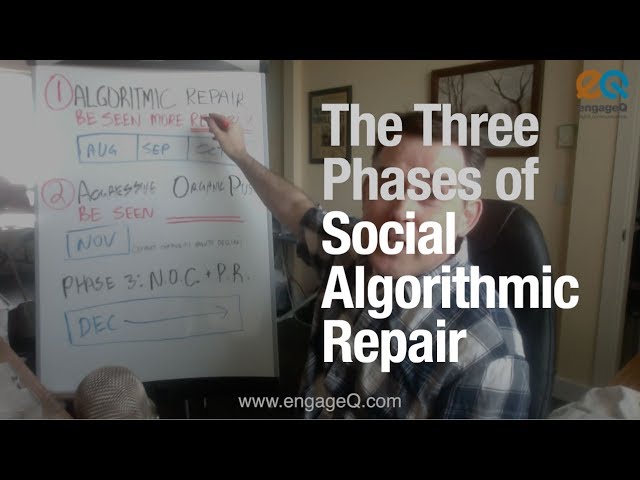
Tod Maffin explains how to restore Facebook organic reach through a three-phase repair process: establish a content mix and boost posts with $5-$10 daily budgets, increase posting to 3-5 per day to gather data, then normalize while using those insights to lower cost per impression. The whole process takes 2-3 months.
Chapters
Hello friends. My apologies if this is the first time you're— or if you've already seen this. I screwed up this new app, Ecamm. It's a great app. I screwed it up. I didn't have the settings right. Ah, so the link didn't work that we tweeted out. However, you'll be able to see this on replay and welcome. Thanks for joining me. If you are joining on replay, by the way, there is nothing being sold here other than a 10-second pitch for our agency, which will come very shortly. It's not an information product. I don't have, you know, lots of things on the go to sell. So here is EngageQ. We are a social engagement agency. It's all we do. We work with clients in their social media channels to get things going and to build more reach, more people seeing things for less money essentially, and then convert that to revenue. So thank you for those of you who have stuck around and joining me. We'll get into it now. Here is the problem with many cases is that you get onto a brand page, maybe it's your own, maybe it's a client of yours, and you discover that you're posting lots and you're not getting much traction in the algorithm. And that is because your algorithmic reach is broken. And I'm gonna show you in this video today how to repair that algorithmic reach. It's easier than it seems, but it does require a couple of months actually to do that. So let's just back up a little bit and understand what I mean by the Facebook algorithm. Basically, when Facebook first started, you had maybe a dozen friends and so on, and so anytime they posted to their timeline, you would see it in your newsfeed. And that became, that was fine for a while until it became a little overwhelming, right? Because people ended up seeing, or subscribing to more brand pages, more friends, and so Facebook changed it. They put in an algorithm that basically controls what you see on the newsfeed. They used to call it EdgeRank. They don't internally call it EdgeRank anymore, but we all still call it EdgeRank. And basically what it means is that you will see less of the friends you have— you are Facebook friends with and the brand pages that you follow, but you'll see them if you are more engaged with them. So if you do a lot of posting and Facebook did this for two reasons, the real reason and the one that they tell you, the one they tell you is that they didn't want it to be overwhelming. And there's some truth in that. They don't want the newsfeed to be overwhelming. Most people follow hundreds of brand pages now. They've clicked like on it. So if you were to see everything, it would kind of be like Twitter now, right? Where you just see everything. There's not really much of an algorithm. Twitter does have an algorithm, but it's more chronological based as opposed to filtering content actually out, although I expect that to change. The real reason though is that they— Facebook wanted brands to pay to force their way into the newsfeed. So what we're gonna talk about here is a bit of algorithmic repair. If you are with an agency and you've taken on a new client, or if you are— have just come into a new position with the company and you've got your social media channels, and I'm gonna specifically be talking more about Facebook than anything else. James, Aaron, glad you guys have found the new link. You may discover that you're not getting much engagement at all or much traction. And this is specifically for organizations that used to have good traction and have now ended up screwing things up through no fault of their own. The algorithm becomes a self-fulfilling prophecy because what happens is that if you are posting, you know, with poor quality posts or your targeting isn't on brand or you've stopped posting for a month or two, then what's happened is your engagement has fallen off as well. And engagement is one of the critical things that controls whether or not you get to the newsfeed of people who already follow your brand page, right? Again, people who have already indicated an interest in what you do. And so if not many people engage with you, and by engagement I mean comment, share, use a reaction, click like, click a link, watch a video, those are the primary engagement points. If they're not doing anything with your content, then you're not gonna be seeing too much on the newsfeed because Facebook will I mean, let's take an example of Pepsi and Coca-Cola. Both put out brand posts. If Coke seems to get a lot of traction in terms of lots of clicks and likes and watching videos, then Facebook will say, "I mean, look, this person here, Tod Maffin, he likes Pepsi's page and Coke's page, but Coke's page seems to be getting more engagement, so I'm gonna show them that post instead." That's more complicated. It also has an impact of whether your friends, your Facebook friends have engaged with it, but basically that's the the way it works. Engagement drives reach. The more engagement you have, the more reach you will get. However, if you have fallen off the map in terms of your posting strategy for a month or so, someone went on vacation or head office took it over and did a crappy job of posts and then all of a sudden it's just not working anymore, you're not getting engagement, then you're not going to be getting reach and you will fall into this death spiral, right? It becomes this self-fulfilling prophecy. You're not getting reach, you're not getting engagement, and so that's it. You're, you're not seeing it. So you need to do an algorithmic repair. Uh, we do this with clients when we first take them on. We just signed a hotel chain and we're doing this for them, um, where, where they, for no fault of their own, it's just lower frequency of posts, increased competition. The algorithm is sending them out less and less. So as a result, um, they're being seen less and less, right? So that's a problem. So we need to do an algorithmic repair. There's 3 steps to algorithmic repair that I'm gonna walk you through right now. The first step is the actual repair phase of it. And that is, the goal of that is to be seen more reliably. We don't care about frequency at this point. We don't care, we're not gonna be doing anything in terms of promoted posts. We just wanna be seen, well, we are promoted posts. I'll explain that in a moment. We just wanna be seen more reliably. This takes time. If you are doing an algorithmic repair program on social media and Facebook, it's gonna take a bit of time. It's gonna take, you know, a couple of months, 2 or 3 months. So if we were taking on a client right now, for instance, we would be in the auditing phase with them. We'd be preparing what we call the blueprint, which is a 150-page document. I don't know if I've got a copy of it up here. Hang on, let me get one, let me get one. So this is a blueprint document that we did for a client of ours, Pacific Coastal Airlines. It is thick. It's 150 pages. Quite detailed in terms of how we're gonna lay things out, some examples and so on. So that's where we would be in this phase right now. Then when we start up in August, for instance, just to use where we are right now, this would be a 2 or 3 month phase. So how does algorithmic repair actually work? It actually isn't that difficult at all. It's 2 things. The first is you apply a consistent content mix. So you identify ahead of time in your blueprint, your strategy document, or whatever you're using, you identify a content mix. And a mix is literally what you're going to post with what frequency. So if you have a 100% pie chart, what is the content made up of? So maybe 35% of it is going to be beautiful photos of your region. Maybe 10% of it's gonna be content. Maybe 40% is gonna be you're showcasing user-generated content. Whatever it is, have that mix down pat. Usually mixes are 4 or 5 elements. When you engage with us, we break all that down, we put it in an editorial calendar, and, and so on. However, you get the mix, that's the first step, and you follow that mix through this whole process, through the first 2 or 3 months. You make sure in algorithmic repair you're following that mix. Because that'll come down in, in Phase 2, which we'll talk about in a moment. That's really important. The second thing that's really important with algorithmic repair, and this is something you really only need to do during an algorithmic repair phase, is you promote almost every post. Because remember, Facebook is not going to organically push those posts out to the newsfeed for you. It's just not going to. And you're in that death spiral, you're in that self-fulfilling prophecy now where posts are not automatically being surfaced. So you need to boost those so that we get lots of engagement. And you boost them by literally putting a budget behind them. It doesn't have to be much. Maybe $5, $10 per post per day. You know, we're talking $200 or $300 a month to get your reach back again. What's critically important in this phase is the makeup, the way the content is in the actual content, right? And it's not just, "Hey, like our page," and so on. You must ask for engagement. You must ask for engagement because as I said earlier, remember, engagement drives reach. When you have good engagement, you will build more organic reach and this will factor in especially in phase 2 which we'll talk about. So you have to ask for engagement. So instead of just putting out a post that says, you know, "Hey, we just bought these dry erase markers." And that's a post, that's a bad example. You may ask, "What brand do you like?" or "What's your most embarrassing whiteboard moment?" or "Do people still use whiteboards anymore? Do you?" You need to ask a question, and that will drive engagement because we want people to comment. Here's the dirty little secret of social media engagement when it comes to this stuff. The question doesn't really matter. Don't overthink the question. Don't spend hours thinking about it. The question doesn't matter as much. It's just ask a question. Part of the algorithm is, you know, I mentioned that the algorithm is heavily weighted towards engagement. It's also on Facebook and increasingly Instagram. It's also weighted toward the type of engagement. The different types of engagement are worth more. They're weighted more. So if someone clicks like, that's good. We'll take a like. That'll get us a little bit more reach with that person in the future. Not a ton, a little bit. If they actually hover over that like and click a reaction like a haha or wow or angry, that gets us a little bit more juice. If they comment, that gets us a lot more juice. If they share, that gets us an enormous amount of juice. And this is why in the past, if you used to remember, every brand page, it seemed that they were just saying, "Share this post if you agree," blah, blah, blah. Facebook's kind of cracking down on those. It actually looks for those phrases, "Comment here if," "Share this page if you agree," blah, blah, blah, and it automatically cripples those. But ask a question. Ask for engagement in it. Don't overthink the question. Do it in every post. So that's phase 1. Phase 1 is 2 or 3 months. It's the algorithmic repair. Remember, crafting the posts are really important. Ask for engagement. Second, get a content mix and follow it to the letter. And third, a promoted post budget, a small one, behind everything you do. Just targeting your page fans, 'cause that's what we're trying to build. Just targeting your page fans. This is not a broad everyone in your market. This is not a lookalike audience. This is not targeting your competitors. That's not what we care about. We're trying to build the organic reach of your existing page. So small budget, $5, $10 on every single post. That's phase 1. It takes some time. Phase 2. Phase 2 is an aggressive organic push. And the goal of phase 2 is not to be seen more reliably. It's to be seen more often. So we, if we've done the job right with phase 1, the algorithmic repair, then we are being seen more reliably, right? Because the algorithm is starting to pick up those signals, helped by the budget and so on. So that's phase 2, is we, we now move, we shift away from it being, we're looking to get on more news feeds more reliably, and now we're shifting it into, we want to be seen more often. What does an aggressive organic push means? It means more frequency than you would normally do. We usually average, we usually check for about 2 to 3 posts a day for most brands, frequently 3 posts a day on Facebook. Some people freak out at that. They say, "Oh my gosh, that's a lot." Remember, the algorithm controls it. So if someone's not that interested in your brand, but they like your page, if they haven't engaged with you much, they're not gonna see it 3 times a day, nor should they. But if someone really, really likes your brand and is always commenting, always always in there, always talking to you and so on, they're going to see it 2 or 3 times a day when you post. And that's right. That's good. The algorithm is doing its job there, right? Because those are the people we want to, uh, to see the post more reliably. So what does an aggressive organic push mean? It means more frequently than that. It means 3 or 4 times a day, maybe 5 times a day. Doesn't always have to be the same type. It can be, it can be sharing posts or so on. An important thing to note here is to not freak out when you notice the growth curve of your fan base decline. You shouldn't see an actual loss in this month of followers. You shouldn't actually see a loss, but if the chart you're looking at is the growth rate, you will probably see a slight dip in the growth rate because a couple of people will be seeing it too much and they may unlike your page. That's a good thing. That's a good thing, right? For two reasons. One is this is the content you're going to be showing them. So if they, if they unlike your page, it means that they're, They're not as interested in your brand as before, but most importantly, we are taking a priority here, right? We're making a business decision. Is we want to be able to, for the people who care about us, we wanted them to see us more often. This is the second phase. You don't have to run it long. Don't have to run it long. Maybe 3 weeks, maybe a month, and so on. And then we move into the final phase, which is a normalized organic content and paid reach. So by normalized, I mean you return it to the, the pace that you were at before. So if your pace was, I don't know, say 2 posts a day, we started with 2 posts a day up here, right? Heavily, heavily tweaked to ask for engagement with a promoted post behind it. Then we stopped the promoted posts. Our goal shifted, the objective shifted to more often. And so this phase was more frequency. So we are hitting people more often with it. 3 or 4 weeks a month or so, just for average measurement. And then a normalized organic content and paid reach. That's when things kind of dip back into normal. And what happens here is that the goal of Phase 2 is not to drive people off the page, and it's not gonna happen. Again, it's unlikely you will see an actual decline in the number of followers. You will probably see a decline in the growth rate, so the percentage at which it's growing. But the goal of this, once we get this, inside this phase, we are experimenting with different types of content. We're still sticking with the content mix, but we are experimenting with different types of posts. Photo posts, image posts, video posts, status updates are the main ones. Those four. There are some other ones. There's Q&A. There's offers and so on. Stick with the main ones. Aggressively. Now we've, we've gained more reach. People are seeing us more reliably, so that's good. And now we're pushing this out. And the goal of Phase 2, other than being seen more often, is to get a collection of data. That's why you need about a month's worth in there, is to get a good chunk of data. And what is the data going to tell you? What post— what post types are people most likely to respond to? And Facebook will break that out for you in your Insights panel. The goal here, besides being seen more often, the real true goal is to get a dataset that you can benchmark in phase 3. Because once you go into phase 3, we'll know what people are responding to. It's not enough posts to necessarily know whether the content mix is working, because you'll probably have 5 or 6 different types of content pieces in there. But it will be enough to get a bit of sense of when people are interested in doing that, what types of posts do they respond to, and so on. So that's it. That's algorithmic repair. We do this with most of our clients that we onboard at EngageQ. A lot of our clients come on and they have, they had an intern working on their social channels for 6 months or something. We've had a couple of clients where another organization took over their social media channels and didn't do a very good job on it and then they've lost a lot of EdgeRank. They've lost that algorithm. And if you were to just dive in, here's the main point of all this. Whole video. If you were to just dive in and do a normal organic content program, you are throwing money away, you're throwing time away because that algorithm is not performing for you. You must go through an algorithmic repair phase if you're going to get those people seen. The other thing about this paid reach component, you know, in addition to the normalized organic content— by normalized I mean it's not aggressive anymore— the other thing about the paid reach is because you're getting a really good traction on on your engagement, on your paid reach and all those sorts of things, because that's been built up through these two phases, it's gonna be significantly less expensive to reach these people. If you were just gonna dive in right away with a paid reach program, like immediately, like a full ad campaign where you're committing hundreds, thousands of dollars behind it, it's gonna cost you a lot of money. It's gonna cost you a lot of money because the algorithm isn't prepared for it, people don't like it and so on. So we do this to build people up, to get it back in, to get it performing. And so on, and then you do that. This, we do this in almost every one of our clients, in every one of our clients where this is the case. So let me just hit the, if you've got any questions, I'm happy to answer them. Again, I don't have, there's no second part of this where I tell you to buy my stuff. I don't have anything to sell. Tanya says, just one day I'd like to see the algorithm go away. I'd like to see everything from my friends and every page I like and follow in order. It's never going to happen. Or go to Twitter because Twitter's like that for now. Look, even Instagram has got that, right? Because Instagram is owned by Facebook now and so they've got that. If you go to your Instagram feed, you'll see your top one will be something that someone posted 16 hours ago. The second one down, someone posted 30 minutes ago. That algorithm's already in place. Never going to happen. Used to. And you know, I would argue it probably shouldn't. It probably shouldn't because you truly— I mean, think about it, Tanya. Let's say you have, I don't know, 500 Facebook friends, 200, 300 Facebook friends. If you see all the stupid little shit that people are posting, you know, "I just ate this," you know, "Oh, I'm out of my iced tea, what am I gonna do?" It would be a nightmare for you. So what if there were a way where Facebook or the algorithm would show you the things of people that you're most passionate about following, right? About your close friends, about your relatives, about people that you went to school with, the people that you actually care about. And how does Facebook determine whether or not you care about those people? Well, family connections. So you, you, just simply by identifying someone as a spouse, you're going to see their stuff more. Just simply by identifying them as a family member, that's going to give those people a boost in your news feed. But also, it's measuring based on how much you interact with them. Which again, in itself, is a bit of a self-fulfilling prophecy. If you haven't interacted with someone in a while, you're not going to see their stuff for a while. I hear the frustration, but so on. Any last questions before I shut this puppy down? Happy to. James, thanks for coming. Brad, Shannon, Aaron, thank you. Sarah, welcome. It may make us complain about the algorithm less. Yeah. Yeah. It's true. That's the way it is. Twitter, by the way, is building the same thing. Twitter already has one, but it's not quite as filtered as before. So in the next video, when I get my ass off the ground, I'm going to be doing two things. Is I'm not gonna push the finish button 2 seconds into my live video like I did this first video. I'm amazed that anyone found this video, this, this live video. I'm amazed that there's 7 of you watching. What happened was I'm using this software and it goes into preview mode. It has a button called finish. And so then it, at the end of preview mode, like when I was supposed to go live, it said live, but the button still said finish. And so I thought that meant finish the preview mode. And it finished everything. Whatever. But the next thing that we're going to talk about is Content Mix, which— let me see if I can find it. You know, I started with these things. We started doing tabs so I could find things better. So Content Mix is— I'm not going to show this too close, but it looks like that. Basically, you've got a percentage. And we break it out Facebook and Twitter in one group and Instagram in another, so a percentage 25% is of this type of content, 10% is announcements, less than 5% is contesting. Then you take that content mix, yeah, dun dun dun, and you break it out into an editorial calendar, which is Sunday to Saturday, and Instagram, Facebook, and so on, and then you just kind of map it out. And you don't have to follow the content mix word for word, letter for letter. It's just kind of a holy crap, it's Monday, I don't know what to post day. If you're generally following this, you know, in this case on Wednesdays, Instagram is branded content for this brand. Facebook, remember, 3 posts a day. So Facebook is branded, lifestyle, and what we call a wildcard, which I can't get into unless you're a client. And Twitter is branded and a contest on that particular day. So there's like maybe 1 post. So, you know, just kind of gives you an idea. So it's helpful. Obviously, if we can help you with, with your social media, all we do is social engagement. That's all. We've got a great team. We handle all of the negative response. We handle reviews. If you have a social media channel and you're finding it overwhelming coming up with content to post, developing a content mix, maybe you don't even have a strategy at all, give us a call. Here's the URL down here, engageq.com, and we'd be happy to help you out. And that's it. Thanks everyone for joining. Again, sorry about the screw-up, and I will see you on another video. Bye.
More from Tod




Ten times Canada helped the U.S. with its wildfires, instead of whining about the smoke. 





