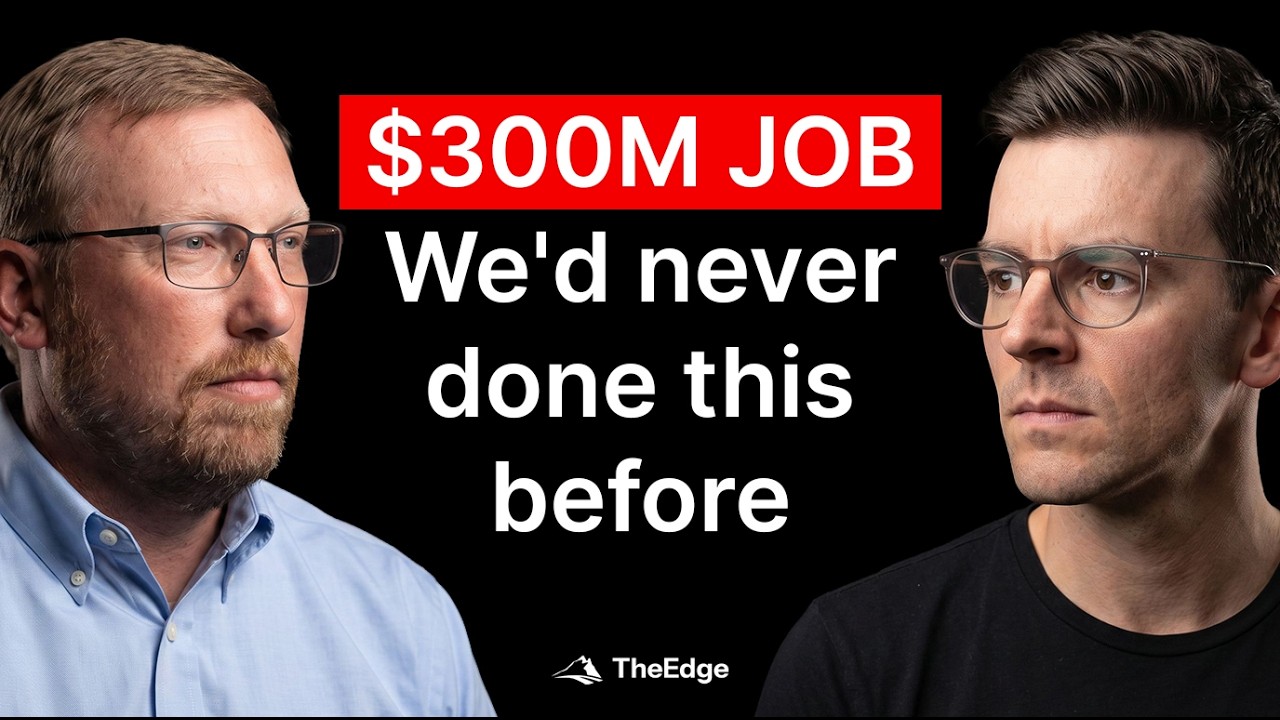
Patrick Nelson: Leadership, Safety, and the Future of Asphalt Paving
In this inaugural Edge podcast episode, host Tristan Wilson interviews Patrick "Pat" Nelson, president of Lehman Roberts and incoming chairman of the National Asphalt Pavement Association (NAPA). Nelson recounts his unconventional entry into the asphalt industry through marriage, his early hands‑on roles from drill crew to map‑coloring, and the diverse hats he wore in a family‑owned business. He describes returning to school for an MBA, which shifted his mindset from scarcity to growth and set the stage for his ascent to the presidency in 2012. Nelson details a multi‑year transformation of Lehman Roberts, tackling a capital‑draining equipment division, improving safety, implementing ERP systems, and fostering organizational health with guidance from Patrick Lencioni’s Table Group. He discusses the 2023 acquisition by Granite Construction, noting significant safety improvements and ongoing challenges with work‑zone intrusions, illustrated by a recent near‑miss incident and the Napa Cares fund response. The conversation moves to broader industry advocacy: celebrating multigenerational families, emphasizing asphalt’s economic impact, preparing for the 2026 expiration of the Infrastructure Investment and Jobs Act, and building a robust political action committee through plant tours and donations. Nelson also highlights mental‑health concerns after a 2021 crew member suicide, urging leaders to address the crisis. He shares insights on bidding discipline, risk assessment, and personal communication techniques. Finally, he recommends several leadership books that have shaped his philosophy. The interview blends personal anecdotes, industry challenges, and forward‑looking initiatives for safety, advocacy, and leadership in asphalt paving.
Chapters
It's a very frustrating journey. Safety's a hard one.
You have it all figured out and then all of a sudden you get the phone call that something's happened.
I audibly gasped. When the truck enters the work zone and you just see explode, fireball.
One thing we need to do in this industry is we need to stop killing people. I looked around, half the people were listening.
Man, that's a rich topic. Tristan.
Welcome to the Edge. Our podcast is dedicated to highway construction, bringing you interviews with industry leaders where we discuss the latest trends and insights. I'm delighted to be joined by Pat Nelson for our inaugural show. Pat is the president of Lehman Roberts in Memphis Stone and Gravel. He's also the incoming chairman of the National Asphalt Pavement association and one of the kindest and most thoughtful people that I know and somebody that I go to advice for regularly. So, Pat, honored to have you on the podcast as our first ever guest. Welcome.
I'm glad to be here. Tristan, thanks for inviting me and appreciate that encouragement. So thank you very much.
You bet. So Pat, could you tell us a little bit about your, your background and your journey in the, in the asphalt and construction industry?
Yeah, absolutely. Tristan. I, I ended up in this industry providentially the old fashioned way. I married into it. And so one of the, in addition to being married to an amazing woman for the last 32 years, I've gotten to be in just what I think is one of the greatest industries on the planet, which is road construction and particularly asphalt paving. So I married into the family business and really didn't intend to work in the industry. I thought I wanted to be a doctor, actually. And I'm very grateful I wasn't a doctor because I'd be broke, because I'd be a terrible doctor, But nonetheless just really bad. Like I said, just God's grace and providence ended up in just an awesome industry that I've really loved for over 30 years now.
Wonderful. And you actually, could you talk a little bit about the first role that you had when you joined the company?
Yeah, Tristan, my. Well, I think my, my father in law, Kathryn's dad, didn't, didn't really intend on hiring me either. But I think he wanted his future son in law to have some sort of gainful employment, so he felt sorry for me. But my first job in the company, Tristan, I worked on the drill crew and we still, we still operate a drill today that does exploration and prospecting for sand and gravel resources, mostly in west Tennessee and north Mississippi. And so the, I tell people the best Shape I've ever been in in my life was, was, was the probably six months that I worked on the drill crew toting around 100 pound augers and putting them on the back of the drill. I was ripped. Haven't looked like that since.
And, and you had, you were involved with the I, with the IT department as well at one point, is that correct?
Yeah, I wore, you know, wore a lot of hats, Tristan, as as many people do at family companies. Right. Like you. And I'm so grateful. I think I was pretty frustrated in my 20s, you know, that I wasn't, you know, using my college degree per se. In fact, I think my first job in the office, Tristan, a. One of our engineers handed me a stack of, of maps. I don't know, it was probably, oh, it's probably 50 pages of maps that were, we didn't have, have a color copier at the time. And he told me, and he handed me a box of colored pencils and he handed me a, he handed me a, a key to go from. He said, I need you to color all of these maps exactly like this. And I sat there for like two hours like coloring of maps. And I thought, this is stupid. I'm going to Kinko's, which is now, you know, FedEx office. And I paid for, I paid for it myself to have, to have him copied in color. And I took him back to his office, you know, what, an hour later. And he was like, you already done it. I was like, oh yeah, I'm done. I remember thinking, I remember thinking, I was like, I've got a college degree and I'm sitting here coloring maps. I could have done this in kindergarten. No, but see, I, I wore a lot of hats from, from, you know, drill crew to environmental to earth moving. We ran some pretty large earth moving operations once upon a time. Didn't know anything about any of them. And then at one point we needed help in it and I'm, I am a self proclaimed geek. And so I, I did. That was one of my, probably one of the areas I enjoyed the most but was probably the least capable or least qualified to be doing. And yeah, I just kind of figured it out along the way surveyed for a little while. I do, I did a lot of things that I wasn't qualified to have to do and I just had to go usually get on, get online or go find a book and read how to do it.
And how did you kind of find your way into the president's seat?
I went back to grad school, Tristan, in probably 0, 2 or 3. I went back to get my MBA and I think the thing I realized probably in my early 30s was that I just didn't, you know, we were laughing about, you know, being the IT guy that I wasn't qualified to do. I realized that I had an ambition to, to lead and to, and to aspired at the time to want to run the business. And then I realized, Tristan, that I didn't have the, I didn't have the credentials or the qualifications to really be able to do that. And they were just, there were tools that were not in my tool bag. So I went back to school. I wouldn't recommend this to, to many, to your younger listeners with young families that I've kind of full heartedly went back to school while working full time with four kids under the age of nine. And yeah, it was not one of the, not one of my wisest decisions, but we did it, we made it through was pretty hard. But I came out of that with um, I finished that MBA in 2005. And I think, Tristan, the thing that it did for me more than anything else that I had done up to that point was it changed my mindset from one of scarcity thinking to more of an abundance or a growth mindset. And I just looked at the, I looked at the business, I looked at opportunities differently coming out of that program and really began to think in the lens of hey, what is this, what is this thing capable or what is it? What's possible with this, with this business? And about the same time, full circle, being on this call with you about the same time I went to go see your family's company right after Katrina. So that would have, you know, I would have been finishing that program. Yeah, I would have graduated in the spring of 05. Katrina was what, 2006? That's right, yeah. So about, about a year later, shortly after Katrina, I go to go to see the Wilson family in New Orleans and had dinner with your two uncles, met your dad. And I remember coming back from three days of visiting Barrier and, and man, I was just, I was inspired or just man, here all these things again, this, this growth mindset of what's possible and, and we, we began to chip away at those things over a long period of time.
You know, it's really interesting about the MBA thing that you mentioned Pat, because the, I think the only reason why, well, one of the main reasons why my dad actually decided to go back and get his mba as you did with a bunch of kids that were, you know, four Children as well, probably all under the age of, you know, 12 or 13 was hit. One of his brothers was so good at managing operations in the field and, and just with connecting with people was that he basically said, I'm never going to be better than he is at that stuff, so I, I better go learn some, some, some other skills, you know, if we're going to be able to kind of make, make a, go make a go of this thing. And, and that's. He actually went to, went to Tulane and then ended up in the same study group as Brian Cooney, who eventually became the, the cfo, you know, of, of Barry and somebody who, you know, we both, we both know well.
So, yeah, it's, I mean, that's one of the things that, you know, I brag on this industry all the time. One of the things I love about this industry is the willingness to share. I mean, the things that your family shared with me and others that I got involved with over the years was just, I mean, it's just so generous and it's, it's, you know, it's been a. They, they taught me that that spirit of, of giving and, and willingness to share things that you learned and share mistakes that you made. Just. It was, you know, that's. If you're willing to listen to that advice and, and take it to heart, Meg, save you a whole lot of pain.
Well, I think it's one thing to have the knowledge, it's another thing to actually come back and, and, and act on it. How, how were you, how are you able to do that? I'm imagining you probably have a, like a, like a notepad from all your visits of things that you've learned. How, how were you able to come back and, and, and then try to like, make some change?
I specifically remember coming back from that first trip to New Orleans and meeting with your family and a couple others and, and not being able to, not being able to digest kind of everything and, and really make a plan of attack. And so probably literally just just vomited ideas to anybody who had listened and. Which was not helpful because it just kind of, you know, basically what I was communicating to folks back at Lehman Roberts was, man, you, you guys just. You guys suck. And we got, you know, we got a lot of things to fix, and people were like, okay, great. Where do you want to start? And then I think probably the sort of the key moment for us was we really began to tackle our equipment division. And I remember we had a board member even going back into the 90s who just called, called our equipment division a black hole. And that's not a thing. It was just a black hole that was just sucking up capital from the business. And, and so we, we, we brought in some experts to help us begin to think about that and begin to strategically begin to tackle. And my father in law was, was exceedingly patient and gracious with me in that. He, you know, he, he knew it was a black hole too and really allowed, you know, allowed myself and my partners to be able to really tackle that. And, and I think, and the organization knew it too. Just didn't know how to, how to do anything about it. And so we, that was probably our first kind of domino that we really leaned into. And there were others after that from safety to, you know, IT systems, ERPs. I mean there were, there, you know, there was a, there were a lot of things that happened in probably 10, 11, 12 year period of time that I think really moves the needle for us.
And did you, how did you kind of navigate through those, those individual things? Were there like champions that you assigned in each area or how did you, how did you figure it out?
Yeah, we always had champions who were, were helping in different areas. But about that same time, Tristan, let's see. I became President in 2012 and I began reading after grad school. My reading pace really picked up and so I was reading at the time, I was reading a book by Patrick Lencioni called the Advantage. And in that book he really advocates for organizational health. And you know, he's got some very practical things in there and he really talks about building an organization that's foundationally built around trust. He talks about these concepts like healthy conflict. And so around that same time I was doing that reading, I actually brought somebody in from Linciani's organization called the Table Group. And we really focused on that organizational health piece and having a strong leadership team and executive team that I think was, was a real accelerator for us as we were working on more tactical things within the organization and some strategic for that matter. But. And there were things, Tristan, that went really well and that, you know, were, were relatively easy lift. And then there were, there were things that we still haven't gotten figured out, man, just, I mean like the, the safety one. You know, you, as you well know, we were, we were acquired by Granite Construction last fall and, and their safety record is just off the chart. I mean incidents, severity, I mean just world class. They wouldn't say that. They think they've got a long way to go, which I appreciate. I Appreciate that level of continuous improvement. But, but they've been really instrumental in helping us to, on a safety front to, to begin to really move the needle. And we've seen a pretty significant decline in our incidents this year. And I think they've, they've come in and been helpful in that area. That was one, that. And we just never, I mean, we'd take two steps forward and sometimes three back and we'd take two steps forward and we'd be one step back. It was just a very frustrating journey. Safety's a hard one because it's a, you're trying to change hearts and minds really at a very deep level. And safety was a very difficult one. And again, I'm grateful we're making some strides there.
That's, that's, that's great to hear. Yeah. Safety is a journey. And I'm familiar with thinking you have it all figured out and then all of a sudden you get the phone call that, you know, something, something, something's happened and it's, and it's serious.
And I mean, you wait. We had a lockout, tagout incident today that I'm just, I'm still just like had, had, had somebody had somebody remove a contractor's lock off of a, off of a generator and then cranks the generator. I'm just like, come on, man, you're killing me.
You mentioned the sale of the, of the business to, to Granite. Could you tell us a little bit about kind of what, what led to that and how, how things are going since the acquisition?
It was a very, we hired a banker to help us run the process who did an outstanding job, ran a.
Very.
Very clean and well managed process course, you know, things leading up to that are, you know, family business is hard. And I think, you know this, I know this. Anybody who's listening to this, whose end family doesn't will appreciate that statement. But, you know, it's just hard and, and, and when you near an intersection of succession, it's, and it's also gets hard in those respects too. And I, I had awesome partners in the business who I love dearly, but we didn't always agree either. Right. And so particularly as you began to contemplate what the next generation will look like. And there were a lot of kids in that generation. It's just a, sometimes the best thing for their business is to find a new steward for the business. And I think what we realized collectively and all agreed upon was that, that our companies had reached an intersection where a new steward was needed who was going to quite frankly, steward into the next season of the business better than we would have or even the next generation might have. And so that was. That was what we decided was what was best for the companies and for the 300 plus awesome men and women who work there was to go find the. The best steward of the business. And I think we did that. I'm really proud of, you know, I'm proud of the decision that we made about why we did it, how we did it, and I'm proud that. That, you know, Granite was the. Was. Was the right company for our folks. The fit and the values around that have been. Have been really great and appreciated. The mentality was Granite has wanted to continue the business, support our employees. It just. It's been affirmed in little ways and big ways over the last, golly, almost 10, 11 months now.
Oh, appreciate you. Appreciate you sharing all that. Yeah. And I totally agree. I mean, family. I mean, you know, my story was in a family business. You know, we worked really hard to try to transition to the next generation, and we were unsuccessful in that, unfortunately. Unfortunately, you know, we as well found great acquirer in crh. But it was really hard, man. It was. It was. It was heartbreaking. And for others, in retrospect, one of the best things that could have happened opened up so many other opportunities for folks to grow. And I think was the right. Was. Was the right thing, you know, for the family as well as for the business and the employees.
Yeah, it is hard, and I mean, it is heartbreaking. But it's also. I agree with you, it's looking back 10, 11 months from now, I think it's one of the best things that could have happened for the companies, for our employees. They're in good hands.
Absolutely. And granted, of course, their reputation speaks for itself. Their resume is quite impressive. And also, one thing I did want to call out was that I think you were actually. It was a panel at a NAPA conference, and you were talking about safety. And I think it was Kyle Larkin with Granite, basically, in the middle of the presentation, stood up and said, you know, one thing we need to do in this industry is we need to stop killing people. And I mean, it's like I looked around and, you know, half the people were listening, so half that we're listening looked around and said, wow, that's. That's really. That's really fascinating. So that safety is that they're willing to kind of, you know, call that out and say, this is because if we're struggling with, like, workforce and, you know, and recruiting and retention, you know, safety is. Is to me, like, number one, fundamental. So I thought that was. I thought that was pretty. Pretty neat.
Yeah, he's. He has a. He has a real passion around that. And is. And as a. You know, as you say, Kyle is. Is very willing to. He's very willing to call a spade a spade. And he's not. He has another saying. Is there. There are no. There are no trade secrets. And safety. Right. Like, we just need to. If CRH or Granite or Lehman Roberts or Barrier or whoever it is, is figuring out a better master mousetrap as it relates to safety, we need to share that. We need to share it aggressively because, yeah, we need to stop killing people. And then. Yeah, Napa has a. Napa has a charity, a fund set aside for employees of members who are killed. The auto plant or paving crew. I got an email this week from Vince Hafeli down at Ajax, Florida. Have you seen this? Do you know about this incident they had earlier this week?
I just missed a call from Andy, but.
But yeah, they had a. They had a work zone intrusion this week, and I asked Vince's permission to share this and. And he said absolutely so by cheering this in your podcast. But they had a work zone intrusion about 11:15. They just taken off from the joint and dash cam camera in the attenuator truck. You see a drunk driver swerve into the work zone from the left and had come through 15 seconds earlier, would have had a roller operator who was getting on his roller. Had he come through two minutes or three minutes earlier, he would have hit the entire crew that was working the joint as they're getting ready to take off. And this. And this car comes right up the back of the paver and you just see it exploding. A fireball in the back of the paper. And nobody. The paver operator had some burns and injuries. He'll be fine, though. Yeah, I mean, just. I mean, I watched this thing and I was just like. I mean, I audibly gasped when. When, you know, when. When the truck enters the work zone. Let me tell you, what a great guy, what a. Just awesome human being advances Vince, turns around and sends a. Sends a check to Napa, to Napa Cares in the amount of what the gift would have been to the family had there been a death on that job. And it was, hey, I want to pay this forward. I hope that this, you know, I never have to receive a check from Napa Cares. And I hope. I hope nobody in our industry ever has to get another check. From Napa Cares because of a fatality on one of our jobs. But if every member, every time there was a near mess or, or near hit and one of our work zones did that, that fund would be enormous. And so I'm gonna, I asked Vince, who got information, to begin sharing that story because I just thought it was so cool that he did that. And honestly, we're very, very, he's very fortunate, we're very fortunate that his paper operator is going to be okay.
Yeah, that. Thank, thank you, thank you for sharing that. Yeah. Vince is, Vince is an amazing, is an amazing person. And Ajax, they're a special, special, special company for sure. Yeah. I've been to the, I've been to the hospital to, you know, when we had a work zone intrusion, we had four employees that were airlifted off of airline highway outside of New Orleans and never want to experience anything, you know, like that again. But it's, but it's a sad reality. And it was the same thing. It was a drunk driver who was driving and we were working on a Friday night and they came into the work zone and a couple of guys were, were cleaning up one of the joints. And I, I, I still think that there's more to be done on the protective side with legislation and, and, you know, working to make sure that our people are safe. I mean, just 70 miles an hour, 70 miles per hour traffic, or 80 miles per hour traffic because you add 15 to whatever the speed limit is, that's about what they're going to drive. And in a half, a wide orange drum in between that and people, wives, husbands, children.
Well, I mean, I don't, I don't know what it was like, and I don't know what it's like in Louisiana, but in Tennessee, I said we have to fight to get blue lights out there. I mean, it's just a, you know, that's a. And of course TDOT doesn't like for traffic to back up, but actually the safest thing for our employees is to have a three mile traffic jam behind the paver because Everybody's going not 80 miles an hour, but they're going five or 10. And you know, I know TDOT, M.every.in the country doesn't want to hear me say that. But that's the safest thing for our employees is to slow traffic down.
Yeah, either that or full closures, you.
Know, or full closure. Yeah, let's close it. We'll pave it in two weekends if you'll let us close it. Or three. I mean, Just, you know, we'll come in, we'll come in and knock you out there. There's sacred ways to do this work. And I know that the work zone legislation is a priority for Napa. It's a priority for Granite. It's a priority for a lot of our companies and industries. I remember your uncle told me one time we had a work center intrusion, called him about it, and I remember he was, he was. He had a lot of righteous anger around it. And his anger came out like we as contractors accepted night work way too quickly. Like, we, we just, as an industry, we accepted that risk too readily. And I, I would agree with him on that. And we still haven't. We still haven't as an industry pushback and just said, this is, you know, we just can't do this.
This is a great segue into your becoming the chairman of Napa. And I'm really excited to hear about what are your vision, what's your vision and what are some of your goals as you. As you take on that very important post?
I'm grateful to have this platform. I'm grateful to have that platform over the next, you know, year plus to be able to really advocate for and speak to some issues. One, Tristan, I really want to, really want to celebrate this industry and celebrate the human beings that I think make it up. And I want to take a few opportunities to highlight, you know, some. I'm sure Barrier had some of these, but we have, I think, three or four families now that are, you know, third and fourth generation working at Lehman Roberts. And, you know, I love this industry. I love that it provides generations of thriving for families like that. And just the history of that and what we get to do day in, day out, weekend, you know, week out, is we get to bless those families that make up this industry and we get to continue those traditions and those cultures that go forward. And we get to put. We get to make life, we get to make the economy happen for the communities where we work. I mean, in Memphis and north Mississippi, you can't. You'd be horrible. I bet you couldn't find a street road in our state that we didn't pave at some point in the last 85 years. I mean, we might not have been the last contract, might have been the first one. But I mean, that's true in New Orleans for Barrier, is true in Northern Virginia for Superior. It's true in California for Grant. I mean, it's just, you know, Grant's 104 years old, 103 years old. And I bet you there's not many, there's not many roads in California they hadn't touched in 100 years. And so we just get to be part of that legacy. So one of the things I want to do is just celebrate that and really just highlight some of the families, some of the culture and really the, the, the impact that we as an industry get to make. And I think that's important that we celebrate that because as young folks come up in this industry, man, it's not just a, it's not just an engineering job that's, you know, that it's not just a, it's not just a job working on a paving crew. It's not just a job estimating a bid coming up. Now we're getting to impact people's lives in a really positive way. And the impact that we make on the economy as an industry is substantial because nothing moves in this country. We saw it with a longshoreman strike that all of a sudden goods quit moving around this country for the three or four days that they were on strike. And everybody's in a panic about it. I mean, it's like, oh gosh, we got a bigger bottle of Christmas presents, man, if our infrastructure isn't there coming out of those ports, the same thing is true. And I think our young folks coming up in this industry need to hear that, what we do. And it is an enormous part of the economy in this country. And so that leads me to the second thing that I want to be able to focus on really. And I'll spend a lot of energy over the next year thinking and talking about this. But IJA expires in September of 26, which is hard to believe because I feel like we just got that thing passed. But it is just around the corner that the highway bill expires and Napa in particular couldn't be more excited about the government affairs team that we have put in place now, now with Niall and his team. And I want to make sure that they've got all the tools they need to, to advocate well for our industry in light of that bill expiring. And the best way to do that for our industry is to have a very well funded and active PAC and political advocacy. You may not like it, you may not agree with it, but man, it's the system we've got and it's the greatest system the world's ever known, but it's still messy. And the, the way to, to be able to advocate and advocate and to have a voice in D.C. is is through political contributions. And I know people hear that, they're like, oh, we're just, we're just paying, no, we're not just paying them for their opinion. You're paying to have your, your voice heard. And it's how the system works and it's how it's worked, you know, since, since the founding of our great country. And Napa has historically not funded that and not really participated very. We haven't done a great job of weaving advocacy into our DNA. And what I'm hoping is that next year we'll raise a pretty substantial amount of money for the pack, but more importantly that we will begin a, what I think is really a multi year vision for weaving into the asphalt industry a culture of advocacy. So in the last month we've done 10 plant tours across the country as the most plant tours that are I can remember us doing during a recess of Congress. And we've done, in fact we might have done an 11th one today. I think Niall was doing another one today maybe. But that is fantastic because we're, and the reason we've done, the reason we've been able to do that is because we've contributed to those campaigns and we've got a pack that's able to do, that's able to make those contributions and then we, that we extend the invitation and they come see and they meet our employees, see what we do to see the impact, see the recycling. There's just nothing more powerful than us being able to do that. But it starts with us making a contribution. And the fact that we've upped our advocacy or we've upped our political giving in the last year, year and a half is substantial and is leading to what I think as well. I just talked to Niall the other day. That's a record for us in plant tours during a recess. So we're, we're super excited about that. And then the third thing you'll hear me talking about over the next year or so, it's interesting we mentioned Vance earlier. Vance has really, along with an accident that happened at Lehman Roberts in 21 between a suicide that happened in, in 2021 with one of our lead men on one of our paving crews and, and, and then, and listening to Vince's advocacy around mental health, it's been a really eye opening for me and we, I'm so glad that we spent a good bit of this conversation talking about safety, but I think it may be even more so than work zone safety. The, the mental health of the construction industry is that is really. I don't think this is being too dramatic is to say it's in a crisis. And I think we as leaders in our organizations and other leaders need to begin to be comfortable about talking about mental health in our industry, and we need to be providing resources around that. And so I don't want to take anything away from Vance, but from, from his advocacy on that, but he's been particularly impactful to me as, as. As I've just really awakened in the last several years to what. What I really believe is a. Is a safety crisis in our. In our industry.
Wonderful. Well, those are. Those are. Those are three big. Those are three big and very, very important initiatives also. On the. Yeah, and thank you for, for sharing that, too, on the, on the mental health side. And thank you for being such a big supporter as well, because I teamed up with Vince and we did a little project for. For a race and were able to. To. To. To raise some, you know, some. Some funds that went to that love.
That you did that, Tristan. That was. That. That was a blessing to get to support.
Well, the only reason. The only reason why that was even a thing was because Vince, the first time I met him, told me his whole story, and it deeply, you know, impacted me, you know, hearing that, hearing that from him. So I'm really excited about. About you taking over as chairman of Napa and pumped. Pumped about, you know, 20, 25 and the year ahead. So I do want to. I do want to change gear, shift gears a little bit. I do want to talk a little bit about bidding because you and I have had a lot of conversation about this, and I just. I'd love to hear if you could maybe share some, some of your thoughts about. About estimating and, and, and bidding and, and share any kind of stories that. That you think are noteworthy.
Man, that's a, That's a rich topic, Tristan, because I don't feel like I'm very good at it. Like, it's, It's. I get in my own head when it comes to betting, and I try really hard to not to. Not to because, you know, I, I hate losing. And I keep having to remind myself on bid day. I like, I really hate losing anything, but I have to remind myself on bid day. It's. It's easy to win on bid day. Like, the goal is not to win. The goal is to win with the least left on the table and the most margin in your pocket. Right, Exactly. It's easy to win. I have a few things that I think about when it comes to bidding and it usually has to do with just areas of discipline. So really understanding your costs, really understanding the risks in a job and making sure that, that you've anticipated or mitigated what those risks are. And I think understanding the structure of your market and knowing you know where your competitor is is particularly important. You know how much, how much backload you perceive or even not just perceive, know that they have. So I think if you can, if you can back up from, you know, the, I mean like the mechanics of bidding, particularly a paving job, are really, really not that, not that challenging or hard. I mean, it's really, it's thinking through, it's thinking through what are the challenges of, you know, bidding the job kind of thing. So, you know, how are the trucks going to get to and from the job? Just all those logistical things. And understanding that I think is really key. We've always tried to, we've always shot for, you know, 2 to 5% left on the table. Felt like anything under 2% was just blind luck.
And so go either way when it's that close, right?
I mean, it's just, that's, you know, it's fun when you win, but it's fine when you win one by 100 bucks. But that's just bad on the other side. Yeah, that's exactly, that's, that's just blind luck. So we were always, we, we are always trying to, to aim for that range. If, you know, if we leave more than 5% on the table, I'm usually doing a little after action on, okay, well, what we miss, what do we not see? What can we learn from that? But bidding is an art. There's the mechanics of it that are really relatively easy and then there's the art piece of it which is as it is harder. And it's the part I really don't think I'm very good at because I can play mind games with myself. And I have a saying around our office that the contractors become complete idiots at 8 o' clock on the morning of a bed opening. If it's opening at 10, 8 o', clock, we all lose our minds. So I usually try to have it put to bed before that point. Like, I'm not saying I don't ever do it, but we rarely change a bed on the morning of. Because I just know myself and I know that's when I'm going to do something stupid.
It's just taking money and just pulling it straight out of, straight out of your pocket and throwing it up in the air.
Usually, yeah, usually. Unless there's some new, you know, some, some new bit of information that's come to the table or come to light, but that just doesn't happen. I mean, you pretty well on 99% of your beds. You've got, you got it pretty well figured out by the, by that time. But yeah, usually just cutting margin on the job, which is. Yeah, I remember, I remember a bid. God, this has been fairly recently in like the last couple of years. And I made the mistake of walking in the project manager that was bidding the job. I walked in his office at the, at 8:00 in the morning, 7:30, something like that. Hey, how you feeling about it? What do you think? And he's like. And I mean, we'd already kind of settled all the numbers the night before and. And he goes, I think we need to put a rap credit in the job. And we, we just don't do rap credit. So I'm, I'm. Anyway, he, he talked me into it and every penny of that. We was, we, we were already low. We were already really lo. And then we got even lower. I'm like. And we ended up leaving like 10% on the table. I'm just like, I just broke my own rule. I, I want to break my own rules.
That's the problem. It's so deceptive, though. I mean, it's. And it's human. It's human nature. I mean, we, Our aversion to loss is, Is just a crazy thing. To your point. I mean, that's, I think that's a big part of why, why people do it. It's just how kind of how we're wired. And it's like, it takes a lot. To your point, I think discipline is, is, Is, you know, as you mentioned, a really big, big part of. A big part of that. I wanted to ask you a quick question on something. What is, what is the phrase. What did you say mean to you?
I think one of the things I learned somewhere along the way is I try to reframe what I heard somebody say and will. Will repeat it back to them. Particularly when I. Y', all. I don't think. I think I do it in a lot of situations. I'm pretty sure I do it my life too, as, hey, well, here's what I heard you say, am I close? And I think that's a, that's one of those little tools that I picked up somewhere along the way that's been helpful for me and being able to communicate that I heard what you were.
Saying finally a question about books. I know you like to read. I think you said at some event recently that you only read one book a year, which I know is not true. Far, far, far from it. So I'm curious as to what book or books have you most given away or gifted to people and why that.
Book, the Advantage, I've given away, golly, 50 copies of that over the years. Stephen Covey's 7 Habits of Highly Successful People. I've given that one away probably 30 or 40 times too. And then one I picked up or a couple that I picked up in the last couple of years by the Arbinger Group. They've written three or four books. But I think the ones that have been most impactful to me were Leadership and self Deception. And then they did a. I guess it was a second book to that was called Outward Mindset. And both of those have been really impactful to me. And then probably one you wouldn't normally think of, that I recommend pretty regularly is American Icon, which is the story about Alan Mulally taking over Ford Motor Company during the recession. And, and ironically I didn't think about this as I was saying that one, but somebody sent me a YouTube video and it was an interview of Patrick Lencioni and Alan Malawi. And Alan Mulally is sitting there in this interview with Lencioni, holds up a copy of the Advantage and he goes, everybody gives me all this credit for turning around Ford Motor Co. And he goes, this is what I did. And that was my playbook for what he did at Ford. I'm not entirely sure he's telling the whole truth there, but it was pretty cool. He's bragging on his bragging on Patrick.
Good stuff. Yeah. Lynch Uni made the rounds at my last employment.
Yeah, we need Alan Mallowe to go back to Boeing is what we need him to do. But I am quite sure if Bowing would allow to get him back right now.
Yeah, I bet they would.
What are the two or three, four books that you're. That you give away?
Let's see, the first one is the the Untethered Soul by Michael Singer. My absolute favorite books about kind of how the mind works and, and the stories that we tell ourselves and just trying to be present in every moment and appreciative. And it kind of that book hit me at a perfect time in my life when I kind of needed that. So that's one of my favorites. Another one is Dale Carnegie's. It just teaches you how to be authentic and interested in other people like I. I just. I. I feel. Always have kind of felt like there's, like, two groups of people in the world. There's people who are really interested in others, and there are people who are not really interested in others, and the. The. The. I'm. I've always been in the. In. In the interested camp, and, And I'm wanting to, like, hone, you know, my skills and getting to know people, you know, better and really kind.
Of.
Um, so those are. Those are. Those are two of the. Yeah, those are.
Oh.
Oh. The third one is Extreme Ownership.
Oh, such good book.
I. I got to go to this, this Dirt World Conference, which is actually coming up next week and.
Next week.
Yeah. And was fortunate enough to, uh, to get to work out with Jocko at 4am and. And meet him. Yeah, it was. It was. It was. It was 20 minutes, no weights, nothing. And by the end, I was done. I was like toast. So it was. It was a lot of fun, and I've enjoyed that.
That's fantastic. Yeah.
Something. All the new hires at Edgevanta. It's. It's required reading, so that's really cool.
That's good stuff, Tristan. Well, Tristan, thank you for having me on. I would just want to. I really just want to commend you for your leadership in the industry and what you're doing through EDS Vanda and the way you're continuing to. To. To lean in. I enjoy reading your posts because they're. They're. They're. They're valuable from a perspective of. They speak from a place of humility. They speak from lessons learned. You're transparent about things you've done well and things you've done poorly. And I just want to encourage you that I'm very grateful for your leadership in our industry and the impact that you and your company are making.
I greatly, greatly appreciate it. That means a lot. So thank you.
All right, man.
Take care.
See you.
More from Tristan
Before We Submitted This $300M Bid, Every Question on This List Had to Be Answered Yes

She Grew Up in the Family Business. I Came From the Outside. That Is Exactly Why It Works

The Number One Thing I Tell Anyone Running a Family Business: High Trust, High Communication

We Held Up the Entire Job Site in Chukchi. It Took Years to Earn That Trust Back

Mercedes Backed Tesla. Microsoft Backs OpenAI. Caterpillar, There Is Another Way to Handle This

Caterpillar Filed a Federal Patent Complaint Against Us. Here Is Exactly Where It Stands

The Best Estimators Don't Win Because They're Smarter. They Have Better Systems.


What It's Like Getting Sued by Caterpillar | Dick Zhang, CEO of Bluelight Machines