Do you often feel like nothing's ever good enough for you?
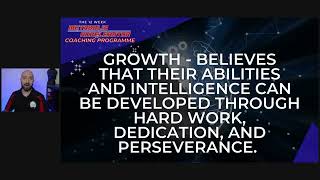
In this session of the Metabolic Accelerator’s weekly "Metabolic Mindset" series, the instructor explains how a "metabolic mindset"—the mental framework that ties together meals, movement, and melatonin—shapes behavior change. The core of the talk contrasts a fixed mindset (seeing abilities and outcomes as static, using only end‑goal achievement as motivation) with a growth mindset (viewing abilities as developable, celebrating progress, and learning from challenges). The speaker illustrates the concepts with real‑world examples (COVID reactions, a martial‑arts anecdote about a fighter’s win‑or‑lose identity) and personal reflections on imposter syndrome and authenticity. He then outlines practical ways to cultivate a growth mindset: recognizing and challenging limiting beliefs, embracing challenges, focusing on process over outcome, cultivating a love of learning, practicing resilience, making decisive commitments, and surrounding oneself with growth‑oriented people. The session ties these mental shifts to concrete health goals—weight loss, muscle gain, strength milestones—showing how mindset alignment can bridge the gap between knowing what to do and actually doing it.
Chapters
Hey guys, what's up? And welcome to this week's session in metabolic mindset. Now of course, as you guys know, metabolic mindset is the key for holding all of this metabolic matrix stuff together. It's essentially the glue that holds together the meals, the movement, and the melatonin, because it's the way that we think in relation to those things that's going to give us the opportunity to act right in accordance with those things. Ultimately, that's why we need to ensure that we are focusing on, sorry, focusing on, I was going to say and on, focusing on our metabolic mindset when we're trying to implement all of these other aspects and change different behaviours and habits and things that we have. Now this week we're going to be talking about growth versus fixed mindset. Now hopefully you guys can see that bigger on the screen now. It's always an interesting subject, this one, to me, because many of us, particularly when we're in the sort of entrepreneurial and business space and whatnot, we think that, oh, well, I've got a growth mindset, but often we actually don't. We might have elements of it or aspects of it, but we tend to find that actually we tend to be very fixed until someone we perceive as authority comes along and says, no, no, no, that's not the way to think, think like this. And then instead we fix ourselves in that new way of thinking and we kind of lose sight of remaining sort of in that growth state. Now both serve a benefit and we'll get into what they are as we go, but we just need to kind of know when to lean on one or the other in order to consistently be able to move forward towards our goals. Now at this stage, of course, we should know, we've covered mindset quite a bit, so we should know and you guys should realize that Ultimately, the mind is the master. So regardless of what it is we want to achieve, it's our state of mind in relation to how we perceive ourselves to that thing that will dictate whether we go out there and get it or achieve it or not. So we need to realize that the mind is the master, and it's our consistent state of mind that becomes our consistent state of life. Now that sounds like a bit of a bold statement. It's like, well, what do you mean? But what we have to realize is that it's our perception, essentially. So life goes on and we have all these different things that go on. The catch is many of us will perceive the same things totally differently. So for example, COVID, for example, some people saw it as, holy shit, there's a virus out there, it's going to kill me. I need to listen to everything the government tell me. I need to go get a vaccine. I need to wear a mask. I need to wear shields. I need to isolate and all those different things. Whereas other people saw it and went, 'What the fuck? These are trying to pull the wool over my eyes. This doesn't make any sense. This doesn't add up. That doesn't add up. That doesn't add up. There's no way I'm wearing a mask. There's not a single piece of research that supports any evidence they help. I'm not locking myself down in my house because isolating myself will actually do worse for my mental health than remaining out in public with people,' and so on. So there were lots of different things going on, and different people experienced the same thing but totally differently. So it's our consistent state of mind that will become our consistent state of life. So we just need to be aware of that, because often if we want to change the way our life is, we're going to have to change the state within our mind, the way we see the world, the way we see ourselves, the way that we show up for ourselves and obviously talk to ourselves and things like that. Those things over time may have to change in order to get those new outcomes that we're trying to achieve. So this ultimately is essential to— oh, sorry, this is why it's essential for us to think right. Because if our state of mind will dictate our state of life, if we're thinking wrong, then of course we're going to continue to get the wrong outcomes in life. So ultimately, what we give ourselves the opportunity to do when we're thinking right is to therefore act right. Now, the catch is, just because we're thinking right doesn't mean that we will act right. As I just mentioned, it means we now have the opportunity to act right. Now, I say that because many of us, for example, before joining this program, like, you knew that you should be eating healthily on a regular basis. You knew that you should probably have an ideally a good exercise or training program that you're following consistently. You probably knew that you should be getting adequate rest and recovery and so on, but many of you weren't doing it. So it's one thing to know something and to think in alignment with it. Oh well, I know that I should eat this, that, or the other, But if you're not actually doing that, well, now you're not acting right. You're thinking right, but you're not acting right in alignment with the way that you're thinking, which means obviously, ultimately, we have a disconnect as well. It's like you're not living in integrity with the beliefs that you have, which is another reason that can perpetuate often amongst entrepreneurs, business owners such as ourselves, this idea of like imposter syndrome and, oh, I don't feel like I'm good enough to this or that. And it's because we know at the fundamental level we're fucking lying to ourselves. And unfortunately, when we lie to ourselves, we know we're out of alignment, out of integrity, and we're always worried about being exposed. Even simple things like this. Oh, well, I know I should be eating healthy, but I don't. That's another lie that just compounds on top of the other lies that we have, which just reinforce these beliefs that, oh shit, I feel like I might be exposed if I don't. I've got to be careful how I operate and do and say and this and that. We don't need to live like that. So let's just live in the truth, and then let's try to get our ways of being and our ways of acting in alignment with the way that we're thinking. And that way, the system as a whole— our mental, emotional, spiritual, and physical self— can now act in alignment. It can act as one being, and it doesn't have to worry about being exposed because everything that I display is already the truth. So what you see is what you get. Which often, as we know, isn't often the case for people. We get this view of them that they want to present to the world. And then of course, that also comes through our own filter. So I see this person, he might be his authentic self, but now I perceive him through my own filters. So I might not actually see the reality of what he's presenting and so on, but that's another story for another day. So back to this growth versus fixed. So ultimately, we're looking to think, right, so that we have the opportunity to act right. Now, that's where we get down to the growth versus fixed mindset. So that's like, this is like one of the first steps that we need to take in the direction of thinking right so that we can act right. Now, the differences with these go like so. Now, if you have a fixed mindset, what you tend to believe is that your abilities, your talents, and your intelligence are fixed traits that cannot be developed further. Now, another aspect of this tends to be that, let's say, in relation to your goals, it's like my goals or my achievements are not good enough until I reach the end outcome. My goal was to lose 20 pounds. So yeah, I might have lost 19, but it isn't the 20 I set out to lose. So therefore it's not good enough. Catch is, when the goal isn't good enough and we haven't achieved that goal, then ultimately what we're telling ourselves is we are not good enough. So that's the catch with this fixed mindset. We need to just be careful of going, okay, well, that's my goal. Until I achieve that goal, nothing else is good enough. Now, on the flip side, of course, we've got the growth mindset. Now, a growth mindset believes that their abilities and their intelligence can be developed through hard work, dedication, and perseverance. So they don't necessarily believe, oh, well, it's just easy and I just have to think a different way and suddenly it becomes. It's a case of, no, I know that if I do the right things consistently enough, that will lead to the new outcomes that I want. I'm not actually fixed or stuck or limited by these things that I may have around me. I can change them based on the way I act. Now, of course, in relation to the goals, you would also see that 20-pound goal differently. Rather than being like, well, until I get to the 20, that's not enough, you'd be like, holy shit, I'm at 19 pounds. As in 19 pounds down. So it's like, holy shit, what they do is they look back and see how far they've come, and they will appreciate themselves and give themselves gratitude and grace for having come that far. So it's a case of, yeah, well, my goal is still to lose 20 pounds, and I will be even happier when I've lost that 20 pounds. But you know what, I'm actually really happy and satisfied with the progress I've made so far also. And rather than kind of deter me from the long-term goal and be like, oh shit, I've only lost 10 pounds, for example, and I've still got 10 pounds to go, instead you go, holy shit, I've already lost 10 pounds. So if I've lost that 10, I can probably still lose the second 10. Now all I need to do is remain consistent, keep doing the things, and I'm gonna get there. So that's the difference between the growth and the fixed. Fixed says not good enough until I get it. Growth says, I still want that, but I'm happy with the progress I'm making along the way. The progress I'm making is what I will use to keep me motivated rather than the fixed mindset, which says, no, I will use my desperation and my belief that I'm not good enough until I am at this goal as my motivation to achieve it. Okay? Now, I've been guilty of this myself also. It's far less now, but of course we all do it. But I was on a coaching call with one of my coaches a few years back now, and we were in the talk, and I don't remember the exact thing that led to it, but my coach then turns around and says, yeah, but the problem is, Tyrone, you're stuck in a fixed mindset. And I'm like, you what? And he's like, you're stuck in a fixed mindset. You've got too much of a fixed mindset. You don't have a growth mindset. And I'm like, well, of course I do, because I'd been doing coaching and I'd been doing all these various things and even some personal development work and so on. So I was like, Well, of course I do. And he's like, no, no, no, I don't know if you guys know, but I also do martial arts and I've done many years of it and so on. And he's like, no, Tyrone, listen, if I was to say to you, right, we're going to train for the next year, right? You're going to train your hardest. We're going to get your nutrition on point, your recovery and all the rest of it. Everything's going to be perfect. And by the end of the year, you are going to be the best martial artist you've ever been. But when you go into your next fight, you're gonna lose. You wouldn't want to do it, would you? And I was like, well, of course not. Why would I want a loss on my record? And he's like, exactly, fixed mindset. Your idea of good or becoming great is the win, not the process that you went through to get there. And the fact that you were now a better fighter— you're quicker, you're faster, you're leaner, you're stronger, you're healthier— like, you're all these things better, but in your mind, it's only the win that confirms that you're better. So he said, that's the problem, you have a fixed mindset. And I'm like, holy shit, you're totally right. So we need to be careful sometimes where we, where we set our targets or what the things are that we use to measure our so-called perception of success. Because when we, we put too much of a limitation on certain things, then obviously that can disrupt us and cause us to spiral into these fucking crises of self and all this type of stuff. As you go. It's a bit like when you see a fighter that believes that they're invincible, untouchable. They have an unbroken record and they're going around, they're beating everybody and they're making everyone almost look silly, like they're just on a whole nother level. Then suddenly they meet their match and they get beaten and then they never return to the combat sport again. Now, this is often because they built up such a belief, such a fixed mindset that they were this invincible being Then of course that reality gets shattered when they get beaten by somebody else, or they finally meet their match, so to speak. But rather than go, oh well, I'm still the best, like Muhammad Ali— luckily he didn't have such an issue with this— he always used to say that, well, I'm the greatest. Not that he's unbeatable or undefeatable. Instead, he was like, well, I'm the greatest, so it doesn't matter whether I win or lose, I'm still the greatest in my mind. Whereas if you have this idea, for example, that you're unbeatable, unbreakable, when you get beaten, suddenly that reality gets shattered because it's like, oh fuck, I'm supposed to be, supposed to be unbeatable. I told everyone else I was unbeatable and then I got beaten. So that's where the fixed mindset can become a serious limitation. Now of course we, we— oh, how does this show up when trying to get healthy and lose weight? Well, I've already told you. So this is often— it shows up with the goals, as we're saying. So we need to be careful not to get fixed in one or the other. We can use a fixed mindset because it's outcome-focused. And of course, that fixed mindset can help move us towards our goals. It's like, no, that's the goal I want. It's over there. That's the direction I need or want to go in. So that's where I'm going. A fixed mindset is great for that. But what we want to ideally do along the way is employ the use of a growth mindset at the same time. So that we can remain focused on the process and the things that we're changing. So it may be a case of, oh, well, I still haven't lost the 20 pounds I'm trying to lose, but I know I'm serving my body better. I've actually got more energy because I'm eating better. I've got more energy because I'm sleeping better. And now that I've got this exercise program that I'm doing consistently and I'm lifting weights and so on, I feel stronger and more empowered and I'm more confident. So yes, I haven't lost the whole 20 pounds yet, but everything else is actually improving and gaining as I go. So yes, the 20 pounds is still important, but it's not the only thing I'm trying to achieve, and it's not the only thing I have achieved as I'm going. These other things are, are often equal or even in excess of that particular outcome that we want, but we just have to be willing to recognize them throughout the process. So what are some ways that we can actually develop a growth mindset? And the fixed mindset tends to be easy, which is why we don't really say, well, how do we develop a fixed mindset? Well, the fixed mindset is, as we just said, what's your goal? My goal is to lose 20 pounds. My goal is to gain 10 pounds of muscle. My goal is to lift 3 times my body weight, or whatever it is. That's the fixed goal. The fixed mindset says I need to get there. The growth mindset says, okay, cool, yes, I need to get there, but I will enjoy, I will appreciate, I will recognize the progress that I'm making, whether related specifically to that goal or not, along the way. So, some things that we can do to obviously improve and develop our mind, or sorry, our growth mindset, are to recognise and challenge our fixed mindset beliefs. So anything that we know is a fixed mindset, something that is perhaps limiting us, holding us back, preventing us from being the best version of ourselves and reaching the goals that we're trying to achieve, We can obviously recognize those and begin to challenge them. Like, does this goal— or sorry, does this mindset, this belief towards this particular thing, does it serve me? Does it help move me towards my goal? Then if it doesn't, as an adult, we now have the opportunity to go, okay, cool, do I want to continue serving this idea and maintain it in my life and my mind, or do I want to reframe it now? Do I want to change it and actually think differently in alignment or sorry, think differently in accordance to this thing so that I can get a different outcome, or if not a different outcome, have a different experience around this particular belief. Then of course, we want to embrace those challenges. Sometimes when we get stuck in the fixed mindset, we can actually end up becoming a bit of a victim and victimizing ourselves. We can get to this point where we feel like we're entitled to outcomes, rather than like we should have to work for them. So often as a, as part of the growth mindset, we will embrace the grind, so to speak. Like we understand that sometimes achieving more requires more of us and that more of us is going to challenge us. So we will embrace the challenge along the way. And then we obviously want to focus on the process, not just the outcome. So yes, the outcome's important, but so is how we develop and how we evolve as an individual. Throughout the process and the different changes and the, the implementation of the different habits and behaviors and things that we're going to make, we want to stay focused on that also, because often during the process of trying to achieve our goal, a lot of other factors within our lifestyle are positively impacted and affected as a result of these changes that we've made within ourselves. So it's often very beneficial to recognize those as we go through the process. We can cultivate a love of learning. Now, most of us in the entrepreneurial business space tend to be learners anyway. We like to study, we like to, to learn more and learn from others who are perhaps further along than we are, and so on. So that's often handy. We maybe already have this sort of love of learning, but if you don't, it's a great way to help develop a growth mindset because by learning from others, we often get the opportunity to see life or the world from other people's perspectives, and that will often help challenge our own narratives and perspectives, which helps to broaden our perception of things and broaden our own reality, essentially. So then that also helps to develop that growth mindset. We become much less fixed and we're more malleable, more pliable. And I don't mean to the point where we're manipulated by others. I mean where we can choose to adapt and respond to different things as they come, and we can see things from a, from a totally different perspective. We're not just fixed in this one way of thinking, oh, what they say is right, I must follow that thing. Instead, we get to see things and then think on it and compare with other things that we've learned, and then discern for ourselves what we consider to be the truth in relation to the various versions or potentials of a given story or outcome. We can practice resilience, so deliberately challenging ourselves, doing various challenges. For example, even this 12-week program is a great way to practice resilience, especially if you're at a point now within the program where you're like, you know what, I have been trying hard, but I could probably push myself a bit more. I have been eating well, but I can probably eat a little bit better. I have been getting to bed at a better time, or I have improved my sleep environment, but actually maybe I can do something else now. Often we find that we are capable of a lot more than we realize once we choose or decide to do it. Decision is one of the most powerful things that we have. Actually deciding that we're going to do something, not thinking about it or thinking, oh, well, maybe I should, or maybe I could. Deciding to do it is one of the most powerful things that you can do as an individual. Even just making the decision itself and deciding, you know what, this is what I'm doing, that often will give you a sense of increased power straight away because you're choosing to live in the land of the definite. You're no longer in the land of the maybe where I might or should or I could or, or this or that. You've decided, no, this is what I'm doing. The good thing when we decide this is what I'm doing or this is the outcome I'm going to achieve, the good thing with that is it gets rid of any other potential. It's okay. We don't have to consider anything else anymore. We don't have to waste time, effort, or energy worrying about other decisions because we've already made the one decision that matters. So practicing resilience is a great way. And then of course, surrounding yourself with growth-minded people. Now this can come in the form of literally getting new friends who tend to live in or experience more of a growth mindset themselves, or of course, consuming content and information from people who have more of a growth mindset rather than just a fixed one. And then again, that can help you to develop your own growth mindset as you move through this process yourself, ensuring that you don't just go, oh, nothing's good enough until I get there, get to that end point. We learn to appreciate life as we experience it, but we use the fixed mindset to give us a point of direction. Cool, I hope that helps, guys. As always, Any questions, let me know. And if not, I'll see you guys in the next video where we're gonna jump into other ways we can directly implement this stuff into your lifestyle based on the 12-week Metabolic Accelerator Program. Thanks for watching, people, and I look forward to seeing you in the implementation lesson. Take it easy.
More from Tyrone







Boost Your Metabolism, Burn More Fat and Reduce Cravings: The ONE Simple Dietary Tweak



