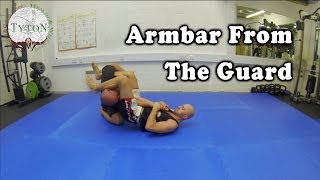
In this instructional video, Master Wong demonstrates how to secure an arm‑bar from the closed guard. He begins by emphasizing the importance of maintaining a closed guard to control the opponent’s posture. The core technique involves a "collapse" motion where the practitioner pulls the opponent’s elbow inward, drives the hips down, and shifts the hips to bring a leg around the opponent’s head while keeping the opponent’s thumb pointing upward to maximize joint pressure. He explains variations for stronger opponents, such as using the leg on the hip to push and turn the hips, and an alternative foot‑on‑hip push‑off when flexibility is limited. Safety tips include keeping the opponent’s arm away from the groin area to avoid self‑injury. Throughout, Wong stresses keeping the hips driving through the elbow joint, maintaining tight control of the opponent’s arm, and adjusting hip and thumb positioning based on the opponent’s resistance. The lesson concludes with a recap of the movement’s flow and encouragement to practice the slick, quick arm‑bar from guard.
Chapters
What's up guys, welcome back to another lesson in the Master Wong Grappler and the Ground Fight System. In today's lesson, we're going to talk through how to secure the armbar from the guard. It's a nice movement, pretty swish and quick, and it's very good for catching your opponent unawares when he tends to try and rush you. If you've got someone that loves to ground and pound from inside the guard, if you're slick enough, it's very good for just catching him unawares and quickly spinning the hips out and obviously break the elbow if he doesn't, if he doesn't tap out. So jump into guard, Naz. Show these guys what I'm talking about. So again, like I always say, initially when you're looking for control on somebody, you want a closed guard. When you're not so fussed about that, you'll let it go. But initially, keep the closed guard. So with this one, again, we'll start here to begin with. And like any of them, they can be done from the punch, etc. But the first thing you're looking for, he's maintaining posture. I'm trying to pull, I can't. So what I do, this position basically, if I'm looking to reach him, I can't. My elbows are sort of at the top of his forearm, and what I look to do is collapse. So with this collapse, I slightly pull his elbows inwards, and then I drive downwards towards my torso. So I can't reach here, collapse. Now from here, I can control where his head goes. Like so. Now with this, I'm looking to collapse and keep the elbow fairly close to my hip. I don't want it on my hip, as in sort of against my thigh, because that can limit my movement if I don't really know what I'm doing and don't know how to manipulate my hips. So from here, I just go 1, so in, collapse. From here, I take the head away and I've let my guard go. So I was here in a closed guard, I've let it go, I shift my hips and this leg comes around. I drive my foot towards the floor. Once you get here, you don't really care about this arm anymore, as in it's this bottom one that does the work. So as I extend my hips through, that's the one that creates the pain. So I can't reach him. I can hit him, of course, but not enough because I'm on my back. It's very unlikely I would be able to knock him out. I can kind of keep him busy and thinking, but what you've got to remember is if If I can hit you, you can hit me. Now he can get a lot more power. I could maybe just annoy him. He, in real terms, could knock me out potentially with a big punch. So it's safer to look for control initially. So I'd be here, collapse, take this. So I've let the closed guard go. I force the head across. Now as I do that, shift my hips. So I use that, I push against him. So I'm here, use his resistance, his body's resistance, as I push his head. From here, my hip turns. That puts his elbow directly in my hips, and I want to keep his thumb pointing upwards. If I turn it down from this position, you'll notice— stay, stay— his arm has ended up on the side. So as I start driving my hips up and through, it may just bend his elbow, which still puts horrible pressure on it, but it's not as effective. So I want the elbow pointed up, so when I'm here— sorry, the thumb pointing up— so when I drive my hips through, that puts pressure directly in the joint up through here because of the position of the thumb. So we're down, collapse, hand, shift back in here, collapse, and shift. Now, if he's a little bit stronger, smarter, then you may find that just using the hand and the switch isn't quite enough. So what you do in this case is I collapse, this leg goes on the hip, okay? So that one will go here. Now I use that to push off and turn my hip instead. So collapse here, that can turn. This hand, obviously the same hand as that leg, goes across. I turn here, so I push his head and push off his hip. This leg comes up and helps turn his body slightly. Now I quickly snatch that in and drive the hips up and through. So here, collapse, leg, hand, push and turn. In. Thumb again. Thumb is up against towards the ceiling. I close up and look to keep this nice and tight, drawing my hips through. One thing you've got to be careful of in this position is as you turn, if you're not wearing a groin guard, it's quite easy to crush your own balls. So this is if you're a guy, obviously. You don't really want to crush your nuts, so make sure you have his arm just slightly to the side on your thigh, on either side. So it's just outside of— outside of your testicles, because it's pretty painful. So we collapse, push, turn, here. Keep the thumb up, drive the hips through. This foot points down towards the floor, and I try to put it there as I'm pushing my hips up and through. Cool, thank you. So as you can see, pretty slick movement. And if you can just use your hand, great. It will depend on how much resistance he's putting against you. But if there's not enough, or you find that you can't shift the hips enough in order to get the leg over because you maybe don't have the flexibility, then you just place the foot on the hip, push away as you turn instead, and and then swing the leg over, no problem. Make sure you keep hold of that bottom arm nice and tight. Keep it fixed securely against your hip, just on the inside of either thigh, and then drive your hips up and through. Remember, your hips must drive through the joint. So you don't want it here, pushing away or in. Directly from his elbow, the tip of his elbow, you push up through the inside of his joint. There. If his arm's this way, you push in this direction. If it's that way, you push in that direction. You basically follow the joint, but that should all be manipulated by where you place his thumb. And then obviously you'll know where he is, what position he's in, and which direction you have to obviously drive your hips. Thanks for watching, guys. See you next lesson.