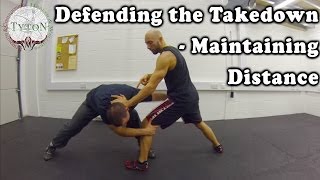
Master Wong's takedown defense keeps distance by controlling your opponent's head with strikes to the neck and ear as they drop in. Mirror their footwork, stay relaxed, and repeat the head control each time they try to close distance.
Chapters
What's up guys, welcome to our first lesson in the Master Wong Grappling and Ground Fight System. In today's lesson, we're going to mainly be talking about just how to keep your opponent away when he comes in for the double leg or the single leg, makes no real difference. Which is how to find him, stick with him, and control his movement. So wherever he moves, you're going to move with him. One thing you're going to have to remember though when you're going through all our stuff is that it's not based on any, like, your standard wrestling or your jiu-jitsu or anything like that. It's based on the Master Wong fighting system. And obviously within that, we use Wing Chun, Jeet Kune Do, Tai Chi, and even San Shao. So the principles that we use in applying our grappling and ground fight come from those systems, predominantly the Tai Chi and the Wing Chun. And then obviously it's put together and expressed in a way that you would see in our, in our JKD body weapons stuff. So we're not exactly going to look like wrestlers, look like standard kickboxers, Muay Thai fighters, or Brazilian jiu-jitsu fighters. That's not the stuff we do. We obviously do Chinese arts, so our stuff is expressed in that way. So it's not that ours is wrong or yours is wrong, it's just different. We just do things in a slightly different way. So as I say, today we're just going to be talking about keeping your opponent away, finding the head, control the head, and then as he switches, you're going to switch with him in order to prevent him getting in close enough to take the legs or the body and obviously eventually slam you down to the floor. So if I could borrow your ass, I'll just show you guys what I mean by that. So initially we're going to be working at distance. Later on we're going to be coming in and working from the clinch. But for now, we're still here. So this is if we're sparring or in a fight. Doesn't matter whether it's the street or in the cage. This particular technique can be applied. Makes no real difference. So if I'm here, for instance, I may have gone for a shot on Naz and he's dropped in. The first thing I've got to do as he does that— so he drops— wait, wait. So as I start throwing and he comes in, the first thing I'm going to do as I throw, he will drop. I have to find his head. So I go to hit him, boom boom, I'm here. So I might have gone for the shot, like I say, I went to hit, he's dropped, I'm here. So my hand literally, if you come back in, finds here. So it's between the shoulder and the head. I'm literally on the neck because the more he forces into me, I just force slightly against the head and he's unable to get it. Force in, force, he just loses balance. So If he's a bit smarter than this and he comes in, he feels that resistance and he tries to change angle and maybe grab a different leg or come up to the body, I now have to switch with him. So he comes in, I shoot, I'm here, he switches, and again I stick with him. I find that same point on the opposite side. So I'll show you from this side. So I'm here, fine, switch, and again I stick with him. So my footwork, I basically go from here, so I'm just neutral, free weight. Here is my first point. Now here I may press a little bit of weight against him if needed, but initially I want to sort of be 50/50-ish. As he switches, this foot comes back, and now my weight is opposite. So I've gone from here, and now I'm basically here. My hand was there, I switched hands, and I'm now in this position instead. So once more, 5, 6, control the head. From here, you he can get rid of it, no problem. There's no way he can get in without coming back out and starting again. Once more. Here, 5, control. Once more on the opposite side. 5, 6, get rid. Easy stuff. Thank you. So as you can see, it's pretty simple, and as long as I have distance initially, once I throw and he drops this hand instantly, must find here. Because every time he tries to force against me, I force slightly towards the ear, which obviously turns the head, and his body will automatically follow the head in order to protect the neck and the nervous system, obviously the spinal cord. So stay relaxed as you shoot. Always watch your opponent. Don't just throw and think, oh, his head's there, so that's where I can hit, because he's never going to stand still for you. So the moment I throw and notice that he drops, I see his shoulder drop, my hand drops too. Find him, I'm here, as he switches, I take it out and obviously keep him away from me the whole time. My start, I'm just here. Okay, nice and simple. Thanks for watching, guys. Try it out and I'll see you next lesson.