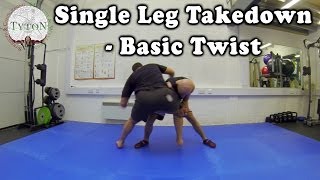
Master Wong demonstrates a single-leg takedown from his grappling system, which blends Wing Chun, Tai Chi, and kung fu rather than MMA. Enter shoulder-first with your head against their hip and forearm behind their knee, then grip and twist to drive them down. Time it when they attack or create your own opening.
Chapters
What's up guys, welcome back to another lesson in the Master Wong Grappling and Ground Fight System. In today's lesson we're going to be talking about the single leg takedown. Just one simple variation, like with any technique there are many variations of it, but we're just going to do one simple version. That will allow you to take your opponent from either your distraction or his own, put him on the ground so that you can either get away and make your escape if you don't really want to fight, or obviously you can go in with knee strikes, punches, you can take full mount, side mount, etc. The choice is yours once he's on the floor. It would just depend on what you want to do in the fight. So, as with all our techniques here, they're all based on the Master Wong fighting system, so they're all from that system. So you'll have principles taken from Wing Chun, Tai Chi, Jeet Kune Do, San Shao, and even a little bit of traditional kung fu. It's not necessarily going to look like wrestling, jiu-jitsu, Muay Thai, or any of these sort of modern arts that you see all over the place these days with the MMA movement. It's not based on those systems. So if we do things different, as I always say, it's not because we're better and it's the only way. It's just how it works for us. It's just our way. You have your way. If that works for you, great. If you can take some of our principles and make them work for you, even better. So then you'll have a better game, hopefully. So, fuck it, I'll show you what I mean. So, as I say, you can do this from his distraction or your own. If I'm setting up my own, that basically means I'm either going in to kick him, I send a punch, whatever it is. But once I move, I'm hoping to get him to react to it, because once he reacts and I go in, he's hopefully not going to see it because he's worrying about the punch, not my takedown. So the other option I have is, of course, I use his own distraction, which would be his punch or his kick, etc. Excuse me. So what happens is, as he punches, I move in. Because what I don't want to do is let him punch and then go in, because that's going to be too late. The hand's already back, he's probably already setting up with the rear hand, etc. So what I do, the moment I see his foot, the knee, the hip, or the shoulder move, I go. As soon as I know there's an attack coming, that's when I must move in for the takedown. So I'm here, bang, the moment he moves, I'm in. My shoulder lands first. So I'll just show you that a bit slower. What happens is, as he punches, I'm moving in. This hand initially, they're here. I move in, my hands have to stay here because if he's quick and he sees me moving in for it, this knee may come up and whack me straight in the face. So what I do, I go here, my hand is in front, and then basically, bang, shoulder comes in and lands first. Once this shoulder has landed, my lower hand, so the hand of the same side as the shoulder, comes behind the knee. I make a fist, it comes behind the knee, take hold of that fist, and then from here I will have a lot of twist through the hip and the drive off this leg, and obviously I can use the lat. It's much stronger than if I grab this side. You can do it here, but it's way less effective. So I— my forearm, the lower part of my forearm just by the wrist, is what rests against the back of his knee. And then I grab here. Of course, my head must stay fixed against his hip. If I'm loose, then I move and he doesn't. My head is here, so if I move, he moves too. Now, initially, it's only really going to be super effective if he's trying to sprawl. If I just go in and he doesn't really do anything except apply weight and pressure, I can't really move much. He can adjust with it. If on the other hand I pull this and he tries to sprawl back, once this leg comes up and his weight shifts— so if he sprawls, all I have to do is a little twist because he's now only based on one leg, which happens to be too far away from his lead one. I just go little twist, and that will put him on the floor and allow you to move on with the technique. So a little bit quicker. Here. So you want to keep this leg, keep it controlled, because from here I can go in with the knee. With this knee, I can come over the top and of course strike with him, or I can come in, take full mount, etc., if that's the type of thing I want to do. And of course, because I've got him, I can just choose to run away if I'm not really in the fighting mood, or I'm thinking, shit, panic, put him down, gone. You don't have to fight, you just do enough to put yourself in a safer situation and then move on. So once more, here, then as I say, you'll come in here. Now, side mount, you've got arm bars, etc., but we'll go into all that type of stuff later on. As long as you stay close with him, stick with him, then you should be able to follow up your technique, no problem. Thank you. So as I say, here, you can set it up yourself or wait for his. Once you cover and go, make sure this shoulder lands first. Cover yourself in case the knee comes. Hand, shoulder. This one catches, here, twist. The moment he tries to sprawl, twist. As soon as you feel his weight, his body get heavy on you, that's when you turn away. And as you'll notice, he'll spin and land here every time. Thanks for watching, guys. See you next lesson.