Q&A- Why Can’t I Stick To One Squat In My Strength & Fat Loss Programme?
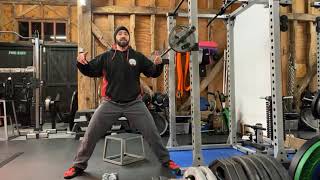
Tyrone Bray explains you can stick with one squat if you vary sets, reps, and tempo, but mixing squat types works better. He breaks down the barbell back squat for all-around strength, the front squat for quads and mobility, and the box squat for glutes and explosiveness.
Chapters
Hey people, what's up? Hope you're all good. So just adjusting my camera here so that hopefully you guys can see what I'm about to show you. So I had a question come in from one of my clients today. He's working his way through his programs and his current goal is to get stronger and to burn fat. Now what he's noticed is each time his program changes, the type of squat we've got him doing is changing as well. And he's like, "Oh man, I've just gotten used to that previous version. I feel pretty good and confident with that now. Do I really have to change it?" And if I have to be totally honest, no, you don't. Like, you could pick a program and you could do the same style of squat the whole time, say for the next year if you wanted, providing you're changing the training parameters, as in sets, reps, tempo, technique, and things like that. But you might also then, of course, have to manipulate the things you're doing around that squat to make sure that you're hitting other muscle groups and maintaining a, a balanced improvement in your strength and obviously maintaining good balance between the various muscle groups in the body. So, no, you don't have to switch up your squats, but you probably should. And I'm going to show you 3 variations that you could use yourself in order to mix up your own training, and I'll kind of explain to you just briefly how or why we might use them, or which, which muscles each version will hit the most or cause the most stimulus to, and therefore the most opportunity for adaptation. Now, most of you have probably seen these types of squat before, but you may not know how or why or when you could or should use them. So the first version is the back squat. Now, this is the most typical one you'll see. It's the one that most people do. And generally speaking, it's the best all-rounder, particularly if you're a newbie, if you're relatively new to the gym and you're just trying to find your groove and get good and used to squatting and so on. The barbell back squat is a great way to kind of introduce yourself to it. And the standard barbell back squat gives a good general benefit to all major muscle groups, particularly within the legs. So it will hit the quads, it will hit the hamstrings and the glutes, as well as all the stabilizing muscles of the trunk and so on. So it's a good all-rounder, a good overall builder, both for building strength, for building muscle, for burning fat, and so on. So essentially with that one, what we're looking at is once we get underneath the bar— so I'm not going to bother with this particular video talking about specific technique and so on. I'm just going to kind of show you how each one's done. So with the back squat, you would take your squat width stance, and then the goal essentially is to sit my heels pretty— sorry, sit my hips down towards my heels. Now we're not necessarily talking about doing ass to grass and all the rest of it here. It's just a case of I sit straight down and then I drive straight back up. And ideally we're keeping the bar roughly in line with the midfoot. I sit down and I sit up. And by doing so, so I let my knees go forward, I let my hips drop back slightly, and I kind of stay in the middle of that position. And then that way I get a relatively even load share between the hip and the knee. That way I get good activation of the glutes, the hamstrings, as well as the quads. So that's why it's a good version for us to start with because we can build that kind of squat technique, build the groove, get used to having weight on our back and so on. And as I say, it's a great overall builder for strength, for muscle, and for burning fat. Now as we transition out of that, we might want to go into a version that's a little bit bit more complex and has a larger mobility demand. Now this means, okay, well cool, so what are we gonna switch to? We're gonna switch to the front squat. Now the front squat puts a greater demand on the quads. So if my goal is I want big quads, not necessarily fussed about my glutes and my hamstrings, maybe they're already well developed, or you're just going through a phase where you wanna hit the quads well, then the front squat is a great version for that. What it also does, because we're now racking the bar on the front, is it also moves the load forward slightly. So it puts a greater load on the extensors of my upper back. So if I'm lacking strength there and I tend to hunch a bit and I want to build strength into those postural muscles, the front squat is a great way to help do that. But it does have a much greater mobility demand at the, at the level of the shoulder and so on. So we do have to make sure that we have that, and particularly at the wrist and the fingers also. So with this one, rather than me sort of sliding under the bar and resting the bar on my back. Instead, it's going to sit across the front of my shoulders. Now, you can hold the bar here if you wish whilst you're building up the mobility requirements to get into a full front squat rack. But if you can do it, what you would do is essentially sit yourself under the bar, elbows sit high like so. Now, with this one, again, we are trying to sit our hips down to— so yes, our hips down to the heels. I nearly said heels down the hips again. So we're still trying to sit the hips down to the heels, but this time I allow my knees to go forward more so that I can ideally stay a bit more upright. In the, in the back squat, I'm allowed to lean forward a little bit because I'm trying to maintain the weight over my center of gravity. With this one, because the bar is in front, that allows me to actually stay more upright with the bar. And again, I sit straight down and then I drive straight up. So where the back squat was a good all-rounder, builds both, this will build both but predominantly it's targeting the quads relative to the amount that it's going to recruit your glutes and your hamstrings. So two great variations, you can do them both. Again, both good for strength, both good for muscle building and for fat burning. Now the final version is my personal favorite, but that's because most of my training that I do for myself tends to lean towards being strong. I like doing strength work, and a great builder for strength, it does the other aspects as well, as in fat burning, muscle building, and so on, but for strength is the box squat. So we can use this both for strength and for speed or explosiveness, and With this one, we rack the bar on the back the same, but now rather than just taking a normal squat with stance, now we go wide. So with this one, I sit wide and then rather than sitting straight down, I actually sit back right onto a box. So you'll see this from the side here. Set this up roughly there. Now for this one, again, as I said, bar goes on the back. Get underneath, lock my scapula in place and my thoracic. Now, I take that wide stance like I mentioned, but rather than me sit straight down here, which is not the technique we use, instead I'm trying to load up my glutes and hamstrings more. So this one doesn't recruit the quads anywhere near as much as the previous two versions, because instead I take my breath and then I sit myself back. I'm driving my feet apart, and I sit back. And as you'll see, as I reach the box, my shin is now actually vertical. Whereas previously I was kind of in this sort of position where my knee was over the toes, now my knee is actually behind the toes. And then another difference with this version, rather than driving straight up in a vertical drive, instead I have what we call a lateral drive and I push my feet apart. So in order to drive me up, I actually almost have to hamstring curl myself back into position, and then I push my feet outwards in order to generate force through the hips, which is what allows me, once I'm back in position, to drive up. Now this weight's a tiny bit light, so when I come up quickly, it actually makes me come up onto my toes a little bit. So I would need a bit more weight if I was actually training. But I sit back like so, I allow the box to take my weight, and I relax my hip flexors, and then as I lean forward again into the movement, I drive my feet apart and lock. Like so. Sit back, let the box take me, and then drop. Okay? So again, not too complex, but does take a little bit of time to sort of drill that skill. And of course, you don't necessarily start on a box this low. You could start on a box whereby you're maybe just about parallel to begin with and then build up to that, then down to parallel and so on. So this is actually a 12-inch box, but you would start, generally speaking, if we're looking at strength, where your weakness is. So you would either go, okay, well, I need to start higher because I've got to groove the technique to get used to sitting back and allowing the box to take my weight. Or if you're a bit more a bit more experienced, a bit more well-trained, and have a good technique, now we're looking at, well, where's the specific point in your squat where you display the greatest weakness? Let's work in that portion of the movement so that we can build that up and then allow you to ascend your weights the, the next time you come to testing. So, those are the 3 variations that we tend to use, and then of course we do variations on those 3 as well in terms of weight or whether we're using accommodating resistance and things like that. But as I say, if we're doing, if we want good overall recruitment of the entire leg or the entire upper leg, of course, so quads, hamstrings, ankles, we want a good all-round workout, the standard back squat is a great choice. If we want more quad recruitment because we wanna target the front of the legs more, then we would use the front squat. And if we're looking to build up explosive power and strength in the hips and we want more muscle development here, in the hamstring and in the glute, then we tend to use the box squat. Now you can of course do that style of squat but without the box as well, where we're sitting back and driving up and so on. But the box is just a great way to put that pause in so that we can make use of that explosiveness and potentiating the nervous system and various things like that to help develop even greater levels of strength and speed, which will help us lift more weight and therefore burn more calories, build more strength, build more more muscle and so on. So that's it for tonight. Hopefully that helps you guys and also of course hopefully it helps my client once he sees this later on and he'll have a clearer idea as to why it is we varied up these squats in the programs. And then of course with the variations in the squat, we also vary the other exercises around that to ensure that we still get that good overall balance and target any weaknesses and things that we find as we're developing the strength and moving towards his fat loss and aesthetic goals. So thank you for watching, people. As always, if you have questions of your own, feel free to drop them in the comments. And if not, I look forward to seeing you all in my next video. Take it easy, people.
More from Tyrone







Boost Your Metabolism, Burn More Fat and Reduce Cravings: The ONE Simple Dietary Tweak



