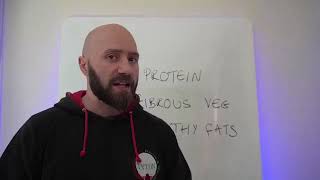
Tyrone Bray lays out three steps to lose belly fat without cutting out favorite foods: eat more protein at each meal, add fibrous vegetables, and increase healthy fats like lard and olive oil. He argues that cravings fade when you add these nutrients instead of restricting calories.
Chapters
If you find yourself as a busy entrepreneur struggling to stick to your weight loss diet because you're reluctant to give up all of your favorite foods, stick with me for the next 3 to 5 minutes and I'm going to walk you through the simple 3-step process that I use with my clients that not only enables them to make the dietary changes needed to actually start burning the belly fat and losing the excess weight, but also do it in a way that enables them to continue eating their favorite foods such as ice cream, desserts, cakes, and so on. And if you'd like a free copy of my Metabolic Meal Method report, which walks you through exactly how to implement the steps I'm going to show you, drop the comment metabolic below and I'll get that sent over to you as quickly as I can. And if you're unsure of who I am, my name is Tyrone Bray. I'm the founder of Stronger Than Life Coaching, where I help busy entrepreneurs and business owners to burn off anywhere between 10 and 25 pounds of body fat in as little as 12 weeks or less. And we do it without using gimmicks, fads, starvation diets, and without doing hours and hours of cardio every single day. Now, what is this simple 3-step process that I'm talking about? Now, believe it or not, it's very simple, and they're things you probably already know that you should be doing. The trouble is, even though we know these things, often we don't actually implement them. So what we want to do is focus on these 3 things, and as a result, those treats and things that we know that we should maybe reduce will naturally reduce as a, as a byproduct of implementing this. But because we get this implemented, we don't actually have to eliminate those things or give them up. What happens instead is, as a natural byproduct of focusing on the 3 things I'm going to show you, that our consumption of those bad things naturally reduces. So what is the first thing? Now, our first step is we want to increase our intake of high-quality protein. Now, if you're unsure of what I mean by protein, We're talking about meats, fish, eggs, dairy, nuts, seeds, legumes, and so on. So foods that are high in protein are what we want to focus our diet around. That doesn't mean we go high protein in terms of our dietary intake. It just means we have an emphasis on making sure that we have an adequate amount coming in to serve the goals that we have. So the first thing that many of us need to do because we're not eating enough protein is increase our protein intake. And as I say, that's meats, fish, nuts, seeds, legumes, eggs, dairy, and so on. So those would be the main protein sources that we start to focus on. Now, alongside this, the next thing that we want to focus on with our meals is making sure that we increase our intake of fibrous veg. So our fibrous veggies is where we want to focus next. Now, when I say fibrous veg, what I'm predominantly referring to is our above-ground veg. Of course, we have below-ground and root vegetables and so on. The fibrous stuff is the, is the veg that tends to grow above ground. So we want to focus there. So we've got now high-quality protein coming in in every meal, ideally in each of our 3 main meals a day—breakfast, lunch, dinner. And then we also make sure we're increasing our veg intake because again, most of us don't get anywhere near enough. We tend to rely too much on convenience foods and processed foods and so on, which often leaves little space for this stuff relative to the bad stuff that we know we shouldn't be eating. So we increase protein, we increase fibrous veg. And remember, at this point, we're still not thinking about eliminating anything. It's not like, oh, I've got to cut this out and stop that and so on. Instead, we're just focusing on what we're now going to introduce instead. And now the third and final step is we want to increase our intake of healthy fats. Now, when it comes to healthy fats, there is a lot of confusion and a lot of misconceptions and so on in our industry. And for years, you'll know that saturated fats have been demonized and so on, but there's a lot of misinterpretation of data and misrepresentation of data and stuff behind that. And what you'll see if you look now is actually it turns out saturated fats aren't as bad as we once thought they were. And instead, where the problem tends to lie is with things like vegetable oils because they tend to be very delicate. They don't tolerate heat or light very well. And unfortunately in many cases they cause a lot of inflammation in the body. But the fats that we need in order to counteract that actually come from our saturated fats. Now in terms of saturated fats, we're talking about things like lard, dripping, tallow, goose fat, duck fat, and so on. Basically all of the fats that your grandparents' parents used to eat, and those are the things that we want to bring back. We want to bring back the fats that nature provided us with rather than the ones that the processing factories and things provide us with. And then alongside that, we could also consume coconut oil, is also a very healthy saturated fat that you can use. And the advantage with these saturated fats is they tolerate heat and light very well. So if you're doing frying and things like that, we want to make sure we're using those healthier fats. Now, other fats that we can use or focus on also include things like olive oil. Ideally, we want extra virgin organic olive oil, and the same with avocado oil. So you want extra virgin avocado oil as well, 'cause we want the oils that have been processed the least or damaged the least during their processing and extraction. Now also, of course, some of our fat will actually come from the protein sources. If we're eating animal fats and so on, or nuts and seeds, they contain healthy fats as well. So the advantage is by naturally increasing our protein intake, we already address much of our fat intake requirements. Requirement as a result of doing so. Then it's just a case of tweaking meals where we might add in a few, a handful of nuts and things like that, or some cheese and certain bits, or cook with butter and so on for our, for our meals in order to just bump the fats up a little bit. Because believe it or not, if our fat intake is too low, we will likely struggle to lose fat as well. Or if what happens is we don't struggle and we have a metabolism that's able to get by on that we might still lose the weight, but we're not actually healthy as a result. So we end up with weight loss, but less health as a result of eliminating fats because unfortunately or fortunately, they are actually essential for our survival and obviously for our body to thrive and function at its optimal and even burn fat at the quickest rates that it can. So if you have any questions around this, feel free to drop them below. And remember, if you'd like a free copy of my Metabolic Meal Method report, which walks you through exactly how to implement this and how many portions of each you'll need in each main meal, drop me the comment metabolic below and I will get that sent over to you as quick as I can. Thanks for watching, people, and I shall chat to you soon.