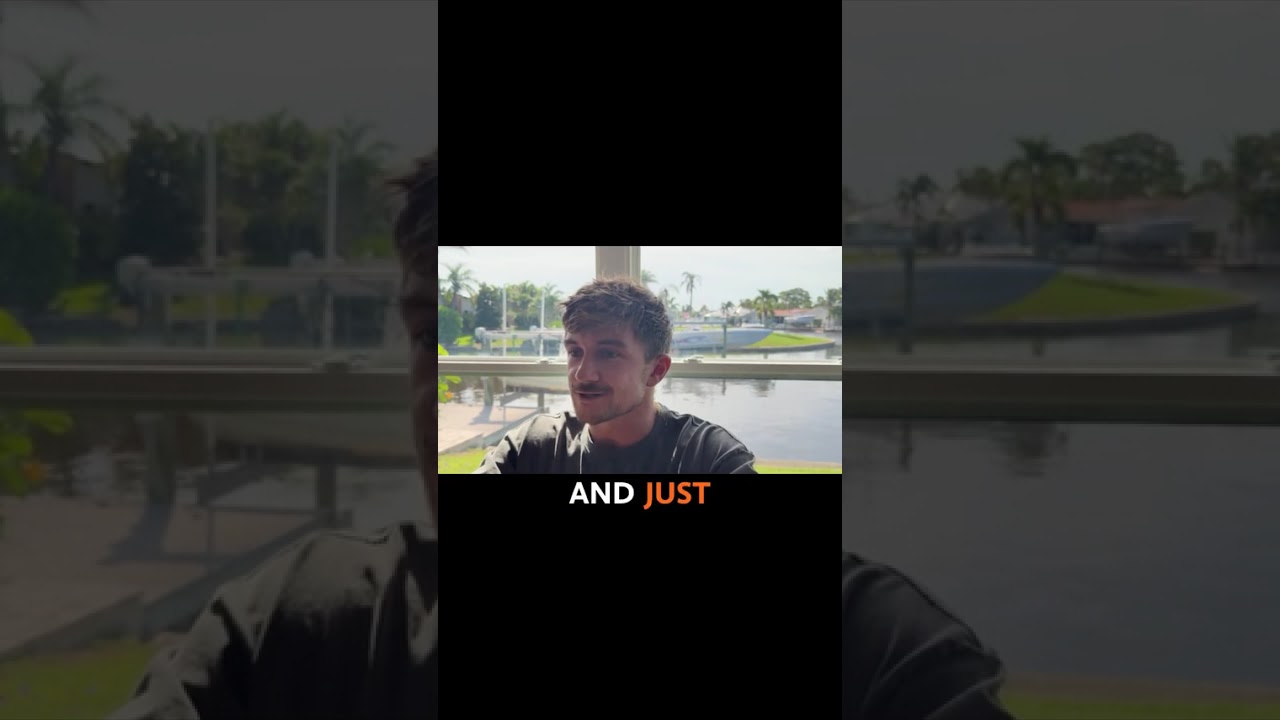
In this YouTube monologue, the speaker (addressing Ryan Ayala) argues that personal and professional success comes from structuring one’s life around innate strengths while building systems to handle weaknesses. He critiques the cultural myth that suffering and hard work alone create value, pointing out survivorship bias and emphasizing that hard work is merely a prerequisite. The core prescription is to identify activities that feel natural, enjoyable, and energizing—often rooted in childhood interests or a unique worldview—and to double‑down on them. He illustrates this with his own experience: living on a $400/month minimalist budget, reducing possessions to a single suitcase, and outsourcing trivial tasks (email, cleaning) to free mental bandwidth. He formed a complementary partnership with someone whose strengths offset his weaknesses, creating a codependent system that lets each focus on what they excel at. The speaker also stresses the need for “career capital”: demonstrable proof of value (e.g., generating revenue for clients) that validates one’s strengths before they can be fully leveraged. The talk concludes with actionable steps: archaeologically examine one’s past to surface natural talents, track daily tasks that feel effortless versus those that feel like pulling teeth, and systematically build scaffolding around the latter, thereby creating a positive flywheel of energy and achievement.
Chapters
Ryan Ayala, we're back. I wanted to talk about this idea I've been throwing around on the internet, and that is to build your life around your strengths and to build systems around your weaknesses. I say this, and it actually got a lot of traction because people don't stop and think and ask themselves, hey, what would this look like if it were easy? What would life look like if it didn't have to be so mundane and difficult? And I don't know how this got into the zeitgeist, of mankind and of our generation. I think it's probably something that's just been around forever. This idea that in order to prosper, you need to suffer, that anything good requires difficulty and it requires hardship and it requires just shittiness. Now I think that one, suffering when meaningful is good in and of itself. It makes you stronger. It makes you better. It gives meaning to things. If you were to just be handed things, on a silver platter, it wouldn't really mean much, but we've taken it too far and it's gotten to the point where it's masochistic and we know that the masochistic approach does not work. I mean, I see it all the time. I see guys who pride themselves on working hard and nothing else, and a lot of people who are at the top say that hard work is what got them there, but that is survivorship bias and that is ego speaking because for every single one guy that said hard work is what got me here, there's 100 guys that worked equally as hard, but didn't make it, right? So that's a survivor bias. Hard work is not the denominator or differentiator. Hard work is a prerequisite. What I think more people need to do is to work hard at the right things. They need to work smart. And the way that you do that is you identify the things that come naturally to you, that come easy to you, and that you would pursue regardless of the outcome and regardless of the incentives. Because if you can do that, you access this infinite positive feedback loop. That'll catapult you into success without even knowing it. Everything that I have done has been a byproduct of me just honing in and identifying what my strengths are, what are the things I enjoy, what are the things that keep me up at night, and just optimizing around that, creating a life where nothing else is really that important. Because I'm gonna be honest with you guys, it's the little shit that gets me. It's the responding to emails, it's the keeping my room clean, it's the doing laundry. And I couldn't handle any of that shit. I mean, I have to pay my utilities and And it's like pulling nails. It's like pulling teeth out one by one. It is so difficult and it takes up so much of my energy. So if you can cultivate the habit of just looking at your life objectively, you can look and you can say, this is fucking ridiculous, right? How can you, random person who's viewing this, be so good at this thing, be honestly world-class, or at least in the top 1% of something, yet still spend most of your time dealing with this totally like non-incidental, right? For me, it's like keeping my kitchen clean. How can you spend so much time dealing with that shit? Or even from a work context, like you're really good at deep work, you're really good at like grinding and calculating or whatever, but you're horrible at correspondence. Or for me, like I'm really good at building systems, I'm horrible at maintaining systems. What if you just focus on the thing that you're good at and you built systems around everything else that kept you afloat so you could put all of that energy, effort, and time into that good thing? And the things that are good and the things that you're good at will naturally give you more energy, right? It'll make you feel better. You'll get better at it. So then it creates this positive flywheel where the more you do of it, the more energy you have to do more of that, which gives you more energy and on and on and on and on and on. Do you see how it's going? So a lot of people, they don't even know what that is. They don't know what they're good at. And even worse, they mistake the things that they're not bad at for the things that they're good at, right? So like people will be like, well, I'm shit at this, this, and this. Well, that must mean I'm good at that because I'm shit at those other things. That's not how it works. I want you to go back and most importantly, I want you to play archaeologist with your past. I want you to identify those things that as a child just came so naturally to you, not naturally in the sense of like, oh, this was prompted to me and I understand it really quickly, although that is important. I want you to look at the things that were the core precipice that grabbed your attention when you were a child, the things that were just this unique worldview that you gravitated towards immediately. For me, it was evolutionary biology and anthropology, and that may sound abstract and that may sound completely unrelated to all the things that I do, but everything I do is within that lens. Understanding the optimal way for human living— evolutionary biology and anthropology, right? Marketing— evolutionary biology and anthropology in practical application of consumer and human behavior. It's all within this individual lens that you'll find is at a very meta level. It's not something as simple as like, I'm good at sales. I'm good at accounting. Find the unique worldview and the unique lens that you naturally gravitate towards that is rare and valuable and double down on that. And then find scaffolding and systems for everything else. So I'll give you guys context of how it looked like for me as someone who really struggles with the basics to hone around my strengths. I built a system around life that made all of my weaknesses non-problematic. Right? What were my weaknesses? Organizing shit. I mean, look at my room right now. It's a fucking mess for no reason. Organizing shit, dealing with the trivialities, responding to email, all that stuff. I spent 3 years pretty much being uncontactable, not worrying about money at all because I knew money would just make me have to focus on my weaknesses. And I just learned how to live very cheaply, like literally on probably $400 a month. I'm not even joking. That enabled me to not have to worry about so many things and just focus on my strengths because I didn't have to worry about paying for a car rental or any of these other random incidentals. Additionally, I didn't have any bills I had to pay other than the cash I gave this dude so he let me live in his casa. That's Spanish for house, by the way, guys. Nice little Spanish lesson there. I got rid of all the things that stressed me out, right? I didn't own anything. I had one suitcase. I didn't have money to buy things, so money weren't stressing me out. I didn't have to worry about that. I didn't even have the capacity to hold on to anything because I only had one bag and I couldn't really afford to buy another checked bag. So I had one bag of things. That's all I did. And I just got to spend all my time focusing on my strengths and I got to spend that time building systems around my weaknesses. And I applied it all to business and not just business, but personal development. So then what did I do? I found something that I was really good at. I'm really good at talking to people. I'm really good at diagnosing problems and I'm really good at building systems, right? And marketing. That's like what I'm good at. So I did that and then I found someone who was the opposite of me. Whose strengths were my weaknesses and vice versa, right? So there's this codependency where it's like, hey, you need me, I need you, let's do this. They were happy to deal with my weaknesses because those were their strengths. I was happy to deal with their weaknesses because those were my strengths, right? So automatically built a system around all my weaknesses. It enabled me to focus all my time on my strengths. And even to this day, I do this just at larger scale. And I got this profuse clarity on what those strengths are. And it becomes clearer and clearer and clearer, and you get to leverage more and more on those strengths. One thing that I'll add here is the importance of career capital, right? You can't just go strictly saying, hey, I'm good at this. And you know, I deserve to focus on this and only this. You don't deserve to do that. You have to earn it and you earn it through career capital. You earn it through proving your capacity to provide value through those strengths. That's how you do it. And that requires competency at base level. So what I recommend is I would find some avenue where you can at least focus on your strengths a little bit. Speedrun to getting like irresistible proof of value at getting so good that they can't ignore you. For me, it was just getting like a certain number of dollars generated for clients. Like that got me to the point where it proved I was valuable, that I was so good they couldn't ignore me and that my strengths were valued. And then once I did that, I was able to elaborate on them and continue to build on them until I built that flywheel where my life was just built around my strengths and all my weaknesses were systematized. Anyway guys, that's kind of it. Super important, you know, like I said, start observing, start observing, go through your past and then also start taking notes. What things come easy to you in your day-to-day and what things feel like pulling nails. All right, godspeed.