If America Had a Therapist — This Is What They'd Tell You
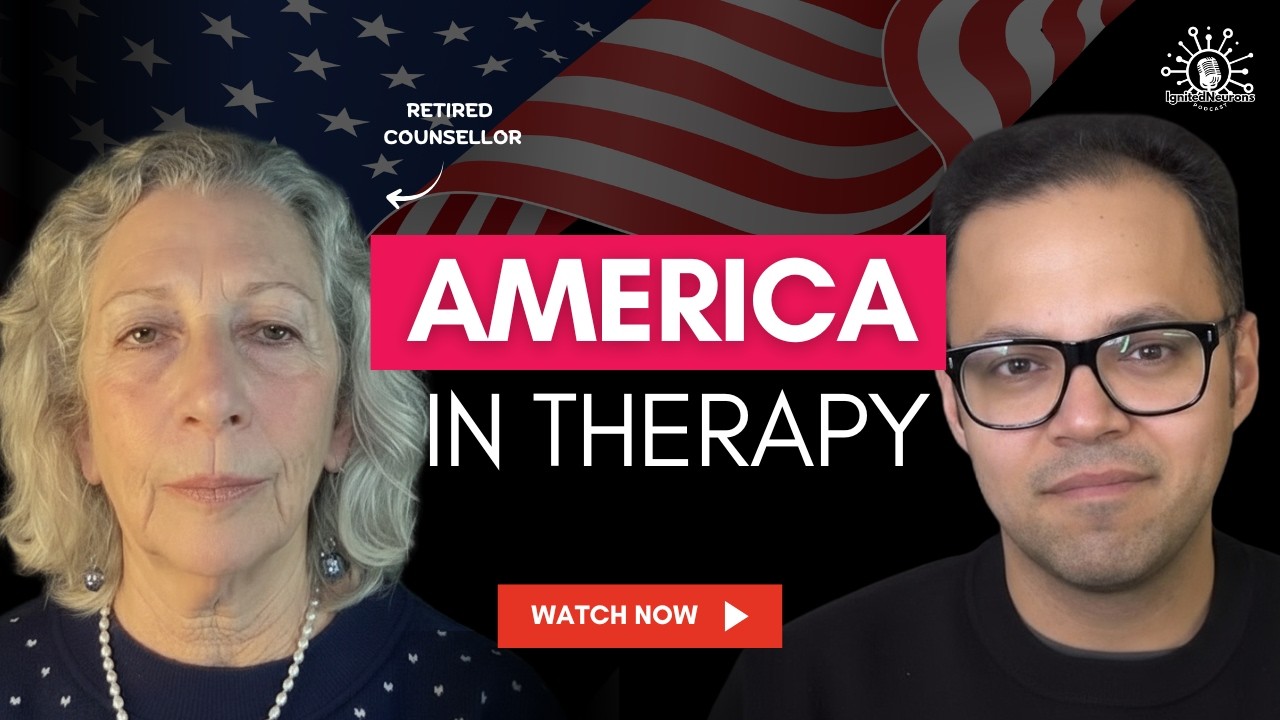
In this 50‑minute interview, host Utkarsh Narang talks with veteran psychotherapist and author Phyllis Levitt about the psychological underpinnings of America’s social and political turmoil. Levitt frames national division as a collective trauma issue, arguing that the country, like any individual, would benefit from therapy. She explores how early childhood safety (or lack thereof) shapes adult coping, the metaphor of "putting down weapons"—both literal and psychological—and how cultural domination, hyper‑competition, and unrealistic expectations create pervasive feelings of unsafety. Levitt describes the symptoms of unsafety, from overt violence to subtle judgment, and explains how unhealed personal wounds lead people to repeat harmful patterns. She outlines a two‑step healing process: first, confronting and healing one’s own trauma; second, using the newly gained capacity to act within one’s sphere of influence, no matter how small, to model healthier behavior. Central to her vision is the concept of "sovereign unity," a state where individuals honor their own paths while respecting others’, fostering collective mental health. Levitt highlights three core emotions—belonging, love, and the ability to tolerate distress—as foundational for personal and societal well‑being. She also discusses various healing avenues (psychotherapy, spiritual practice, nature, creativity) and stresses that mental health, not partisan ideology, is the root of violence and division. The conversation ends with a call to action: put down weapons, cultivate inner safety, practice fearless authenticity, and recognize that each person’s contribution, however modest, can tip the balance toward a healthier, more united world.
Chapters
When a nation feels divided, we often look at politics. But what if the real issue is psychological? She's a psychotherapist with over 3 decades of experience helping people heal trauma, reclaim belonging, and rediscover love. Her latest work asks a bold question: What if America went to therapy? Please welcome Phyllis Levitt.
The children in cages, the intolerance for, you know, our diversity. There's just so many things. That have caused so much pain and still do pain and suffering in our country today. And then the next thing you usually look for in a therapy process is, okay, tell me about your history. Nobody is native to America. We're all immigrants. Many, many, many of the people who came to America to begin with and over many hundreds of years were fleeing war. They were fleeing poverty. They were fleeing religious persecution. They were fleeing Discrimination. Some people came for adventure and riches and wanting to discover a new land, but many people brought massive unhealed trauma at a time in human history where we didn't talk about trauma.
My guest today, at 78, is fiercely alive. I have Phyllis, who's a psychotherapist, an author, and a truth teller. If you sit with us through this episode today, I'm sure that you'll have questions that you can ask yourself to go deeper into giving yourself hope, healing, and belief that we are not helpless. We are moving forward as a society, and a psychotherapist's insights and a view into her world will allow us to learn more about ours.
Thank you so much for having me here with you today.
Absolutely. Looking forward to this conversation. And we straightaway dive into the deep end, Phyllis, before, so that our listeners can really understand who's on the other side here. And so the first question we start with, Phyllis, is that if that 8-year-old little girl, Phyllis, wherever you were growing up, if that 8-year-old girl comes and meets you right now, what kind of a conversation, a dialogue will emerge between, between your current self and your 8-year-old self?
Yeah, I love that question. And I thought about it a little bit since you teed me up with that question. And what I, my, the first thing that came to my mind was that I would hold her. I would really want her to feel safe and I would want her to feel like she could say anything that she needed to say. But since my 8-year-old self didn't have a whole lot of language for her feelings or her perceptions, I think it would help her learn to identify her feelings and be able to speak them safely to someone who actually cared and listened. And I think that's where I would begin because when I grew up, that just really wasn't in the culture that I grew up in. Um, and I had to learn that later.
Being safe, um, that, that 8-year-old girl and, and, and I feel like as a child, You need less to feel safe compared to when you grow up. So how do you see the safety that you spoke about evolve for someone who, say, as listener has evolved from being an 8-year-old to now 18, or maybe 27, or maybe 34? How does humanity feel safe?
I think we have to put down our arms. You know, I think we have to put down our weapons, whether it's psychological weapons or emotional weapons or literal weapons. I think that's the first step. And you know, as both someone who's been a client and a therapist for many, many years, you know, you know, from sitting with people and really trying to help them heal the wounds that are fueling the most dysfunctional or unfulfilling parts of their lives in the present, that they have to leave their weapons at the door. And if they've been armored because that's how they defended themselves to survive, Then kind of have to dig underneath that and find out what it was they were trying to survive so that they can take a different stance in life. I mean, we have to become safe for each other really is the way I see it, whether it's in our individual families or workplaces or communities or nations and in our global community. And that's number one.
Put down the weapons. I like that thought. It seems really intuitive, right? That you would want to put down the thoughts. psychological or physical, but it feels in a world that's evolving too quickly for sometimes someone like me to really grasp what's happening. What makes it hard for us to put those boundaries?
Well, I think there's a number of things that contribute to that. So I don't know if I can say them all in, you know, in a short period of time, but I think we still live in a culture that believes in dominating other people and forcing other people to submit to our will, whether it's subtly and, you know, not so violently, or if it's really overtly through war and assault. And I think we believe that we have the right to do that. And as long as we don't see ourselves as equally worthy of the treatment that we ourselves want, which is we want to be safe, we want to be provided for, we don't want to be discriminated against, we don't want to be alienated or ostracized, as long as we don't see that that's Everyone's right. We're going to be in the position of not putting our weapons down because, um, because we've been taught that other people in some ways are our enemies rather than— and of course there are people out there that are dangerous. There's no question about it, but how do we stop that cycle? We have to help each other heal the things that have made us most defensive and most assaultive as a way to survive. So that's, that's one thing. I think another thing is that we live in a highly competitive culture worldwide. I think maybe some cultures more than others. And that's another aspect of domination and submission. I have to beat you at this game rather than literally, and I really believe this in the present time for humanity on this earth, we have the possibility of going extinct if we do not change that paradigm. That we're in it together and we have to learn how to work together.
I love both those points. One is, one speaks to a very inner nature of the human being that we want to dominate the other person. And so in that dominance, it's hard for us to put those weapons down. And the second thing you're speaking about is it's the society, it's the environment, it's the world that we live in, which is, which has taught us that it's a hypercompetitive world and someone needs to lose for me to win.
Right.
Right.
And all of therapy, really, if you think about psychotherapy, it's all based on a win-win paradigm. When a couple comes to therapy, for instance, or a family comes to therapy, you don't support one person to dominate the rest of the group or one partner to dominate their partner. You help them come to the table as equals and hear each other deeply and build empathy. and a desire to work things out for their mutual good. And you help people and this is not easy. It's much easier to fight. It's always easier to fight. Winning, winning, you know, I remember a teacher that I had in graduate school saying this, that no one wins the power struggle. And the reason why is even if you win the argument, you might lose the relationship. Wow.
That's really deep. And I know like My brain is poking me again and again to talk about your book, which is America in Therapy. I just love the title. It's, it's so deeply intriguing that I'd love to know more about that. If you were to look at how we operate and, and your vast experience, Phyllis, how does unsafety show itself? Because those symptoms might help someone to recognize that they are in a space right now where they— so let's go deeper into first understanding what does maybe unsafety feel like, and then move into how do we create a safety for our own selves individually. Like, what can I do to create safety for myself? And then what can I do for others? Does that sound like a good, uh, good—
I think there are many things that contribute to unsafety, and some of them are like harder to recognize, and some of them are very overt and can't miss them. Like, the overt things are physical violence or verbal violence or the threats of starvation or alienation or discrimination or jail or Assault or sexual assault, physical or sexual assault. Those are obviously things that make people feel unsafe, but there are other things that are less recognizable or they're more tolerated that make people feel unsafe. And that is unrealistic expectations, severe consequences for being a human being and having, you know, making mistakes, extreme judgment, you know, like you're only good if you do this and you're bad and you're a sinner or you're unworthy if you do that. And these things can be, you know, happen in homes where it's never actually said, but you know it. You know that you're only gonna get approval if you be quiet and you don't make waves and you don't express too many needs. That kind of thing leads to a lack of safety. One of the things that I do, and again, there may be many that you might add that I've missed, but one of the things that I have learned personally, both As, you know, a human being myself and as a therapist of many years is that one of the deepest sources of safety is actually trusting your inner knowing. We really do have a sense of what's going on around us. We can pick up the vibrations of other people that are often different from what they're saying. Somebody might be saying, I hear you, but nothing in their body language or their vibration or their emotional communication to you is communicating that they hear you. And many of us, including myself, have been taught to believe the words we hear rather than our own inner sense of what's actually happening. And many people are punished or ignored or alienated for listening to their own intuitive sense of what's right and wrong or what's happening until it becomes dangerous for them. To speak up or actually just trust themselves and navigate their lives that way. And we've become, I think, a society in many ways, and of course this is not true for all people and it's not true for all people everywhere, but I think there's a huge part of our cultural systems, operating systems, that requires people to deny their own instincts and follow what they're told. And that's very, that's very dangerous. It's also very damaging.
As I'm listening to you, and I know the external forms, the violence, the alienation, the assault, and the discrimination, that's something maybe right now is out of our purview of this conversation. But these deeper inner shifts that you spoke about, the unrealistic expectations, the extreme judgment, the mistakes being penalized, I see that. happening in the corporate world all the time. I see that happening in families between parents and kids and sometimes siblings and society. Like, what makes you do this and why are you doing this and what's wrong with you? And these are, these are very subtle statements that we are so used to using in our communication that we don't even realize that how it can make someone feel so unsafe.
Right. And I wanted to just add one other thing that I think is really important is that when When children, let's just take children for example, but this could also apply to adults for sure. Let me just say people, when people are not treated well, when they are judged, when they are discriminated against, when they're unfairly criticized or penalized or overtly hurt by other people, they become symptomatic. There's no way that we don't become symptomatic, even if all our symptoms are kind of hidden and turned on ourselves. And then what happens in an unhealthy family or an unhealthy culture or society is that then we blame each other for our symptoms instead of saying those symptoms are a call for help. Just like when the body has pain, it's a call for help. Something's wrong that needs to be treated, not punished. And, but when it comes to our emotional and mental wellbeing and our behavior, We tend to punish and judge rather than say, that person who is being a bully is suffering somewhere. They need to be stopped, but they also need to be helped.
Seems such a fine balance. And as you were speaking about this, what I was also thinking was there's this, the world wants people to innovate and think outside the box, but they want them to conform to the rules and then make sure that you're on the path, not, not too much of a rebel. So, so this, this dichotomy that also leads to unsafety is what I'm, what I'm thinking right now.
Yeah. And you know, one way that I look at that is that the push for conformity, there's a certain need for that. You know, we all have to know that you have to stop at a red light, right? Otherwise you're going to have a car accident. So there is a need for a certain amount of conformity just for safety, just for survival, just for thrival even. But I think what happens is that the push for conformity often is it becomes extreme and it denies individuality. And then the pushback is, I'm gonna assert myself no matter what you say. And so then you have rebellion and that can be healthy, but it can also be dangerous. And as we see from the world scene and in America and in families that when there's, you know, really oppressive urge to conform and make people do life a certain way, and then someone rebels and asserts their individuality, it just Often creates war in the family. And we have the same thing going on in the world. And one of the things that I've learned from being a therapist and applying, because that's what my book America in Therapy is about, applying what I've learned as a therapist to the world situation, specifically America, because I live here, is that we have to find a balance between honoring our individuality But that means honoring everyone's individuality and working together for the good of the whole. And that, I learned a word for that, which I find very powerful. And that is called sovereign unity, which means we're sovereign and we're united. And that takes a high level of mental and emotional health to actually even want that, let alone try to embody it. And of course we embody it imperfectly.
Yeah.
in our lives. But to me, that is one of the places where our focus on our mental health really is the answer to so much of what we're suffering from, from violence and divisiveness and injustice and discrimination.
I love that term and the phrasing. Thank you for sharing that. But I also feel that before the world, America or any other country or the world as a whole or society moves into this state of sovereign unity and understanding, I think it needs to start from ourselves. And so if we were to turn that lens towards our own inward and our own selves, how do we, if someone's listening to us right now and they feel, oh, what Phyllis and Utkarsh are talking about makes sense. And I've felt unsafe in my toxic work culture, in my family, in how I speak to my spouse, in how my friends make fun of me. And I felt unsafe even though I Let it go in humor or in spirit, or that's how it is. How do we help them build this inner safety?
Well, I think there's 2 things that are really important and please feel free to add. But the first thing is often, and this is often what I have dealt with in my own life and with, you know, hundreds of clients, is that we tend to be attracted to what we know. So if it wasn't safe in your home, And you came up with the best, you know, way to survive that you could. It might've been to withdraw. It might've been to become aggressive. It might've been to become a people pleaser. It might've been to start drinking a lot and numbing your pain out. Whatever it is, we tend to take those coping mechanisms with us into our adulthood. And so we continue the pattern of unsafety and often unconsciously attract ourselves to people who will do to us or engage with us the way that we learned growing up. Because, you know, you, you know, you hear this story a lot, someone who was really abused as a child and they end up with an abusive partner and you think, well, wouldn't you go away from that because you already know it hurts? But that's not how our psyches work. Unconsciously, we keep being attracted as moths to a flame, trying to get love and safety and belonging from the people who are like the people who hurt us in the first place. So the first step is to really go back and heal some of our own wounds so that we begin to feel a choice in not only who we're attracted to and what we engage in, but a choice over our own responses. If someone in your family or your workplace, um, or your school or your church or wherever, um, doesn't treat you well, can you find your voice and stand up for yourself? Or do you just blame yourself as you might have done as a child? Can you seek safety somewhere else? Can you look for safe people? Can you get out of the web, perhaps, which many people fall into, of self-blame? Well, if I get treated this way, there must be something wrong with me and I must have deserved it. So I think the first step is to begin to heal our own wounds. And of course, on a societal level, I'm a big advocate, but that's what we commit ourselves to. Which is helping each other heal rather than building more bombs. I mean, really, it's that simple and that complicated, right? So I think that's the first step. And then what I see is that very naturally when people do have that opportunity to heal, they do develop different coping mechanisms and they make different choices and they learn different strategies. And then they're in a position to offer something else to the people around them. Whether it's on the level of just being a better parent or a better partner, or, um, you know, a more affirming and supportive boss in an office or coworker, or less discriminatory in their attitudes, in their culture, whatever it is. So it's a combination of healing our own wounds and then bringing that to other people. But what I see is that it happens naturally.
And I think like, and correct me if I'm wrong, I think therapy or exposing yourself to the right kind of content or coaching or investing in your own self is a path which maybe expedites the healing process. Would that be fair to say?
I think so. I think there are many paths to healing. I happen to have been a psychotherapist, so I think it's a really good one. I think there are some spiritual paths that can bring a person to healing. I think that a deep connection to nature and a love of animals, or just pursuing your creativity can also be healing. But for me, in my experience, for people who have really been wounded by other people, many of those other things are not complete in the way they help us heal. They may help us cope, but the actual wound doesn't necessarily get addressed. And so I think psychotherapy is one of the really good ways to actually get to the heart of what needs to be healed.
I love that. Thank you for sharing that. I was talking to A coachee of mine, and in that conversation, somewhere they spoke that as a young adult, they had written, they had read this statement that being the victim allows you to stay powerful or something like that. Something which almost amplified and celebrated being a victim. And so in every relationship that they had, they were putting themselves in that state and saying that, oh, I am the victim and that's great. And they were almost celebrating themselves being the victim. And through our conversations, when I was helping them get to their values and things, they figured out that it was not serving them. That belief was not serving them. And so they moved it into a more empowered belief. And I feel, I feel it's the story that we tell ourselves that sometimes needs to change.
Yeah. You know, it's interesting because we have a lot of, a lot of things that people say today about victimization. And, you know, one of them is, I think goes along with what you're saying, it's like, well, don't play the victim. You know, that's That's a role you're playing. My feeling about that is this. Anyone, or I don't, you know, I can't speak for all people cuz there's no one size fits all, but often people who see themselves as victims and see themselves just as in that role were victims. The actual victimization needs to be addressed because I don't believe in anyone's true heart and soul that they actually want to be a victim. We want to be powerful in our own lives. We want to be advocates. We want to be creative. We want to be healthfully related to one another. I don't think anybody actually wants to be a victim. I think if someone is really identified with that role, they haven't been helped to deal with the real victimization that underlies it and see a more healthy and productive and fulfilling way of life. That would be my response.
I love that, that we all want to be more creative, more powerful, more curious, more everything, more everything. I love that statement. As we move forward, I want to come to your book because you've spoken about this idea of what we were just speaking about. In your book, you say that you see America in therapy. And if America were to walk into your therapy room today, what would be the first thing, Phyllis, that you would notice?
Well, you know, I start my book that way. So I kind of personified America as the Statue of Liberty, and I have the Statue of Liberty come into my office and talk to her. Um, and I start where I would start with a person, which is what brings you here? You know, what is the pain? 'Cause it's usually pain. I would say it's probably 100% pain that brings people to therapy in the first place. Something really isn't working and it hurts bad enough that you're willing to ask for help. And so what brings you here? And when I talked to America in, in the form of the Statue of Liberty, it was like all the divisiveness, all the hatred, all the violence, the children in cages, the intolerance for our diversity. There's just so many things that have caused so much pain and still do pain and suffering in our country today. And then the next thing you usually look for in a therapy process is, okay, tell me about your history. How did you grow up? What happened? What was your conditioning? What did you learn to believe? What behaviors were acceptable? And so for America, we look at our history, we look at our past. Who are we? We're people. We weren't the natives here for the most part, except for the Native Americans. Nobody is native to America. We're all immigrants. Many, many, many of the people who came to America to begin with and over many hundreds of years were fleeing war. They were fleeing poverty. They were fleeing religious persecution. They were fleeing discrimination. Some people came for adventure and riches and, you know, wanting to discover a new land. Many people brought massive unhealed trauma. At a time in human history where we didn't talk about trauma. We just talked about you pull yourself up by your bootstrap and you make it work. And so we have generations of unhealed trauma that are informing us today. And then we look at, we look at our strengths and we look at our deficits. This is all part of therapy. Many of the people here who came here were incredible survivors and inventors, and they devised ways of agriculture and science and medicine and art and technology. We're incredible human beings, but we also slaughtered hundreds of thousands of people. We made Black people slaves. We discriminated against women and the disabled. We've, we've all, I think we've always had religious conflict. So that's part of our conditioning too. So we, we look at our strengths and we build on them, but then we look at our own wounding and the wounds that we have perpetrated ourselves. And that's the beginning. And that's how I start my book. And that's how we start therapy.
That's, that's so powerful. I'm almost like imagining the picture of Statue of Liberty and I've been there at the statue and it's such a beautiful piece of art that, that I'm getting goosebumps as I'm thinking about that.
Oh, you said that.
It's unreal. And, and I'm also thinking about the great forefathers of the country, right? Because I've heard and listened and read about a little bit of the history and I'm not an expert here, but the Lincolns and the Washingtons and the MLKs and all the leaders who've brought America from where it was to where it is, to the dream, to everything. So where did America go wrong? Because right now it's, and correct me if I'm wrong, right now America is not yet the, not yet fully in its glory the way it was, say, a few decades ago. Would that be right?
Agree with you. For sure. I think we're in a decline. And I think, you know, the focus of my book was that we are being conditioned to believe that it's a partisan ideological issue that's dividing us and causing all this violence and hatred and discrimination and all of the pain that we're suffering here. When I believe that at its heart, it's a mental health issue. It's not a partisan issue. Mentally healthy people Don't kill each other. They don't wanna wage war. They wanna get out of war. Mentally healthy people actually thrive on love and safety and a sense of belonging and cooperation. And mentally healthy people, and again, none of us is perfect at any of this. I'm certainly not. But mentally healthy people have a commitment to resolve conflict without violence. And with the goal of coming back together in some kind of relationship. And when they really can't do that, they're willing to leave each other alone in peace. And we just don't see this kind of mental, um, health being promulgated in our society or role modeled in our society. And so just like in an abusive family, if you have the role models of the parents are screaming and yelling and hitting, and molesting and kicking people out of the house or starving their children, you're going to have a really unhealthy family and you're going to have people who then grow up and reenact some of the same drama in the world that they live in as adults. And that's exactly what we're seeing in the United States. And I think around the world in many countries.
And so let's maybe like the nuggets that you just shared because it's happening across the world. It's, it's not. just America, but it's happening all over the world. And I'm hearing you say that the challenge with people not focusing on your mental health and also the leaders that we have across the world right now are maybe not leading us into the bright future that we are wanting. And there's somewhere there, there's a flaw, and we are not experts in geopolitics to solve that problem today. Because then what it makes me feel, Phyllis, is that this downward spiral is gonna continue and it's gonna get worse because The current generation is facing a different kind of trauma, which is then gonna get passed down to the next generation. And, and it does.
Well, you know, I would say that's why I wrote my book. And I think there are other people who are trying to shift our understanding of the paradigms that we need to operate on. So if we take, you know, a physical medical kind of model, once it was discovered, for instance, that the source of a Plague was contaminated water supply. Before that, nobody knew where the plague was coming from, right? So they kept drinking contaminated water and contaminating the water because they didn't know what they were doing. Once it was discovered, then they knew how to stop the plague by starting to clean up the water supply, purifying it, whatever was done. Okay, right now I think we're at a place where we actually don't all know. What's creating this plague of violence and discrimination and the belief in war. And I would say an addiction to power, an addiction to power over other people. And I think it's a psychological issue. And so my book is designed to like point that out. This is the contamination in the human relationship water that we're swimming in, and it can be healed. Because we know that in our own offices, we know that from our own healing journeys that many, many, many people have made and are really trying to talk about on the world scene. But one of the difficulties that we face is that what we're talking about is not profitable in the way that power over is. And I think we have to come to terms with that as one of many things. But you also know that addictions are hard to give up. Addiction to drugs is hard to give up. Addiction to sex, addiction to money, addiction to power, addiction to righteousness. And we have all of these at play.
It's just fascinating because I'm now stepping into the shoes of the listener who's listening to both of us and is feeling that sense of helplessness, is feeling that sense of the violence around us, the division, the, the news about wars, the news about whatever's happening across the world. And, and I feel that we also want to feed on that news because that news, as you're saying, is profitable. And so there's not enough positive news that gets percolated into the world. So how do we, how do we tap out? How do we say it's timeout? Let me, let me get out of that.
Well, this is what I would say. I would say that the feelings of helplessness that a lot of people are feeling are real. I think many of people, most of us are helpless against the powers that be. I think it's a fact. I can't go change What Congress votes on. I can't change our president's mind. I can't stop ICE. I can't stop, you know, other countries from bombing each other and killing children. I can't stop that. So I think it's real. And I think when people come to therapy, there's a place for actually realizing and just embracing, this is what I'm up against. And I do feel helpless and powerless over it. But the next step is, okay, then in my sphere of influence, in my life as I live it with the people around me, the places I work, those I have some influence over, and it may be one person or it could be 500 people, or it could be 10,000 people. What can I do? And the focus is on that and to not give up. You know, really my sphere of influence might be 50 people.
Or 10.
But who do I wanna be in that sphere of influence? Because we really don't know. And of course, this is again something I think, I think the powers that be would like people to feel helpless and hopeless because then they're more manageable, they're more controllable, they're more influenceable. So in our own healing journey, that's part of what happens. You know, I've had many, many people that, and I would say rage is one of the symptoms of helplessness and powerlessness. So it's not just sinking and collapsing and becoming passive. It might be rage, but that's also a symptom of feeling helpless. Rage is the way to counteract that feeling of helplessness or powerlessness. And what I've always said to people is that the only antidote is to find your appropriate power and look for that and find people who support that and support that in others, support the people who are feeding the hungry, who are cleaning up the water, who are running for office, who actually want to use our resources to benefit families and children and communities. Whatever your sphere of influence is, that's where your power lies. And don't give up because, because if you make a difference with what you have to contribute and I do, and we support other people to do that, Somewhere along the line, I believe there can be a tipping point. It might be that you're a teacher and you're committed to really helping every student shine and find their ability and their intelligence and their creativity. But it also might just be that you walk into a store and you're friendly to the people that you're standing in line with. It can be anything. Those are all expressions of appropriate power, whether you have political influence Or you're a stay-at-home mom and the most people that you influence are your children. All goes into the same well of making a contribution and no contribution is too small.
The eternal optimist in me always looks for these statements of hope because what you've just said, I want to kind of stay with it for a few seconds. I often say that, and I don't know if I read somewhere or that came through like some conversation. But the antidote to anxiety is action. And today you've second statement, which is the antidote to the helplessness and the hopelessness that sometimes creeps in is to find your appropriate power. And you could be an at-home mom taking care of 2 children. You could be a single parent. You could be the CEO. You could be the frontman who's opening the door every day for the staff at work or in a building, or just someone who's making coffee at a cafe. Whoever you are, you can find your power. And that power could be the power of love, healing, joy, education. That gives me hope. That gives me hope.
Because I think a lot of people really, in their feelings of powerlessness, feel like what they do doesn't matter. And that only adds to the feeling of hopelessness and powerlessness. And So we have to help each other know that what we do really does matter. When somebody greets me with a big smile, it changes my day. We have to know that.
Love that. I love that. As we're going down this path and the universe streams these new ideas, what was also on my mind was that, and I was talking to someone who's an emotional intelligence expert a few weeks ago, and, and, and they were saying that the most number of emotions that human beings adults understand is about somewhere between the range of 5 to 12, or maybe maximum goes to 14. Whereas the emotions that we feel as human beings is in the list of like hundreds and thousands, maybe almost. If you could give 3 emotions that you feel through your experience of decades, if adults can start to work upon and embrace those 3 emotions, what would they be and what would they do for humanity?
This is, if this is an emotion, so you can correct me or stop me. But the first thing that came to my mind is we really aren't alone here. And so this sense of belonging that we're part of the human race, we're part of a family, we're part of a community, we're part of a country, we're part of a gender, we're part of, you know, artists or doctors or scientists, that we are really A part of, because I know in America this whole, and I don't know what it's like exactly in other countries, but in America, this whole belief in our individualism and we don't need anybody, even though we, we know we do, but there's denial of that need. But that feeling of belong, and I want to build on that belonging and I wanna create that for other people. So that's maybe not a feeling, but I just had to say that. But the other feelings that I guess I would say are love, you know, love. It was interesting when I was writing my book, 'cause you know, I did a bunch of research when I wrote my book and I wrote a whole chapter on love. One of the things that I talk a little bit about is that even scientifically it is known, and I don't know the science here, but it is scientifically known that we come into this world wired for love and belonging. That is who we are as human beings. And what I have discovered is that all of our wounds, no matter what they are, no matter how they came to us, can be traced back to some injury to love and safe belonging. All of them. And I've never worked with anyone who that wasn't true for, no matter how different their stories are. And so to really find what you love, even if love doesn't feel safe, maybe you don't feel like you can reach out to a lot of people. Love an animal, love your plants, love art, love music, love nature. Find some way that you connect to that in yourself and it will grow and it will get expressed. Um, and the other thing that I guess I would say is, uh, and you know, you could add like 500 things to this list, but the other one that comes to my mind is that what I really feel like we desperately need as human beings, and we really need this in the U.S. Is we will need to learn how to tolerate our distress without acting it out. And that's huge. Really like being able to be with your distress and finding your center and healing whatever wound might be, you know, helping it accelerate so that you can tolerate the distress and not act it out on yourself or other people to the best of our ability. And again, nobody does this perfectly, but then When you learn that some of these things, then you can even tolerate being, oh my God, I screwed up here. You know, I had a really harsh tone in my voice. I didn't say what I meant. I said something that really wasn't very kind or whatever I did. And I can tolerate the distress of that self-reflection and commit to doing it differently.
Yeah. I love these 3 emotions, belonging, love, and this tolerance that you spoke about. And I think What you said there, that we all crave love, we all crave belonging. And I don't think there is, there is a human being on whatever spectrum they are or whatever part of the spectrum they are who can say that they don't seek belonging, they don't seek love. They might not appreciate or perceive it in the right way right now, but they still crave for it.
It's in there. It might be buried, but it's in there because there's no baby that comes into this world that is in desperate need of love and belonging. That's survival. That is actually survival. And somehow we've lost touch with that. We think our defenses and our brilliance and our wealth and our power are what survival is about. And ultimately it's not.
Yeah. As I'm talking to you and as we come towards the end of our conversation today, I'm seeing you and I'm about 40 years right now. So I'm 38 years away, but as I imagine my own future, Phyllis, I feel that at 80 years old, I want to be as energized, as purposeful as you are right now. And so beautiful it is to watch this. What's the, what's the, the, the, the woman stay inspired about doing all the beautiful work that you are doing right now?
You know, I think the thing that helped me the most, I think I kind of touched on this earlier because it was part of my journey, was to really learn to trust myself. And to tune in to who I am, not who I was expected to be, not what society might be saying, but who am I? And, you know, I would love to see a world in which children are encouraged to find that connection to who they are and pursue their loves and their, their bents and their talents, because so many people grow up in a world where that's not even allowed or considered to be something that's important. So for me it was, and I don't know why I was born this way, I just was born this way that I was always in pursuit of that connection to who I truly am. And I had a sense as a young child, well, not, not so much as a child, but maybe as a very early adolescent, that there was something buried inside of me and I was trying to uncover it. And I had some trauma in my early life that helped bury it. Which I think many, many people do. When you try to survive trauma, you bury not only the pain of the trauma, but you bury some of your own natural resources. And I just was always on a quest to uncover what that was. Went in a spiritual direction and I went in a psychological direction. And today, for me, those 2 things are just, they're one and the same. True healing, I think, is also spiritual as well as psychological. So I would say, you know, really go into a deep inquiry of who you are and love that. And because we're, I'm not, I'm not a scientist, you know, I'm, that's not gonna be my contribution. I'm not a politician. That's not gonna be my contribution. What is my contribution? It was, it was really in the realm of spiritual growth and psychological development. And yours might be completely different and yours doesn't have to be mine. And that's where the place of, I think, foundling unity really comes in. Can I honor what your contribution is, what your path is, and can you honor mine, even if they're completely different, as long as we're not harming each other?
This conversation's filling my soul. So, so thankful. Aw. As we get to the end of our conversation and the final question comes up, I know it's It's just 2 years from now that you'll be— I've had conversations with people who have been between 16 to my speaker coach who I had a conversation with. He was 81 when we recorded this. So I had to rephrase the question. But if the 80-year-old self, Phyllis, from 2 years from now comes to you right now and gives you one piece of advice on how you should be leading the rest of your years on this planet, what would—
I think what Phyllis would say is be more fearless in being your true self, in sharing your message, in sharing what you feel is of value to others. Just be fearless. Don't worry so much about the response of other people. Don't take it to heart if they don't resonate with your message. Listen for appropriate feedback always, because that's just been a part of my life, but really be more fearless. This is your life. This is what you have to live. And you're not gonna regret it on the day that you die if you gave it your all.
Thank you, Phyllis, for that powerful conversation. To everyone who's listening to us 50 minutes into the conversation, we listened to the 80-year-old Phyllis. So be fearless and live life in a way that you don't regret when that last moment on this planet comes for you. If you can, go ahead and do a deep inquiry of who you are and who you are supposed to be on this planet, not what others want you to be, but who you truly are. If there are 3 emotions that you can inculcate in yourself, in people around you, in your children, in your partner, in your, in your circle of influence, they are belonging, love, and tolerance. And remember, the only antidote to the current helplessness that you might on some days feel is finding your own appropriate power. And that's gonna shift what you do and the impact that you have on this world. There is a lot of generational trauma that goes Through all of us. It is we who need to put a stop at what's happening and not let that go to the next generations. And to America and to every other country, you all need to be in therapy because there's a lot of unresolved conversations that are left undone and they are now impacting the current generation and they're taking the lives of souls who had a long, beautiful life on this planet. And we owe it to them. We owe it to them. And if there's one thought that you can take away from our conversation today, that is to have Sovereign unity, which is that I'll have my own path and you have yours. I'll respect yours and you respect mine. And we don't have to hurt each other because we are here together, united. There's only one planet. There's no planet B right now. Maybe Elon Musk or someone will discover that planet B, but we, we cannot rely on them right now. There's just one. And always remember that when there's a power struggle between you and your loved ones, or people that you admire, or people that are in your influence or circle, In that power struggle, no one wins. If you win the argument, you lose the relationship. And finally, it's time to put down our weapons— physical, psychological, and every kind. It's time that we put those weapons down. And to that 8-year-old Phyllis who started this conversation, just hold yourself. Just make yourself feel safe because safety is something that we all crave for. So do that. Maybe after listening to this episode, just take a moment with yourself because there's a little kid, 5 years old, 8-year-old, still growing up within you. Just embrace that little kid. Feel safe for yourself, to yourself, and others around you. Phyllis, thank you for that soulful conversation. Any last thoughts before we close?
Really, I loved every minute of it. And I really want to thank you, especially for such an amazing summary of the high points of what we talked about. So just thank you for what you're doing, because this is a really good example. Every one of us matters. You matter. The people that you reach matter. And we don't even necessarily know the ripple effect of what we do.
Yeah. Love that. Love that. To everyone who's listening to this podcast on a podcast platform, or you're on YouTube, do not share it with anyone because not everyone's ready for this kind of wisdom, this kind of conversation. But if you feel that there is someone in your network who would value this, who would be ready to put down their weapons, who would be ready to feel safe, would be ready to go deep within who they are, then absolutely share the link. Because if you don't, then you're doing a disservice to yourself, to them, To the podcast, a piece to the algorithms, share it with others when you feel like that. And then, then comment on this YouTube video if you're here, on your podcast platform, because we wanna hear from you and we wanna see what's resonating and what can we bring more of. This is Utkarsh and Phillis signing off.
More from Utkarsh

You Left Yourself Behind | The 7 Questions That Help You Find Yourself Again | Michelle Chappel




Are You Trapped in a Life You Didn't Choose? | Dr. Michelle Chappel | The IgnitedNeurons Podcast

Financial Freedom Doesn't Make You Free | Tim Kelly | The IgnitedNeurons Podcast


Your relationship might be missing this! #shorts #ytshorts #shortvideo #shortsfeed

The Truth About Financial Freedom Nobody Talks About | Tim Kelly | The IgnitedNeurons Podcast

The Question We Ask When Life Hurts #shorts #youtubeshorts #shortvideo #shortsfeed #shortsviral

How to Keep Going When Life Changes Everything | Kenneth James Kunken | The IgnitedNeurons Podcast