The Psychology of Self Sabotage | Why You Keep Getting in Your Own Way | Kelli Russell
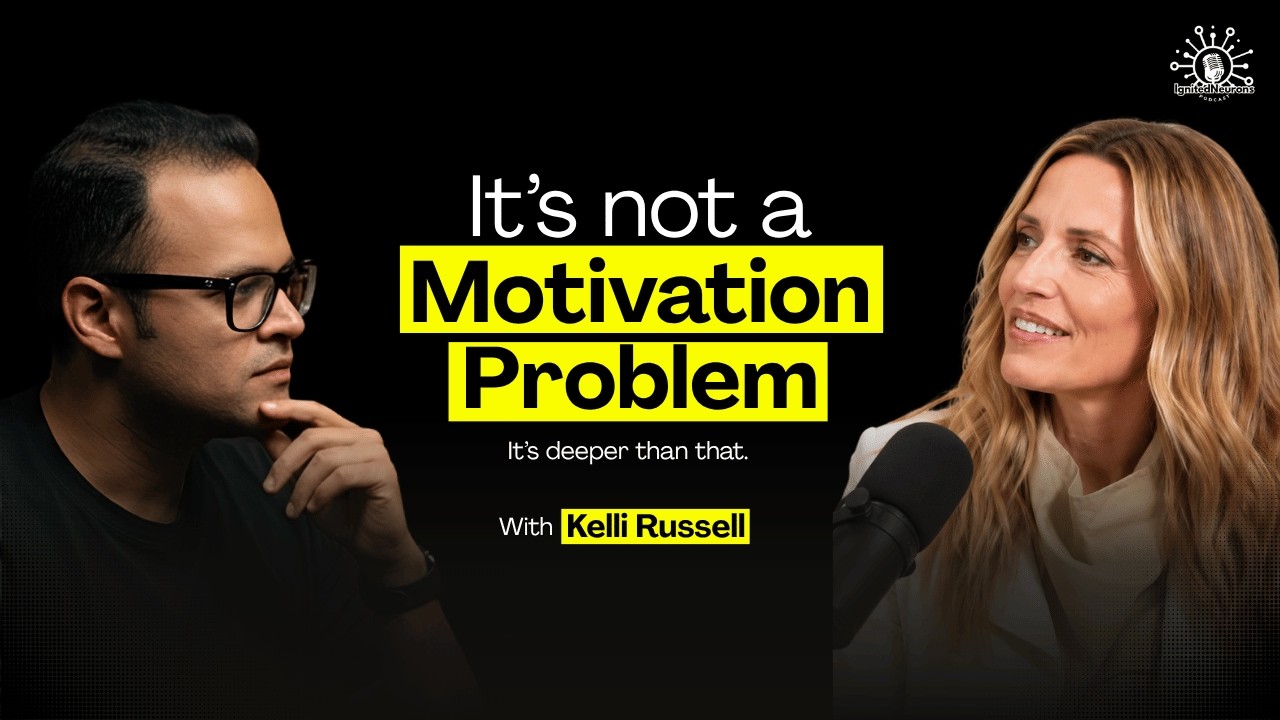
In this 45‑minute podcast, host Utkarsh Narang interviews transformational coach Kelli Russell about why people repeatedly get in their own way. They explore how the subconscious mind governs 95% of behavior, creating invisible forces such as fear, feelings of unworthiness, and a victim mindset that manifest as self‑sabotage. Russell shares personal stories—from a cruel third‑grade teacher to a pivotal hike in Colorado where she realized she didn’t have to do what she hated to get what she wanted—and explains how those experiences shaped her work. The conversation delves into her core methodology: neurosomatic reprogramming that combines muscle‑testing (applied kinesiology), breath‑balancing, and whole‑brain integration to align the body’s cells with new beliefs. Practical tools are presented, including a daily gratitude‑and‑let‑go journal, “if‑then” action planning, and a non‑negotiable “why” statement. They also discuss the role of optimism, humor, and creative visualization in overcoming fear of failure. The episode concludes with a live guided meditation and breathwork sequence designed to shift listeners into a balanced, heightened state, followed by a mind‑movie exercise that helps participants envision and embody a desired future self. Throughout, Russell emphasizes that change requires both conscious choice and subconscious rewiring, encouraging listeners to move from victimhood to creatorship.
Chapters
You don't have to do what you hate to get what you want.
90 days of telling yourself you're worthy, and the nervous system thinks, no, you're not. Half an hour of affirmations, 5 days a week, 90 days straight. I am smart. I am worthy. I am beautiful.
With each one of them, it tested weak, which means her body does not believe her when she says it.
But if every cell of your body does not believe in the affirmations that you repeat, Then repeating those affirmations is a waste of time.
We're in our subconscious mind for 95% of the time, and there are different things running the show than we're aware of.
25 years in psychology, counseling, and subconscious programming. But the line that changed her life landed in the middle of nowhere during a hike in Colorado, just past the dandelions. And within 24 hours of listening to that, she quit her job.
Have more fun. Everything doesn't have to be so serious.
We end the podcast today with a guided visualization and meditation breathing practice. And so today you'll not just listen to it, but you'll actually experience it live and have it affect your own life right now. Let's dive into it and see what meditation and breathing can do for each one of us.
I find 2 things almost always, like 98% of the time, is feeling unlovable or Before we dive into the podcast, there's one humble request.
Every week when my team brings me the data, I see that 84% of you are not subscribed to the channel. I truly appreciate you for being here, and it means the world to me that you're listening to our conversations, but it'd be amazing if you can click on that subscribe button. What it'll help us do is to bring better and bigger guests for you as you and us, we continue to live, lead, and build our lives. It takes a lot of blood, sweat, tears as a small podcast to bring these to you, but it gives us immense joy. And so we plan to continue forever. So click that subscribe button and it tells us that you're here. Thank you. What are those invisible forces that stop human beings from being who they can be? And that's the crux of our conversation today. Kelly, welcome to the conversation.
Thank you for having me. I'm excited to be here.
Such a pleasure. And the first question, Kelly, let's go deep into the deep side of the pool. Why do you think humans keep coming in their own way?
Why are they in their own way? I don't think they mean to be. I think it's probably because we are unconscious. We're in our subconscious mind for 95% of the time, and there are different things running the show than we're aware of. And once we become awake and aware, That's when we have the opportunity to create a change through choice. We become the creator of our life rather than feeling like we're just being swept along, or for some, the victim of their life.
Such a powerful start. And there's so many words that I'm going to hang on to for the rest of our conversation. Awake and aware, change through choice, and not be victim and be empowered instead. Let's go to that 8-year-old Kelly. If that little girl Kelly, that 8-year-old, wherever you were growing up, if that Kelly comes and meets you right now, what kind of conversation will emerge between the two of you?
I think about how, okay, age 8, I was in 3rd grade and I asked myself, what stands out to me about 3rd grade? And the biggest event for me that stands out is I had a teacher who was very cruel. And in all of my schooling in my entire life, all through grad school and everything, she's the only one I remember being that way. And it wasn't even necessarily that she was cruel to me. I witnessed her being cruel to others. She would call out their faults and put them on the board and minimize children and make them feel small and hurt their feelings. And I was a very sensitive little girl and it hurt me. And then I went to my mother and I said, I don't like this teacher. She's so mean. And my mother said, well, let's do what we can to get you out of that class and into another class. So we went to the school and spoke to the principal and requested it. And they were taking it into account, but it took some time, like several weeks in order to be able to send me into the next class. In the meanwhile, the teacher knew that I requested to be out of her class. So making it, I don't know, it made it much more, less, more friction and much more uncomfortable, her knowing that I didn't want to be there. And I think thinking back, I was just like a really sensitive little girl. And I also remember too, when we would have PE and there was baseball. When the kid was up to bat, the other children would say, you suck, you're horrible, you didn't get the ball, boo. And I would sneak to the back of the line because I didn't even want to take the swing and accidentally miss and have people yell at me and tell me that I'm bad. So when nobody was looking, I would just sneak to the back of the line. That's what stands out to me about that age. But I remember— being a sweet little girl and very kind and thoughtful and sensitive, like a really sensitive sweetheart.
That's so powerful because what you were just sharing about that teacher or about the experience of people around us, even at that young 8-year-old, I mean, how can you be horrible at something at 8 years old? I just don't, like, my brain does not wrap around that. But that's where these invisible forces start, right, Kelly? Because they're then going to stay with you for a very, very long time.
Yes.
How did you overcome those feelings?
I was just gonna say, I'm lucky I had a mother who listened and honored my perspective and went to bat for me instead of saying, oh, you're being ridiculous, don't worry about that. She said, I'll go to the school and stand up for you. So that felt good. I also watched my parents go through a lot of changes in my life. Like at that time, my dad was very angry. He would yell at my mom and tell her things that were not very nice about herself. And that really hurt me as well. But later in life, he changed and I was able to see that people can change and adopt a whole new way of being. And that was very inspiring.
Yeah, I'm just, uh, I'm taking a moment to soak that in because I, I have 2 boys who are 15 and 12, and I'm just imagining them and the conversations I have with them while I'm dropping them to school, where they'll say, oh, this teacher, they're very mean. I don't want to be there in that class. And how I'm approaching that and how that would impact them. And one day, maybe on a podcast, they'll be talking about these moments with someone else. It's just fascinating where my mind just went for a second.
It's true. Yeah. The ways that we handle situations impact us and some things that we don't think are very important end up being pivotal moments in a person's life.
Yeah, absolutely. Yeah. You spoke about your dad going through a change. Let's generalize it. Let's like zoom out from that experience and then what the work that you do now, what comes in the way of change for people? And I know we started with that, so let's go deeper in that because there might be a listener right now who's wanting to change something about their lives, whether that's on the outside or the inside, but they feel this strong resistance that stops them from changing. What are those symptoms of that resistance according to you?
I ask more questions and become a detective. So sometimes people feel held back by their boss, the world itself, the political spectrum, um, by limitations. And that would be more of the victim mindset. Sometimes people feel there's an invisible force field that's right in front of the thing they want, and they can see it so clearly, but they feel like there's just something right there in their way that if they can only get over that or through that, everything they want in their life is right there and present. I love working there. That's very powerful. Often what that thing is, is a fear of putting themselves out there, a fear of looking foolish, a fear of failure, which what I know is every successful person has multiple failures and must embrace failure in order to do well. So that's something I help people understand. And sometimes when we get to the root of what is really going on, if I go, what's under that? What's under that? What's under that? What's under that? I find 2 things almost always, like 98% of the time it's feeling unlovable or unworthy. And once we can build up from there, so many things become possible. They're willing to take more risks. They're willing to extend themselves and to be willing to risk looking foolish because the love is coming from the inside rather than external validation.
In about 45 seconds, you've given us the whole overarching theme, right? But it's still easier said than done because We all understand that failure is necessary. We've heard the J.K. Rowlings, we've heard the Satya Nadellas, we've heard the Gary Vees and all of them in the world, right? And there's enough content that's telling us that you'll have to fail, you'll have to look foolish, and— but it's really hard still. So where does one begin?
That's why I do the work that I do, because there's something called subconscious reprogramming, neurosomatic reprogramming, Where we can get a different state in the body. So sometimes I used to do this all the time, and now it's just part of my work, but there's something called muscle testing, applied kinesiology, where you can test a person's muscle response to a belief and check to see if their body actually believes what they are saying. So here's a really good example. I had a woman who, she's a physicist and she got fired from her job. And also her relationship was pretty rocky. And she didn't know if she was going to stay, and she was feeling really kicked down by life. So she came to me and she said, I've been listening to my affirmations. And I said, oh really? What do the affirmations say? And it's something like, I'm smart, I'm beautiful, I'm worthy. And I said, how long are you listening to that? And she said, half an hour. And I said, how many days per week? 5 days a week. Her routine is she goes to the beach, puts in her headphones, listens to the affirmations for half an hour. And I said, how long do you think you've been doing that? And she said, about 3 months. And so we muscle tested her body. We do an arm test where I have her say this statement out loud after we've balanced her brain and nervous system with a little breathing. So she's balanced. I have her say those beliefs out loud. And with each one of them, it tested weak, which means her body does not believe her when she says it. Her system's like, no, you don't. You don't think that. So with the tools that I use that I was trained in, we do different techniques that help the system understand the truth. We program it in how it looks and sounds and feels. We get somebody into a whole brain state where the right brain that is more creative. And that's where the emotions are, as well as the left hemisphere, which is the logical brain, hop on board with the new belief. And when they're complete, we go back and we retest again. And so with this woman, we did that. And then her body believed her. And then the muscle test became strong, which means there's no resistance to what she's saying internally anymore. And then they feel different. We're able to release stressors that happen in their life. Like I had one woman where she got into a fight with her brother and she said, the things he said to me, I will never forgive. And right now I do not wish to have a relationship with him. But she said, it's been weeks where I'm like replaying in my mind what I wish I would've said or would happen. And I can't sleep at night and I can't get it out of my head. So there are processes we can do where we can access that stress program, that event itself, and we get into a balanced state with emotion and logic and calm the nervous system. And she gets to decide how she would rather feel instead. So resolved, letting go, moving on, forgiving. And she got to decide how we would transform that stress. And after doing the process and she notices the change, I got to see her a few months later and she goes, it's not there anymore. She's like, after doing that with you, she's, I know that that thing happened. I still don't want to see my brother, but I'm able to sleep. I'm not ruminating. I'm not thinking about all the different things that I should say differently. I've totally released it.
Hmm.
It's like accessing the stress program and shutting it down so that it's not playing in the background, kind of like an app on your phone where it's sapping your energy. It's playing in the background. It's taking your focus away because, you know, it takes energy to do that. So I help people shut that down and then reorient to what they want with actually things that work, that would change the way that they relate to things in their body, their mind, and in their spirit where they feel different.
And can some of this be done virtually, Kelly?
Oh, yes. So I see about 40% online and 60% in person.
Okay. So what we are going to do today, after we have our conversation, I'm going to give you something that I'm right now grappling with. And let's maybe experiment. I'll be the live experiment for our listeners to see if that's possible or not. So what you're saying is that the brain and the body are connected. And when we are ruminating over a few thoughts that are not constructive, they're sapping energy out of us. Something that I often say is that for any change to happen, every cell of your body needs to believe in that change. And that's exactly what you're saying. Is that understanding correct?
I think so. I think the more cells in our body we can get to believe the desired outcome, we do, it's like future remembering where we create such a rich internal experience that could be seen and heard and felt. And the same chemicals are released in your body as if it's already occurred. And I also get strategic. I like to look at what's a potential downside to achieving the goal, because often that keeps people held back, whether consciously or subconsciously. For example, I was working with a woman who's a singer, a performer, very talented. And I said, well, if you get this goal and you become well-known and very popular, your success blows up, what's a potential negative? And she said, well, I have this relationship that I'm really connected to, and I'm afraid that the relationship would fall apart because we're doing long distance. And she said also, I have bursts of energy, but overall a general low energy. So she was afraid that if she goes on tour, that she could get sick or the energy in her body would be sapped and she wouldn't be able to continue. So we were able to address it. I said, well, if you notice that you're not able to spend time with your boyfriend, what are you going to do? And she said, well, I'm going to make sure I only travel for 3 weeks a month and that the rest of the week I'm staying home and we're having quality time together. And we're connecting on every weekend, at least, you know, via phone or via FaceTime so that we maintain that connection. And then I said, what are you going to do if your energy drops? And she said, I'm going to maintain my energy by, if I don't have a concert, I'm going to go to bed early. I'm going to sleep in. I'm going to continue to do the practices that fuel me, like yoga and meditation and eating healthy and having green juice and taking supplements that support my energy and making sure that I'm resting and taking time off in between. So then when we have these if-then strategy, then they're 3 times more likely to actually meet the goal. And then we create action steps too, like based on what we worked on and the subconscious changes that we make, what are you going to do differently?
Hmm.
What are you going to do that is different than what you've done in the past? And we have to be willing to take those steps no matter what. If I'm tired, you still do it. If I'm grumpy, still do it. If I'm excited, you still do it. If I'm bored, you still do it. You know, we just have to do it no matter what.
How does one get the energy, like the, like the still do it energy? I, I resonate with that, but how does one get there?
Creatorship, first of all, because there are certain things that you want in life and because you want certain things in your life. There are certain things that one must do that become non-negotiables. And when you fully know that this is what you truly want for your life, and there's certain aspects that you need to do in order to get that, then it's like you must. And when there are certain things that you don't wish to do, or you're doing it for other people, but you're not quite bought into it, Those are the things we might need to say no to or don't do. But when you're very clear on what you want and that there are aspects that you love about what you want, and then there are necessary things that you know that you need to do to get what you want. But when you're very clear, it's like, I need to do that no matter what. This is my clear outcome. I think it's helpful to have a goal and to Have it out somewhere where you can see it, especially if it has to do with your work or even your relationship. Like, this is something that I'm working towards. This is something that I'm striving on, and I want to see it every day as a reminder for my why. Because when I'm connected to my why, it makes it much more easy to do the things that are a little bit more uncomfortable.
Yeah, this statement, why I'm reading the book, Man's Search for Meaning for the 5th time. And it's like, you can know things, you understand failure is important, you know you have to reflect, you know you have to pause, you know you have to exercise, you know you have to choose the right things and just do it. And then you got to do those things. What's on that bridge? How does one bridge the gap from just knowing to doing?
Let's take the exercise. I was working with a woman who wanted to lose 30 pounds. And when we talked about the exercise that she was doing and the options that she had, she said, well, I run, but I don't really like it. And I was pulling more information from her, like, well, why don't you like it? What is it about that? And what crept out of her mind, out of her mouth was When I do that, I feel like I'm punishing myself. And then we started thinking of it differently. Well, don't do running if it feels like you're self-punishing. What would be something that would be more of a gift that you'd be more excited to do? And we created a list and the ones that came out that she really wanted to do were more like a dance exercise class, kind of like a Zumba type thing where she could like move and have fun. And If I'm remembering correctly, it was Pilates. And she said, well, I have much more fun when I do those things. And so we said, okay, that's, that's your action step. You're going to stop running and you're going to switch to doing a dance class, you know, that's athletic. And then she got back to me later and she said, you know, I'm already down 20 pounds and I'm not punishing myself anymore. So sometimes it's tweaking what we're doing. There's a morning routine that I love that I think is really impactful that I like to do. And I like my clients to do it as well. It takes about 10 minutes and I recommend grabbing a cup of matcha or tea or coffee and your notepad. And you put today's date. And then at the top, you list the things that you have gratitude for, you know, just like 3 to 5 things. And there's different ways to look at that. Some people will say, well, you should go come up with different things to be grateful for every day. And then I heard somebody else say, it's okay if it's the same 3 things, because even if it's the same 3 things, you have those things to be grateful for every day, right? The next thing you write down is an area or something that you want to let go of. So for example, I'm ruminating about that thing that happened with my brother, or I felt like I made a mistake yesterday. With someone or at work or whatever. So what am I letting go of? And then the next thing you say is, where am I winning? Where are things going well? What's really going well for me right now? So there's a refocus on what's good. Then you write, what am I doing today to move the needle forward on my bigger life goal? This is the thing that my old self would be proud of me for? And then lastly, what do I want today to look like? So there's number 4, what am I doing today on my bigger life goal? That's going to be in there. There's some little thing I'm going to do to move the needle forward. And then the rest is like, okay, what's on the schedule? What are the things that I need to do? And then what do I want my day to look like? And I feel like that really helps one step into creatorship of one's life. And if you say, well, I don't know what my bigger life goal is, that's time then you're going to put in today's task. Start exploring what that is. Where do you feel a little bit of excitement? Where do you want to know more about? If you had to watch a podcast on something, what would it be? If you needed to read an article on something, what would that be? If not, just start exploring, exploring.
It's all about being awake, then being aware, and then taking action. Because what you're just like the morning routine that you put out, again, gratitude is super important. Have the same things, but that's okay. The person you spoke about earlier, when you're telling yourself the story that you're punishing yourself, it's going to be hard to do those things. You'll not enjoy them. And so just creating that reframe as to what is the What is something else that you can enjoy? I think that's such a powerful shift. It's also about the stories we tell ourselves, Kelly, because that person in that moment was telling herself a story that I need to punish myself, I need to exercise, and that's the only way to lose weight.
Yeah. And sometimes they're half-conscious. It took a little bit of drawing out to figure out what that was. I remember when I was doing a training, There was like a belief that tested, we call it tested weak when you don't truly believe it. And for me, it was like, I don't trust the choices I make. And I was like, ooh, okay. So I started thinking about that. And at that time I was doing sales for a friend of mine. Like she was selling $5,000 packages and she was out doing speaking events. And then they filled out a card that they want more information. And then I needed to call them.
Mm-hmm.
And convince them to, to book the $5,000 package. And I don't really like this job. I love working with people and helping them with, you know, changing their programming and awakening and expanding. At that time, I felt like I had to do that. And my dad was a salesperson and he would tell me, Kelly, just make it a game, make it fun. You can do it. There's adrenaline, you know, like, and so I was, I felt like every morning I was waking up, giving myself a pep talk. Trying to fit myself into this box that I didn't enjoy or like, but I felt like I had to. And so I was at this training in Colorado and before dinner, I went for a walk by myself and there's this great big blue skies. And there were these giant dandelions, the ones that you blow to make a wish, huge, like almost as big as my fist, almost even bigger. And as I was walking, Noticing all the beauty, this voice came to me, and I've only had 2 experiences in my life like this where it was so crystal clear. And it said, you don't have to do what you hate to get what you want. And I was like, oh. And within the next 24 hours, I quit the job and I stopped distrusting.
Can we slowly repeat that?
That, yes.
Can you slowly repeat that statement you just said?
You don't have to do what you hate to get what you want. So I quit and I stopped mistrusting the choices I make. Now I get clear on what I want. And then I know that sometimes there are things that are, you know, when I'm doing admin or the tech or things like that, it's not as enjoyable, but It is part of the bigger why of me doing this work that I love. And because of that, that strong why, it's okay, I'll do it. If not, I'll get rid of it or I'll, you know, we can reach a point where we have someone else do that or pay them to do that, you know.
Challenge that I've been kind of personally grappling with, which I don't know if I want to solve or Maybe there's a solution to it that we'll come to today in this conversation. So he said, you don't have to hate what you do to get what you want. What that's bringing for me in this moment is that there's this statement, I think it's Aristotle or someone said that we suffer more in imagination than in reality. And I was with a group of coaches a few months, a year ago, and I came up with the second part of the statement that if we can suffer more in imagination, We can find more joy in imagination as well, and that's a choice. But then the challenge that I'm grappling with, Kelly, which I'd love your views on too, is I'm an eternal optimist. And so even if I'm jumping from an airplane, going down free fall, and I don't have a parachute, I'll still be eternally optimist that there'll be someone or something that'll save me. And if not, then this is what the end looks like. But I'll be full of joy in that moment also, is what I'm assuming. I've never been thrown out of a plane. Is that serving me or is that sabotaging me?
I think it's serving you. I have, I have a piece of paper here I show people all the time that's just like that. Let me show. Okay, so on one side, with all this colored ink that represents fear, worry, nervousness, upset, anxiety, and maybe there's a 2% chance the bad thing happens. Or over here we have optimism, bravery, strength, fortitude, faith, trust, resilience, and love. And maybe there's a 2% chance the bad thing happens. Who is going to have the better life?
Thank you for sharing that.
I say be an eternal optimist. It's much more fun. And the more we can have a sense of humor, a mischievous twinkle in one's eye, even as we go through life's challenges, we're going to have way more fun time as we go through life and things happen.
That's so beautiful. I love— we're going to use that as the thumbnail of the video, maybe. I was at the gym yesterday and I'm talking to a few people around there. How's your week been? Blah, blah, blah. That normal, like the small talk that I hate. So I've started to ask deeper questions, but that makes people uncomfortable. Conversation another day. But I'm hearing again and again, people are using the word busy, busy, busy, exhausted, busy. What's happening here? What's, what is this about modern life that's gotten us to this state?
Wow. That's a big question. Before I answer that, I have an idea is, um, you can ask people like, what's something exciting that you have going on that you're, or what's something exciting that you're working on? Do you have any interesting projects right now? Because that'll cause their brain to think a better question. They'll start percolating like, do I, what is it? And then if not, they'll think about it later. They'll go, hmm, I need an interesting project. Okay. So the question, what is causing people? Well, we're coming up of this culture that's like, like for women, it's like the boss babe culture or, you know, the bro culture. It's like achieve, achieve, work, work, work. We're starting to come out of that. And in fact, in my field, it's so much more about self-care, self-nurturing, self-love. So that is starting to shift. But in general, I think people are so maxed out and there's a lot going on. in our society, as far as the prices of things are going up 30 to 40%. I know our government says it's not that much, but one can just look at one's bills as it was compared to a couple years ago without changing one's lifestyle and see how much it's gone up. There are more entrepreneurs now instead of working for somebody else after COVID. A lot of people reconfigured. And they said, I don't want to do that anymore. I'm going to do something for myself. And many people are figuring out how to do it. What's that looking like? Learning, growing, evolving. And there's a sense of like hustle, even if we don't quite know what to do. There's, we're busy trying to make it happen. We have responsibilities. We have children. We have spouses or partners. We have parents that we sometimes take care of. And just a lot. Even my daughter just got back from college. She's 20 and it was very high stress. She got really good grades, but just adulting. Mom, I took myself to the dentist. Mom, I'm doing my best to do 2 yoga classes per week. Mom, me and my roommates are cleaning on the weekend to make sure our apartment is clean and we're getting rid of mold in the bathroom. We're walking to the grocery store, carrying our bags because I don't have a car in New York. So just simply all the adulting, very high stress. There's not that much downtime in our culture.
Yeah. Yeah. What does downtime look like for you?
Um, I'm lucky enough to enjoy dinner with my family every night. Uh, my husband is a great chef, luckily, and I'll do the dishes. And our daughter being home from college, she's been joining us. So we have a close relationship and we share dinners together. On the weekend, I like to do yoga. I like to go rollerblading on the beach, and I have these loud Skullcandy headphones that I play trip-hop music. And I even have this speaker, it's called a Woojer. It's for gamers where you can feel the reverberation of the game you're playing.
Right.
I had actually purchased it for my father for Father's Day, and he passed away a few years ago. So, I took the gift myself and I was like, let me just try this and see what this is all about. So you strap it onto yourself, connect it to the headphones and the music I'm listening to, and it turns your body into a woofer. So, and we have this place in San Diego where I live where you can go for miles. It's in Pacific Beach on the boardwalk. And I just put in the headphones, I go very fast. I feel the wind in my hair. I look at the beautiful beach and the water and the sun. the clouds, and I feel the music, and I feel free. I feel amazing. And I found that love once I took my daughter. I was like, I forgot how cool this is. And then she didn't really like it, but I did. So I continued to do that sometimes.
And I love it. I love it. The beautiful picture that you painted. I've started to do long runs on the weekends, like 16K, maybe 20K. And it just feels like Oh, I'm getting goosebumps just thinking about it. It feels like you're free. And I think for those who've not experienced, and there'll be people who will be right now wanting to switch off this podcast, like, what are these 2 eternal optimists talking about? And does not make any sense. But those who feel this bliss, Kelly, they, they can't move away from it. So someone who's still in the shackles of whatever life's offered them and is not experiencing freedom. What's the smallest step that you'll ask them to do right now? Where do they start?
Well, I could guide us through a process. I would have this person do a little brain balance and do some breathing, which would take 3 to 4 minutes to feel better, to change and alter their state. And then I would say, how do you want to feel instead? So how do you think this person would rather feel?
They would want to feel something else. They would want to not feel the stress.
So that's a not doing. So what, what's on the other side of that? What do you want?
Joy.
Do they? Is that too far of a leap?
Happiness?
It still might be too far of a leap for somebody in victimhood. Or when stress is so overwhelming and bleak, they cannot see a way out of it. Often they don't come to me seeking joy. Hmm. So they just want to feel like they can wake up in the morning without their heart beating in a panic, without the world feeling like it's closing in on them, without feeling like they don't even care anymore, or they want to burn it all down. So often it's just trust or faith that things will change and can be better, that a shift can be experienced in their life that they can move through to the other side of. And then we create mind movies. What would that look like to have that? And at first it's hard because they go, I don't even know what that looks like. And it's almost like opening up the cranium and teasing it out. Like, okay, what— imagine stepping into a lifeline in which this is already happening and you've already created a shift. What would it look like specifically? Where are you at? Who are you with? What are you doing? What's the circumstance? What time of day is it? What is the look on your face? And we create several mind movies where they see it. And then what does it sound like? What are you saying to yourself? Not the old voice in the head, the critical voice, but what are you saying when you have this different outcome, when you've experienced a shift? And then how does that feel? And they might say like content or excitement or glorious. And I have them draw that feeling into their body and they might have to remember a time when they felt it, or they might need to self-generate it or imagine what it would possibly feel like. And I have them localize that in their body and tell me, what does it feel like? I feel a warmth spreading across my chest. I feel this inner rod that feels like Just this confident white light that goes from my pelvis up my chest. And we get into symbology. If this feeling has a color, a shape, a texture, a sound, what is it? What is it? And they really embed it where there's this total sensorial experience. And it's like their system's like, oh, that's what you want? Yeah, that's what I want. So, okay, I better hop on the new program then. And after you've seen it and felt it and heard it, it's rehearsed and those chemicals are released. And it's hard to go back into that downshift. Once you've shifted up, you're like, oh, this feels good. I like this. I want more of this, please. And then it's practicing that new state. And just like we work out the muscles in the gym.
That was so beautiful. Um, I, I feel it like after doing something like that, and I was visualizing it with you as you were speaking, this needs like a moment of silence before, before we move forward. That was so powerful. And, and what I feel, Kelly, is that People need to experience it. So let's actually give that to them today. When we finish the podcast in the next few minutes, there'll be a guided exercise that Kelly's gonna do for us. So for those who are still listening, stick on. But Kelly, the final question, I loved our conversation, but if we now go a few decades into the future to that 8-year-old Kelly, The one with those beautiful wrinkles, the hair, and that Kelly comes back to you right now in this moment and has one piece of advice on how you should live the rest of your years. What would the 80-year-old say to you?
She'd say, take a deep breath. And she'd say, have more fun. Everything doesn't have to be so serious. Um, my dad gave me great advice 3 months before he passed away and he died peacefully in his sleep at age 76. So to me, way too young, but it was almost like a premonition where he goes, Kelly, I wish I could be your age and I could start over again. And I said, well, I'm my age. What, what should I do? What should I do differently? And he said, I would stop Striving so hard to get somewhere. And I'd go outside and I'd just look at the beautiful environment, look at the clouds more. And he said, heck, you live at the beach. I'd go to the beach and I'd watch the waves roll in and the waves roll out. And I ended up like a week later taking my e-bike down to the beach and recording the sunset for my dad. And I said, Dad, I did it. You know, I've I'm here. I'm watching the waves roll in, then the waves roll out. And I think we need more of that. You know how you said you go to the gym and everyone's so busy? I'm so busy. We need moments to watch the sky and the clouds like we did when we were a little kid and we lay on the grass and we imagine what animal is in the cloud. And we look at nature and beauty all around us. And if you live near water, watch the waves roll in and the waves roll out and take a deep breath and remind yourself it's not so serious. And we can have more fun and we can have that twinkle in our eye even through life's challenges. Can we laugh about it? Can we pivot quickly? Can we not let us fall down and stay there? It's like, get up, shrug it off, laugh it off, twinkle in your eye, moving forward, learning, growing, evolving. So I think my 80-year-old self She'd be proud of me and she'd also remind me like, you can have a little more fun too. It's okay.
Yeah. Just fills my soul up and just thinking like about your dad's advice. What's stopping us? We, we are not 76 right now. We are not 87 or whatever. And yeah, let's just start over. So everyone who's listening, let's listen to Kelly's 8-year-old's advice. Take a deep breath, have more fun, take it easy, experience nature. Remember, you need to choose freedom. On some days it'll be hard, but you need to choose freedom. Through this hyper mode that we have created in this modern life, we need downtime. You don't have to hate what you do to get what you want. Do not forget that every morning when you wake up, do these 3 things: gratitude, what can you let go of, and where are you winning. And always remember your why, because that's going to guide you forward. We all go through fear— the fear of failure, the fear of looking foolish, the fear of starting something new. But deep down, that is because we are unloved and we are unworthy. But there's one person who's gonna always infinitely love you and feel you worthy, is you yourself. So go back to that little person right within you, the little kid. Be awake and aware and change through choice. You have the power to move from being the victim To being empowered. To everyone who's still with us about 45 minutes into the conversation, thank you for staying here. Now we are gonna get into a, a guided meditation exercise, whatever Kelly decides to do to me right now in this next few minutes. Everything for you to reach out to Kelly is in the show notes. So find her on LinkedIn, find her, reach out to her and work with her. And if you're still listening, then this made sense to you. Do not share it with everyone. Share it with someone special, someone who you think will value this kind of conversation, will value this kind of wisdom. After we are done with Kelly's exercise, we'll sign off. Kelly, I know, any final words before we get into the exercise?
Yes. It's not that one is unloved or unworthy. They are intrinsically worthy and valuable beyond measure. They get faulty thinking Somewhere along the line that causes them to believe so. And there must be a remembering that they always were 100% worthy, lovable, and they are a child, a son or daughter of the universe, and they belong here and have a right to be here. They hold intrinsic value that has nothing to do with a skill set or what they're able to accomplish. It has everything to do with the essence of their being that is hyper-specific to them, like life knowing itself through them, that through their experiences, through their preferences, that has an opportunity to unfold. So that's what I want people to understand, that it never was gone. We just forget. We forget. Yes. So What we're going to do is just take a few minutes to balance the brain and to create an enlivened state through the breath. The first thing that we're going to do, the right hemisphere of the brain controls the left side of the body. The left hemisphere of the brain controls the right side of the body. So when we do this activity, it turns on both and we have access to more. So the way we do that is we hold our arms open like goalposts. We lift one leg and we tap the thigh with the opposite hand. Then we open the arms like goalposts again, and then switch opposite hand to the opposite thigh. And then we get into a rhythm, opposite hand, opposite thigh, opposite hand, opposite thigh. With your eyeballs, look up and to the right, and I'll count us from 20. 19, 18, 17, 16, 15, 14, 13, 12, 11, 10, 9, 8, 7, 6, 5, 4, 3, 2, 1. Everything else stays the same. Now looking up and to the left. I count us from 20, 19, 18, 17, 16, 15, 14, 13, 12, 11, 10, 9, 8, 7, 6, 5, 4, 3, 2, 1. Allow that to settle. So we're going to do just a few minutes of breathing. We're going to take 40 deep breaths in through the mouth and out through the mouth. We're going to use the diaphragm, the belly, like a pump. Using your mouth like you're sucking in through a straw, like a boba straw, where you're pulling in air, pushing out air. I'm going to guide us with 4 different cross-body positions. So again, it's getting the hemispheres of the brain talking through the corpus callosum. So activating the creative right, logical left. And then I'm going to have us hold on the empty. You are going to be hyperoxygenated. If at any time you panic and you feel like, I need to take a little tiny sip of air, you can just go, but do your best to hold on empty. And I'm going to help us become the eye of the hurricane. Even though there's external pressure, we are going to open up internal space. And then I'll guide us through a little identity shift. So begin by crossing right ankle over the left, right wrist over the left. Turn your thumbs down, interlace your fingers, put your hands in between your thighs. So we're going to be taking 10 deep breaths, then we'll switch the crossing of the arms, 10 deep breaths, then we'll switch the legs, 10 deep breaths, then we'll switch the arms. Now I have a noise-canceling microphone and headphones. It's a loud breath, but I've noticed when I listen to my recordings, you can't really hear the breath. So just know those that are practicing at home with us, You won't be able to hear it, but you'll be able to watch our chests rise and fall. They might be able to hear you depending on, on your setup. So, okay. So through the mouth, let's begin 10 deep breaths right now. Lick your lips, swallow, switch the crossing of the arms. Left wrist over right, hands in the lap. Let's go, 10 more breaths.
4, 5, 6, 7, 8, 9, 10.
Lick your lips, swallow. Switch the legs only, left over right. Keep the arms as they are. 10 breaths, let's go. Lick your lips, swallow. Switch the arms, Last 10 breaths. You might be getting lightheaded. That is normal. Let's go. Give it your all. One more deep breath in. Exhale all of the breath out. Hold on empty. Lock your throat muscles. Remind your brain you are hyperoxygenated. You can close your eyes. You may feel compression at your chest. Lift your chest, roll your shoulders back. Create space in your belly and your internal organs. This is about becoming the eye of the hurricane. Even though there's pressure, you're holding your breath, you can create internal space. Keeping this body posture, bring your awareness to your feet. Wiggle your toes. Relax your lower legs. Relax your thighs a little bit. Keeping your hands interlaced, relax your hands a little bit. Drape your shoulders away from your ears. We're getting close now. Softening your jaw, your lips, your cheeks, the space between your eyebrows, your forehead, every hair on your head. In 10 seconds, we're going to take a huge breath in, hold the top of that, and squeeze our body. Make an O shape with your mouth. Great big inhale right now. All the way up. Hold and squeeze. Now try to push the oxygen towards your brain. Squeeze your butt and your thighs. Flex your ankles, pull your toes up to your shin bones, pull your hands against one another, pull your shoulders down into your strong core, scrunch up your face like a sour lemon. Hold everything as tight as you can for the last 5, 4, 3, 2, and 1. Relax that energy. Now you just changed your internal state. Place your feet flat on the floor, uncross the legs, bring your hands onto the thighs, close your eyes. So bring to mind right now some goal that you wish to attain that would require the next expansion of yourself, something different than you've done before. Make one specific goal. It could be in your relationship or in your business or the way that you feel inside of yourself. Or something else specific that you would like to have come to life. And then you're going to, we're just going to do one mind movie where you can see yourself doing something different because of this next layer expansion you've stepped into. Who are you with? Where are you at? What's the circumstance? What are the objects around you? What time of day is it? What is the look on your face? If there are other people, what are the looks on their faces? See it with as much rich detail as you can. What would this next version of self be saying about the biggest challenge? It might say, no big deal. I've done this before. I got this. And what is the feeling that you have? Draw that feeling into your physiology right here and right now, and notice where in your body you feel that the most. How does this version of you sit? Feel your posture adjusting to match. How does this version of you breathe? Feeling yourself breathe as this version of you. And before we leave this exercise, ask this version of you, what is one thing that you can do today? If it's the end of your day and you're heading off to sleep soon, what is the one thing you can do tomorrow that you can be stepping into this version of yourself? One tangible thing, one action item. And because you know your why, you know you must. It's a non-negotiable. Whether you're tired or hungry or bored or angry or irritable, you're going to do it anyway, no matter what. And when you feel ready, you can open your eyes. And most importantly, we have to do the darn thing. If it's an email, send it. If it's a new habit or you need to create space, put it in your phone, block the space in your calendar. Thoughts become things. Make it real, tangible. And hold that in your calendar because you know it's important. And then when you see it on your calendar, you say, oh yes, I'm doing that thing now. And then you do it.
Thank you. That was intense. The holding of the breath at the end. There was like a part of me suffocating, but then as soon as we released it, there was like a gush of everything, and not just blood, not just sensation, it was like a gush of everything going through my body. Thank you.
Yeah, absolutely. We must shift our state, especially if we're in a downshifted way of being, and we've been there for some time. It's a disruption practice. We have to change that current state. And create something different. In this case, a balanced and heightened state, and then program in something different. So, you know, we get much more involved, but just a little taste of what that can be. And, you know, if people wake up in the middle of the night because you can't sleep, envision the life you wish to create for yourself, see it with as many rich details as you can, practice it, and that becomes the new state of being.
Thank you.
Um, thank you so much for having me. It's an honor.
Absolutely.
More from Utkarsh

You Left Yourself Behind | The 7 Questions That Help You Find Yourself Again | Michelle Chappel




Are You Trapped in a Life You Didn't Choose? | Dr. Michelle Chappel | The IgnitedNeurons Podcast

Financial Freedom Doesn't Make You Free | Tim Kelly | The IgnitedNeurons Podcast


Your relationship might be missing this! #shorts #ytshorts #shortvideo #shortsfeed

The Truth About Financial Freedom Nobody Talks About | Tim Kelly | The IgnitedNeurons Podcast

The Question We Ask When Life Hurts #shorts #youtubeshorts #shortvideo #shortsfeed #shortsviral

How to Keep Going When Life Changes Everything | Kenneth James Kunken | The IgnitedNeurons Podcast