Your Nervous System Is Controlling You Here's How to Take Back Control
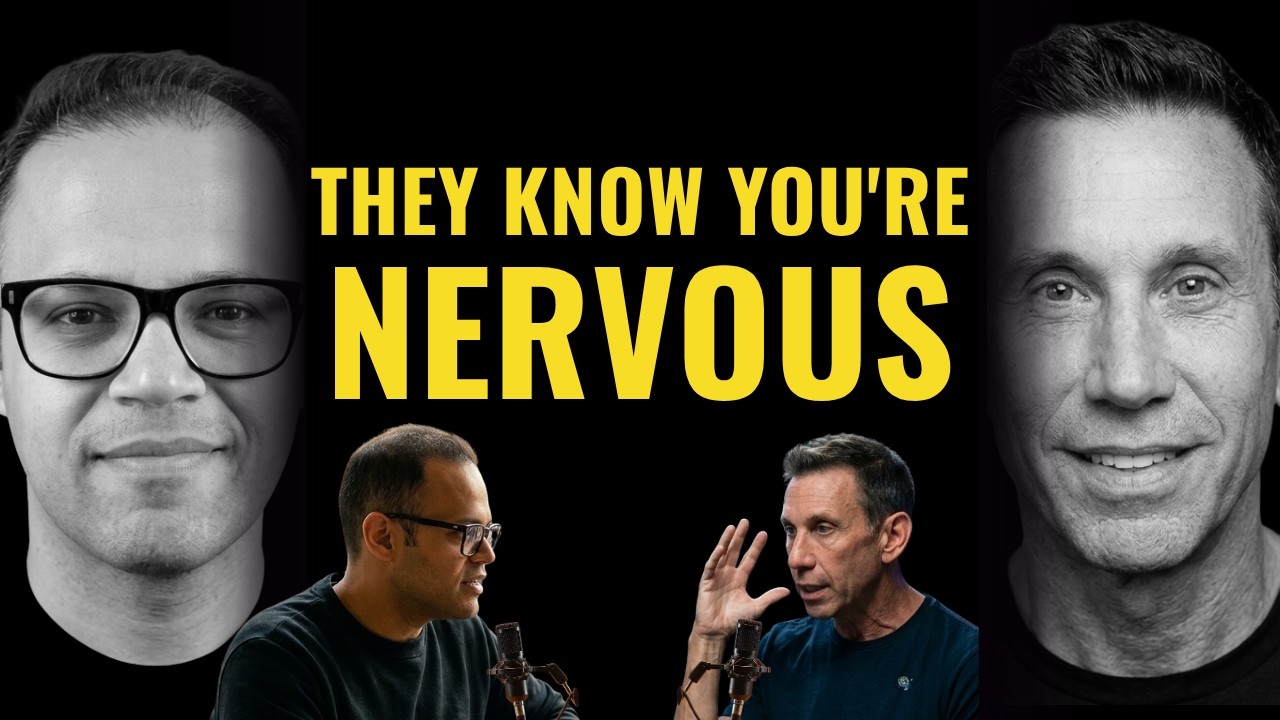
Brett Lavender, an executive coach, explains how childhood trauma shaped his nervous system into a hyper-vigilant state and how that insight became his coaching method. He maps the brain into three zones: 25% known, 25% known-unknown, and 50% "Zombieland" of blind spots, then offers tools like box breathing and mindfulness to calm your nervous system and reclaim control.
Chapters
No one is coming to save you.
You walk into that interview, that conversation, that boardroom. You walk into life with your shoulders stretched, smile on your face, the perfect voice, and inside you're breaking.
But you can't hide from your thoughts.
At 6 years old, Halloween night, Brett found his father a mile from their apartment in his car with a gun and a bullet across his temple.
To this day, do not know if that was self-inflicted or if he was murdered.
And at 19, his mother died in his arms at 12:30 AM. No siblings, no grandparents, no one coming to save him.
A radar was installed in my nervous system, a hypervigilant apex predator-like pattern recognition radar, depth perception, behavioral understanding, because I had to survive.
And that radar is now his methodology. Brett has written a book, The Lion's Code, and he trains executives on presence and communication. And he says the mask that you're wearing is as clear as a glass pane. And then before our conversation ended, he gave me these four words that changed everything. Utkarsh, stay on the snow. By the end of our conversation today, you will know if you're watching the snow or you're heading for the trees. Let's dive in. About ninety episodes, and I've said this a few times: we update our iPhones, we update our computers, we update every freaking thing that is technology. but we don't work towards upgrading our mindset. We don't upgrade towards upgrade our nervous system. And today's conversation with Brett is going to be all about that. But Brett, the first question that I want to dive with you on is, as soon as we face pressure as human beings, we get into the state where we fight or flight and we have no control over our nervous system. What's happening there?
Oh, I mean, well, that's a very broad— there's a lot happening there. Because, you know, when we receive information, we receive information through all 5 of our perceived senses, the senses that we know that we are aware of. So sight, taste, touch, smell, and hearing. And when you say we go into fight or flight, you know, the fundamental principle that is actually part 2, tier 2 of my program, I encourage my clients to make a contract with themselves. And the contract is very simple. Protect your nervous system at all costs. And then there are a variety of different protocols and rituals and skill sets that I offer through my program to maintain that calm nervous system. But I've always said, the minute you let anything, when you go into fight or flight— now, fight or flight is good if you have to protect yourself, if there's imminent danger. But oftentimes in today's society, we're not in imminent danger of life or death where fight or flight would take place.
Mm-hmm.
So in other words, through box breathing, through meditation, through mindfulness, I always encourage my clients to protect your nervous system because so many things happen the minute you start to tax your nervous system. Number one is you speed your life up. It's literally when they say stress is the all-time killer, right? What happens is when you get into that fight or flight or you're taxing your nervous system, as I say. It's like taking the gas pedal in your car and pushing it all the way down to the floor, even if the car is not in drive, and you speed up everything in your system, thereby getting to the finish line faster. So if you want to slow things down, you calm your nervous system. The other thing is, once your nervous system starts to get, let's call staticky or distortion-filled, it immediately— shifts your ability to think clearly, to communicate clearly, to deliver a clear message through your eyes, through your hands, through your words. And then think about it. Your nervous system is in control of everything. So your pheromones start to fire differently. Your pupils maybe dilate or constrict. So all these things, it's almost like DEFCON 5, you know, red alert goes on in your body and your body essentially goes into lockdown. So when you ask me what's happening, That's what it is. You automatically start to set the 5-alarm fire off, speed up your life, and limit your ability to connect with others and, of course, with yourself.
It's like my challenge here, Brett, is that it's like information that we've been studying since grade 5. It's knowledge that's available to the world. And then yet when we are in that moment, there's zero awareness. There is where we give that control back to the nervous system. What do you think are the symptoms when someone's Someone is letting stress control themselves, is in that taxing state. What are they seeing there?
Wait, I want to make sure I understand the question. You're saying what are people experiencing when they are in that state of fight or flight?
Absolutely.
Oh, I mean, think about it. Sweaty palms, heart rate elevated, pheromones firing differently, fidgeting, shaking your leg, and all these things. bleed through the human machine, especially through your face and through your eyes. You said that maintaining the calm nervous system, how do you do that? Well, you mentioned awareness. In my book, actually, is a section that I call the human epidemic. I identify the human condition right now as the human epidemic, which is lack of awareness in general, but lack of self-awareness. lack of awareness of our surroundings, lack of awareness of others and how we show up to them, how we're being reflected back, lack of how people are responding to us. In other words, oftentimes we're thinking about the next thing we want to say before we even received the feeling or the emotion or the reaction from the last thing we said.
Hmm.
When we lose control of that, we start bleeding through our machine. In other words, you can think a certain thought, you can be angry, You could be afraid, you could be panicky, you can be in fight or flight and think that you're controlling it. When you walk into a boardroom, when you walk onto a stage, when you walk into a first date, you think that you're controlling that chaos that's going on behind this mask because you are holding it together perceivably. But you can't hide from your thoughts. And that's why maintaining your mindset to control your nervous system is the priority here. The minute you start to get out of control in your mind, it bleeds through your face in a million different ways. It bleeds through your movement of your hands or swaying side to side. And so it all originates from the original thought.
So, so what you're saying is that what's happening within us in that nervous system, on that hormonal level, starts to express itself on its own without even our control, through our face, through our eyes, through whatever we are speaking in that moment. And that's when the nervous system is taking control of, of us rather than what we have in control. Is that understanding correct?
Well, let me, let me go back to the basics here. The way I look at this and the way I teach about this is, you know, we are in possession of this impossible computer. This is a CPU, the most powerful quantum computer known to mankind on this side of civilization. This computer is running this very high-powered, technically insane machine. And the remote control for the CPU and for the machine is our mind, is our thoughts, is our consciousness. So that's where this all starts. It's not necessarily about controlling your mind and control— I'm sorry, controlling your brain and controlling the machine. It's about controlling the thought that goes into the machine.
Mm-hmm.
Because every single thought that you can imagine, every single piece of input that goes in here is going to have an immediate reaction in the machine. Something you think, your body reacts. People think, oh, I think a thought and I just do a thing, and then someone else does a thing back and we react and we bump into walls, and nobody's really paying attention metacognitively to how the process is actually working. So if you think about it that way, it's just like a high-powered computer. Any piece of input that goes into this brain through your thoughts is going to create a result in the machine. Whether you want it to or not. So the access, the limit to control, right, is actually just at the thought. Once the thought happens, it's like the roller coaster takes off and you're on the ride. That's why every behavior, every reaction, every interaction is originated from the original thought.
Hmm. This, I love that. explanation, because what you're saying is that the CPU, and then there's a remote, and the remote control is the consciousness and the mindset you spoke about. These 2 are massive words. And I think let's, for the listener's sake, let's clarify, like, what does consciousness mean? What does mindset mean? Can you elaborate a little bit on that?
I mean, what does consciousness mean? That's That's a rough one for me to wrap my head around in one kind of standardized answer. There's a lot of different variables that come into understanding what consciousness actually is.
What's Brett's understanding of consciousness? Because I love what you said, Brett, because consciousness is so wide and deep and broad that it's really hard to describe. So what's your perception of this word consciousness?
I mean, to simplify it into layman's terms that we can all kind of wrap our head around and have a rational conversation about, it really is awareness. Awareness of self, awareness of others, awareness of our surroundings, and looking deeper into it than we've been taught. You know, let's— I mean, if you really want to talk about the expansion of potential consciousness here, well, number one, We've been told, like I said, there were 5 senses: sight, taste, touch, smell, and hearing. But what happens when you walk into a room and you feel somebody looking at you from behind and you turn around and there's somebody looking at you from behind? So in other words, awareness, right? When I am speaking to you right now, you're feeling my energy through these speakers, through the tone, the melody, and the pitch of a sound. The words are just wrapped around that sound. So when I talk about awareness of what's going on here, nobody thinks about it this way. People think you say words, people hear them, they respond back, you absorb those words, and then you respond back again. And it's just this very surface-level transactional interaction. That is not the way this is actually working. In between our— the space between us right now is filled with all kinds of interactions that are going on beyond What we're aware of beyond the sight, taste, touch, smell, and hearing. Because you're feeling a vibration come through your speaker right now. That vibration is sending information to your nervous system. If we were in person, it would even be deeper because I have a resonant, round voice. So the sound of my voice, the notes that I'm choosing, the shape of my words are hitting you in your nervous system. That nervous system is sending signals to your brain, which is creating a reaction. The pretty wrapping paper around the signal that I'm sending through my tone and my melody and my pitch are the words. And that's kind of what identifies the message. But there's so much more going on here than is just the actual words. In fact, you're responding to way more than everything other than my words.
Right.
You're responding to my face and my tone and my hand gestures and my conviction and my intention. So if we want to get close to the definition of understanding consciousness through awareness, that would be my best definition.
I love that. It, it, and, and to the mind who is able to understand the depth at which you're describing this, Brett, I think consciousness is just such a beautiful thing and, and it, it makes me feel that it starts to develop Much before we even have the cognitive abilities that we have. And so if I go to that 8-year-old Brett, the young Brett growing up wherever you were, if that 8-year-old Brett comes and meets you right now in your current self, what do you think will be a dialogue between the two of you, Brett?
My 8-year-old self?
8-year-old self, the young boy, the little kid.
I mean, I'd have to give you a little context about my story, my backstory. So, I mean, speaking to the reason I do this work in the first place is because this is all self-taught through a life that was really forged in very, very severe trauma. Before I was born, all of my grandparents had already passed away. So when I was born, I never knew a grandparent, never, which was interesting because I've grown up around, obviously people have grandparents, so I've grown up around that. energy and watching that interaction, but never really got to have that experience of what it's like to be around a grandparent. When I was 2 weeks old, right after I was born, my only uncle, my mother's brother, passed away. And I don't even know what the causes of that were. When I was 6— and by the way, I'm an only child as well, so no siblings. When I was 6 years old, my mother and father moved me to Penn Valley, Pennsylvania, which is a wealthy suburb of Philly. We were living in Rego Park, New York. And shortly after that, right after my 6th birthday on Halloween night, my father was found a mile from our apartment in his car with a bullet through his right temple. And the circumstances there were never fully resolved. I, to this day, do not know if that was self-inflicted or if he was murdered. All I do know is there was some shady business going on. He was involved in some dangerous stuff, never fully expressed. But the fundamental problem of my life became an unanswered question that I will never have the answer to. And so I grew up in this very wealthy neighborhood with just me and my mom. Now she was on her own because both her parents were gone. Her brother was gone. Her husband was now gone. No family at all. And so I grew up in this very wealthy neighborhood and I was kind of the poorest kid in the wealthiest neighborhood. I really could not keep up socially, financially. So I spent a lot of that time by myself, graduated high school, decided I was going to go to college, went to college for a year on Long Island. I went to a college called, named Hofstra University, went back home after a year, decided I didn't like it. I wanted to move on. I was going to move to LA and found out that my mother. had gotten diagnosed with terminal liver cancer. So at 19 years old, with no family, nobody to call and go, hey, I'm in trouble, my mom's sick, I sat down in an office at the hospital and this doctor looked me in my eyes and said, I'm just going to tell you the way it is because the truth is the truth. And he said, your mom has about a year to live. And you should really make it worth it. And so 3 months later, she ended up dying in my arms alone in a hospital room at 12:30 in the morning. And so then I started my life over and it would got, I mean, the story goes on from there, which is all outlined in the preface of my book. But, uh, so in answer to your question now, you know, what happened to me when I was 6? didn't really dawn on me until much later in life. And it's why I do the work that I do and why I am so skilled in the ways that I am. Because what I didn't realize until much later on was that when my father died, a radar was installed in my nervous system, a hypervigilant apex predator-like pattern recognition radar, depth perception, behavioral understanding, because I had to survive. And the only way, as a 6-year-old kid with no male role model, nobody was coming to save me, which I didn't realize at the time. I had to learn how to survive by recognizing safety and not safety. And oftentimes, more often than not, it was not safety. It was disloyalty. It was lack of honesty. It was a really rough wilderness that I ended up going through for decades alone. And so if I were to look back and my 8-year-old self were to ask me a question or kind of want to know what was up, I think the conversation would be, after all those years, did anybody show up? Did anybody step in? Did anybody see you? Did anybody acknowledge The talent, the skillset, the life that needed to be supported. And my answer to my 8-year-old self would be, um, no, nobody came. Um, nobody helped. Nobody really supported. But the good news is, is that you were there for yourself. And after a lifetime of Exploration and lessons learned and very harsh realities of life. When you walk a tightrope with no net and there's nobody there to support you, pick up the pieces, show you the way, you become very, very self-sufficient. And so after hitting the floor many, many, many times, I would look back at my 8-year-old self and say, Stick it out. Hold the line. Stay the course. Follow your dreams. Don't give up on your dreams because the only one coming to save you is you. And that is where I found my mentor, and that is where I found my religion, and that is where I found my safe place and my solace and my stoicism. Is in the mirror.
I was not ready for that. I was not ready for that.
I don't listen. Thank you for for saying that, and your your reaction is earnest and real and genuine and authentic, and I really appreciate you for that. But I want you to know something: there's not an ounce of regret. So I'm going to show you two things. I have a tattoo. on this arm that says amor fati, and that means love everything, good and bad. And I got this many, many years ago before I even knew what I was really thinking about. I really didn't have language for a lot of what I'm doing right now, what I understand. But this was very meaningful for me because there was so much bad, there was so much trauma, even after my mother died. That's a whole other— that's a story for another show. But being on your own at 19 years old and being this very alpha, outgoing performer type. Even though I was picked on in high school, I ended up finding this pathway to being in front of audiences for so many years. And that's what brought me down this pathway of understanding human behavior. I was in the event entertainment business for decades, and instead of me looking at it through the lens of a performer, I looked at it through the lens of a scientist. And those events that I did over the course of Thousands of people, thousands of events. It became a databank across the entire species. So literally, those events became a behavioral laboratory for me to understand human nature and human behavior and every archetype under the sun at a level that you cannot possibly imagine. I couldn't have learned it through a course or a certification or a book. It was designed for a nervous system that had been designed for pattern recognition from childhood. Through trauma, you know, and that's, that's where this whole thing comes from. Yeah.
Love everything. There's this vision that's coming to me right now, Brett, and I think I, to, to honor what you've just shared, I want to share that with you. Um, I have this strong belief that, um, that the, the, the From where this question emerged from me was that I believe that there's the 5, 8-year-old, 5-year-old, 7-year-old, 8-year-old, whatever number we think of, that's still within all of us, our individual selves, right? Can I ask you to give yourself a big hug for me?
Let me tell you something. I, I, I have a very solid relationship with myself after many, many years. It took a long, long time to come together with the fact that, you know, the quote that I, that I live by, I had it on my mirror in my bathroom for so many years. No one is coming to save you. This life of yours is 100% your responsibility. And let me tell you, bro, I finally succumbed I finally came together with that philosophy, kicking and screaming, right? Angry, bitter, jealous, resentful, afraid, petrified of homelessness, of illness, of being alone, of not being able to pull it together. And for many, many years, it caused me a lot of struggle because I was frantically looking for somebody to fill that role. And like I said, I mean, for years I was looking for a mentor and every time I would communicate with somebody who was in that role, I'd go, well, I know more about this than you do because my animalistic hypervigilant instincts were developed and I wasn't imprinted by normal means. I wasn't imprinted by family. I wasn't imprinted by siblings or even social networks. I was imprinted By the jungle. I was imprinted by survival. You know, someone in my demographic, in my situation, typically there's somebody there to step in to go, hey man, I got you. Even if it's a phone call away, even if it's a down the road kind of a thing, or let me help you out. There was nobody, man. But you know what? I look at it as a design. To me, it was a blueprint. Yeah. Because the reality is I was definitely designed to do the work that I am doing right now. And the only way I could have ever gotten to this place of understanding is to have walked through that burning building. And the reason I do the work that I do now is so that those that I coach to learn about awareness and consciousness and controlling your mind so you can control your machine so you can control your surroundings. The reason I do this now is so that those that I coach don't have to walk through that same burning building to get to the same place.
Yeah. And I hear a little bit— no, I hear a lot of love and care for that path that you've traversed, right? Because I don't hear any resentment here. I hear that that led you to where you are right now. Am I hearing it correctly?
No resentment. In fact, the exact opposite. Grateful for everything. Everything. I'm telling you, I live by this one, and I also live by this one. This one says, the mind is your instrument. Learn to be its master and not its slave. True victory is victory over oneself. And again, I got this many, many years ago. It was just meaningful for me in the moment, but I really didn't have a full grasp on what it even meant because I wasn't doing this work at the time. I just knew that This was the answer to everything. Controlling your consciousness, controlling your thoughts, because that's all we— this 6 inches of real estate is all we have control over.
And, and, and this 6 inches of real estate is all that we don't have control over as well. I think it's where we choose, Brett. So, so help— let's, let's help someone who's listening to us right now who feels that what you just said, the, these 6 inches are out of my control because I'm unable to build the discipline. I'm unable to manage my emotions. I'm unable to show up with confidence. I feel I can show up with confidence in my conversations, in my interviews, in my board meetings, but I'm breaking inside. How does one bridge that gap?
I mean, look, You're talking about going from someone who feels that they are out of control to someone that is, who is like myself, completely mindfully in control of my emotions and my machine. It starts with the understanding that can or can't in that situation doesn't really exist if you think about it, right? Can't would mean I can't slam dunk a basketball on a regulation-sized rim because I do not have the physical ability to do that. Okay? But when it comes to matters of the mind, it's an absolute choice. It's never can or can't. In that situation, it's always will or won't. That's why they call it willpower, right? You're choosing. So when somebody said, and I mean, look, there's so many avenues we could go down with this. Now we're talking about self-talk, right? Whatever you tell yourself, your mind is set up to believe. So if you're married or you have kids or your parents or your siblings or someone in your life who is important to you, who you trust and you value their opinion and you respect them, and they say, you know, you are such an idiot, you're so stupid, you're so ridiculous, you're such a loser, that's going to make you feel some type of way about yourself. Because someone that you respect and honor is telling you how poorly they look at you, how they reflect on you. When you say those same things to yourself, I can't, I'm so stupid, I don't have confidence, I'm not capable, your mind can't differentiate between the other person saying it to you or you saying it to yourself. So I always tell people, it starts with having a different conversation with yourself and coming to terms with that. And With respect to the work that I do, it's accessible to anyone that has a brain, a machine, and desire. But there are barriers to entry. The barriers to entry are, number one, you have to believe what I'm saying. You have to understand that when I tell you that your nervous system is in control of more than just telling you if you're hot or cold or something hurts, right? Your nervous system is in control of all of it. So you have to believe the tech— technological methodology. Then you have to believe that the thought process that I'm gonna run you through and suggest that you follow along this path will work for you.
Hmm.
So it's double-sided belief. And the belief, as in many situations, comes before the proof. You have to believe in this before you commit to going down this journey. And then it is about consistency, persistence, And discipline. Consistency and persistence will lead to accuracy and precision. And with work like this, with the tangible hard skills and the soft skills, you have to put in the reps, man. This is not going to happen overnight. It's not like you go to the gym for a week and you're in shape. You got to go to the gym for months, and then you still have to consistently maintain and maintenance. That's this. Mindfulness is an everyday journey. for the rest of your life. And it's a never-ending journey because every single day you are either growing or you are dying. This is one of my bedrocks. The only reason I'm able to continue to coach in the way that I do is because I am constantly learning from my own coaching. I tell a lot of my students, especially when I'm in a group setting, I'm really playing 3D chess, running a lab session, expressing ideas about mindfulness and showing somebody how to say or think or be a little different, and then validating that information in my own mind. So I'm actually using these players as chess pieces, coaching myself, and the audience kind of just gets to watch the process and they get coached right alongside me.
Hmm.
But if I couldn't do that, I wouldn't be able to do this because it's either a growing or dying process. It's like a tree. Trees grow for their entire lives until they don't, and then they start shrinking just like humans. Well, it's not just physically, it's mentally, it's emotionally, it's spiritually, empathetically, consistent growth at all times.
I love the framing because A, you've differentiated that physical ability of dunking a ball to the abilities of the mind, and all of us have a similar mind and the capabilities of Shifting it. I love the framing of will or won't and the conversations that we are having with ourselves. And so the first step that the audience can get to right now is to really be aware of checking again and again as to the kind of conversation that they're having with themselves. And everyone's gotta put in the reps. There's no other way out of this.
Yeah, for sure. For sure. And then another piece of this is When it comes to mindfulness is identifying the map of your brain. So, so the map of your brain through my lens is very specific. Number one, anything that you, you know, I identify with the story of The Lion King, which is why I call my company The Persuasive Lion. And, you know, there's a line in The Lion King where he says to his son, everything that the light touches. Is your kingdom. Everything that is illuminated, right, is your kingdom. So if you look at your brain as your kingdom, your mind as your kingdom, I look at it in 3 quadrants. Quadrant 1 is 25% of your brain, and that's the stuff that I call the stuff that you know, that you know. Fully illuminated.
Mm-hmm.
I know that I am sitting in Hoboken, New Jersey right now. on a podcast with you. I know that my name is Brett Lavender. I know a laundry list of 100 million bajillion things that exist in that 25%. Then there's this other 25%, and this is illuminated, but in a different way. This is the stuff that we know that we don't know. It's still— we don't know it, but we know that we don't know it, right? I know that I do not know how to speak Mandarin Chinese. I know that I do not know how to perform open heart surgery. Okay? And that list goes on and on and on, and they're constantly shifting these lists. And then there's the 50%. And you, you know, we can go back to awareness now and consciousness and self-evaluative thought. And this 50% quadrant is where most people that I encounter operate from, from the time they wake up to the time they go to sleep, and even probably while they're dreaming. And this 50% is what I call Zombieland. This is the stuff that we don't know we don't know, and we don't even know we don't know it. And those are our blind spots. And when I say lack of self-awareness is the human epidemic, this is what I'm talking about. People show up every day to their families, to their work, to their friends, in the mirror, saying things and doing things without having any idea what the actual results are, the actual feeling. It's never what you say or don't say, never what you do or don't do. The result is how you made the person feel. And unfortunately, in today's society, as a result of technology and iPhones and iPads and computers and Instagram and Facebook and Snapchat and texting and emailing and dating sites, that interpersonal connection of actually making somebody feel a certain way is one of what we call the lost languages. That's another, that's the fundamental part of my program. It's called The Lost Languages. What are the lost languages? These verbal and nonverbal interpersonal skills that have pretty much been buried by technology, especially through COVID.
And this reminds me, you also speak about, and I think goes back to the frequency and the intent and all of that, the emotion. When we enter a room, say for example, Think of someone who's 28 years old and listening to both of us, and they have a big interview tomorrow, or they have a presentation for funding. They're an entrepreneur. What does the body start to communicate even before one enters the room and speaks anything, Brett?
Oh, well, listen, this is all about presence and delivering through your nonverbal communication skills. And I think this is one of the biggest misconceptions and a biggest part of the human epidemic is people don't realize that You are speaking in so many different variations of languages and delivery systems before you even open your mouth. And it all originates from your thoughts. That's why I always say, before you walk into a room, I have protocols. You know, I say, do a few rounds of box breathing, have a mantra to yourself. There's, there's so many different techniques that I suggest that my clients employ in terms of how to prepare yourself before you walk into the arena. You have to start to get yourself prepared to walk into the arena while you're driving to the event. And here's one of my favorite ones. One of the things about walking into a room with confidence is about your mindset. Because if you want to speak confidently and you want to have the right outfit on and the right watch, and you want to walk in with your shoulders back and have your posture right, but in your mind you're terrified or you're frustrated or you're anxious, Mm-hmm. That's going to speak before you say a word. So you want to make sure that you get your mindset clear. Tell yourself the story that you want to believe. It's almost like creating a memory of a future event.
Mm-hmm.
Right? And then when you walk in the building, it's not cocky. It's humble and hungry. And the mindset in my mind is, I am not walking in this building right now to get the job that I'm looking for. I'm walking in this room right now as if I own the building that the job is in. This is my room. These are my people. It is my responsibility to create the energy that is going to magnetize these people to me and show them exactly why I'm here.
Hmm.
But that has to be— that originates from your mindset. You can't manufacture that. You can't fake it. And like I said, people walk into these rooms, whether it's a boardroom, a classroom, a date, any kind of interaction, thinking that they're hiding behind this bravado, this mask that they have on that's sending a different message than they're actually thinking about. But that mask is as clear as a pane of glass, especially if you know what you're looking for. A lot of what I teach is on the opposite side of this in terms of pattern recognition and paying attention for certain behavioral cues that nobody pays attention to. But you have to be able to look way deeper than the average bear.
Yeah. And there's so many layers, right, to this conversation that we could continue to have and maybe do another few episodes on this because it's what society has conditioned us. It's what we have been talking to ourselves. It's been what people have been talking about us where, and it's the fear that what happens when I show up cocky? What happens when I show up arrogant? Because what you're doing is the complete reverse that you show up like I own the building, but you're humble about it.
Yeah. I mean, look, I attribute mindset to everything. And the reason this work is so important is because for whatever reason, people, like I said, have lost the ability to communicate. When you look at the divorce rate, when you look at anger in the streets, when you look at businesses that go belly up because the partners couldn't get along, when you look at international relationships right now, all of this is fundamentally based on poor communication, lack of understanding, especially because, I mean, I could take this to an even deeper level and say, as human beings, especially in America, let's say, or English-speaking human beings, we're all human and we're all equal, but we are all extremely different. Again, going back to the concept of the persuasive lion and The Lion King, a lot of what I talk about is based on the fundamental laws of the jungle.
Right.
So in the woods, in the forest, in the natural world, animals of different species do not interact in the same way that this melting pot of very different species of humans is forced to interact. In the jungle, a lion is never talking to a tiger. A gorilla is never talking to a deer. A rhinoceros is never talking to a bunny rabbit other than kill or be killed for survival. In the jungle, it's very segregated. Those of like mind, so to speak, stay with their own kind.
Hmm.
In this society of humans, which is very different than any other biological species on this planet, right? We're forced into a situation where even though we're all human, we're as different as a Rottweiler is from a toy poodle. Different diet, different intelligence, different aggression, different physiology, different everything. They're both dogs. They both have 4 legs and 2 eyes and, and a tail, and they're all dogs, but they're extremely different. Now they're domesticated by humans, which is also why they interact with one another. In the real world, they would never— a Rottweiler would kill a Toy Poodle.
Mm-hmm. Right?
So here we are, this human species on this planet, especially when you look at like college kids that were stuck behind computers during COVID and then they get thrown onto a college campus in a sea of 20,000 other mammals that are from different cultural backgrounds, different educational backgrounds, financial, religious, physical, genetic, emotional, every which way. And they are told, go communicate, go interact, even though nobody has an idea. As to what the hell they are saying or how to say it. And so that is a big part of this problem, is that nobody understands the fundamentals, the thread that goes through all the humans to communicate at the basic level— eye contact, body language, melody, tone of voice. And so they get thrown out into this melting pot, and nobody has any idea how to communicate with one another, nor do they understand how to communicate with themselves. Why? Because they were never taught. I told you before, computer, machine, amazing gifts, amazing gifts, amazing vehicle, amazing vessel that we are in control of. No manual.
If you could simplify it to the bare minimum and tell, tell that 8-year-old Brett now, From, from the wisdom of the current Brett, if you could tell that 8-year-old Brett that, hey son, here's the synthesis of what I want you to do, start doing right now to, to strengthen and build that relationship with yourself, what would you tell him, Brett?
You know, there's a variety of ways that I could answer that, but the thing that, the thing that really illuminated in my brain was be brave. Be brave. You know, my whole life I was told, wow, man, you are so strong. You're so strong. And candidly speaking, bro, I did not feel very strong. I felt helpless. I felt like I was going down a path of no choice, that it was either do this or you will die, do this or you will not survive, do this or you will be homeless, do this or you will get sick and you will not be able to take care of yourself. And that did happen again, all outlined in the preface of my book. But I did get very sick and almost lost my life and my mind, and I was alone. And so The advice that I would give to my 8-year-old self would be, don't let fear get in the way of your path because 99% of the things that you fear only exist in your mind and you will survive and you will make it as long as you take it step by step, day by day, stay focused, stay on. I have a philosophy of stay on the snow. Stay on the snow. If you're, I don't know if you're a skier, but one of my favorite analogies is, you know, Tree skiers, right? So people that actually go intentionally and ski through the trees, right? So think about this. They're going downhill with trees all around them, and they're like this. The only reason that they're able to do that is because of their mindset. Because what they're doing is they're going, stay on the snow, right? If they were to go, don't hit a tree, don't hit a tree, don't hit a tree, don't hit a tree, don't hit a tree. Eventually, you know what's going to happen? They will definitely hit a tree. Because even though the thought is, don't do this, It's the focal point of their mind. Just like getting scared, getting nervous, having fear and panic. You're focused on the thing that you want to avoid.
Yeah.
Which is the complete opposite of what you want to focus on. You want to focus on the thing that you want to have happen. So instead of focusing on the trees, tree skiers go, stay on the snow, stay on the snow. Just focus on the snow. Keep the white part right in your view. And then you will never hit a tree. And that's the only way that they're able to go at that pace through all those trees so quickly. So that's the philosophy in my life. There's always gonna be obstacles in your way. There's always gonna be moguls. There's always gonna be another problem or another perceived problem or another fear, another stress or another something coming down the road. Stay on the snow.
Snow.
Yeah.
For everyone who's listening right now, I want you to really like pause the episode and for yourself, just, just close your eyes for a minute. What does that snow look like for you? Because it's— I don't think, Brett, you could have simplified it in better words than what you've done just now. Just stay on the snow.
At all times.
At all times.
And protect your nervous system. And think about that. Those are symbiotic thoughts if you think about it. Staying on the snow is controlling your nervous system, and controlling your nervous system allows you to stay on the snow.
100%. Good advice. I'm sure 8-year-old Brett is hugging you back right now.
Yes, sir.
As we go now a few decades into the future, Brett, to the 80-year-old Brett— 8-0 now— and if that Brett travels back in time and comes to you right now in this moment after the podcast and says, Brett, here's my advice on how to live and lead the rest of your years on the planet, what would that Brett tell you to do?
Well, first of all, be a good person. I know that sounds corny and poetic and pie in the sky, but I do believe in karma. And I do believe it's not so much this woo, like, oh, if you do bad things, bad things will happen to you. It's energy transfer. It's you, you, you, the giving is the getting in a good way and in a bad way. And the more I give of myself and the more I offer myself to people, and the more that's, that's also kind of bleeds into the whole concept of performance versus presence. You know, performance is, look at me, I need validation, I need applause. Look at me, look at me, look at me. And presence can be kind of parallel to performance in this way, but presence means Look at you.
Yeah.
And look at me looking at you. And that becomes magnetic. So that's the advice my 80-year-old self would give back to me right now is stay where you are, man. You are right in the center of your lane. And then the other thing would be trust yourself because, man, did I spend so many years driving myself crazy on a yo-yo. This is gonna work out. Well, maybe it's not. This is gonna be great. Well, maybe it's not. What am I gonna do if this, then that? And just driving myself nuts and really taxing my nervous system for many, many years over things that, number one, were outside of my control. But the only thing that was in my control was controlling my nervous system, controlling my thoughts, controlling my energy, and managing my panic and my fear. So it would be just trust yourself and just be a good person, man. Lead with honesty, lead with earnestness, lead with empathy. Be genuine, be real. When I coach new clients, I say, man, what I really do when I kind of vet out my clients is I go, are you down? Are you down? And that's a very specific term for me. Are you with me? Are you cool? Can I see you? Can you see me? And there's a very fine line. It's very difficult to kind of define what that actually means. It's just more of a vibe and a feeling. But yeah, it starts with— Confidence, authenticity, genuineness, believability, being real. I'm being down.
To our listeners who are with us at about 48 minutes into the conversation, are you down? Are you with us? Because 8-year-old Brett's advice, be a good person, trust yourself. And the current self, Advise the 8-year-old self, stay on the snow, just protect your nervous system and you'll be okay.
Stay on yourself and be very careful about the story that you tell yourself.
Yeah, yeah. And your mindset is where the story arises. So, so make sure that you tell the right story to you. I love, Brett, what you said to us about the 3 quadrants of the brain. And think of this in those who are the fans of The Lion King. Everything that the light touches, that's your kingdom. Remember that you need to start having a different conversation with yourself. There will be barriers to entry, but you have to start by believing in yourself, believing in the process, and then doing the reps, because there's, there's no other way. True victory, Brett told us, is victory over yourself. Brett learned this the hard way, but that relationship that you have with yourself is the most important. And try to make it the strongest relationship that you have, not as a disservice to others around you, but as actually a service to yourself and to others around you. And remember, stress is the biggest killer. You've been given a great CPU, a great machine, and there's the consciousness, the mindset, that's your remote control. Use it wisely. Use it wisely and make this a life, life that's, that's well-lived.
Optimized.
Optimized. I love that. Everyone who wants to get in touch with Brett, all the links to his book, to his LinkedIn, to everything that he shares is in the show notes. Brett, any final thoughts before we bring this to a close?
Um, I just would say that Like I said, even if you're not a part of my program, even if you don't read my book, even if you don't contact me, protect your nervous system. Look yourself in the mirror, have a really intelligent, uplifting, elevating, intellectual conversation with yourself consistently.
Yeah.
And the only other thing I was going to say is, you know, it is very important to protect yourself, obviously, but The contract shifts when you are in relationship with somebody else. So your significant other, for example, the way that this works is if you are in relationship with a spouse or a significant other, the protect your nervous system at all costs contract actually transfers over to your significant other first.
Mm-hmm.
Because in protecting them first, you don't realize you're actually bulletproofing Thank you for sharing.
With that, everyone who's listening on a podcast platform or on YouTube, do not share this with everyone because not everyone's ready for this kind of a conversation. But if you feel that there's someone in your network who deserves to listen to this, who will value this conversation Brad and I had, send them a link, send them a note, and make sure that they listen till the end. But yeah, don't just share it with, with your network. This is Utkarsh and Brett signing off.
Thank you so much.
Thank you, my friend.
More from Utkarsh

You Left Yourself Behind | The 7 Questions That Help You Find Yourself Again | Michelle Chappel




Are You Trapped in a Life You Didn't Choose? | Dr. Michelle Chappel | The IgnitedNeurons Podcast

Financial Freedom Doesn't Make You Free | Tim Kelly | The IgnitedNeurons Podcast


Your relationship might be missing this! #shorts #ytshorts #shortvideo #shortsfeed

The Truth About Financial Freedom Nobody Talks About | Tim Kelly | The IgnitedNeurons Podcast

The Question We Ask When Life Hurts #shorts #youtubeshorts #shortvideo #shortsfeed #shortsviral

How to Keep Going When Life Changes Everything | Kenneth James Kunken | The IgnitedNeurons Podcast