You're Thinking Too Small And It's Limiting Your Future
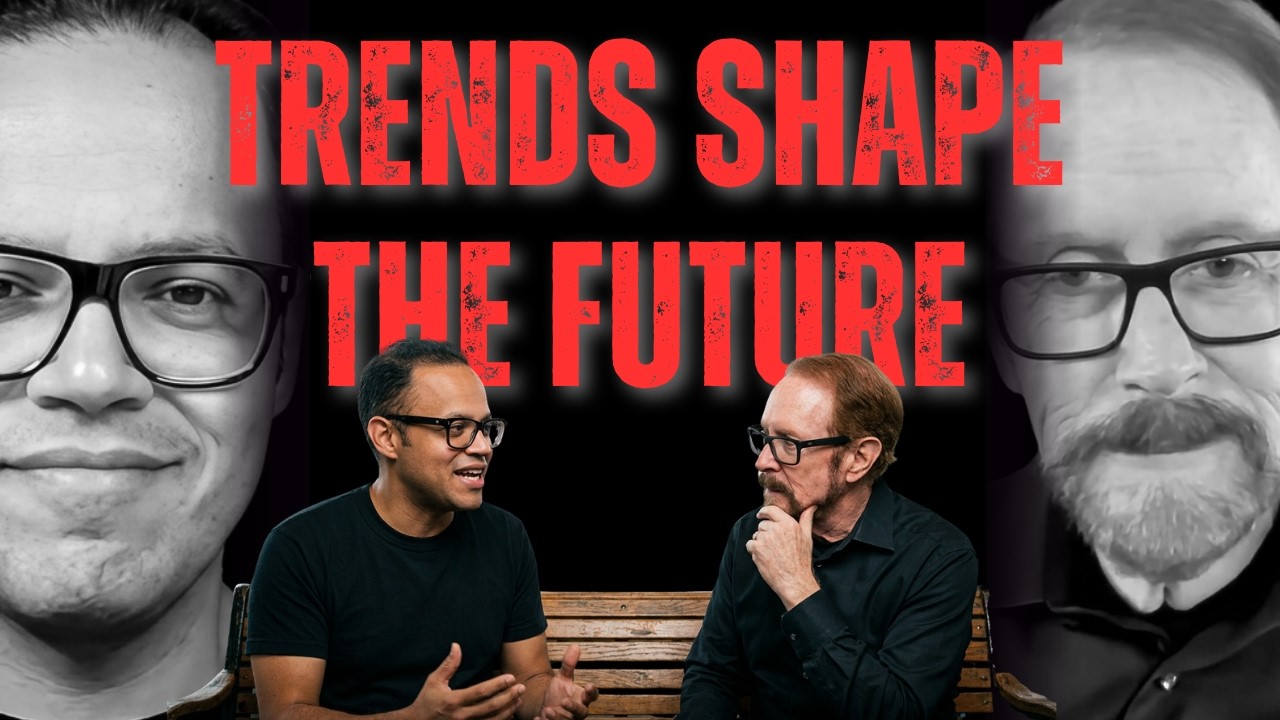
Futurist Daniel Burrus explains the difference between hard trends (unchangeable future facts) and soft trends (assumptions you can alter), and how to use them to anticipate change instead of just reacting to it. He predicted Netflix and the iPhone in his 1993 book by thinking bigger. The key is shifting from a reactive mindset to an anticipatory one.
Chapters
In 1993, our guest today, Daniel, wrote a chapter in his book where he predicted Netflix. He did not know the name, but he knew the shape it would take.
There was a bold thing that said Blockbuster is busted, and underneath was a description of Netflix.
No internet in most homes, no streaming, but here's Daniel able to identify the pattern and predict what nobody else was looking at.
How you view the future shapes how you act in the present.
Daniel has written 7 bestselling books, and he's the force behind the innovation and strategy for biggest Fortune 500 companies in the world. The New York Times calls Daniel one of the top 3 business gurus alive in our world today.
If all you are is reactive, if all you are is agile, if all you can do is pivot, you're not going to be a very happy camper going forward.
And most of us, we're all playing defense and we call it our strategy.
The increasing power and speed of AI, by the way, hard trend, not slowing down. If you don't like it, too bad.
This beast called AI isn't a maybe anymore. It's right here and it's capturing more than our imagination.
There's always a bigger big.
By the end of our conversation with Daniel today, you will know how to predict the future and see the biggest disruptions before they hit and take advantage and be ready for what will unfold in the future. Let's dive in. If you're someone who's impacted by AI and if you're someone who's not, In either cases, you should be listening to this podcast because today I have with me Daniel, who's a futurist who's been predicting the future and helping people shape the future and not fear it, not passively receive it. And so this is going to be a conversation about where artificial intelligence meets human intelligence and how you and I, all of us listeners, get to shape it up. Hey, Daniel, how are you? Good to have you here.
I'm doing great. Thanks for having me on.
Absolutely. Looking forward to this conversation. And one thing that's been kind of, as I was preparing for this moment, it's been on my mind that what do you think is something that's happening right now, Daniel, that people are almost ignorant to, but it's going to shape how the world evolves in the next 5 years? What's that one thing?
They don't really realize how big a deal AI is at this point in time. Some realize it's big, but it's actually bigger than that. Some think that it's, you know, it's kind of like other technologies that came along, like the iPhone or the internet or things like that. But it's bigger than that because it impacts everything. It impacts everything. And it's growing at a beyond exponential rate. 2 becomes 4 becomes 8. Actually, it's even more than that. And so that's what people are missing and the impact on individuals and more importantly, how we can use it together and individually to shape a better future for ourselves rather than to sit back and let AI shape our future for us, which I don't think you're gonna like.
Yeah. Yeah. I love that. And we'll talk about all of that. I wanna unpack that with you, but before we start to shape up the future, I want to go into the past and I want to ask you if that 8-year-old Daniel, wherever you were growing up as an 8-year-old kid, if that Daniel comes and meets you right now, what kind of a conversation do you think will emerge between the two of you?
Well, I think what I would want to do is tell the 8-year-old version of me to think much bigger about the future. I was thinking pretty big about the future already, and I was kind of wired to think about the future even when I was young. I was always projecting myself. out frankly to being in my late 90s or 100 years old, and then thinking back towards the present, asking myself, am I on the right path to have a really great future? And I was doing that even as a little kid. So I don't know why no adult ever told me to, but frankly, I was 8 years old and I just was not thinking big enough. And as a matter of fact, I'll use that as a as a teaching moment for all of us right now. Because that's what I love doing is helping people. And rather than just give you some trends and say good luck and say, hey, it's going to be a big deal, good luck. I'd rather teach everyone today some principles and some ways of thinking about it that can help us out in our looking at the future. So the When it comes to, think back to, now I'm talking to all of the listeners here, all of us that are watching. Think back to when you got your last degree in school, whatever that degree was. Now, it was a long time ago for me. Might've been a long time ago for you, but if you think back, you were probably thinking pretty big about your future. However, if you think back now in hindsight, you'll realize, you know what? I was thinking too small. You were thinking too small. And here's my point. You're thinking too small now. You're thinking too small now about what the future can do. We have tools and technologies that can allow us to solve every problem on planet Earth right now. Even if we said, all right, you get no new physics, no new biology, no new technology. All you can do is use what you've got. We've already got exactly what we need to solve every problem. It takes awareness, It takes vision, it takes innovation, and it also takes a mindset. And my worry for all of us, and I'm going back to my 8-year-old self, but now I'm going to talk about my current self and your current self. And that is, let me share the concept of future view. Now, how you How your family, how your employees, if you ever run a company, how the people that you manage, how your customers, how we all view the future to a great extent shapes how we act in the present. Let's face it, right now people might be buying Nvidia stock.
Hmm.
Some people might be selling Nvidia. What's their, what's the difference? Their future view of Nvidia. Some kids might be thinking of going to college. Other kids are thinking of going to drugs. What's the difference? Their future view. Some customer, you may have a great customer right now that's thinking of leaving you. Why? Because their future view of staying has changed.
Hmm.
So how you view the future shapes how you act in the present. How you act in the present shapes your future. In other words, your future view will determine the future you. And right now our future views are really based more on where we've come from versus where we're going. If you were driving a car, you know what it's like looking in the rearview mirror? You're looking more from behind, not looking through the windshield.
Hmm.
So one of the things that we need to do is understand what really is happening so that our future view is elevated based on the amazing capabilities that we all have access to. And when we do that, guess what? We have a better future because I think right now most people's future view is actually quite low. I mean, we've got problems in the Middle East, we've got inflation on a global level that's taking place. We've got political unrest, we've got technology, we've got AI, all this uncertainty out there, and it makes people Let's wait and see what's gonna happen. Let's hesitate.
Yeah.
And uncertainty does not give you the confidence to make a bold move. That's why I love to teach people the science of certainty.
Love it. There's so many neurons getting fired right now because it feels like this is a cycle. The view of the future decides what I do in the present. So it's a cycle. It can be a vicious cycle if I'm thinking of being a certain version and doing drugs right now versus If I'm anticipating and being proactive in shaping the future, I'll do a lot of different things right now. I think there's a lot of fear to that uncertainty, which is what our brains are programmed to, Daniel, which is what's leading a lot of people to right now be either passive or reacting to things. How do they move from this reactive state to becoming anticipator, to going into maybe becoming the shapers of the future?
Great question. Well, the way that business and people have dealt with rapid pace of change so far is using agility. And you've heard, especially since COVID people saying pivot. I pivoted because things changed, so I pivoted. Or, and what is agile? It came from sports, reacting as quickly as you can.
Mm-hmm.
With business context here, Reacting as quickly as you can to a problem after it occurs, reacting as quickly as you can to a disruption after it disrupts. And that is reactionary. And by the way, there are a lot of things you can't predict. You gotta get good at being agile. However, that's only one side of the strategy coin. It's a reactionary side. I'm teaching people today, today with all of you. The anticipatory side. That is how to anticipate problems before you have them so you can pre-solve them. I mean, how many of us have all said to ourselves, I knew that would happen. Now, if you knew that was gonna happen, why didn't you stop it from happening? And by the way, I know why you didn't. I know why we didn't. We didn't trust our gut on that. If we absolutely knew that bad thing was gonna happen, you would've pre-solved it. But you were not 100% sure. You waited for it to happen, and then you said, "See, I told you that was going to happen." So what if you had confidence in those things that you know are bad that are going to happen? If you did have that confidence, you would pre-solve it. That's being anticipatory. I'm going to show you how to do it in a minute. Hang in there.
I'm waiting.
I'm waiting by the end of the seat.
I'm waiting by the end of the seat.
Okay, good, good. So. To be anticipatory, you can predict problems before they happen and pre-solve them. What does that do? It allows you to move forward faster. Secondly, you can see disruptions before they disrupt, turning disruption into a choice. I'd like you to have some choices here. And I've been doing this for decades. You know, I've written 7 books that have been bestsellers. They're in many, many, many different languages. And if I go back to my 1993 book, Techno Trends, One of the things that was in there was in one of the chapters, there was a bold thing that said Blockbuster is busted. And underneath was a description of Netflix. Now, I didn't know they would call it Netflix. You have to leave the parts out you can be wrong about, but I knew it would happen because the tools to create it were already there.
Hmm.
And a matter of fact, I even talked about the first virtual bookstore that we would have 2 years before Amazon was created. I talked about, uh, all sorts of things, including the iPhone. I didn't know they called it the iPhone. I didn't even know Apple would do it, but I knew it would be a mobile multimedia computer. All right. That's how I defined it.
Hmm.
Now that's 1993. Um, I don't wanna be the only guy that can do all this. I would like you all to be doing this. Well, there's a way to do it before I show you how to do it. and give you some examples, let me just say one more thing about agility versus being anticipatory. If you think in terms of sports, agility is playing defense. Anticipatory is playing offense.
Hmm.
One other thing, the pace of change driven by AI and other technological changes is accelerating. And I don't think anybody out there is going to debate that with me. Change is getting faster. Things are going faster. Things are moving faster. By the way, I'm going to make a prediction. They're not slowing down. So if everything is speeding up, the pace of innovations and change and AI getting stronger, more powerful, all these things, if all you are is reactive, if all you are is agile, if all you can do is pivot, You're not going to be a very happy camper going forward. You got to learn how to get ahead, but how can you get ahead when everything is uncertain? And that's where there is a methodology I've come up with and perfected over the decades. It works great. Companies around the world are using it. I want everyone here to use it. And that is, there's no shortage of trends about the future. Of course, the problem is which ones will happen. and when, I've solved that problem for us. Hmm. All trends fit into one of 2 categories. They're either a hard trend based on a future fact that will happen. Now, the litmus test for it is if it can be changed, it's not a hard trend. Let me give you a quick example so that you know what I'm talking about.
Yeah.
Let's talk about a demographic example. Different countries have different demographics. Some are aging populations, some are younger populations. In the United States, 10,000 people every day are turning 70 years old. Just let that sink in for a minute. 10,000 a day are turning 70. By the way, are they going to get chronologically younger all of a sudden and start turning 60 and 50? No, no, no. They're going to turn 75 and 80. By the way, I call that a hard trend. And we could predict a lot of problems that we could pre-solve. We could predict a lot of opportunities that we could pursue based on the future fact that they're getting older. I'm just giving you a quick example. Let me give you a technology one. The increasing power and speed of AI, by the way, hard trend, not slowing down. If you don't like it, too bad. It's a total hard trend. Uh, let's take another one. Wireless technology. Some of you might remember 3G wireless.
Mm-hmm.
4G wireless. Today we have 5G wireless. Is that it? No, we got 6G followed by 7G followed by 8G. We'll be talking about it on a future interview.
Mm-hmm.
And you'll be saying, wow, you're right, Dan. You see, you can predict the future when you have some tools and some understandings of how you can do that. So all trends are one of 2 types. I gave you just a few examples of hard trends. One type is a hard trend based on a future fact that will happen. The benefit, you can see problems before you have them so you can pre-solve them. You can see disruptions before they disrupt so that you have a choice to either be the disruptor or the disrupted.
Hmm.
The other type of trend, excuse me, is a soft trend. And a soft trend is based on an assumption, not a future fact. Now, I didn't say a soft trend won't happen. What I said is it might happen. And might versus absolutely will future fact is different.
Correct.
And soft trends are based on assumptions. And let me give one other little lesson in here, a little side lesson that's really important. There's 2 types of assumptions. To make it simple, I'll just call them a hard assumption and a soft assumption. All right? What's a soft assumption? Something that you have been true your entire professional career. This is how I do what I do. However, the last couple years, the world's changed. Is it still true?
Hmm.
Is it still true? If it's not true anymore and you have strategies based on those soft assumptions, your risk level is like way up there.
Mm-hmm.
So I need to evaluate all of the assumptions that my business and my life is running on. Surely we can't have another recession. Soft assumption. By the way, I didn't say we will. I just said that is not a future fact. Yeah. See what I mean? Yeah. My company has been growing for 20 years. Every year we grow 10% a year, every year for 20 years. We'll grow 10% next year. Hard trend or soft? Soft. It's not a future fact. It's likely.
Yeah.
Not a future fact.
Yeah. Based on the previous data.
It could go down. It could go down. It could change.
Correct.
Right. Right. So the power of a soft trend is if you don't like it, you can change it.
Hmm.
Now I think we have people from many different countries watching this.
Hmm.
But let me just give you a, I'll give you another US example because it's a classic.
Hmm.
And that is healthcare costs in the United States, which are crazy compared to any other country. I mean, we are a totally stupid country for how, what we're doing. But healthcare costs in the United States have been going up, up, up, up, up for 20 years.
Right.
20 years it's been going up. So if you ask people, is that a hard trend or a soft trend? 90% of people would say, well, it's a hard trend.
Correct.
Why do they say that? Because it's been going up for 20 years. By the way, that does not qualify it as a hard trend.
Correct.
Could it be stopped? Could it be reversed? That's the qualifier here. The answer is it sure could. So our government in the US, because they assume it's a hard trend, all of the reforms, healthcare reforms are really healthcare. How do we pay for the mess the baby boomers will cause as they get older? It's all health payment reforms.
Correct.
Not giving you a better knee. All right.
Yeah.
So, but what I'm saying is we could lower costs. I'll give you an example. Again, the US system is so crazy. It's almost humorous just to talk about it. For example, an aspirin, one aspirin in a hospital can cost $20. Now, if you knew that, you'd have your spouse bring it. You're getting an artificial knee because you played a lot of tennis. Well, that same knee made by the same company, same size, same everything can vary in price by over 100%. But again, we don't know that. No wonder they can charge so much. But what if we put all of that on a blockchain, which is highly secure and totally transparent? Now we can see the aspirin costs $20. I'm not paying for that. In other words, what would happen? Prices would go down. And there is a blockchain for healthcare in its first round of funding, got $100 million in the first round. I'm just giving you an example. So if you don't like it, you can change it. Let's say that I'm in an industry where sales have been going down because of, uh, um, maybe tariffs or something.
Hmm.
And so it's been going down for like 2 years. The whole industry, and I'm in that industry. Is that, does that mean I've gotta write it down? It's a hard trend. No, no, it's soft. What I do is, let's see if, again, if you don't like something, you can do something about it. How would I take advantage of the forces that are driving it down?
Hmm.
How I can't change the world, but I can change my company. I can change what I do. I can change what, how I take advantage of it. Back in 2007 and '08, there was a global meltdown, as you know. Homes were going into foreclosure.
Yeah.
And real estate agents were going out of business because no one could sell a home. I mean, you know, the prices were going down like a rock. However, a couple of real estate agents that read some of my books, Anticipatory Organization and Flash Foresight, They, what did they do? They started selling foreclosed homes. They were selling more homes than they were doing before the crisis. In other words, they took advantage of it.
Yeah.
So, so the power of a soft trend is if you don't like it, you can change it. The power of a hard trend is you can see the future before it happens, giving you a big advantage.
I love the differentiation and I understand how that could make us feel that we have certain control on certain things versus not. And we can, because it's a soft trend, we can do something about it and change it. What's an example then?
Wait, wait, wait. You just said something that was really good that I want to address. 'Cause you said what you were getting at is it makes us feel better and we get a little bit more certainty. So what is a hard trend? What, when you define hard trends, what do you have? Certainty in an uncertain world. And when you have certainty, you have the confidence to make a bold move. Let me give you, why don't we, why don't we invent some things together right now using this?
Let's do that.
I'll show you how it works.
Absolutely.
I'll show you how powerful this is.
Okay. Yes, let's do it.
Let's take old people wherever they are. If you're in an area with rivers and lakes, Probably people like to go boating. And when they get into their 80s and 90s, it gets kind of hard to launch the boat. So what if you and I decided to design the easy launch trailer for seniors and we did a good job? Would we have a built-in growing market in all of the countries that have aging populations? Well, yeah, in the US, 10,000 a day, or 270.
Yeah.
By the way, pretty soon 10,000 a day will be turning 80 and 90. We got to build it. You know, you could actually go to the bank with numbers solid like that and get a loan for that trailer because you're going in with solid numbers. It's not guesses. These are hard trends.
Hmm.
Um, we would know exactly what countries to export to. By the way, there is no, uh, right now there is no, easy launch boat trailer for seniors. Now, let me ask all of you rhetorically that are watching this, raise your hand virtually if you think we're not going to have one of those. We'll never see one of those. Now, I know none of you put your— well, you know what? We will, won't we?
We would.
We will see them. Somebody's going to do that because the opportunity's too big not to. Let me give you another thing that doesn't exist. Right now, talking about older people. When they get in their 80s and 90s, a lot of them fall. And sometimes they break a hip, sometimes they die, very expensive, very painful. Why do they fall when they're old? Because their muscles have gotten weak. Not just their big muscles, their smaller muscles. So when you're your age or my age, if we trip, no problem, we don't fall, we don't go down. But if you're 85 or 90, boom, you're down. You are down fast because you don't have the muscle control. Well, there's a technology called exoskeletons. Maybe you've heard of those.
Yeah.
And an exoskeleton, it kind of, you put it on, it's got a little electric motors and some batteries, and it gives you added strength. And, and by the way, as a side note, let me just test you on this. Will the batteries get lighter And will the exoskeletons get thinner every year? Sure.
Yes, they should. Yeah.
Yeah. By the way, will they cost less every year? Yeah, because they'll be making more of them. Yeah, of course. So see, it's easy to predict the future once you start getting the hang of how it works. There is no exoskeleton for seniors right now. What if you and I decided to make an exoskeleton that goes around the ankles up to the hips?
Hmm.
Giving an old person the strength of a 20-year-old.
Hmm.
So they could go up and down steps, no problem. They try to fall, no problem. They don't fall because they got the strength of a 20-year-old. Now, you could do that. That could be done. You don't even have to invent anything new. We already have exoskeletons. It's how you apply it. Now, right now, there is no exoskeleton for seniors. I want you to raise your hand if you think we're not going to have any of that. We'll never see that. Put your hand up. Nobody put their hand up. Why? Correct. Because, you know, hey, that's gonna happen.
Possible.
Yeah. And by the way, I'm named in dozens and dozens of patents because of what I'm doing with you right now. Because there have been people that said, I like what that guy said. I'm gonna make that exoskeleton. Nobody's not done that yet. But maybe one of you will. Because why? Low risk.
Yeah.
Now I'm picking on old people here, but we could pick on young people too. As a matter of fact, a lot of times many companies are trying to attract new employees, qualified work, and finding that difficult in a lot of places. They might say there's not a lot of qualified talent. It's hard to get. I would say, well, it may be hard for others, but it doesn't have to be hard for me. First of all, how are you attracting them? A lot of people have a one-size-fits-all way of doing it. Instead of realizing every generation uses technology different, they respond to things differently. I need a strategy to attract talent in different demographic categories. I've got to go to them in different ways. And what'll happen? You'll start attracting them. If I attract them with, if I'm a baby boomer and I'm trying to attract a Gen Z, I'm probably going to blow it because I don't have their mindset.
Yeah.
So how do I figure that out? And one of the principles that I teach, we could talk about it later. I love it. That is to take your problems and skip them.
Hmm.
And one, yeah, it's really good. We'll come back on that. And one of the ways of skipping that problem is why do I have to figure that out? I'm a baby boomer. Why don't I ask the Gen Zers? What would get you to want to work for a company like mine? Have them tell you. Why do I have to figure all this out?
Got it.
So, um, I've been, I've been hanging on to demographics for a moment here, but technology is one of the most predictable areas there is. And you might think, wow, it's changing so fast. No, no, no. Very predictable. As a matter of fact, if anyone there, um, If you'd like to look at my list of 25 key technologies that are shaping the future, you can get that free by going to 25, the number 25, techtrendsreport.com, 25techtrendsreport.com, and take a look at it. Just look through those because that's your future. That's the future of technology right there. A lot of us think it's all AI. Oh, and there's a lot more than AI going on. AI is big and impacts everything, but there's a lot of big things going on. You should be aware of what's happening. You can't use a tool if you don't know it exists. Maybe we should broaden our view a little bit.
Yeah, yeah. I think as I'm listening to you, I'm thinking anyone who's listening to us right now might feel like, oh, I can do that. But I think it comes back to what you said earlier, Dan, which is awareness, vision, mindset, innovation. That's where people struggle, right? Isn't it true? Or where do you see people— these ideas are out there in the world. You're sending them out there. But people don't act on them. What stops them?
Uncertainty stops them. They don't have confidence. You see, if you actually go through the process of identifying the hard trend that will happen is growing every year, and you see an opportunity, because a trend by itself is academic, you've got to attach an opportunity to it. So when you identify a trend, And then you attach the opportunity to it and you say, I'm going to pursue that. You have the confidence to move forward because you know, if I don't do it, someone else will. If I don't do it, someone else will. So that gives you, because I know it's going to happen. So it gives you that confidence. And there's some ways that you can move forward where you are blocked. I mentioned a very powerful principle about 5 minutes ago, and it's so powerful, I think I'm going to have to share it all with you right now. And that is the skip it principle. So I'd like you all to think of your biggest problem right now. Just think of your biggest problem. It probably doesn't take long. Those big problems surface pretty quick. Now, here's what I'd like you to do. Skip it. Now, I know you're thinking, how can I skip it? It's easy to skip. It's the wrong one. You're trying to solve the wrong problem. That's why you're stuck. You're smart. You would've solved it by now if you're working on the right problem. You gotta dig down to what the real problem is. I'll give you a couple of simple examples and I'll give you a more complex example so you know what I'm talking about. A simple example. My niece Hallie called me and she's got her first job and she said, Uncle Dan, I'm, I can't save any money. I don't know. I just can't save any money. Now, Hallie knows that it's possible because her older sister Audrey can save money like crazy. But Hallie, she just can't save any money. So she said, I've been trying to save money. I just can't save money. And I said, oh, you gotta skip that. Wrong problem. Why don't you work at how you spend money?
Hmm.
When she started working on how she spent money, guess what? She was saving money. She was working on the wrong one. Let me give you another one. It was a big hotel chain that put up 10 new hotels. And when they opened for business, they were getting everybody in all 10 hotels were complaining about the slow elevators. By the way, you can't just turn a dial and speed an elevator up. So it was an impossible problem. We built 10 new hotels and everybody's complaining about the slow elevators. That's an impossible problem. No, it isn't. It's the wrong problem.
Yeah.
What's the right problem? What was the real problem? People were bored waiting for the elevator. That's why they noticed.
Yeah.
Let's give 'em something to do. So what did we, what did we do? We put a mirror in front of every elevator.
Love it.
And then they started checking their tie and checking their dress and all of a sudden, uh, and all the complaints went away. Hmm. Again, working on the wrong problem. So, uh, whatever problem you've got, I'm already telling you that's not it. Now I've worked with Fortune 1, 2, 3, 4, 5 CEOs. I've worked with mid-sized companies. I've worked with some of the biggest. And over the years, some very big names. You know, I met Steve Jobs back in the '80s. I met Musk in the, when was it? Early 2000s. You know, I've known a lot of big ones. So when I meet someone, First thing I ask them is, what's your biggest problem? Because I'm armed with something very powerful. I know whatever they say, that's not it. It's very powerful. I know whatever they say, that's not it. By the way, it's been true 100% of the time. We start to dig down just a little bit. Let me give you an example. I was speaking to the top 50 CIOs on planet Earth. All of them have a billion, over a billion-dollar IT budget, every one of them. And I said, I'm going to show you how to skip your problems. And there was a guy over in the corner, raised his hand. I had never met him before. He said, I got a problem that I'm dealing with. I can't really skip. I didn't realize he was the CIO of the US Department of Defense, which is the biggest CIO with the biggest budget on planet Earth. Okay. And, but I didn't know that at the time. He said, I got to get all my legacy systems into the cloud as quickly as possible. And it's giant because I got so many data centers and so much. It's like really a difficult problem. How do I deal with that? And I said to him, well, let me get something straight. Uh, if you get all of your legacy systems into the cloud, won't you just have a legacy cloud? And he kind of laughed and he said, well, I guess that's not it. And I said, you're right. That's not it. And we started digging down to what the real problem was. We found the real problem and I ended up doing a lot of work for for the Department of Defense and actually helped found their futurist group. So, but it all started with the problem he thought he had. That wasn't it. It was another one. So use that as a way to go forward. So here's what we think we have to do as an entrepreneur. I got to do this, this, this, and this to achieve this. Do you really need to do this, this, this, and this? Let's challenge every one of those things. Maybe you think you need to do those things, Maybe you don't need to do those things at all. Maybe there's a way to virtually do those things. Maybe you're doing them because everybody else has done those, but you really don't need to. You know, I've started 6 companies. 5 were profitable in the first year. 4 were national leaders in the first year. I've never had a business loan. So, you know, and I started out teaching biology and physics, so obviously I didn't have any money. So I'm using the principles that I'm teaching you all how to do. So it's like, for example, back in 2008, '09, I was writing a book and I wanted to test the principles of the book while I was writing it. So I thought I'd start a company based on the principles and see how good the company is while I'm writing the book. And I decided at the time to create the first mobile real estate app. Because there was no— iPhone was still fairly new and there were not many business applications for the iPhone at that time.
Right.
So what did I ask myself? Will the iPhone get more powerful every year?
Yes.
Yeah. Hard trend, by the way. Um, will there be an increasing number of business applications for a smartphone?
Yes. Hard trend.
Hard trend. What would they be? So I made a list of 100 apps that didn't exist, but I knew they would. And then I started zeroing in on what I wanted to do. And because foreclosures and all of that were so big in that 2008 and 2009, and there was no mobile real estate app, I decided to make a mobile real estate app. By the way, I don't know how to program. Skipped that problem. Skipped it totally. What did I do? I called a local university, asked for the computer science department, asked for the head of the department. I got him on the phone and I said, I'd like the name of an undergraduate who's getting a degree in software engineering who is smarter than all the professors. And he said, oh, you mean Steve? And I said, yeah, Steve. Because there's always a Steve, a Betty, or a Sue. There's always somebody like that. So I called Steve and I said, Steve, what are you doing to make money on the side? And he says, I'm programming websites for businesses. And I said, oh, I bet you're bored with that. He said, yeah, I've been doing it since I was in junior high. And I said, well, how would you like to make a mobile app for a smartphone that's never been done before? And he said, oh, cool. And I said, well, I got a rule. I can't pay any money, but what I can do is give you Uh, 10% of the profits for the first 2 years. He said, I'm in.
Hmm.
So that's how I got away with not even paying. See, I mean, I'm just showing you how you can do things. How did I get employees? I got a whole bunch of employees I didn't have to pay.
Hmm.
I got super, super smart talent. Easy. See, I'm just showing you, you think you can't, you think you got barriers. I gotta hire all these people. I gotta do all this stuff. Do you? Do you really? Come on, let's think. I mean, I developed a product that was going to cost me a couple hundred thousand dollars. And what I did was I pre-sold the first customer and charged them a couple hundred thousand to get to use it exclusively for the first 2 years. So I was able to develop it for free.
All of this, Dan, and it's like, it's mind-boggling and I'm seeing the pattern. What does all of this teach you about human potential?
Let me talk about human potential right now and let me relate it to a piano. So there's only, only so many keys in a piano, right? A regular full-size keyboard. There's only so many keys. By the way, same number of keys that Beethoven had.
Yeah.
Same number of keys that it's been all the way back in time. You can look at some of the earliest, uh, you know, keyboards, same number of keys.
Yeah.
Did the limitation of the number of keys limit humans' ability to come up with new music?
Did not. Did not.
It's infinite. It's infinite. Can we create new businesses? It's infinite. Infinite. Infinite.
Infinite.
Stop thinking. Stop thinking so small. Remember what I told my 8-year-old self? Think big. Think bigger. You're all thinking way too small. So, and now we don't want to lose AI in this conversation. Let me help you to see the future of AI very quickly. And that is, imagine that you know someone that has cancer, heaven forbid. You're going to probably need an oncologist. That's the doctor that treats people with cancer. And right now, AI knows more about oncology than any living oncologist. It's absorbed every MRI, every chemotherapy globally. It's got all that in there. I mean, no human can recall that stuff. I mean, that's— it knows more than any human doctor.
Mm-hmm.
So if you know someone with cancer, I'm going to give you one of 3 choices. Choice number 1, a really good oncologist. Choice number 2, just AI. Choice number 3, a really good oncologist that has access to AI. There's your future. By the way, that's your future.
Done.
That's my future. So what are we doing? We're augmenting our thinking, not replacing it. We, there's a reason we call it Artificial intelligence. It's not human intelligence. And by the way, we, we could use that.
Hmm.
I need that AI increasingly. In the biological world, we call it symbiosis. 2 different creatures that live together and they can't live without each other. We're getting to be more and more like that. But again, each creature's bringing something to the party here. Um, for example, um, we live in an increasingly technological world, but we live in a human world. Let's remember that we live in a human world and it's all based on relationships. And good relationships are based on one key thing, trust.
Hmm.
You don't have trust, you don't have a good relationship. And you get trust by, uh, by values, honesty, integrity, delivering on promises. So, um, What we, uh, so in this human world we live in, we wanna make sure that we're maintaining trust wherever possible. That's why all of you need to be verif— double verifying anything that you are sharing with somebody. If you got it on the internet, if you got it on social media, whatever, you heard this news report, you saw it on Facebook. Oh, look at that new science innovation. I wouldn't trust anything that's in there. Anything. Uh, now it doesn't mean it's not true. It means I need to verify it. If that sounds good, let me go and check. You might read something that a magazine, Fast Company, or, uh, the, uh, or some other publication in whatever country you're in. Um, that doesn't mean it really happened. Remember, AI can make things up.
Yeah.
And by the way, people would say, I don't like AI because it can make things up. And I would say, hey, I got news for you. Humans make things up. Where do you think you got the idea? So, uh, so that, so if I hear things from humans, what do I do? I need to verify. And by the way, why am I doing that? So the people that read my books and read my articles and, and listen to me know I double and triple check everything before I share it. Why? Because I want to maintain trust.
Yeah. Yeah. And so it boils down to trust as that currency, which then on which you can—
Trust is the key currency. Yes. Yes.
Love it. Who should be afraid of AI?
Let me, uh, let me even give you a bigger, uh, thing about that subject. AI can do amazingly horrible things, amazingly horrible things. And by the way, it'll get even better at it. By the way, it can do amazingly wonderful things. Do you know that AI last year, uh, took it several months to come up with the first new antibiotic? In 60 years. And by the way, that antibiotic treats drug-resistant bacteria, which is a really bad thing. By the way, that's fantastic. Lithium is in short supply for all these batteries, right? Well, AI analyzed 32 million substances, came up with 8 that can replace 70— that are common, that can replace 70% of the lithium in a battery.
Mm-hmm.
Whoa. Fantastic. Now, I could go on and on and on and on of things that are unbelievable. You know that we can use AI, visual AI, to actually analyze your skin and better than any dermatologist can tell if it's cancer or not, or what kind of problem you've got, better than any human. So, at first, you might think, well, we can get rid of all the radiologists. No. If AI spots a skin cancer and it's melanoma, you know, I'd like to have a doctor, a human tell me, right? Who's qualified to tell me what I need to do and everything. Why? Because it's about relationships and trust.
Correct.
And by the way, if you can't trust your doctor, get a different doctor. If you can't trust your accountant, get a different accountant. You see, it's all about trust, isn't it? Wow.
Um, I'm, I'm, I'm slightly overwhelmed because what you said is—
I know, I know. There's a lot going on here where there's a whole lot. And, and there are, uh, let me, one other thing on AI, um, to try to make it help you to understand the problem that we all tend to have in businesses especially. Is we get looking at the tools, the AI tools. Should I use Claude? Should I use ChatGPT? Or we have Microsoft Copilot in our company, so we're set. You know, by the way, you aren't. And so we think we're good, but we're always looking for tools. But that's the last thing you should be looking at.
Hmm.
What you have to do for— there's 3 things you need to do. First, you need to adjust your mindset. Then you need a skillset. Then you look at the toolset. If you go to the toolset first with the wrong mindset and you don't have any skillsets, you're not gonna be using AI very well.
Hmm.
And if we have a legacy mindset, you know, it, it does not work. It's kind of like when you give people new software, a new software upgrade, Yeah. What do most people say? How do I get the classic view?
Yeah.
Dumbing it down to what it used to be.
Correct.
Can I go back to where it was?
Yeah.
Instead of asking myself a better question, where's the competitive advantage in the new software? What am I doing that I couldn't have done before? That's what I want to concentrate on.
Yeah.
See, it's a different way to look.
Correct.
See, instead of going backwards, I want to go forwards.
Yeah. We are looking at the problem wrong. We are looking at the toolset first, not looking at the skillset and not looking at the mindset at all. Yeah. And you spoke about—
the mindset to me is a human-first anticipatory mindset versus an AI-first reactionary mindset.
Yeah. Love that. Love that. You spoke about legacy and as we are getting into the final question of the conversation today, which I think we should have a part 2, which we've spoken about. We will do. Listeners will have to wait for that. If now we go to that 80-year-old Dan, the one from the future Dan, and that Dan comes to you right now and has one piece of advice, one mental model with which you should operate in the rest of your years, what would that Dan be saying to you?
I would be saying, Think bigger about getting as many people on planet Earth to be less reactive and more anticipatory, actively shaping a positive future for themselves and for others.
Hmm.
Now, I'm already trying to do that, but I want to continue to challenge myself to think bigger and think bigger again. See, there's something I call the bigger big. You can't see the bigger big until you define the big. So what we do is we come up with our big idea and then we start doing it. And I would say, no, no, wait, wait, wait, wait, wait. You can't see the bigger big till you got the big. So I'm glad you got your big plan now. I'd like you to step back. Are there some things you can skip? Are there some things that are even bigger than that? And if anyone out there has ever climbed a mountain, I have. If you're at the base of the mountain, you see the top, that's your goal. That's your big. But when you get about halfway up the mountain, you realize that top isn't the top. There's another top. There's a bigger big. Same thing. You can't see the bigger big from the bottom. So just remember, there's always a bigger big.
There's always a bigger big. To everyone who's still with us, I hope you are because that was full of energy. I did not even notice how we spent these 50 minutes. To everyone who's still listening, think of the bigger big because you cannot look at the big from the bottom. Whatever you're doing right now, build a human-first anticipatory mindset. Don't think of the toolset, work on the mindset, get with the skillset, and then think of the toolset. AI can do amazingly horrible things, and it can also do amazingly Amazing things. And the common currency that we as human beings need in this human-driven world is trust. Trust is what it boils down to. The possibilities that the future has is infinite. The human potential, which Dan so beautifully put, is infinite because the same piano keys were available to Beethoven and are available to the one in the future. Remember the skip-it principle, because if you have a problem, that you're trying to solve and you're stuck, it's not a problem worth solving for. Skip it. To everyone who's worried about the unpredictability, the uncertainty, remember that you're the one who's shaping the world. It'll start with thinking about the hard facts and the hard trends and the soft trends. And if you can start to differentiate between the two, you become the shaper, the anticipatory, not the agile, reactor. Disruption is always a choice, and you better take that choice. And finally, we get to that 8-year-old Dan who reminded us again, think big about the future. Think big in a much, much, much bigger way. Work on your awareness, your vision, your mindset, and your innovation, and the world's your oyster.
And the world needs all of you. The world needs all of you thinking big. I mean, every one of you is, we're all under, we're all kind of coasting along anyway. There's, well, let me give you one last little thought here. I'll call it the undiscovered self. All right. There's an undiscovered part of you that could die with you. That may be the best part of you of all, but you're too busy to discover it. You have, you know, your talents. Have you discovered your gift? Because you all have a gift and a gift is different than a talent. And have you spent any time trying to explore that undiscovered part of you by experimenting and so on? I gave a, my, I did a process when I was back very young in my early 20s. I wanted to discover what's inside of me. So I needed a system, right? I didn't want to die having not discovered it. So I decided every year I would intentionally work on learning one new thing. I figured 2 or 3 or 4 might be hard because I was, you know, we're all doing our work and whatever we do. One I could do. So one year I learned how to scuba dive. One year I learned how to play the piano. One year I learned how to fly. One year I learned how to sail. One year I learned, there was an open mic in a in a comedy club on Thursday nights and I could get my buddies to laugh, could I get strangers to laugh? I went in there not one Thursday, a bunch of Thursdays working on that way before I ever started speaking, not even knowing I would be speaking at that point. Well, you know, I started doing that in my 20s. That's many, many decades ago. You know, I've made films, I've been, I've done photography. And what I discovered is Um, there are some things like, for example, I've, I'm an award-winning filmmaker. Well, who would've known that? I would've never discovered that until I decided to make a movie and borrow a camera. Um, I've been a feature artist at a couple universities. I never took art in school. Who would've discovered that? But that was something I decided to do that one year and it turned out, whoa, I'm, I can do things. What's inside of all of you? What's undiscovered? You want it to remain undiscovered? I'm going to challenge all of you on that. Why don't you start discovering what's inside?
That was a mic drop moment. I'm not going to say much after that. To everyone who's listening, send this to someone who you feel has an undiscovered gift within them, and hopefully they'll listen to this and get on that journey. And if you're on YouTube, comment, because we, Dan and I, are both looking for your comments. Dan, thank you so much for being here. And mic drop. This is Utkarsh Narang signing off.
More from Utkarsh

You Left Yourself Behind | The 7 Questions That Help You Find Yourself Again | Michelle Chappel




Are You Trapped in a Life You Didn't Choose? | Dr. Michelle Chappel | The IgnitedNeurons Podcast

Financial Freedom Doesn't Make You Free | Tim Kelly | The IgnitedNeurons Podcast


Your relationship might be missing this! #shorts #ytshorts #shortvideo #shortsfeed

The Truth About Financial Freedom Nobody Talks About | Tim Kelly | The IgnitedNeurons Podcast

The Question We Ask When Life Hurts #shorts #youtubeshorts #shortvideo #shortsfeed #shortsviral

How to Keep Going When Life Changes Everything | Kenneth James Kunken | The IgnitedNeurons Podcast