Dr. Shashi Tharoor Discussing the Art of Writing on Network Capital
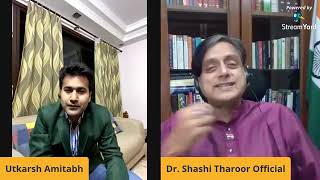
Dr. Shashi Tharoor talks about Tharoorosaurus, his collection of 53 words chosen from Penguin's original proposal of 100. He traces his love of language to childhood word-games with his father, explores Indian English and etymologies like satyagraha and namaste, and added pandemic entries during late edits.
Questions this video answers
53 words.
100 words.
It came out in the beginning of August (publication delayed by the COVID pandemic).
Chapters
Welcome to Network Capital. Dr. Tharoor. Your three part podcast was a massive hit on our platform. In fact, it was downloaded millions of times. Which goes on to say that your career and work principles appeal to millennials around the world. Today, we're very excited to talk to you about your newly launched book, Tharurosaurus and the Art of writing. So Dr. Tharoor, tell us, where did the love for words come from? And what did an average afternoon during summertime look like in the Tharoor household back in the day?
It goes back to my childhood, as you rightly surmise, because to be honest, it's very much linked to my father, who was a bit of a word nut in the classic sense. He just loved everything to do with words. He loved word games like Scrabble and bingo. I mean, not bingo, Boggle. Scrabble and Boggle. And he would make up word games like, you know, there was never an idle afternoon for my sisters and me. He would come up with a nine or ten letter word and challenge us to make the longest possible list of four letter words. And my kids sisters might be allowed to make three letter words as well. And then we compare the lists and we'd always discover that he thought of words we hadn't. In con car journeys, he used to have a wonderful game of his own invention, which I regret very much that I no longer play, which consists of one person in the group imagining in his head a five letter word and the rest of the people in the car have to guess that word by suggesting other five letter words that all the first person has to say is how many letters are in common. So let's say you imagine the word stick and somebody says myths. Well only the S and the T are in common. So the personal thought of six says two. And then you have by a process of elimination got to figure out which those two are and then save them in your head. And within 20 tries you have to guess the five letter word. It's a lot of fun and we did that kind of thing. So anyway, the point is, with my dad it was that he really instilled in me a fondness for words, word games. I'm not a linguist or a philologist. I have no pretensions to being an English teacher or anything like that. I've just been brought up to love words, love them. All my life, my cherished childhood memories are around word games with my father. And along with that came the conviction that words are what shape ideas and reflect thought. And the more words, you know, the More the more precisely and effectively you're able to express your thoughts and ideas. And so the whole business of how words could be put together, their origins, the letters in which they're made, the way in words in which words, all sorts of ways that they can offer you pleasure and delight. This has been a recurrent interest of mine since my childhood. And I must say that one habit that's gone on past my generation is my father's fondness for Scrabble. I now have a nephew who's as much of a Scrabble nut as my dad was. My son somehow got too busy to develop that habit, but he and my. And my sister. He usually beats my sister and me, for that matter. Scrabble lives in California. So we've got this. It's almost a genetic thing in the Tharoor household.
Since you asked, what's the longest word in the English dictionary?
Well, I mean, there are long, long words. There's one word that goes on for 20 pages of the dictionary, but no one ever uses it. It's pointless. I don't actually value long words for their own sake. The longest word that one can imagine, a very rare use for, is pneumono ultramicroscopic siliconovolcanoconiosis, which is an extremely obscure word for a very rare disease that affects, I believe, 1 in 99 million people. Because it is a kind of illness of the lungs that affects coal miners or other miners who get a particular kind of very microscopic particles of coal dust in their lungs or something like that. I read about this once and I said, well, I'm never going to need to use this. I won't bother to remember it. But it stuck. And that's the word. But if you look at words that are usable in multiple contexts, which is where the usefulness of a word comes, right? I mean, if you can use a word only in one context, it's pointless, it seems to me. But if you look at words that can be used in multiple contexts, then you have, you have more fun. And fluxinos in helipilification would therefore be my favorite long word. It's a made up word. It was made up, I believe, by a bunch of undergraduates in England in the 19th century. But the fun of floxinosin heliopolification was very much the idea that it was a fancy way, and certainly amusingly fancy way of saying the act of estimating something as worthless. It came from, I think it was Eton College, by the way, where they did this. It came up from Fluxus which is Latin for a wisp, naucum, which is a trifle, nihilum, which means nothing, pilus, which means a hero. And fication, which of course you can add to anything, you can add fication to and make an abstract noun out of it. So they've got four different ways of saying nothing. Trifling a wisp of things, no consequence, like a hair. And then with that they throw it into absolutely, absolutely every context where you want to say something is worthless. So I actually knew this back in school and college, but it was.
How did you find that word? That's the question. You don't read dictionaries?
No, I don't love dictionaries. I mean, I don't need to because I grew up in an India without television, without computers, without mobile phones, without PlayStation or Nintendo. Essentially I grew up without any other distraction available to an asthmatic and often bedridden child than books. So I read widely and indiscriminately. Books were my escape. Books for my education and books for my entertainment. And because I did that, and I read so widely and indiscriminately and I must say I read above my level because I didn't have any older brothers or sisters. So once I finished the books available to me suitable for my own age, it was only my parents books I could find on the shelves. So I read and read and read. And when you come across an unfamiliar word in two or three places in context, you will figure out the meaning, not just the meaning, but even the nuance and the usage fairly quickly. So reading was the way I acquired these words and reading about words, you know, my father, for example, used to subscribe to the Reader's Digest. It was quite amusing because he later joined them, but he did spend a lot of his hard earned money buying the Reader's Digest. And they had lots of articles about words and so on, which were fun to see as well. And then of course there was the whole business of, of if you read widely enough, you'll come across things. I must have come across voxinhosin vilification in some article about long words. And the conventional thing in my childhood was that the longest word in the English language is supposed to be anti disestablishmentarianism. Establishmentarianism was the British argument of an established church. The Anglican church is the establishment, is the established church in England, just as the Lutheran church is the established church in Denmark, and so on. So when you have an established church, disestablishmentarianism is the position of those who argue that the state should not have an established church, all religion should be equal, and anti disestablishmentarians were those who opposed those who wanted to unestablish, as it were, the established church. So that was the word. But Floxinosi, the hillipunification is even longer by a few letters than anti disestablishmentarianism. And that's why I thought it was a fun story to throw into my, into my Theurasaurus book.
How did you choose the words? As somebody who knows quite a few words for his love of learning, narrowing it down to, I believe, 53 words would have been unfair to some. So how did you go about that task?
Well, I think the idea was supposed to be that in fact, the very first time Penguin proposed it to me, they suggested 100 words. But it takes time to, you know, write each of these. I was busy, I had lots of stuff going on. Parliament is a demanding thing and so on. And therefore what I did was I said, why don't we do it on the principle of one word for a week? I actually had a short lived word of the week column in a Delhi newspaper. And I thought, why not follow that principle, a word of the week and we'll throw in one more for the leap year this year. And I imagine Tharu Rosaurus as the kind of book that people would, you know, leave in the bathroom and dip into every few minutes when they were contemplating the universe, as it were. And they would, they would actually not ever read it from COVID to cover. So if they wanted to read a word a week, it would keep them occupied for a while. That was the, the kind of argument that I came up with. And Penguin liked that idea because it also meant that I'd finished the manuscript sooner and they could publish sooner. But ironically, their intention of publishing in, in, in May, I think it was, got completely knocked out by the coronavirus and the pandemic lockdowns and all that. And finally the book came out only in the beginning of August, so we lost a few months. But by then the book had been cast in stone and so we stopped at 53. I mean, frankly, you're right, I could easily have done 100, 150, but it would have just taken me much longer to write.
You've also included a lot of examples which are current, some from politics, some from the global. Pandemic is a word that you go on and explain in great detail. That means you edited it till the very last minute, it seems. What was the process of writing?
Well, I Mean, the thing was that, you know, the words were going to be any case, I think so from a. A variety of sources. The idea was always that we would have some words which, shall we say, The origin stories of those words or the nuggets of history associated with the word, becomes interesting in its own right. In some cases there would be words that we suddenly started using much more like pandemic and quarantine because of what was going on with COVID So I tossed them in and some words are not difficult or rare words at all, but I wanted to say something interesting about them. So, you know, this whole business about the word yogi and how it's often conceived differently in America, or the word goon, which I have an argument with all the established lexicographers because I'm convinced it's a contraction of gunda and they disagree. So all of these things gave me. So these are words which are not particularly rare or difficult, whereas there are words like paraprozdochian or epistemophilia or whatever. There are words which are complicated, abstract and unknown in many cases that I felt are worth describing, that I even threw in a couple of words of Indian origin. But this book is meant for Indian readers and the examples given are very often of Indian relevance. So I threw in satyagraha. Very few people know that it was a word invented by Mahatma Gandhi in South Africa as a result of a newspaper competition calling for a better term to describe his activism than passive resistance, which is the unfortunate word that British journalists use for civil disobedience. And he said, if you believe in the truth, you can't be passive about it. I want a better term than passive resistance. We invited suggestions and Satyagraha emerged from that. So there's an example, Namaste, again, in the context of the way in which it's become President Macron of France's favoured greeting for other heads of state today, because they're not going to be shaking hands in the present climate. And the other gestures all seem much less civil than a good namaste. And I talk about that. So it's a very mixed up set of backgrounds and stories for all of this. But the idea, frankly, is that people should find different things to interest and please them. And I was very pleased when one of the reviews of the book, the one in the Hindu, pointed out that if you read this book, you get quite a cross section of my interests in life because there are allusions to history, there are allusions to cricket, there are allusions to Politics, they're just allusions to words for their own sake and to literature and writing, all of which have been the principal preoccupations of my life.
I'm flying to London tomorrow and I'm carrying quite a few copies of your book because I'm not sure if it's available there or not.
I think it's only available abroad in Kindle. It's not physically.
Well, I'm going to change that tomorrow, at least for the network capital London people. Yeah. But I assure you that this cross section of words that you've chosen, they're not just going to appeal to, say, an Indian audience or, say, a South Asian audience. But a lot of people would be really interested in learning about words like pre porn. I mean, in fact, before I read your book, I thought pre porn was a word that, you know, it's not really a word, it's just something people say in India, but evidently, like.
No, you're right. I mean, I agree with you. I too, I too thought it was something that I had invented because, you know, whenever I used it, the purists frowned at me. And I had used it in an article way back in 1971 or 72 in then Junior Statesman, and I wasn't aware of anyone else, but then it became a very commonplace expression during my time at Delhi University, and I sort of briefly thought, maybe I'm the guy who first put it into print or first invented it. But then I was corrected by no less an eminence then an editor from the Oxford English Dictionary who wrote to me with citations for the word prepone going back to other countries and other eras, an American newspaper letter writer in the very beginning of the 20th century, and also an Indian source from the 1950s. So I said, all right, I give up. You can't invent anything really easily in language unless you're Shakespeare, because he invented a lot, but not so easy in today's day and age.
Okay, so now you've to connect the dots between oxymoron, PG Wodehouse and Shakespeare.
Well, an oxymoron, as people know, or oxymoron, as some would prefer to pronounce it, is essentially a contradiction. Right. So, I mean, one of the jokes we had when I was working at the United nations is that United nations is an oxymoron because it's a phrase or figure of speech in which seemingly contradictory terms appear in conjunction with each other. Nations are almost by definition not united with others. And if you look at other jokey oxymorons or Oxymorons. You basically are taking two terms which seemingly are the opposite of each other but which are conveying a particular idea. The usage example I give in the book is of somebody who was falsely true in his manner. Now false and true, but that's a good oximera. Shakespeare in Romeo and Juliet talked about loving hate. You know, often with human beings you actually have this love or hate relationship. And Shakespeare is the one who put those two together in Oximerum. P.G. woodhouse, the connection that you asked for was I always advise people never to give advice. And, and then, I mean the truth is that Shakespeare is full of other oxymorons. For example, one of his most famous one is parting is such sweet sorrow. Now sweetness and sorrow together, it gives you such a poignant feeling about like let's say imagine a mother sending off her 12 year old to boarding school for the first time. Something I disapprove of. But it happens a lot in our country. And he's got tears in her eyes. He's got tears in his eyes. At the same time he's excited about starting a new life, making new friends and becoming more self reliant and independent. Parting is such sweet sorrow. Almost perfect. Shakespeare had this genius for coming up with these terms and I think that really is something that one can milk for humor. For example, anti Americans often say that American diplomacy is an oxymoron. And people who sneer at people in uniform say military intelligence is an oxymoron, and so on and so forth. But there are the cleverest ones are more than just a two word phrase. They're often an entire sentence or an idea. For example, there was, you know, an American writer who said, I find nothing more depressing than optimism.
I thought a French person said it.
Paul Fussel. Yes. I mean the thing is that to be honest, I never checked his nationality. Maybe you did, but I think that I did.
I was just guessing. French often take that line, let's say things like that.
Yeah, well, Edna St. Vincent Millais famously said, I love humanity, but I hate people. I never often told my mother that. She's, you know, she's the opposite. She loves people, she's constantly wanting to be in contact with people. She hates humanity. So these are all oxymarins that are there. And you know, so often ordinary people in conversation are using oximerins without even thinking about how many times have you been told to act naturally, you know, or this is an open secret. I mean these are phrases that are so obvious. Or in our country Constantly. In bureaucratic offices and government offices, clerks often ask me for an original copy. How can an original be a copy?
Or an exact estimate?
An exact estimate, exactly. Anyway, so all of these are. All of these are real problems. But at the same time, it's a fun, fun way of putting things together. And people do it all the time without, without thinking of it very consciously. I mean, young men talking about women and saying, oh, she's awfully beautiful. Awful and beautiful together is an oximeran, but the meaning is not meant to be awful. Right. So anyway, or a girl saying, he's terribly nice about you.
Dr. Throor, I've seen a picture of your mum reading the book with a smile on her face, and I think your book does bring a smile on people's faces. What did she say and what have people told you about the book so far? What kind of feedback are you getting?
Well, the feedback has been essentially so far, positive. I can't say it's been extensive and I haven't had the time to go and look at any of the online review feedback from readers on things like Amazon or Goodreads or whatever. But as far as I'm concerned, I think that when you look at a book like this, it's more about imparting pleasure. I'm not really trying to impress or change people's minds, any of those highly noble things that writers are often all about. I have another book coming out in November which is a very much more serious endeavor to influence people's thinking and make them think about things they take for granted. And that's a book on nationalism called the Battle of Belonging, which is about the theory, the concept and the practice of nationalism worldwide and then more specifically in India, especially at a time when nationalism, what's anti national and so on have become such important issues in our national discourse.
I did check, actually. Your book is a best seller on Amazon, so congrats on writing a bestseller every year. I don't know how you do it, but people definitely appreciate Dr. Sru. Do you think that your being multilingual has made this book really rich? Because I see that you often talk about the origin of the roots and these origins contain these stories. Has that been a factor? How did you find some of these stories? Extensive research as well.
Yeah. As I acknowledged in the beginning of the book, I did have the help of a retired English professor who, very sweetly, Shiva Tatil did the research for me on things like word origins. Many of the stories, of course, are public knowledge and some I knew some came from her research and some, frankly, well known enough that I just needed to check some of the details. I mean, for example, I knew Voltaire's play condide, in which Dr. Pangloss appears. So when I was writing about Panglossian, that's a story I could tell. Or on Satyagraha, that's something I knew from reading and studying about Gandhi, our Mahatma Gandhi. But then there are other things. For example, I'm not a versed in classical Greek or Latin, so if I wanted to explain to people that pandemic comes from the Greek, classical Greek, pandemos, meaning pertaining to all people, public or common, which is made up of pan, all and demos or people, that's something I would need to get from serious research, because I don't have the Greek in my head to be able to say that. Whereas I do, I think, have the capacity to say something authoritative about Namaste or Satyagraha. And I have enough French to explain the usage of the word plaque and so on. So it depends. The Welsh qutsch was something I actually read about. I didn't know. I'd never heard the word qutch used, but it's sort of this very special hug that combines all sorts of wonderful qualities and I thought it was a wonderful word to know, and I'm very happy to popularize it. And ever since I put it out in print, a lot of people have been using it in the unlikeliest places, particularly on the Internet. So it's always nice to contribute to a bit of the conversation with this kind of thing.
And you've actually done a great service to readers by including the pronunciation, because I didn't know the meaning of this word, but the pronunciation really made it accessible. It's, it's, it's not what it like, it's not what one would have expected. Right. It's, it's, it's very, it's, it's different.
I think, because it's Welsh and there's no, there's no vowel. It's cwtch. So you've got to figure out. I, when I first read it, I assumed it was quatch, and then I was corrected by Welsh person. So there you are.
So, Dr. Sroor, it seems like you also invent words. Pre porn, maybe, sort of. But quizzard seems to be something that comes from St. Stephen's Yes, I did.
I did, I did. I established, I'm proud to say, the first ever quiz club of any campus on India, or probably any institution, educational institution, India. The quiz Club of St. Stephen's College. I was president of it. And I must say I do did well at quizzing myself. And I developed a habit of referring to people as quizzes. A quiz wizard was a quizzer. That was the idea. I don't know if that's going to get into any dictionary, but I'm proud to lay claim to it. Except I can't show a published source for it because it was a word I used in conversation in college and speeches in college and maybe in announcements on the notice boards in college. But I don't think it was ever published anywhere at that time.
Dr. Srur, you talk about you being free from envy in some part of the book. It's just something that struck me as a very important career, principle, life principle, work, principle in whatever. Is that like? I'm sure it's true, but is that easy? Yeah, is that easy? How does one inculcate that? Or how did you make that happen?
Well, I made it happen because, you know, I had very much the sense that I could do what was expected of me. And, okay, this is going to sound much more arrogant than I intended to, but I had this habit at school of coming first in the things I did. Whether it was coming first in class and the exams or winning the debates and speech contests I spoke in, or winning best actor in the school plays. Mind you, I also did pretty badly when it came to athletics or sports or physical exercise or other activities. And so I realized that people had different talents. I just happened to be good at the things that I was good at, and other people were good at things that they were good at. And therefore there was no reason to envy them because that's the way they were. And they should have no reason to envy me because it's the way I was. Equally, somehow, from a very young age, I had the conviction that the world was large enough to accommodate everyone's success. That is, that if other people did well, I rejoiced for them because it was good to see my friends happy. And if I did well, I expected them to rejoice with me. And I must say I was blessed with friends who did rejoice with me. And so envy and jealousy and resentment was sufficiently uncommon in my life that whenever I was the object of it, I was both hurt and repelled. And because I thought that that was such an unworthy emotion for another person to have and to express that I too felt that it would be unworthy of me to ever feel that way about anyone else. Now I'm not saying that that's perfect, but to me it's the best way to live. I've often found that some of the things that I've instinctively adopted, for example, I tend not to be very judgmental. I accept people as they are. I've often been astonished when other friends, you know, somebody will come meet us, chat, they go away. Then immediately friends start judging them behind their backs and making adverse comments. I don't see the point. I said, you know, just met and talked to this person. That is how he or she is. Why do you need to judge them? What do you gain by judging them? What do they gain by your judging them? What does the world gain? So I tend to be instinctively somebody who accepts people as they are. I don't envy people their successes. I do commiserate with their failures because you don't want to see people suffering, but I don't envy them their successes. I wish them well. That doesn't mean that I haven't going to give up the idea of my own successes. No. I want my books to be read. I write because I want an audience. I'm in politics because I want to make a difference in people's lives. I have ideas that I want to communicate to the world. So all of these things I'm motivated to do. But I don't see the world as a zero sum kind of place where I, I can only do it at the expense of somebody else, that I can only rise by pulling somebody else down. Unfortunately, coming into Indian politics, I've seen much more of the negativism, the so called crab mentality, the India famous or notorious story in India about. I think you all know the story, but just for those who don't, it's the story of how an Indian wins a global tender for shipping crabs by throwing all the crabs into an open crate and sending them off by ship. And all the other companies come to him and say, but how can you do this? You've quoted below our packaging costs. He said, I don't do any packaging. I throw them into an open crate. And they say, but that's crazy. Live crabs will climb out of the open crate. And the Indian says, ah, but you don't realize these are Indian crabs. The moment one of them starts climbing to the top of the crate, the others will get together and pull them down. And that joke, which is a joke I've known for 40 years, it was a joke you could tell when you never took it seriously. But I have come back to India, and particularly in the domain of Indian politics. I see a lot of that crab mentality.
So management thinkers call it the difference between playing infinite games and finite games. Infinite games are ones where you keep playing and where your objective is to, you know, stay. And finite games are where only I can win when you lose. That seems to be the core of envy. Now let me tell you an interesting fact about the Pali and envy. The language Pali word called mudita, which means taking pleasure in another person's success. There is no word, there's no word equivalent of that in English. So that.
No, in fact the opposite word is there. In my book epicaricy, which is actually English form of a better known German word, schadenfreude. Schadenfreude is used often by English speakers as well, particularly in America, where there's a lot of, a lot of words. But epicaryocacy is precisely about that. It's about taking pleasure in other people's failures, humiliation, sufferings. And I'm so pleased to have you tell me about Mudita. I've known people with the name Mudit without realizing that their word has such a philanthropic connotation that their name is such a positive connotation.
In the book that I just published, like publishing this coincided. I talk about this as a philosophy for working life and Internet games. So when I read the word that you talk about in envy, I thought that's a clear parallel that I observed.
Thank you. Yes, not just a parallel, it's an opposite. And that makes it all the more interesting. It says something about a culture if it can produce a word for taking pleasure in the successes of others, when other cultures have only produced words, both, in this case both German and English, in deriving pleasure from the misfortunes of others. Very good.
And Dr. Sroor, you talk about a wide range of words. One difference that I would love for our listeners to understand is the difference between xenophobia and racism. I thought it was really well explained in the book, although a bit like, you know, I know that you have a lot more to say on the subject, but I mean, I know we have limited time, but is it possible to explain, explain that a little xenophobia.
Is essentially about foreigners, about disliking foreigners. So irrespective of race, xenophobia is fear or hatred of anything or anyone, alien or foreign. And so there's no question that there are people, of course, in every country, including ours, who resent foreigners because they're strange. Phobias are of course, fears. And it's because of your fear of something strange and foreign that you then become somebody who wants to promote xenophobia. Now, what's interesting about that is that racism is a variant but is not the identical thing. Because whereas, for example, America or Brazil are multiracial countries, and some would argue, theoretically, we too are a multiracial country, a racist would hate somebody of a different race even if that person were an American in America or a Brazilian in Brazil. Whereas a xenophobe would hate somebody from a foreign country even if he or she was of the same race. So the two are not identical. In other words, let's imagine a white American xenophobe would dislike, let's say a white Bulgarian, whereas a white American racist would dislike a black American. So that's the kind of difference between the two. To put it very much in brief.
I just want to do a quick time check because we have a small rapid fire round, but do you have five, seven more minutes?
Sure, go ahead. Yeah.
Are you a geek or a nerd or neither. And people need to read the book to find out?
Yes, let people read the book to find out. I'd like to think that I'm not either, but I'm sure that after reading this book, some people will decide I'm a word geek.
Okay.
Do trolls trouble you very much? Daily? I've had to learn to ignore them on my timeline and Twitter, for example.
All right, do you have a favorite word?
I was asked this by a school child once in Thiruvananthapuram, and I said, yes, it's a very simple word, read. I said, the more you read, the more words you'll acquire. So that I think would have to be. My favorite word would be read or reading, which is really what I've done to acquire all the words I have.
When you come across a new word today, what do you do? You don't run for the dictionary that we know. How do you figure it out?
Well, I basically come across words in the context of reading. So I'll figure out from the sentence what the meaning is, and then I'll store it in my head until I come across it somewhere else and reconfirm that the meaning I understood was right. I mean, so it's entirely possible that you may misunderstand from one usage. So ideally, you need two or three usages of a word to be sure you've got the meaning and then you use it. And if somebody doesn't tell you that you've got the word completely wrong, you just go ahead and become part of your vocabulary. It's almost like acquiring, shall we say, a new habit. So, you know, it's like growing a beard or something like that. You know, first hairs appear and you look at them and you figure out, okay, so this is what this is for. And then you let some more grow. And after a while you have a beard. And as long as people don't, your spouse or partner doesn't tell you go off and get rid of that fuzz you have, you have the beard. And similarly you acquire a word in that way.
Do you think that Indians are. Or English language is far more inclusive than Indian languages?
Yes and no. English is inclusive in that it's an unashamed borrower. I mean, my joke going back to my work on colonialism, which said that the British took the word loot into their dictionaries as well as their habits. That's actually true because it was a Hindi word. They took that and it became an English word. And most people who use the English language don't realize it's a Hindi word. For that matter, what they say as thug, which is actually thug in Hindi, again, came into English from India. So what you got with the English language is a capacity for absorption from French, from German, from pretty much every country they've had in dealing with, they've happily taken words. And it's a live language. I think every year the Oxford English Dictionary issues updates with new words in it and so on. Many Indian languages are a little more fossilized, a little more set in stone, and they have a tendency, when a new word or a new concept comes their way, one of two things happen. Either they sort of completely Sanskritize it, as in Hindi, or in some rare cases, they just keep the English word intact but render it in an Indian script. So I would say that English is a little more flexible in its willingness to borrow from other languages. But Indian languages have the flexibility sometimes of lifting directly and just allowing it to use. For example, there is, I'm sure somewhere a fancy Hindi word for passport, but as far as I know, everyone just says passport. I think there is definitely a sign for immigration at the airport. That is a big Hindi word you can't lift and pronounce. But again, moose, casual speakers of Hindi, Hindustani, would say immigration, the English word. So to that degree, Indian languages are also flexible, but perhaps some would argue, not flexible enough by comparison with English.
Malayalam, the language, your mother tongue, is different, right, from Hindi and Sanskrit in that it's a little more inclusive.
Yeah, well, a little more. No, Indian language in that sense is terribly inclusive. This way. The thing about Malayalam is actually it has a lot more pure Sanskrit in it than any other language does, including Hindi. Pure in the sense that whereas in Hindi you can see the derivation of a word from Sanskrit, but it's been chopped off. So, for example, in Malayalam you can talk about a place of worship as a devalayam, which is the Sanskrit word. In Hindi, at most you can say devala. And of course, most of the time you'd say mandir anyway. So the thing is that you do have more sort of direct borrowings from Sanskrit and Malayalam. At the same time, you have a Dravidic linguistic structure derived from classical Tamil with a lot of vocabulary, verbs and so on coming from Tamil, sentence structures coming from Tamil. So it's an interesting language in that sense because it's born of these two very different roots. But at the same time, I would say that most Indian languages today are a little more ossified than English is. But I believe that's true. One of the strengths of English is its constant capacity for living and expanding and changing.
Is there a difference between, say, Indian English and poor English?
That's a very tough one to say because I believe that most linguistic scholars around the world accept the proposition that you can't just have one standard version of a language or one standard received pronunciation, as they call it in Britain. That American English, for example, which is the first distinctively different English, but then Irish English, Australian English, South African English, they're all valid forms of English language with their own accents, their own conventions. Then you come up with the Asian languages versions of English. So, for example, in Singapore and Malaysia, they will add Allah at the end of a sentence, a way in which in Hindi you might add a ya or something when you're speaking. Is that bad English or is that just Singapore English, Singlish? I think today the more indulgent practitioners of linguistic theory would tell you that you can't judge that that's okay for the Singaporeans. Why can't you accept it? Just as you accept the Americans staying gotten. Whereas gotten went out of use in England by the 17th or 18th century. America, remember, took the English language with them in the 16th and 17th centuries. So some of the usages that remain valid in America had died out in England, for example, in England, they only talk about autumn. In America, they talk about fall, when the leaves fall, you see. But that was the term in England in Shakespeare's day. So this kind of thing gotten and fall and so on made American English very distinctive. Now, of course, there's so Many more differences. I mean, elevator rather than lift, or apartment rather than flats. And in India, you've got this very interesting phenomenon of both American and English coming into our usage. And it's very interesting to see that both elevator and apartment are much more common now than in my childhood, when British English was the only acceptable English. Now, elevator and apartment often, more often used. I see Indians saying schedule all the time rather than schedule, which was the way the English was taught to us. The way that English was taught to us. Now, coming back to this entire business of Indian English, some things are usages or fashions of speaking, such as prepone, which I believe are entirely valid, and there's nothing completely wrong. But some terms are simply bad English. And knowing which is which is something that ultimately has to do with the actual user of the language.
I think, Dr. Saror, you're a learn it all. And you even today, despite your intensely busy schedule, the one thing that jumped out at me from your podcast that we did a few months back and the book, is that you find time even today to learn new words, learn new concepts. So the question that our listeners will ask is, do you sleep? And if not, what's the secret to this hyper productivity?
Well, I don't sleep enough, and that's actually not a good thing. It's not something I'm proud of. I genuinely believe that it'll be much better for me and for all those around me if I did get six hours sleep, which I almost never seem to manage. I manage between 4 and 5. And people around me also often keep those hours when they need to work with me. So it can be. It can be. Can be a bit frustrating. But let me say that I've been blessed with an insatiable curiosity. And with that curiosity comes an appetite for learning. I always want to know more things, interesting things, different things, and that's how it comes up. Ultimately. I didn't finish my answer to your question on Indian English. I would say that the only test that matters is the test of time and usage. If enough people find a word or a form of use of that word or phrase useful, that makes it legitimate. And because Indian English is used by millions every day for practical purposes, why can't we use it? You know, many phrases we take for granted in ordinary conversation are actually quite unusual abroad, like calling elders auntie or uncle. Only Indians do that, but we do it. The British and Americans look at us with astonishment or, you know, saying, I'm not non veg. No one says non veg outside India. But this, to my mind, is Indian English. It's not bad English. Now, you can argue about terms from our media like air dash or history cheetah for somebody with a long criminal record, but I don't see any particular problem with that. These are Indian usages. Or when an Indian student tells a foreigner he was mugging for an exam, bewilderment will be guaranteed because they don't use mugging that way. They have two other meanings for the word mugging in the West. So being a victim of a mugging in a dark alley, right? Or somebody making a really funny, comically exaggerated expression like he was mugging for the camera. But for us, when we say I was mugging for an exam, that's a term or a user that doesn't exist in Western English. Does that make it wrong? No, it just makes it Indian. So that's the kind of. Kind of difference that I would make. And I would say that everything from British complexion and our matrimonial ads to even phrases like, you know, we are like that only. Which sounds a head nod. Yes, that's right. What is your good name as opposed to your Dhaknam, as they say in Bangla. So all of these are. But there are some mistakes in Indian English which are simply mistakes because they violate the basic concept of the word in the English language. Like, for example, we have this terrible habit in India of saying till when we mean as long as. So I will miss you till you are away. Which is actually an absurd statement. You actually mean, I'll miss you until you come back. Because what you mean is, I'll miss you as long as you are away. You see, I mean, that misuse of till is a classic Indian mistake. And I think that kind of thing one can genuinely dismiss as badding. Whereas a use like, you know, within the Americans and the Brits, there are so many amusing misunderstandings. One is the British, sort of purest, who said he had a heart attack on a plane when the pilot said, we'll be airborne momentarily. Because in English, English, momentarily means for a moment. And he thought, oh, my gosh, we're only going to be airborne for a moment, that it's going to crash. Whereas in America, momentarily is used to mean in a moment. Now, you can't say that's bad English. Foreign Englishman is bad English, but it's actually American English, American usage. So that kind of thing also applies to Indonesia.
Well, Dr. Sarood, thank you for sharing your curiosity, your stories. There's so much more that we can cover, but I want the readers and our listeners to actually read the book, learn about Farrago, learn about Indian English, the beauty and inclusivity of Indian English. And we look forward to having Dr. Saror back in his new book launch in November. But before that, Network Capital London waits for your book hard copies day after when I land. Thank you doctor.
Have a good safe flight. And don't forget your mask and your shield and all the other protections you will need for the journey.
I will not Dr. Soor. And thank you for again for sharing and doing so much during the COVID pandemic. We really appreciate that.
Thank you Utkarsh. Much appreciated. Always enjoyed talking to you. Take care. All the best.
More from Utkarsh



Utkarsh Amitabh: From building my startup along with my job at Microsoft to Literature & Philosophy!



Freedom Of Speech, YouTube Economy & Algorithm Unplugged: Utkarsh Amitabh, CEO of Network Capital

The President of India and Dr. Anamika (mom) at the inauguration of the Festival of Libraries




What was India like when Education and Skilling Minister Dharmendra Pradhan was 18?