ADHD Rise | ADHD, Autism & Parenting | Carly Considine | Hosts: Val Nichols & Summer Christiansen
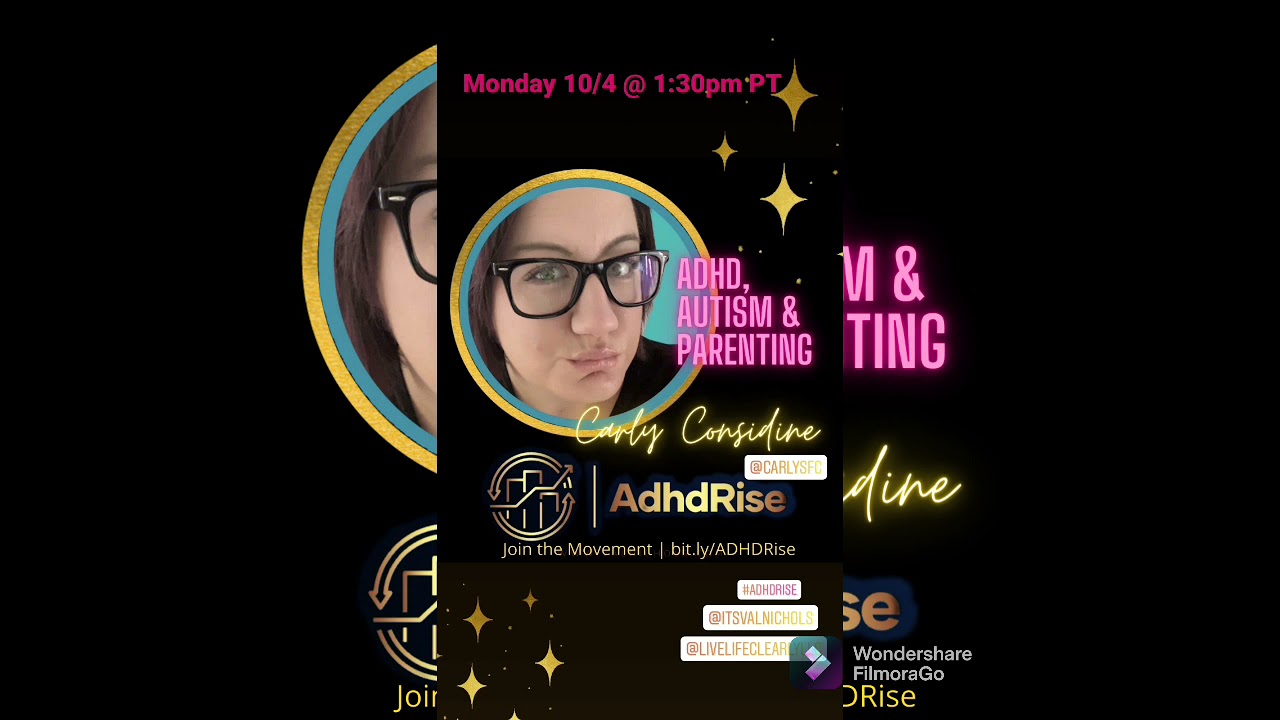
Val Nichols and Summer Christiansen talk with Carly Considine about parenting neurodivergent kids, late autism and ADHD diagnosis, and masking. They cover school support, sensory issues, the difference between meltdowns and tantrums, and how parental guilt and burnout show up.
Chapters
As the evening goes on. Um, and on a side note, I am now exploring the idea that I could have ADHD as well, and I am on the waiting list to be assessed. So yeah, thank you.
Awesome. I did not know that, Carly. I know that, um, you have children or a child that has ADHD, so why don't we, why don't we just go there? Tell us about your experience with autism Um, and then how, how that affects your life or how it's in your life, and then with ADHD.
Um, no, my, my daughters are autistic, then they haven't got ADHD. Um, okay, it's only me. Yeah, it's only me that, um, we are, um, we're looking into. And it's because of Clubhouse that it was just, you know, Damon's Rooms and you guys and stuff. It was just a bit like Okay. Because I also thought ADHD was where you just couldn't sit still. You were, you were hyper all the time. You, you were just fidgeting all the time. I didn't realize ADHD could be that you were hyper in, in your brain, in your mind, in your, um, in the inability to be able to focus. And that's something I really struggle with, is the inability to be able to, um, process things. So, you know, I have 150 billion ideas in my head, but it's, but it's putting it on paper that I really struggle with. It's the, it's the executive functioning, I guess you would call it. Um, and it's really frustrating because I procrastinate massively as well. And, um, yeah, it's just really difficult. And I'm learning more and more about ADHD, and as I've learned more and more, it was a bit like Okay, I could be then. Because as I say, the misconceptions are that, you know, as I am a prime example, that people think that people with ADHD are those who have the inability to sit still, when actually it's a lot more than that.
Yeah, it truly is a lot more than that. I think, uh, now that we're, you know, in the 21st century and we are having so much more, um, research and ideas that are being presented about what ADHD, neurodiversity in general is. I feel like we really do know more. And so it's, it's hard because I feel like it's not getting out there, um, at a fast enough pace, but we are learning so much more. And as parents especially, I think that that's something that's super helpful. Like, I was diagnosed when I was younger, but there's so much that, you know, that we are starting to learn. And it isn't just for the hyperactive, um, like little boy that's physically hyperactive. We also— there's lots of research that's showing that it's our brains that are also hyperactive, which is, um, why ADHD and generalized anxiety disorder can often go together. So I think that that's such, such a good point, um, that, you know, it wasn't like it used to be, but we really are kind of branching out there and learning So many good things. I think it makes it makes my my mom heart and my woman heart super happy to to know that our future generations are going to be empowered and educated on how they can live their life with ADHD and autism as well. Like the I think it's 40% of those with autism also have ADHD. So I think then that's that's kind of an interesting. Interesting study that I've read. So, okay, so tell me about your children and autism. So let's keep it like, as a mom, what things are you doing for yourself being a mother of 2 autistic kids and having autism yourself?
I mean, I will admit it's not easy. Um, both my girls were diagnosed in 2019. They are now 11 and 14, and their autism is very different. They are very different children. They present it in very different ways, and they have very different comorbidities. Um, and so juggling that, juggling trying to navigate the school system and, um, trying to get support not so much my oldest, but for my 11-year-old, um, you know, trying to navigate support, emailing school all the time. Oh, she wants to know if this— like, example, tomorrow they're having school photos and they want me to— she wants me to email to say, can that— can they not use the flash on the camera because she won't be able to cope with it? So it's just— it's like tiny admin bits like that, trying to chase the school for support. But now I have now taken on homeschooling my 9-year-old son, um, because school was just not suited for him. He's— he has high anxiety, and actually, probably, I would put money on it that he's probably autistic as well. Um, and that, that's something that we will look into in the future because it's very prevalent in my family. Um, like massively, that we've got lots of people who are autistic in my family. Um, my oldest, um, She did come to me and say, "I think I have ADHD as well," but the school were very much like, "Well, you know, it's hard to differentiate between what is autism and what is ADHD," and and that it would be hard to get a diagnosis based on that because they can't differentiate between what traits she is presenting in ADHD. She's presenting in autism. So they completely dismissed me. So it's something that, you know, maybe in the future we can look into. Um, so it's really— it can be really hard and overwhelming for me as a neurodiverse person trying to juggle all that. Um, trying to navigate in the neurotypical world with my needs and my children's needs. So yeah, it's, it's hard. But it's rewarding at the same time because I teach them to embrace their autism. And, um, and yeah.
And I think that's, I think that's key, um, especially as we do know so much more now, helping them feel empowered in their place. And, um, with ADHD, with autism, with any neurodiversity, I feel like it's such an important place to be, um, where your kids will feel empowered. Because I think the past has us being able to, um, feel stuck in the past. It feels like we are like this different, uh, almost this like different breed of people. And, um, I think autism definitely has that stigma. And I think it's important that as our kids, um, grow up in this generation, that they feel empowerment. Like, that's one of the things I really, really try and push is that We are helping our kids to become who they're meant to be and to step into their power as an ADHD, autistic in this case, like we're talking, neurodiverse, is stepping into that power. Like, what works for you? You know, Carly, what, what do you do like as a mom to help empower your kids with autism?
Um, I think try to teach them to use their qualities. Um, now my oldest is very artistic, so I, I try and get her to utilize that tool. Um, and that, I suppose you'd call it a gift. Um, and it, it's— I try hard to make them not feel that it's a hindrance. It's actually, um, it's a positive thing. And I don't know if you saw my post on Instagram, my 11-year-old made a picture that said, society says I'm autistic, but God says I'm perfect. And that to me was just— that showed me that she has learned to embrace who she is.
I have chills, Carly. I love it.
I know, I don't know, it just— it's just amazing. Um, And you know, they're both very—they're both very self-assured. You know, they're very strong females, and—and it's just proud of them every single day because they—they own who they are. My eldest is also LGBTQIA, and she is so pow. She's just empowers who she is, and she. She owns who she is, and she's just— she, she knows who she is at 14 more than I do at 39 years old. And it's just— she just makes me so, so proud.
Yeah, excuse me. I love that. I love that. I, I have enjoyed seeing my kids kind of come into themselves. I mean, as they're constantly learning, but I have enjoyed watching them come into themselves a lot. Sooner than I did. It took me so much longer because my parents tried, but even though I was diagnosed younger, it was very difficult for them to give me what I needed. I was diagnosed at 11 and I still felt like it was very difficult to get the help that I needed because there just wasn't. My mom was here this weekend and we were talking about that same thing. So Val, did you have any thoughts or comments on, on what Carly's Yeah, absolutely.
I am so excited that you're talking about this. And the cool thing that I'm hearing you talk about is like, you know, that empowering the child, making them feel like they're not different. Because for me, when I got my late diagnosis, I did feel shame and guilt. And, you know, I went through a little bit of a thing, right? Because if we're ready to rise, that means we're starting from somewhere. So we all start from somewhere. And I was definitely starting in that space of like, Oh my gosh, there's something wrong with me. Why didn't anybody know? You know, that feeling. But I'm wondering from a parent's perspective, the parent who's out there who's listening to this right now, and maybe they're thinking like, oh my gosh, my kid is ADHD and/or autistic. And I'm like, holy cow, you know, how do I do this? Did I give this to them? I mean, I've heard of the mom guilt thing, you know, and I'm sure that that is a very real thing. But like, what would you suggest to someone who maybe is just starting out and they've— they're like, I don't know what to do. Like, what do I do next? How do I get support? Obviously they're here, so this is great. But, um, you know, what would you give— what advice would you give them?
When they were both diagnosed, I had 100% had very much mum, uh, you know, guilt, the guilt of knowing because I was diagnosed first. The guilt of knowing that genetically I had passed it to them. And I just felt this immense feeling of guilt. But it's better now. It's, you know, it's very much like it is what it is. You know, we are what we are, and let's embrace it. And yeah, I did really struggle with that. It was really hard. But I'm very, very much pro-diagnosis because, I mean, the downside to diagnosis is that you only get this— you only get the support and services with a diagnosis, which is completely wrong in my opinion. There should be services for children who who do identify, um, to have those traits. But it's sadly, especially in England, things don't happen until you get a diagnosis. Um, but I'm very, very much of the— I'm very much of the idea that it's important to have them diagnosed as a child because then they will have the support throughout school. Um, because I didn't have that and I— it, it it was very impacting on my mental health because I spent my whole time at school just feeling completely misunderstood, um, lonely, miserable, um, and I, I was often pretending I was ill so I didn't have to go to school, um, because it was just— it was like hell for me because All people did was just pick on me or just think I was weird, or— and there was no support. There was no support with lessons. There was— it was like I was just thrown in the deep end. Even the teachers would laugh at me because I was in learning support. Um, and then even navigating my 20s, working again, not knowing how— who I was. And it just got to a point where they just then threw antidepressants at me. And I spent many, many years on antidepressants, feeling so incredibly miserable because even with my own family, just that massive feeling of just nobody understanding me and feeling completely misunderstood and ostracized and the black sheep. And, and when I was diagnosed, it was just like this massive light bulb moment.
Mm-hmm.
And right in that moment, my whole life just made sense. And it's the best thing I ever— apart from obviously getting married and having my children, you know, having that diagnosis was the best thing for me in my life because I changed right in that moment. I became— although I still, you know, really struggle with mental health now, I became a lot more empowered than I was before. It was, it was just this massive epiphany, like, wow, okay, I suddenly understand why I am like I am. So that's why I very much am very pro-diagnosis for children, because it opens avenues for support, um, and for self-identification. I hope that makes sense.
Yes, that does. So you're encouraging, and I think I agree with you. That wasn't my experience, but I do wish I would've gotten a diagnosis when I was younger because there are so many supports. I don't know how it is in other countries, but in the US, there's a lot more support than there used to be. There's more education, maybe not in every place everywhere, But at least, um, you know, they can start working toward a solution of how to support the children. Like in school, there's different learning techniques and stuff you can do. So yes, that was beautiful. Thank you so much for that.
Yeah. And as I was listening, I was thinking, we met with my son's therapist yesterday. Oh, it was Saturday. Wow. My world got a little rocked. As the parenting coach, I won't even go into that, but it's a very interesting subject about, you know, letting your kids feel their feelings. And oftentimes we don't recognize that we're not allowing that because we think things should be a certain way. But when we were talking about that, he has depression, and we were talking about how you can live your life. If you stop feeling, You're— and you don't have any of those feelings, that's what's causing like depression or other mental health things. And so when we can move forward, or at least be okay with where we are, we're still making progress. And what she was saying is that we, we can't wait to live our best lives until everything is better, right? Because we want to live our best lives Where we're at, even when things are hard. And I think that, that when Carly talked about how she, you know, may still deal with mental health issues, I think it's so important to remember, like with anything, we can't wait until we feel so much better because we're not always ever going to feel so much better. And we will have times, periods of times in our lives when we do. But I think it's important to remember we can still live. and have a productive life. Like, I have depression pretty much all the time. Like, it, it a little bit ebbs and flows, the severity, but, you know, sometimes I'm literally— I can't function, or I feel like I can't function, and I just show up anyways, no matter where I'm at. And I think that's, like, important as moms, um, as individuals with ADHD, with autism, neurodiversity. It's so important to be really cognizant About the fact that we can have something that is different or not typical about us that we have to deal with and still live our lives. It's not always great, but having that paradigm shift, oh, it is, it is life-changing. It really, really is life-changing. So thank you so much for that, Carly.
No problem at all. And yeah, Feedback to both. Yeah, sadly in the UK, especially where we live, it's a small county, so it's, it's all down to funding. So they're not going to offer support willy-nilly, you know. It's very much— my 11-year-old, the support that she had didn't really happen until we had the diagnosis because we spent many years Again, you know, misconceptions. We spent many years of them typical. So autistic girls tend to mask, so they slip under the radar. And we spent many years of school not, um, not agreeing that the fact that she is autistic. And we had lots and lots of to and fro, to and fro. And I mean, I've known since she was 2, and she wasn't diagnosed until she was 9. And, um, and it was only once she was diagnosed that all of a sudden this support happened, and it shouldn't be like that at all. Um, I mean, the school told me that, that my girls weren't autistic, um, they were just copying my traits. That is how education is in this country. There's a lot to learn. They have a lot to learn, and the misconceptions, you know, more needs to be talked about, about autism and ADHD. And, and like, I'm a prime example thinking that ADHD was just where people were hyper all the time. Um, and I think that we've still got a long way to go yet with, um, advocating for these children and teaching professionals and schools The misconceptions, you know, one being that we don't give eye contact. We absolutely do sometimes, not everybody, but I certainly do, and I know others that do. So it's, it's just the weighing up the myth, you know, trying to eradicate the myths of these neurodiversities to get these children support earlier and it not be brushed under the carpet for too many years. Because then these children are failed, you know.
Oh, absolutely. I think that that's interesting how different countries, you know, are producing different ideas of what the neurodiversity actually is and looks like. And, you know, that they would say that they're just trying to, like, mimic what their mom does is It's super interesting because it happens, but I, I mean, it doesn't make sense, you know, in, in your case at all. So, um, yeah, that is such a difficult thing. And thank you, Carly, so much for sharing those things, because even though sometimes it's just hard, it's hard to put yourself out there, um, it's so helpful for others to know that, you know, they're— that someone else is experiencing some of the same things, and it's It's helpful, you know, it makes you feel like you're, you're not so alone as a mom and as a, as a woman. And, um, like, since you are a woman with autism and kind of, um, kind of going into that, like, tell me, tell me what it has been like for you as a, a neurodiverse woman and mother in Um, a neurotypical world once you got like your bearings? Like, what is that like? What does that look like for you on a daily basis?
When I, when I was doing the school runs, that was really interesting, trying to mingle within neurotypical mums in the playground, trying to make conversation with them. Um, I mean, I've had mums walk away from me mid-conversation and You know, I've always been that one that doesn't fit in, and, um, it is hard to navigate the world as a neurodiverse person in a neurotypical world. And I think me finding my voice was the most important thing because I then had that voice to stand up to people, whereas before I was always very much like, A yes person, you know, a pleaser. And I can be still like that in some terms, but, you know, like pulling my son out of school, I said enough. I just, I said enough's enough, it's not working, I'm removing him, and they didn't even question it. Um, so yeah, it is really hard to navigate in a neurotypical world, but I guess the things I spent 33 years thinking I was neurotypical. Um, so it's only been 6 years since I was diagnosed. Um, but I am more and more, as I get older, I'm starting to not care what people think about me, whereas before I used to always panic, and I still do in some terms, but most of the time I'm very much like, now, well, if you don't like me for me, that's fine. You know, we can move on. Um, and yeah, I think it is difficult, but as, as I get older, I become more of a stronger, empowered person, if that makes sense. Yeah.
Yeah, it absolutely makes sense, Carly. I love it. I love that you're, you're feeling into your own. I had that same, uh, It was deep down. I was kind of a loud person. Um, I had a lot of insecurities, but I never had a hard time speaking my mind. And so, you know, even as an adult, I, I think it's interesting cuz if you look at like how you were more of a let's go with the flow and I was like, I'm gonna go against the grain. I think it's interesting that we all find, especially as we get older, that we all find, um, That, uh, path, you know, that works for us, that way as a person, as an individual, how that works, you know, for us. For me, I am, um, I'm very compassionate, but I'm very, uh, straightforward. I tried to say that I wasn't super blunt anymore the other day, and my entire family started laughing at me. So, I mean, I don't feel like I'm Blunt because I don't think any of them knew me as a child or as a teenager. So, but I think it's it's so interesting because we all have our own our own feelings. We all have our own way that we can contribute to the world, and I think it it comes at a different pace for all of us. And when we can step into that and empower ourselves and really be like Carly, like I'm. Yeah, I'm sorry. Like I'm not for everyone, and not really care what people think, and not in like a sassy way. Like I really don't care what you think. Maybe that's how I always thought of it, but really in a way that's like it's okay for you to have an opinion and for me to be me. You know, you can be you as much as you want, and I can be me, and that's totally okay. So I love, I love the thought. That, you know, you're expressing, you know, as you get older, I think naturally we kind of let go of, you know, some of the things that people think about us and don't worry about it as much. But it serves— it serves you also because then you're recognizing, you know, the person that you are and that you can love that person. So I appreciate that so much, Carly. Sorry, Val, do you have any— anything you want to add or talk?
Gosh, I'm just loving where this conversation is going. It's been— thank you for your vulnerability and your honesty. And so much of what you said, I definitely related with, you know, those feelings of when you're younger, not really feeling like you belong, or, you know, getting that diagnosis and being like, oh my goodness, there's something wrong with me. You know what I mean? Like, I always kind of knew there was something wrong with my brain, but like really accepting that.
Yeah.
It kind of took me back to remembering what my childhood was like and remembering what it was like to be an ADHD kid, not knowing that that's what was going on. But yeah, great conversations.
That's great. So we're going to reset the room. Val, do you want to go ahead and do that for us?
Yes, absolutely. Everyone, welcome. If you just popped in, I'm seeing so many incredible faces in here. Future speakers, people who are you know just incredible, incredible people here. So welcome to the ADHD Rise event today. We are talking about moms, ADHD, and autism with Miss Carly Considine. Considine? I think I said that right. Considine.
Considine.
Considine. Yeah. Considine. Woo! I nailed it. Awesome. Well, she said it already, but thank you, Carly. And we are in the ADHD and Parenting Room. So go ahead and hit that club up at top, follow this club because this is where most of the things will be happening here in the next week. If you want to join our event, you can message me since, you know, all the conspiracy theories are flying about what's going on with Instagram and Facebook. That's another topic for another room. But you can message me if you want to be a part of this event. We'll be sending emails out each morning with the speakers, what we have going on, what the topics will be. So you can absolutely pick and choose. Which ones you want to be a part of. It is going to be an amazing event all month long for ADHD awareness because we rise together. So hit that follow button up at the ADHD Parenting Club. And, um, yeah, so Carly, what is— I'm wondering, um, well, I guess everything's down right now, but follow Carly because she's amazing as well. And I think we want to bring some people up.
Yeah, perfect.
If you would like to— awesome. So go ahead and raise those hands if you would like to come up, if you have any comments or questions. We would love to— Carly can answer your questions you may have. I know there's probably a lot of parents who are dying and itching to ask her some questions. So great, looks like we're filling the stage. All right, we'll go ahead and go in PTR order.
And if I can just say something real quick. Yeah. So if you want to join the Facebook group, um, that's for ADHD Rise, we're going to have the replays available for 24 hours on that. And if you— Val, how can they get, um, access to the Facebook group?
It's— I can't access Facebook right now. So, um, we can do— oh, that's true. Yeah, I can put it on like my website if you guys want to. I'll email that link out to everyone who signed up so that they have access to it, or I can email the replays. We can, we can pivot.
Yeah. Yeah. Let's do that. So if you haven't, yeah. So if you haven't signed up for ADHD Rise, then you need to go ahead and do that. It's bit.ly/ADHDRISE. Is there a .com? No.
No. You can message me if you want it. I can send it to you. It might be easier.
Yes. Just message one of us and we can do that for you. So if you haven't signed up, go ahead and sign up. Then you can have access to the replay because you'll get an email with a link to the replay and we'll try and get that all set up for you. So make sure you go and sign up if you haven't already. If you need that link, go ahead and message either Val or I. Okay, so let's turn the time over to Gayathri. Hello, Gayathri.
Hello, Summer, Carly, and Val. How everyone's doing? Yeah, so this is an all interesting topic, especially for me right now, because as some of you know, I got my daughter diagnosed at 12 for ADHD. And well, before that, I got myself diagnosed with ADHD. But since I did my social work, I knew something was not okay with me. So, um, so yeah, just like everyone else, I was like, oh, something's not wrong, something's not right, I'm not falling in place with the rest of the world. And it was really tough for me maneuvering my childhood, especially, uh, growing up with poverty and childhood trauma. My life was a mess. So it was really, really, uh, tough. I mean, really tough. And I I'm still surprised how I survived. So I didn't want— obviously I didn't want this to happen to my child. So like, come what may, I'm gonna give the best to my child. So, so that's why I got diagnosed. And that— I mean, my— I also got my daughter diagnosed, and I'm also getting help for her, like, you know, psychiatry and therapy and whatever I can do, you know. But I'm just thinking, like, sometimes I used to I just think all the questions, you know. Yeah, I feel like okay now I get get the sense of my life now why I was doing that why I was doing this but it's never enough you know as a mom I always feel like my imposter syndrome hits me a lot every day and also my mom guilt so I feel like am I doing enough am I doing the right thing for my daughter like I keep asking her every day are you happy are you do you trust me Am I keeping you happy and safe? I don't know why I do that, but I do that. I ask her every day because I'm, I'm terrible at understanding or reading minds. Um, so I used to think like people misunderstand me a lot. I don't know for what reason, but I would always wish the best for them. But I used to always be called rude, and you know, um, I would be called all names, all kind of So I just don't want one day to pick up and say my daughter say that or my son say that. I really want my best of my efforts to do that and make sure that they have a good life. So I and it is a very very hard I mean tough journey. I mean like it's really a kind of a roller coaster ride for me. Even no even though I am in a better and a safe place right now, I know every day I just take you know. Every day, just day, uh, one day at a time. So it's like that is helping me a lot nowadays because I have anxiety, I have, uh, CPTSD. So it's very tough for me, especially during my PMS. It's— I'm miserable. I don't even, you know, socialize, uh, for a week or so during my PMS just so that I don't hurt anyone unintentionally, you know. So yeah, I just wanted to share this out. Thank you so much for having. I'm Gayatri. I'm complete.
I was trying to get back.
Thank you, Gayatri. You know, all of our experiences are so different, and there's always a—not always—but very often there's some kind of comorbidity. So a lot of us are dealing with you know some of the mental health issues that we have. I mean, I am a prime example of that, and Carly. Carly as well, and Val, I, I think you as well. But yeah, it's just, it's a difficult thing, you know. We all have our own journey that we're, we're traveling down and just trying to figure everything out. So thank you so much for, um, for contributing the conversation, Guide 3. I love seeing you in all the rooms. Hi Amber, how are you today?
Hi, I'm doing good. Thank you guys so much for having me. I unfortunately have not gotten a diagnosis for my son. However, we have put him through speech and behavioral therapy through the state. They recently tested him and I believe he was at moderate risk, which I have no idea what any of that means because I'm a first-time mom and I have no idea. I don't have anybody in my family that's neurodivergent. I experience really bad mental health as well and really bad anxiety, and I'm a full-time stay-at-home mom. My son is 2. He's not talking that much. He headbangs. He's— he understands like basic tasks and stuff like that, but unfortunately he's just not talking at the same level as other kids. So that's why we're going through therapy, and I was hoping That you guys maybe have some recommendations on what to do during temper tantrums. It makes my anxiety, like, super horrible, and I just love all of the feedback and input that I can get to try to, like, help him the best way I possibly can. I mean, it's gotten so bad that at nighttime when he doesn't want to go to sleep, he gets out of his room and he bangs his head in the wall. And there's currently a hole in my wall now. So it's definitely starting to eat at me. Nobody wants to see their child get hurt. He has bruises on his forehead and stuff. We've talked to the doctors about getting a helmet for him and things like that, but I just kind of wanted some mom insight on things that I could possibly do to help that oversensory kind of issue that he's been having.
So firstly, is he— do you think he's autistic or ADHD?
My husband has really bad ADHD, and I do feel like it's a sensory issue with ADHD, but he has also shown a lot of stereotypical signs of having autism. So it's very, very difficult because I don't have anybody like that in my life. To kind of know. I'm going based off of Google, and that's really not a big help. He does the typical toe walking. He flaps his arms. He does make really good eye contact with us, and he's very, very like— he loves hugs. He loves being around us. He loves playing with other kids. So it's like, it's mixed. So I'm, I'm kind of at a loss and a little confused as to what it is. But yeah.
Yeah, see, this is the thing. ADHD and autism, they have very— they have lots of overlaps of traits, so it's difficult sometimes to differentiate. Um, the headbanging and the tiptoes are moderately— I would say moderately common in especially boys. Um, and, um, so that you, you're saying about temper tantrums Now, temper tantrums are when they aren't getting their way, whereas meltdowns is where they are not coping with the environment around them, or if they're feeling overwhelmed, um, and they can't cope with it. So the way they deal with it is to have a meltdown, and a meltdown is not bad behaviour, it's just They don't understand how to navigate this situation right now, and they're not coping, and they're feeling incredibly overwhelmed. Um, I think it's just, it's one of those with meltdowns, it's one of those things you've just got to ride and just stay calm, talk to him on his level, um, because I, what I find with mine is if I shout, they shout. So there's no point at all. So it's just allowing them to self-regulate and then maybe just then give them a hug. But if he's not coping, then it's definitely not a temper tantrum, it's a meltdown. And the headbanging is another indication of not coping. And sensory, I mean, I'm not an expert on sensory, things like um, hypersensitive hearing or heightened sense of smell or sensory in clothing or likes to chew on things, or like my 11-year-old used to like spinning manically. Um, does all this resonate with you at all?
Yes, definitely. And, uh, that's another thing that was shared with my therapist As well, because, uh, the therapy is mainly to help me learn how to parent him rather than them watching him play and do stuff like that. When they did the evaluation, that's what it was. But yes, the spinning round and round, having to do things routinely every day— if his routine's messed up, he gets really, really upset, especially a mixture of both tantrums as well as meltdowns. As of late, he's been sick with a cold So, I think a lot of that is just stemming from not feeling well, and it's just making it too much for him. So, yeah, it definitely resonates with me.
And the other thing is, if he's got speech problems, you know, he's going to feel frustrated that he can't express how he's feeling because he, he can't verbally do that. Um, and it is frustrating. You do have, you do have a point of just like, I can't do this anymore, I've had enough. Um, but it's, it's difficult. You can't parent, um, a neurodiverse child the same way as you can a neurotypical child, um, because especially when they're older, consequences and things— you can't give them consequences like you can with a neurotypical child. Um, but I would As frustrating as it is, just try and remain calm when he's in that, um, in that mindset, and then just give him a hug when he's self-regulated. And it is really frustrating, um, but yeah, just know that he can't help it. Does that make sense?
Yeah, it totally makes sense. I appreciate your input. Thank you.
No problem at all. You can always message me anytime if you have any questions.
Thank you.
That was amazing, you guys. Oh my gosh, I'm just like soaking it all in, hearing it, loving it. Oh, beautiful, beautiful. I know people are getting a ton of value out of that, so thank you so much, Carly, for your generosity and for just, um, pouring into that situation as well. All right, up next we have Karina. Hello, beautiful girl.
Hi guys, um, I just wanted to just come up because yeah, I did really love everything that I was hearing, um, and just support you wonderful ladies, but most especially my lovely sister Carly. Um, I think all the advice you just gave Amber is literally like spot on. That's exactly what I was gonna say. Um, it's so great to like kind of— for me personally as an autistic adult, and I also have ADHD as well, um, I wasn't— I wouldn't say I wasn't necessarily parented in the correct way, but I'd say I wasn't necessarily parented with the level of awareness that I, like, very much needed. Um, I definitely think, like, your child knowing what to expect from you when they are going to melt down— I know it can be, like, a really hard situation for the parents involved as well, but just knowing what they can expect from you and just knowing that, you know, there's no huge expectation on them to kind of, like, do anything else or verbalize or carry on going or anything like that, that you just kind of will just give them a moment. And also, yeah, like, you kind of, yeah, get on the same level as them. And I find, like, sitting next to them as well can be really really comforting, um, because I find it can be quite intimidating, like someone kind of sitting like directly in front of me and like me having to look them not necessarily in the eye but still that feeling, like body-wise. I do kind of appreciate like kind of that side-to-side, um, contact. Um, but I just kind of wanted to kind of, um, just say that like the— you guys are really, really awesome, and I do definitely think that the rooms you do are super, super important. Um, now more than ever as an autistic adult, now that I'm coming to understand everything about myself, um, I just definitely feel like, um, The feelings I'm experiencing at the moment are like quite severe burnout, um, just from kind of just going and going and going and kind of pushing myself like beyond my limits and always having like mini burnouts and meltdowns. But now I kind of see that I can't really go on kind of thing. I can't really do the skills I used to have and everything like that. So I think, um, it's kind of a case of like being excessively burnt out. Um, so I'm just wondering on a smaller scale, I hope to God that, you know, your children haven't experienced the burnout to the level that I'm experiencing it. But I was wondering on a smaller scale, um, any advice potentially you had for like kind of signs that, you know, your children were getting burnt out? Um, and then also as well, like kind of how you kind of resolve that in like more of the early stages? Because often I find that in these parent rooms, it's— you don't grow out with them as a lot, as you guys do know who are in this room. Um, and like often I find that the same advice that you guys give as parents is literally spot on and always very relevant to me still. Um, as an adult. So I think that'll be great, and for those in the audience too.
So with me, mine have, um, and I tell, I tell the secondary school that they're in, they have once, once every while, um, it's not very often with my oldest, but they have something what I call a mental health day, which means they don't go to school and they use a day to self-regulate And to build their spoons again, because we all use our spoons every day very quickly, um, and usually by mid-morning we're all out of spoons and we are exhausted. Um, and I don't know about you, but it's this time of night, so it's 10:20 PM here, that's when I suddenly go ding, I'm wide awake, you're not going to sleep, you know.
I was gonna ask about that, but I thought you had a really good sleep hygiene, so I thought it was Pointless. That actually was actually my more important question, but I'll let you carry on.
It's literally like in the morning, like, oh my God, I've got to get up, can't cope. Have a shower, a couple of hours of like, yeah, I can do this, I can do this day. Lunchtime hits, then you're like, oh, is it bedtime already? I can't cope. Spend the whole afternoon going, oh, I'm so tired. Early evening thinking, right, I'm whacked, I can go straight to sleep. And then, yeah, this time of night, 10, 10:30, I'm like, yeah, you're not going to sleep anytime soon. It's just so frustrating.
Carly, uh, or someone, can you— I'm sorry to interrupt, but I just wanted to get this out first. Like, you're talking about sleep. It is very, very important for me because I've always been a poor sleeper, and I always thought, okay, something's wrong with me. I mean, like, I'm not able to get up in the morning, and, uh, you know, this whole world is Biological. I'm completely against this world's biological clock. That's what I would feel, you know. I have a neurotypical husband and he's like spot on. He goes to bed, sleeps in 2 minutes, and then wakes up at 5 or 6, or like probably 5. And then, you know, he's just like a robot. He's like, he's a clock. And for me it is, oh, I have to try to sleep for like at least 2 to 3 hours. And we used to have so much of arguments when I was new to the marriage. It was, it was really hard for me. Like, he used to say, you're scrolling the screens, that's why you're not sleeping. And I was like, no, I am not able to sleep, that's why I'm on the phone. So it was a constant battle. And like, I'm not able to sleep. And then, you know, it goes on, you know, that the wishes, like, getting stressed out, getting burnt out, money burnt out. And It is really hard. And then when I got my kids and when kids started going to school, especially when this, you know, my son was born and I have to pack lunch for my daughter and my husband. And anyway, in, in our culture, it is like we do pack every day. Then now I slowly learned, you know, I adapted a lot of, uh, I changed my lifestyle. So I sort of Packing lunches in the evenings or before they go to bed so that like everything is put out and okay, they just grab it and go. But they are still young. My daughter is just 12, so my son is 6. So it, it was really hard. So the sleep, I'm never gonna get fixed, I guess, in my life. And I also heard the menopause near— I'm nearing menopause. I'm almost nearing 40. So. It's gonna get worse. That's what I heard. Like, ADHD, it gets exaggerated in menopause for women, and it's gonna be tough. I'm sorry to break this, but this is what I heard from many experts and ADHD coaches and fellow women. So I don't know how you people do this because I feel like the whole world is against me on this.
I'm done.
I totally resonate with what you're saying, and I, I have a, um, a neurotypical husband who does that as well. Goes to sleep, sleeps all night, and is up really early. Um, and it's, it's, it's very common for neurodiverse people to not sleep properly. Um, correct me if I'm wrong because I'm not a neuroscientist, but I believe we lack in melatonin. Um, and that's why we, we struggle with sleeping. Um, and that's why quite often children are prescribed melatonin to balance, um, themselves so that they can get some sleep. Um, and yeah, I totally resonate with the menopause because I'm perimenopausal at 39. Um, and yeah, so I've always— I mean, I've always been insomniac and I do take sleep tablets. And I think if I didn't, um, I would be awake all night. Um, so yeah, I do it.
Carly, I was wondering how you sleep. So like, I get it now.
Yeah, yeah, now I'm medicated. Otherwise I wouldn't sleep. I wouldn't sleep at all.
You know, uh, medicate— I was prescribed medications. I tried it, but, uh, it makes me super drowsy in the mornings. I'm like, I can't keep my eyes It was so hard and it was like, nope, I'm already drowsy in the mornings. I'm already— it's really hard for me to navigate through the day, so I'm not gonna put this on me. And, uh, melatonin, you know, I've been trying melatonin since more than 6 years now and it stopped working. Probably it gave up on me. Um, and yeah, the sleep medications, uh, it doesn't work sometimes when I'm really having that anxiety or anxiety attacks. I do get some, uh, anxiety medications which I'm prescribed, so that helps me sleep. But otherwise, if I take sleep medications, uh, like, I either sleep, uh, 4 hours and wake up and I'm really sleepy throughout the day, or I don't sleep well at all. So I don't know, my metabolism is completely, you know, fired up, I guess.
Um, in this country, um, sadly melatonin is only prescription only. You can't buy it over the counter at all. And the only people for children who can prescribe, I believe, is the only people are paediatricians. And it's not always so easy to get it. There's lots of questions before, you know, sleep clinics. Are you doing this? Are you doing that? Are you turning tellies off? Are you putting them to bed at a certain time? So there's lots of avenues before they give you melatonin. And I believe in America you can just I think you can buy it over the counter, can't you? Um, so yeah, okay. Um, so yeah, it's really difficult, um, to, to get melatonin here. And this is the thing, I've asked for melatonin, and to me, I'd rather take melatonin than— and I'm not ashamed to admit I take amitriptyline to help me sleep, and I think I'd rather melatonin than, than that. But it's— the system's just all very upside down. Um, But yeah, sleep is definitely a very struggle— a big struggle within the neurodiverse, um, community. Um, so did that help at all, Karina? And, and actually, the burnout question, um, it's, it's recognizing that you are burning out, you're recognizing that you're overdoing it. And, um, and like I said earlier in another room, it's very much do a bit, little bit, do a bit, leave a bit. Do a bit, leave a bit. And otherwise it'll just seem like a massive mountain. You'll feel overwhelmed and you'll feel burned out. Um, so, and I know it's really hard for you because obviously you are, um, a medical student and, you know, you're working towards becoming a junior doctor and you've got lots of work within work in the hospital as well. So it's just knowing your limits and knowing when you are at home. Like, you know, the weekend you just slept, didn't you? Because you had completely burnt out by working at the hospital and studying and running a house and doing 50,000 Clubhouse rooms. Um, and I think the weekend your body just went, right, okay, I need to regulate now. Um, so it's just, it's just trying to find the warning signs before it gets to that stage.
Yeah, I totally agree. I think, um, it's really bad. Like, I've definitely worked through a lot of that, but I think I'm still kind of ashamed about, like, kind of how little I can manage, if that makes sense. But I do need to just kind of just deal with that. But definitely a lot better at it than I used to be. But still, there is that because, yeah, my capacity is not as much as it used to be. But thanks so much, Carly. Definitely helped on both fronts, the burnout and the, and the sleep question.
You know, that's so good that you mentioned that, Carly. I want to, um, circle back for a moment that, you know, that whole like sleeping issue That's actually how I discovered I had ADHD. When I, like, my late diagnosis, someone thought I was going through perimenopause because I wasn't sleeping. I was having like night sweats. And so I went to get checked out at the doctor and, um, yeah. So that's 100% how I got diagnosis. I got diagnosed with ADHD was that I wasn't sleeping and, you know, all the crazy things that come with that. So thank you for talking about that. Great topic, Miss Belinda. Hello, sassy mama.
Belinda, Belinda.
Hello, I'm so happy to. My son wanted to say something real quick. This is Mr. B. Hi, Miss Carly.
Hi, Mr. B. Hope you had a good day at school and you're doing well.
Thank you for giving my mother good advice.
Oh, always. I'll always— I always will. Um, yeah, and yeah, I always will. So thank you, Mr. B. You're— you have an amazing mum there, um, and I'm privileged to know her.
He was just saying to me, why are you— are you crying, Mum?
Are you crying?
I said, I'm so proud of my friend.
Carly, I'm so just proud and honored to know you and have you as a friend and able to have confided in you and have your support in my journey with Mr. B and my own. I got a referral to a neuropsychologist today. I know Agatha had given me some advice on that, but yeah, my therapist was telling me that, yeah, you definitely have ADHD. So now it's the journey as far as trying to find The correct, you know, the correct doctor and with insurance and all that fun stuff we'd have here in the U.S. I did want to tell Gayatri that I had surgically induced— I had a partial hysterectomy in 2020, and that was following the car accident. They decided that that's what I needed to be done. And on the positive note, that was a cure for adenomyosis that I And I didn't know I had, which was causing a lot of pelvic pain. But I am a very emotional person, Gayatri. I know, you know, everybody here knows how emotional I am. I will say though, now this is just based on my therapist telling me that she believes— well, my therapist, my neurotypical husband, my whole family, and myself. But again, not formally diagnosed. I, after the hysterectomy, I noticed the fluctuation of highs and lows as far as, you know, one minute I'd be really, really angry, one minute I'd be weeping. It just took a little bit to get stabilized. I don't— I'm not on— I use estrogen cream, but nothing else, anything further at this point. I've tried other things, But personally, I would prefer to do things as holistically as possible because of my size. Medication is rough. But Gayathri, I just want to tell you that don't worry, you know, when it happens and you'll have support. But I don't want it to be a thing that you fear, you know, because on the plus side, you know—
Oh God, Belinda, thank you so much. I'm sorry for interrupting. Again, the thing, main hysterectomy actually sinks a lot for me. I mean, brings up a lot of memories because my mom had a hysterectomy and my mom's sister had breast cancer. So I freaked out when my mom's sister got diagnosed and it was really hard for me. I have a small lump in my armpit and then I get it checked out every year. And it's since I'm gaining more fat in my body, it's it's gonna I know it's gonna keep growing. And though my doctors confirm that to me every year, I have that anxiety every day. Like I can't afford to lose this life because I just started living. And you know it looks like oh my god what what's happening now? It's it's I sometimes I'm really anxious that. What if, you know, I don't have much years left? I, I'm sorry, I'm sounding really dark, but this is what goes in my brain every day because I haven't as such started living a life which I, I suppose living, you know, as a child. So yeah, I am very scared about that. So just listening to that word was like, really, really, ah. Yep. I wouldn't say triggered, but, you know, this is, this is my life every day. I am anxious about my health, about my life. I have anxiety and it's hard. I'm managing it, but really hard. And after hearing that ADHD gets worse in menopause, it was like, oh my goodness, there we go again. So I'm sorry to break anyone's spirits here, but I'm— this is, this is me. This is me. Thank you so much.
I guess I'm— it's because I'm living it at the moment. Because I'm I'm 49. My mom hit menopause at 50, and you know, Gayatri, I always try to be look at the brighter side of things. Um, I both grandmothers had and you know breast cancer. I currently have three spots on my left breast that we're looking at. Um, this happened before also, um, and I'm here to hold your hand, my sister, through this. Um, but I always, you know, I'm very anxious right now. I'm masking heavily, trying to keep it calm because it's about Carly. But, you know, I mean, there's a lot of challenges, and especially with family history, you know, especially when you're talking about cancer. My mother had a hysterectomy. I mean, every person is unique, but with, you know, with this ADHD pending diagnosis, I'm not gonna lie, I have highs and lows. And that's definitely hormones. But, you know, if you work with your doctor and have support like we found here amongst these amazing women and men, I think it's going to be— you will rise to the occasion. Oh, hey, there you go. Rise. But you will, Gayatri. I can assure you. And I think that the anxiety, holding on to it, and it takes work. You know, it really takes work to not have it because I, I 100% understand, 100%. Um, but when I go get my breasts checked, you know, this coming up, I can't, you know, uh, living like that, you know, it's, it's, it's, it's rough and it will— it's— so I just, you know, we can back channel, but I, um, I—
yeah, and I'm really sorry if I have triggered any of your anxiety or anybody's anxiety. I didn't mean that, but I know I'm in my PMS and I'm sorry. Thank you for hearing me out though. Thank you so much, Belinda. I love you.
Oh, I love you. Thank you.
I'm loving all the connections that get made here. I love that. That's awesome. So, so great. I love that you guys can share and connect, and it sounds like that would be a good room to have. So, um, there's also an ADHD Moms Club that I talked to Lisa Piana and she does that club and I think she's gonna start it back up again. So that sounds like a, like a really good topic to do in that club. So it's called the ADHD Moms Club. So if you wanna go follow that club, that's a great one for some of the moms out there. So awesome. So does any— let's have Val give some closing comments and talk a little bit and then we'll— And and have Carly finish up too, and then we will close the room down.
Absolutely. Thank you so much, Summer. You are incredible. This is Summer's club, the ADHD Parenting Club. So go ahead and follow, follow, follow. Click on that green little Monopoly house up there and follow this room because this is where we'll be having a lot of events in the next week or so. Also, make sure you guys are signed up for the ADHD Rise events. You can message me for the link or, or Summer as well and get the event. The website should be up very shortly. I think we're about to hit publish on it from the messages I'm getting, but it will be up very soon. So we will be able to direct everything over there. And luckily, we're very resourceful. So we don't have to depend on our Facebook group. So we will definitely be in contact. We're sending out emails every day to let you guys know what topics are coming up. This is definitely the type of summit where you will have the entire month to pick and choose what you want to listen to, what topics you want to be a part of. And I just want to thank you, Carly, so much. This has been— oh my gosh, I'm just sitting back listening to the vulnerability, the connection, the realness, the rawness. And like, there's not a lot of places in the world where we get to do that. So the fact that, you know, you sourced that today, you created that experience for all of us, is absolutely beautiful. And I'm curious to know, um, if people want to get a hold of you, what is the best way to get a hold of you? Here, Instagram, whenever it comes back? Like, what's the—
Yeah, definitely here or, or Instagram when eventually it comes back. Um, but yeah, either of those are perfect. Bryce wanted to know where he can listen back. Could you share with how he would be able to hear it?
Sure. Oh, for the replay. Yes, absolutely. So I can message you the link here. And then if you sign up for that, we will be mailing out the replay, emailing out the replay, or putting it in a group depending on what our executive decision is. I will send you the link right now, Bryce.
Thank you very much. Okay. Could I just see? What an incredible woman, and honestly, and just an incredible person Carly is. Honestly, she's shown nothing but just incredible compassion and just unbelievable amounts of just courage.
And honestly, I just cannot put into words the friendship I've made with Carly on this app. And I just want to say a huge thank you to Carly for this. And I drew—
and I'm honestly, I'm so excited to listen back to her incredible interview.
And, um, just want to say that, that honestly, um, coming from an outsider's point of view here, is that Carly is genuinely an incredible human being. And I really just want to just add, add that kudos and respect to that, to this discussion. Thank you very much.
Thank you so much, Greg.
That melts my heart.
Thank you. And I was going to say, it looks like if you guys are wanting to sign up, you can go to valnichols.com/adhdrise. That is up right now. And, um, we will get you all of the information you need. So that's valnichols.com/adhdrise, and you can sign up for the event and get all of the juicy details as well. So we are going to be shutting down the room here in a moment. We do have events every single day, Monday through Friday, where we are going to be live. We are going to be having amazing, incredible topics just like this one. And there's a little bit of something for everyone. So definitely join in. Thank you for being here today, you guys. This has been amazing. And Carly, do you have anything else? that you would like to add or say to the audience as well?
Um, one thing I will say is for parents and for autistic and ADHD adults is, um, definitely find your tribe because there are people that don't understand and won't resonate with you. So find your tribe, people who understand you, who support you, and who, who get you. Um, and I think, you know, parents resonate with other parents with SEND children. So in England we call it SEND, special educational needs. And definitely find your tribe, find the people that, um, that understand and support. Facebook groups, um, for parents of SEND children are so valuable, and you learn much more on there from parents and from neurodiverse people yourself than any textbook ever. Um, and yeah, definitely, definitely reach out to autistic adults because we have a voice that we can share with the world, and we, we know firsthand what it's like to be autistic. Um, definitely, definitely reach out to autistic people, and there is Facebook called, um, I think it's— I can't remember what it's called, but it is only so neurotypicals and parents and stuff can ask questions and only autistic adults can answer. Um, and yeah, I think we, I think we have a voice for this world and we should embrace that and help where we can. So yeah, thank you. Hey.
Oh my gosh, you are— oh, I could just listen to you all day. You're so calming and the way you describe things is so beautiful. So thank you so much, Carly. My heart is just full. Oh my goodness, my heart is full. I'm so full of gratitude for you and for everyone that was here. Thank you everyone who contributed, even if you didn't, you know, if you didn't speak up, you being here and sourcing the energy and, you know, being a part of this event. We are rising together because when you rise, I rise and we rise together. That is why we are the ADHD Rise Clan. Welcome to the tribe of these misfit toys. We love you guys so, so much. Summer, do you have anything else you'd like to share?
No, just that I'm glad everyone's here and we hope to see you tomorrow morning in the ADHD Parenting Room for our next speaker. And we're super excited to have them here. Okay. Let me look real quick on our schedule. Who is the next speaker?
It's Vandy Flake. Yes. Okay. Yeah, she's yeah. She was just in here. She was.
So yeah, Vandy will be here. Awesome. Okay, everyone. Thank you so much for being here. Make sure you go ahead and sign up at the bit dot or no. We can go to your website now, right? Yeah, you can do Val Nichols.
So if you look at the way I spell my name, Val Nichols.
Fantastic. Awesome. Okay, everyone. Bye-bye.
Bye. Thank you, Charlie. Thank you.
You are beautiful. So good. Have an amazing day, everyone.
Bedtime now. It's a little— it's quarter to 11.
More from Val

Kind of Chic to Treat Your Business Like An ACTUAL BUSINESS | ADHD & Business Creator Val Nichols

ADHD Creatives Make The Best CREATORS! I Can't Wait To Show You How! ADHD Content Creator Val

ADHD Creators Never Apologize For This! Be Too Much | Val Nichols ADHD Creator & Entrepreneur #adhd

Fidget Toys for ADHD! What do you think? What do you think is the BEST Fidget toys for an Adult?!



Social Media For Business | Content Pillars | Val Nichols ADHD Business Coach

Your 'TOO MUCH' energy is actually your highest paying brand ASSET In Your Business

