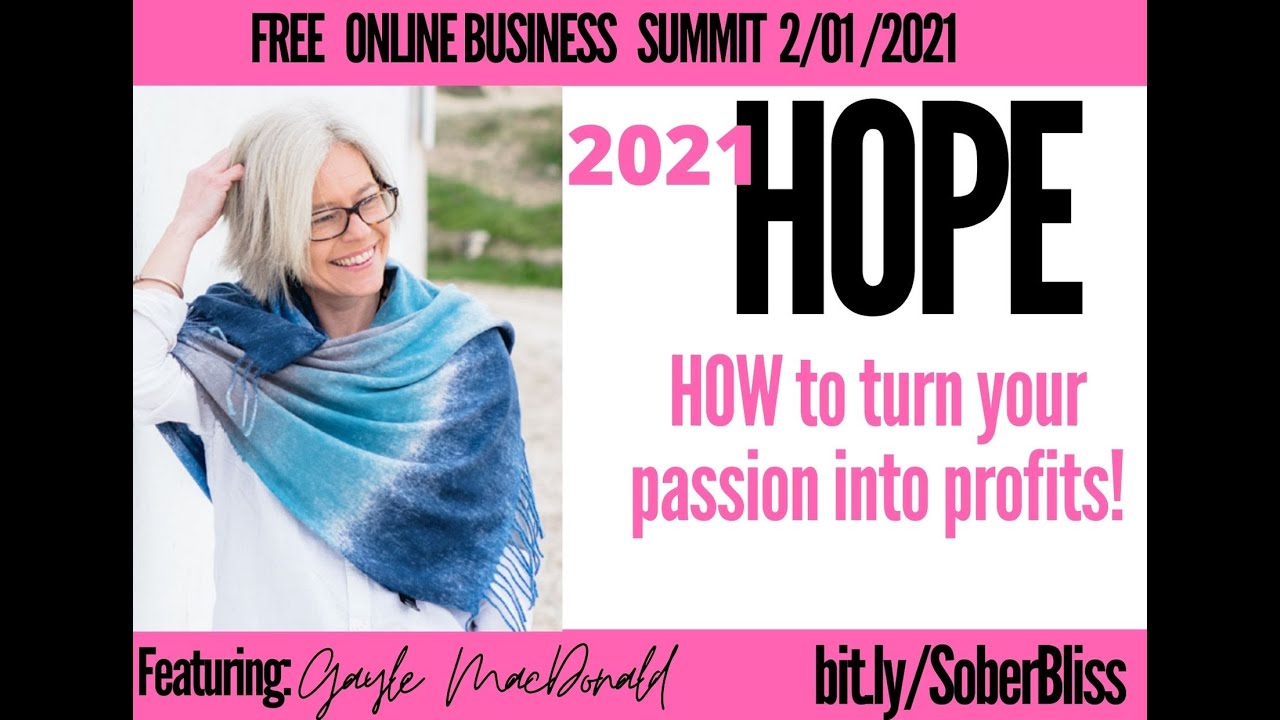
Val Nichols interviews Gayle MacDonald about her sobriety journey and coaching program. MacDonald discusses practical tools for managing cravings and triggers, a Transform coaching program, and a 30-day Sober Inspiration journal designed to help people reclaim their identity while building support networks.
Chapters
Hey everybody, welcome back to day 6 of the 2021 Hope Business Summit. I am so excited to continue the beautiful conversation that we've had going today, and we have someone who is joining us all the way from the south of Spain, and she is a beautiful woman who is going to continue the conversation about, you know, getting in addiction, avoidance, all of those things. And I'm so incredibly excited to introduce this woman because she has such a beautiful heart. She's doing amazing things in the world. She is Gail MacDonald of Soul Bliss. Welcome, Gail.
Hello, Valerie. Thank you so much for having me. I'm excited to be here today.
Yes. So can you share a little bit about You yet, and they are, you know, tell me about, you know, knowing your story a little bit. Um, I would love for you to share, like, how did you get here? What was your inspiration to get here? And share a little bit more about your business and yourself.
Yeah, of course. Um, well, I am coming up to 3 years sober, so that is the main motivation for what I do. I am a sobriety coach mentor, and I help women to transform their relationship with alcohol because, you know, that's what, that's what happened to me. That's what I did. Um, after about probably 5 years of daily drinking, I would say, um, I finally stopped drinking. And the day I stopped, I just knew that was it. I was never going to drink again. And that was a massive, massive thing for me because I'd been struggling for so long, you know, how am I going to do it? When am I going to do it? Now's not the right time. Oh, it's too hard. All of those things. And then when it, you know, I finally made the decision, I was like, okay, this is it. this is it. And I kind of— the reason I kind of knew that in my heart was because the very first morning that I woke up and I hadn't been drinking, I just felt so amazing. If you're, you know, anything like I was, when you're waking up every day not necessarily hungover, but, you know, with that underlying Fog, grogginess, low self-worth. You might, you know, I woke up at 3 o'clock in the morning hating myself most nights because it was just, you know, the regret, the shame, the guilt. I did it again. What's wrong with me? Why can't I do this? So to wake up and feel normal and just feel so light and free, I just thought, this is amazing. And I say it quite a lot, I feel like I've been let into the, the biggest secret in the world, and I just want to share it because I want other people to experience the same feelings that I feel now, even today. Um, it's that freedom, the freedom of the negative self-talk, the freedom you know, obviously of hangovers and feeling ill. So that's why I started Sober Bliss, because it is bliss. It really is. Being sober is just blissful.
I love that. You know, I share this a lot, but people might not know this, but, you know, I too struggled with that same addiction. And I just want to open up the conversation a little bit about, you know, that feeling of you know, when you talked about waking up at 3 in the morning and just hating yourself and like that, like I remember for me, I don't know if I was really waking up very much. It was more like coming to, right? Because that's where my drinking took me. And coming to in the morning and just having that— gosh, I just get so like back in that feeling like that just instant, the voices in your head, just the self-beat-up, the terror, the remembering the disappointment because you promised that you wouldn't do it again or you Promise other people or you say you're not going to drink and then next thing you know, you're like powerless and defenseless against that drink.
Yeah.
Is that what you experienced as well? Like, can you take us a little bit into that, like that feeling and what that felt like for you to just, you know, continually be disappointing yourself, maybe those around you?
Yeah, it's soul destroying, I think. Is how it feels. Because I knew that, you know, the things that I did when I was, you know, after I'd been drinking, the things that I said, the things I didn't do, it wasn't me. You know, I'm, I'm a calm, sensible, quiet person. I like the outdoors. I love my family. I've got loads of energy. But yet I would, you know, put on loud music and dance till 3 in the morning, or I would just forget that I had kids, you know. Forgetting that you've got your own children there, that's just awful.
Mm-hmm.
It turned me into somebody that, that I'm not. And I think those were the main feelings that I experienced when you would wake up at 3 in the morning and just that anxiety and that fear and that terror. Because you think, why can't I stop? You know, what, what's wrong with me? Why can't I do this? Because, you know, I'm quite a strong person, I'm intelligent, but yet I just couldn't. I couldn't talk myself out of it. I would end up talking myself into it, really. Um, and it was just, you know, I used it for everything. And I think my, my self-esteem got so low and I had no confidence or faith in myself that the worst of it was I didn't think, I didn't believe that I could do anything without a drink.
Yes, I love that. And I think that, you know, for anyone that's watching this and is wondering, or maybe they're going through that, like, that's my heart. Like, if you're feeling that you might pick up some clues in this conversation because, you know, for me, like, I was very high achieving on the outside. Everything looked really good. I worked very hard to make everything look good. But on the inside, like, I knew something was wrong with me. And, you know, I went through that same experience like you are talking about of, you know, just not understanding, not getting why I could have the, like, I could have the self-will, the willpower, I should say, the willpower to not eat fast food, to eat healthy, to do all these things. yet I didn't have the control to not drink, right? And I know that there's a lot of people out there that are high achieving, that are in businesses there, that might be going through that where you feel— I love what you said. I want to highlight it for a second of, um, that's not who you are and that's not who you want to be in the world. Because I remember that, like looking in the mirror being like, who are you?
Yeah. Yeah, yeah, it takes, takes everything away from you, doesn't it? Um, and I think it, it makes you believe that you need it.
Mm-hmm.
Um, there's obviously the physical, because it is an addictive substance, you know, alcohol is, is addictive, so that's part of it. But I think the other part of it is because we You know, certainly in my case, I would just use it for everything that I believed that it would help me. I believed that I could only do what I wanted to do with the help of alcohol, and that was difficult. I think that was more difficult to accept than kind of the physical side of it, you know, the emotional attachment, the The mental attachment to it was more difficult to come to terms with and let go than the physical side of it.
Yeah, I agree. So what is your take on it? I'm curious to know what your thoughts and your school of thought around it is. You know, I know there's people out there who will debate that alcohol is— or alcoholism is a disease. It's a choice. You know, I know there's people that don't understand it. You know, I'm— I'm grateful for people who don't understand it because I hope that they never have to go through it. You know, I'm thinking about— I was sitting with a woman just yesterday whose husband is going through some very scary addictions right now. It's not alcohol. It's, it's, it's actually prescribed pills. Right. So there's, there's that justification. But, you know, addicts and alcoholics, we do things in a way that is very scary and unhealthy. Right. And I think about, you know, his poor wife that I was sitting with yesterday. She doesn't understand. Why can't he just quit for me? Or why can't he do it for the kids? Or like, what is your thoughts around the idea of alcoholism? Like, what are your— what's your experience in that?
Yeah. Well, I never associated with the word alcoholic. I don't consider myself to be an alcoholic. But I did have a problem with it, definitely. And I mean, I've never been to AA, but I've read a lot about it. And in my addiction therapy training, we had to, you know, do a bit of investigation. And what I don't agree with— and this is my personal opinion, because I know this helps a lot of people—
Yes.
I personally don't feel that, um, once an alcoholic, always an alcoholic, and that it's a disease and you've got no Power over it. I do agree that is addictive, very addictive, and you do need help if you want to break free from that addiction. But my take on it is that it, it is a choice, even though it might be extremely difficult to take that step and get the help that you need. I do think it has to come from within. And if you surrender to the idea that it's not, you know, within your power to do it, you've got to turn yourself over to God or higher power, you know, which is fine, and it's not your responsibility— I mean, it's not your fault, but it is your responsibility. And I do mean that in the nicest possible way, because that was true for me. It was my responsibility to, to get the help that I needed to get to where I am now. No one else was going to stop drinking for me. I had to do it myself. Um, no matter, you know, how difficult it was and how much help and support I needed, it had to come from within.
Hmm.
You know, um, And I don't think it's a disease because I think that makes it all negative. You know, there's enough stigma and shame attached to it as it is.
Hmm.
So I like to help people see that it is a positive thing to look your relationship with alcohol in the face and decide, okay, I need to do something about this. Yes. I obviously need help, but it's not my fault. However, it's my responsibility to get this help and, you know, do what I need to do to get through it. I love that.
That's beautiful. Because what I hear you say is instead of saying, you know, like labeling yourself as whatever that is, you know, deciding that you have a disease and there's nothing you can do, you're saying, okay, so This happened. Let's face the reality. Let's look at it in the face, your relationship with alcohol. And now let's move forward because it is your responsibility. I love that because, you know, for me, that's the biggest difference between like counseling and all of that, which I've done, and coaching. That is so beautiful that, you know, in counseling, you're kind of staying in that and you're trying to dissect it and you're trying to figure it out. And I'm not saying anything wrong with counseling at all. But the power of that is that, you know, in counseling, there's one way of like looking back and you know, figuring that out. But in the coaching side of it, it's like, okay, so this is what's going on, let's face it, and then let's figure out what do we do to get to change that relationship.
Yeah, yeah, absolutely. Yeah, and I think it's so important, and this is what we focus on a lot, it's so important to start with yourself. And love yourself, care for yourself, respect yourself, and know that you are so worth it, worth, you know, what you have to do. You are so deserving of this freedom and this new life you want to create for yourself. Um, and that's why obviously in my coaching we do look at the issues underlying it and what's caused it perhaps. But we also focus on where we want to go, and how we can get there, and how we can get there in a way that feels good, where we, we don't need alcohol anymore, because we love and care and respect ourselves so much that really we do have everything inside of us. We might just need a little bit of help to, to get it out there.
It's beautiful. I love that because I agree 100%. We have it with inside of us. We just sometimes cover it up with all of the things— distraction, avoidance, the pain. Then we pour alcohol on top of that and it's like destruction, right?
Yeah, yeah, yeah.
So I'm curious to know, um, can you share with us a little bit about your process? Like, what would someone, if they were hearing this and they're like, Yeah, you know, I've tried a lot of things. I'm hearing this. I'm recognizing that this could be something that would work for me. Like, what is your process? What would that look like?
My process is, it's very personal. And I do have a program which kind of follows certain steps, I would say, looking at the reasons behind it, but more importantly, the reasons why we want to stop. And my overall process is looking at it from a positive point of view. It's— my program is called Transform because that's what we do. We transform lives together. When you can transform your relationship with alcohol, You literally can transform your life.
Hmm.
So we work very hard together to build up our self-respect, our self-esteem, and obviously, you know, we look at the underlying issues and we deal with them because they have to come out. We can't keep burying them, but the focus is always on how do I want to feel Who do I want to be? What do I want to do? And how can my sobriety help me with that? So it's about building people up, really, helping them to love themselves enough that we can move on and we can do anything.
Mm-hmm.
You know, we look at the practical things like cravings and triggers and coping with difficult situations, coping with people around us who drink, how to incorporate exercise into our daily lives, good nutrition. There's quite a bit of holistic therapies as well involved, you know. But the philosophy, I suppose, is that everybody is open and they have a willingness to try. So what works for you, just go with that. It doesn't matter what it is. Um, you know, I spent my first 2 months talking to the moon every night and eating cake. That was my thing. Somebody might prefer meditation or yoga or weightlifting, you know. But we, we are open and It's a personal journey. So I help people to use what they've got inside on this journey.
That's beautiful. I love that you talked about the cake because I used to joke that I went from, you know, obsessing about the pints of beer to obsessing about the pints of Ben Jerry's. Like, I definitely put on weight after I quit drinking. And I think, you know, from what I've read the research, and let me know if this is true for you too, I feel like there's an underlying sugar addiction a lot of times with alcohol, or like drinking alcohol, because you're craving that sugar. Do you experience that too? Is that something that you work with?
Oh yeah, absolutely. Yeah, yeah. I talked with a nutritionist once, and there is so much sugar in alcohol. It doesn't matter what you drink. I was a beer drinker. So you can imagine, I was very bloated, because there's just so much sugar in that. But there's sugar in everything, whether it be, you know, wine, or spirits, or whatever. So we do often crave the sugar when we stop drinking. And my, you know, my clients, and the ladies in my membership, they worry that they might be having chocolate in the evening, or they worry that they might prefer a piece of cake to a banana. But really, in the beginning, when we're trying to work through it and get used to not drinking, I say, you know, eat the chocolate, eat the cake, it doesn't matter. And we will eventually be able to work on that as well. So yeah, chocolate and cake were my thing, definitely.
Yes, I know. And it is, it is interesting how you are like, for me, like your body just craves it and it is almost like this, you know, and that is what I heard too, was just like, you know, eat it, eat the chocolate, eat the cake, do the thing because it is a lot better to eat that than make an unhealthy decision and pick up a drink, right? So you have to start all over again.
Yeah. Yeah.
And I'm curious to know too, something else you shared about was, you know, helping people to cope with the everyday life, right? And I know that that's a big thing that I see, and it was a big thing for me too. I call it like changing my sandbox in a way. I had to find new people to play with or had to, you know, maybe not go to that social situation for a while until I had enough strength in being alcohol-free. So how do you teach women, like, what are some of the methods you use or prepare them with in when they're experiencing that, when they're, you know, choosing this new lifestyle choice?
Yeah. Well, I think we have to be realistic to begin with. You know, you've heard me talk about how beautiful it is, how transformational, how freeing and liberating it is not to drink. It is all of that, but life happens, you know. I've spoken to a lot of people lately. I'm from the UK originally, so a lot of my clients are in the UK, and when the news of the 3rd lockdown happened, those people who might have been committing to Dry January just said, okay, I can't do this again, and they reached for the wine. So life happens. It does. And from my personal experience, um, I think we were alcohol-free for about maybe a year-ish, and then we had the biggest financial disaster ever. We were almost repossessed twice. I had to use food banks to feed my family. I've got 2 boys, so I know that, you know, bad things can happen. Just because you're sober, life doesn't become all rosy. So I think it's important to accept that. And also, we do a lot of work on the Sober Toolkit, which you're probably familiar with, and it's about actually listening to your body, your emotions. What do I need in that moment? So if you're suddenly stressed because you've just heard that you're gonna have to homeschool your kids for another 2 months, what is it? Do I need, you know, do I need to scream and shout? Do I need to go and hide? Do I need to cry? Do I need to go and lie in the bath, or do I need to calm down? And it's about finding things which can be chocolate and cake, Also, to help you feel how you want to feel, and not have the alcohol.
Mm-hmm.
My kind of decision was pretty final when I made it. I said, okay, I'm not drinking, no matter what. And that is a thing that helped the most, because it gets rid of the will I, won't I, um, you know, maybe just one, or maybe today. But if you're clear that you're not going to do it, then you can search for other coping mechanisms which will not only serve you in the moment, but they will serve you in the long term. Like meditation, for example. You can't meditate for 10 minutes and everything's all right with the world.
Mm-hmm.
You have to commit to it. But when you do, then you're much better able to cope. cope. And actually, when we're not drinking, we can cope so much better with what life throws at us. Yes.
I love that you said that because, you know, it's this weird thing for me, and I think for a lot of people that go through addictions or, you know, decide to become alcohol-free, and they, you know, you make that firm decision. You know, that's me too. Like, my identity is now I am a woman who does not drink alcohol. That's my identity. And that's not, you know, like, I think there becomes this decision where you actually take action and you decide that's who you are instead of wondering or wobbling back and forth like, well, maybe, I'm not sure, I'm one foot in, one foot out. I think that's where I see people stumbling, whatever it is, if that's alcohol or a new decision they've made to, you know, maybe better their finances or whatever that is. It's when you really decide and create that identity that that's who you are, that really makes the biggest difference.
Absolutely, yeah, yeah. I share the Michael Jordan quote because that's what helped me a lot, where he says, once I made the decision, I never thought about it again. And that's not to say, you know, one day you wake up and, you know, alcohol doesn't figure in your mind, because obviously it's not that simple. But the decision that you're not going to drink no matter what, that's the freeing, the liberating thing. It's beautiful.
I love that. You know, and I hear it said a lot, like, if you had a nut allergy and you swell up and you can't breathe because you eat nuts, you're not going to eat nuts again. But then with alcohol and other things like that, sometimes it's this weird enigma that people will, you know, Until they decide, make that decision that I'm not going to do it no matter what, they can get caught up in that still.
Yeah, yeah, definitely, definitely. That little, you know, the wine witch on your shoulder or the beer monster in my case. But yeah, when you make the decision, then you can shut them up forever.
I love that. And so how important is it in your experience And I can tell you, for me, it was the biggest difference between making it on those hard days in the beginning that when I chose the alcohol-free lifestyle and was choosing a new way, all of a sudden I went from numbing all of my emotions, not having to really cope with anything, to now, you know, life kind of being there and me getting to face it. How important is it for you to get those, the right people, the right circle, the people around you that are going to support you and help you through that?
I think it's a game changer really, because when you are drinking, you're numbing out and you can quite easily go and sit alone and drink. You know, the wine or whatever it might be becomes your friend, and when it's not there, you need You need friends, you need people. I was extremely lucky in the fact that my husband and I stopped together.
Hmm.
So if I was having a bad day, I could say, I'm having a bad day, the kids are driving me mad, I need help. Whatever it might have been, I knew that I had that person there. So he would say often to me, just think of the morning, just think how you'll feel in the morning when you don't drink. And that's what kind of got me through in the beginning. But it is so important because it's, it's like a whole new way of life. And unless you've got somebody who you can check in with regularly, who you can ask questions to, who you can just say, I'm having a wobble, you know, help me, um, it's so, so important. I mean, we have a little In my membership, we have a WhatsApp group, so we can check in regularly with each other, even if it's just to say, I'm doing really good, I'm having a good day, or I'm a bit shaky. You know, it is important to have that support around you, however that might look— at home or in a group or whatever. It's so important.
That's beautiful. Because, you know, based on my experience and what I'm hearing you say is we go from having alcohol as our everything. It's our best friend. It's our companion. And we kind of go through like a mourning or a loss in that. And having community, having support, and also getting in the habit of asking for help.
Yeah.
One of the hardest things for Me to do. I don't know about you, but it's one of the hardest things for me to do is, one, ask for help, two, be seen, and then three, actually receive the help.
Yeah, yeah. Oh yeah, yeah, that definitely, because we think we can do it on our own and, and yeah, we might be able to do some of it on our own, but when it comes down to it That's when you need somebody, I think. When, when the everyday life just gets too much, you want somewhere to go or somewhere, someone to talk to who won't say, have a glass of wine.
Mm-hmm.
You want somebody who will say, you can get through it, you can do it. One of our lovely members last week had a really tough week. And she said, I used all the sober tools, I did all the bubble baths, I did the walking, I did the talking. She was in contact with us regularly, and it does get you through. But, you know, like you said, you have to be willing to ask for the help, because it's there, it's, you know, available to you, but you have to ask for it.
I love that. And with that, I know you have a 3-day experience coming up at the end of February. Can you share a little bit about that?
Yes, it's starting on the 22nd of February, and it's a 3-day experience all about how to cope with life without alcohol. Basically, it's how you can um, get through life when it gets difficult without having to rely on alcohol. So it's going to be over 3 days in a little private pop-up Facebook group, and I'll be sharing my own story, also the tools, the hints, the tips, the tricks that I've picked up along the way. And we'll also be joined by other amazing sober ladies who share how they did it, how they do it. Because, you know, you're not alone. People have gone through it, people are going through it, and if we can help you get through your difficult stage in your life, then that's what we're going to do.
That is so beautiful because, you know, I want people to hear this if they're feeling like this is something that they really want to do. that the shame and the thoughts will tell you you're alone and that you can't be seen, you can't come out and share your story. But let me tell you, once I had the courage to actually start talking about some of the things that were going on in my life and the ways I was feeling about myself, I literally had women come around me that were like, honey, oh, we've done way worse. Like, this is how we did it and this is how we got through through it. And honestly, if I didn't have those people in my life that were like, you can get through this, even to everything comes up in my life now, there's somehow someone around me that's like, I— they've been through it and they can share that strength with me. They can share that hope. And that has been the biggest game changer in my life.
Yeah, yeah, because we're scared, aren't we? We're scared to admit we've got this thing going on. Especially, you know, I'm from England and it's very much a stiff upper lip kind of thing. Okay, just get your head down, just get on with it. In my own childhood, I was brought up to believe that children should be seen and not heard. So, you know, it wasn't natural for me to say, I've got a problem, or I don't agree with this. So that's what we do. We just I call it kind of rushing and numbing. We rush through the days doing the best we can, and then we numb it all out at the end with a drink. So when we want to say, okay, that's it, I don't want to do this anymore, it can be difficult to raise your hand and say, look, I'm going through this, can you help me? But we can, we absolutely can.
Beautiful. So for those who are watching this and are like, I definitely want to learn more, I know that you have a, um, it's the 30-day ebook, the 30-Day Sober Bliss Sober Inspiration ebook. Yeah, we'll go ahead and put the link in the comments. Um, can you share a little bit about that with us?
Yeah, um, it's called 30 Days of Sober Inspiration because I do think it is an inspiring journey, but often it's difficult to find the inspiration behind it. So basically, there's 30 days of a journal prompt to help you, you know, focus on the day, to reaffirm your decision, you know, why am I on this path, what does it mean to me to be sober. There's a mantra or an affirmation to help you through that day. And there's also an inspirational quote, which I love inspirational quotes because they come from other people who've obviously been there, they've done that, and they found inspiration. So I just like to share as much inspiration and positivity as I can surrounding this journey. So the 30 Days of Sober Inspiration will guide you in a beautiful positive way through 30 days of sobriety. You will feel uplifted and joyful and inspired to be where you are on this journey.
That's so generous. Thank you so much. And I'm wondering, you know, for someone who maybe they have some, some time sober or alcohol-free, are they— is this something that would help them as well?
Absolutely, yeah, because, you know, no 30 days are the same. So you might have 30 days that go swimmingly, and then you might have 30 days that are difficult. And also, the more sober time we have, the more we grow and change. So it doesn't matter if you've got 3 days, 3 months, 3 years, there's something in there for everybody. Because it's You know, it's a personal journey, so you can take what you need from the quotes, take what helps you. And because there's some journaling space, you can get your own thoughts, feelings, emotions out as well.
Beautiful. And Gail is very generous and loving and beautiful. She also donated a sober— a virtual sober retreat over on our auction page, so go check that out too. I know we have a couple of bids on that. And, um, how can people find you when— if they want to get connected? Where do you hang out? What social media? What's your website? All of that.
Okay, um, so my website is soberbliss.com, and I'm also on Instagram and Facebook, again soberbliss.com. I also have, um, a YouTube channel and Podcast, all under the name of Sober Bliss. So you can listen, you can watch, you can read. And when you come over and join the, the Sober Bliss community, or if you sign up, there is a free guide to helping you through wine o'clock with a guided visualization as well. So everybody gets that when they, when they join the Sober Bliss community.
Beautiful. And we'll put those links in the comments as well so people can find you. Gail, thank you so much for joining us all the way on the other side of the world. I just love your, your inner confidence. You have this— I don't know, I'm not sure how to describe it besides it's like this kind of like inner confidence where it pulls you in to learn more. And I just want to speak to that because I know you've done the work, right? You've done the work and now you have used this experience you went through that, you know, can be painful, can be confusing, all those things, and now you're creating a ripple effect around the world. So I just want to honor you for that.
Oh, thank you. That means a lot to hear that.
You are so welcome. And thank you guys so much for watching. We will catch you tomorrow for day 7.
Bye! Bye!
More from Val

Kind of Chic to Treat Your Business Like An ACTUAL BUSINESS | ADHD & Business Creator Val Nichols

ADHD Creatives Make The Best CREATORS! I Can't Wait To Show You How! ADHD Content Creator Val

ADHD Creators Never Apologize For This! Be Too Much | Val Nichols ADHD Creator & Entrepreneur #adhd

Fidget Toys for ADHD! What do you think? What do you think is the BEST Fidget toys for an Adult?!



Social Media For Business | Content Pillars | Val Nichols ADHD Business Coach

Your 'TOO MUCH' energy is actually your highest paying brand ASSET In Your Business

