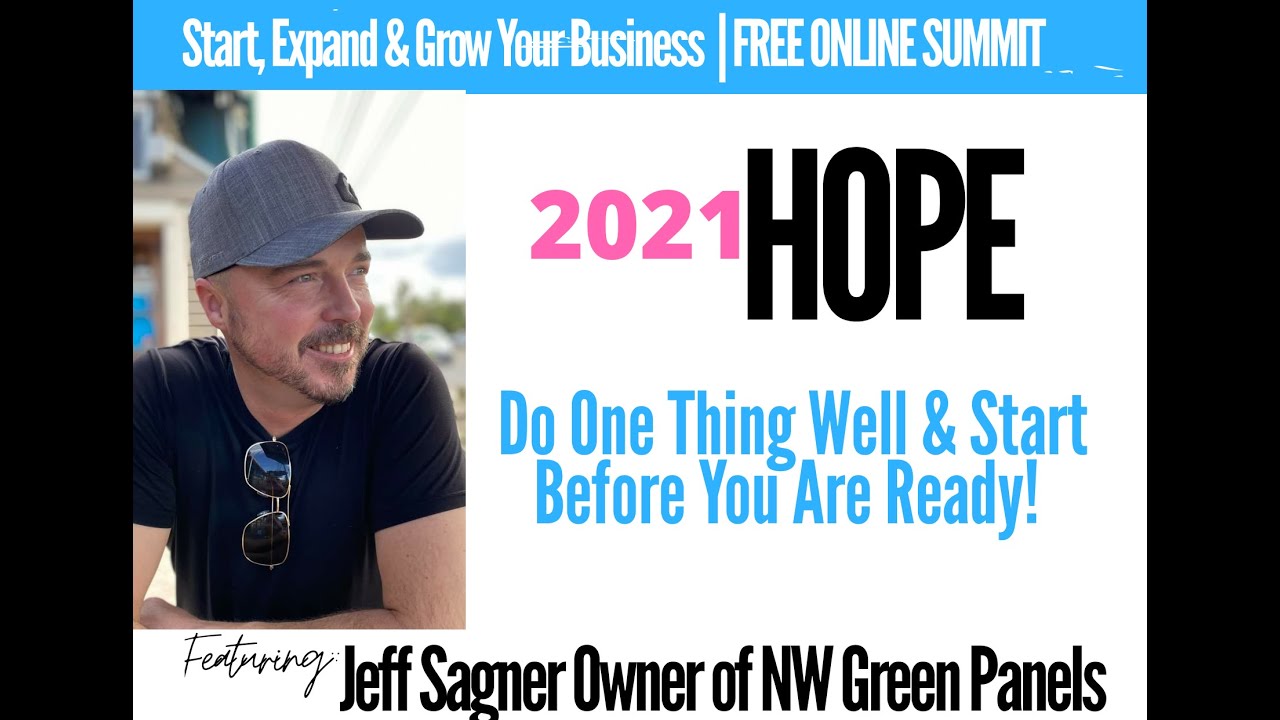
In this 21 Hope Summit session, host Val Nichols opens with an energetic welcome, framing the event around hope, confidence, and overcoming self‑doubt for entrepreneurs. She introduces guest Jeff Sagner, founder of Northwest Green Panels (now NWGP), who shares his entrepreneurial journey from a parenting‑driven need for a home‑grown food source to a $1.5 million‑annual‑revenue modular greenhouse business. Jeff recounts how he built the first prototype in his living room, sold early units on Craigslist, and leveraged a home‑garden show to jump‑start sales. He discusses key lessons: start before you feel ready, the power of branding (and the pitfalls of a geographically‑limited name), the necessity of supportive partners and clear partnership agreements, financial risk management through worst‑case scenario planning, and the importance of a tribe for feedback and accountability. Jeff also outlines current growth—rebranding to NWGP, franchising plans, and expansion into Canada and other U.S. states. Throughout the dialogue, both speakers emphasize trusting oneself, embracing failure as a learning tool, and actively seeking mentorship and honest feedback. The interview closes with practical contact information for Northwest Green Panels and a 10 % discount offer for Hope Summit attendees.
Chapters
Good morning, good morning, good morning, everybody. I hope you are having an amazing day. Let me get in here real fast. For some reason, it is not letting me into this meeting. So let me find out what's going on with the technical side here. Sorry, guys. Let me pull this up. Here we go. There we are. Perfect. You guys, welcome, welcome, welcome, welcome, welcome. To the 21 Hope Summit. We are so excited to be here. This is a business summit for entrepreneurs, small business leaders, anyone out there who's really looking to get the knowledge in their business, maybe go to that next level, and to really hit all of those amazing things that you truly desire. For those of you who don't know me, if you're just hopping on, hello, hello, hello. I know we have had a couple of new people jumping in the group. So, I want to give my biggest, most boldest, most happy, fiery Friday hello. I am so incredibly excited to be your host. My name is Val Nichols. I put all of this together for you because the thing that, you know, I kept hearing and I kept feeling in the world is that what the world needs right now is hope. Oh, my goodness, you guys, have we had some powerhouse Leaders that have shown up, have really just poured into you, that have served, that have given their time, have given valuable information. We had amazing nonprofit leaders yesterday who came in, and I am just super, super pumped. So I want to say hi to a couple of people. Um, Deanna, can you send me your book in the mail? I don't have a book. I don't have a book that I've written. Um, welcome to Toastmasters. Yes, girl, fellow Toastmasters in the house. I love it, I love it, I love it. So, Deanna, I am going to put you in the drawing because I saw that you tagged a friend. Um, so what I'm going to do is I'm going to put you in the drawing. I tagged a friend, and I think you're talking about the book that I drew for last night, I think. And we actually— that went to Beth, that went to a girl named Beth. So I'm going to put you in the drawing here. We do have a really fun drawing going on, you guys, and we have amazing guest for today that I am so super pumped for. I know that I'm pumped for every single day, but let's be honest, like I've hand-selected these amazing business leaders to show up here to serve you. And I know their hearts. I know that they're generous, they're giving, they are all for the cause that we are having here to create hope, to serve. And we are all committed to giving and contributing to the cause. So that is why I've selected them. They are all amazing people. Today I'm going to be giving away this super cute mug that I found. I think I found this at Target. It says— it might be backwards for you guys— I really need a day between Saturday and Sunday. Who feels that way sometimes? Can I get an amen? I kind of need a day between like Monday and Tuesday sometimes. But yeah, we all need a day between Saturday and Sunday. So I'm going to be giving away this super cute mug. And Deanna, I'm going to put you in— I'm sorry, Deanna, I'm going to put you in the drawing so that you can get a chance to win this super cute mug. If you win, If I draw your name, I'm going to mail this to you, so stay tuned. I have that and a couple other prizes. My dog is being weird again. He kept— if you guys were on last night, you saw that he kept popping into our video. I was doing a little live video introducing myself, sharing my story a little bit more. And I'm trying to reach my cord. I just realized my computer has 11% battery, so I'm trying to reach my cord with my toe. Let me grab it real fast. Oops, now I unplugged my light. Oh my goodness. So you guys, I am going to have you put in the comments, put in the comments, why are you here and what are you hoping to get? I'm going to give you guys just a moment. I'm going to go replug in my, my ring light because it looks like I knocked it out when I plugged in my computer. So let me know in the comments, why are you here? What are you pumped about? And what are you hoping to get from this Summit. All right, guys. Deanna says, I love you. Oh, thank you so much. I'm sending you so much love too, Deanna. Thank you, thank you, thank you. Oh my gosh. Okay guys, I am feeling like we need some energy shift right now, right? Like, I'm feeling like this is Fire Friday and we've got to go big. We have got to shift some energy. We've got to shake it up a little bit, right? So I feel like we might have a random dance party coming on. If you are excited for that, let me know if you are excited for a random dance party to come on. And you guys, this is the type of dance party where, you know, like, it doesn't matter if you're in your office, if you're standing up, whatever you're doing, it doesn't matter. Because the truth is that we can move it, we can shake it, we can do it all exactly where we're at. So I am going to put on some awesome, incredible, amazing music. We're going to rock it out for a minute. Are you guys open for that? Are you guys open? I want to see in the comments, are you guys ready? Because here's the thing, I'm going to be sharing a little bit about self-doubt and self-sabotage, right? Self-doubt and self-sabotage. Has anybody here ever experienced self-doubt to the point that you, like, maybe you're analyzing yourself, right? Like, maybe you're You are beating yourself up. You are noticing all the things about yourself that maybe you don't like or, you know, maybe that aren't right or maybe you are doing something wrong. You know, whatever that is for you, we all have this tendency to kind of get in this place of self-doubt. Am I right? Like we get in this place of self-doubt. Maybe we beat ourselves up. Maybe that is the thing. So, I would love if you guys— Just move it out. Shake it off. Shake it out wherever you're at in your chair. You guys, it's Friday. We are here to rock it out. We are here to bring the level energy up. We are here to rock it out. We are here to do all of these amazing things, and we get to do this together. Shake it off. We don't want self-doubt. We don't want any of that. No more. No more, right? That is the thing, right? Like, there is a point in our lives. There is a point in, you know, in everyone's journey where we experience that self-doubt. We experience that feeling of, you know, I mean, I will be honest with you guys. When I was in the corporate world, I used to think like every single time my manager, my boss would say, hey, I need to talk to you. Hey, we need to talk. I would immediately go there, right? Like I would immediately go to that self-sabotage, that doubt, that fear of like, oh my gosh, I'm in trouble. I did something wrong. They're going to fire me, right? Like I would go to that place. I would go to that place. So I wonder if there's anyone here that would ever— has ever done that, because I work with very successful entrepreneurs on a daily basis. I have clients that are literally like— one of my clients just hit $1 million in revenue on Friday. Oh my gosh, $1 million. Another one of my clients, you know, like they've started their businesses in the pandemic. They have you know, make 6, 7 figures in their income. They are like, but they still suffer with that self-doubt, right? Like, and here's the difference between, you know, like you think of self-doubt and you think like maybe about confidence, right? If I was just more confident, then I wouldn't doubt myself. If I was just more competent, then I wouldn't doubt myself. But the truth is You can be extremely competent and not have the confidence. You can be extremely competent and not have the confidence. I have power. Disability Friday. Woo! Yes, girl. Yes. Yes, girl. Yes. And that's the crazy thing, right, Deanna? Like, I was, I was looking at your profile last night and oh my goodness, you are just so cute and adorable and I love your energy. I love your, your vibe and your giving and I love that you're a Toastmaster. That is so awesome. I am too. I love Toastmasters and you know, the cool thing about that is like, so for someone like Deanna, you know, her, her— I'm going to use a quotation— disability is visible, right? You can look at her and say, oh, she's in a wheelchair, you know, there's something going on. But for a lot of us, for a lot of us, that disability is in our head, right? With the self-doubt, with the fear, with all of that that riddles in our minds, we can create this disability that is, you know, like it holds us back. It holds us back. And on the other side, we can be completely confident and have no competence. But if you're competent without the confidence, you will get the competence. Does that make sense, you guys? So if you're confident but lack the competence, you can always get the competence. Meaning that regardless of whatever it is that I've ever done, you guys, and again, being a recovering perfectionist, there's a lot of things in life that I was afraid to go after, or I would do this thing where if I didn't think I was going to win, I wouldn't join, right? Like, if I didn't think I was going to be the best, I didn't join because I was so afraid of, you know, being judged or not winning or doing all of those things. And so I wouldn't even try, right? And we talked about that yesterday, that you only fail if you don't try. You only fail if you don't try. Because here's the thing, no matter what I've done in my business— and you guys, I've only been in business— this will be year 3 since I got my business license, is this month. This month on February 14th, I finally went on and got my business license, and then I started my business officially in July of 2018. So it's only been 2 and a half years. And no matter what's been going on in my life, no matter what I'm faced with, in my business, in my personal growth, in my spiritual development, at Toastmasters doing speeches, right? Like, I just took on the role as president in one of the busiest years of my life, but I stepped up and I said yes because I knew I would grow and I knew that I would learn something. So no matter what's going on in your life, no matter what's happening, you know, whether if it's, um, you know, you want to learn how to build out sales funnels or you want to learn how to market or you want to learn how to do social media, right? Like whatever that is. If I don't know how, if I don't know how to track my KPIs, there's somebody out there that I can reach out to, a mentor, a coach, someone who can teach me, someone who I can learn from, someone who can train me. Or I could just hire it out to somebody that knows how to do it well. That knows how to do it well. And my point in that is that, you know, if you're, you're lacking that confidence, if you're lacking the competence, no matter what happens, you can always find someone who's gone through it and ask them for mentorship, you know, hire them as a coach, get the training, get the skills that you need because, you know, like, we're not all born with confidence. We are not born with confidence. I think even the most confident person in the world, who off the top of my head I can't think of who that is, but let's use like Beyoncé, for example. She is a powerhouse on stage. Beyoncé, Oprah, powerhouse on stage. They didn't just wake up one morning and be like, oh my gosh, I'm so confident. This is amazing. I'm going to go after it. I'm all the things. This is incredible. Oh my gosh, this is incredible. They didn't wake up just feeling that way. If you want to be confident, if you want rock-solid confidence, then you have got to work toward that and start doing things to push outside your edge, right? Like I talked about that yesterday. When you push outside your edge, and it is so interesting, too, because all of the speakers have shared some form of this story, right? Like we started before we knew how. We didn't know what the path was going to look like. And there we were. We didn't know, you know, I didn't know what I was going to do or how that, where the money was going to come from. And they take that step. They took that leap of faith and it showed up. And it showed up. And the crazy thing about that is like, you know, people ask me, how are you so confident on stage? How are you so confident on Facebook Lives? You know, I'll just come on and do a rift and go like, just, just go without really having a topic or subject or anything like that. But you know, like it hasn't always been that way. Go back 3 years ago and I would pre-record and redo and redo and redo and every single— before I'd even put it out. I never went live on my personal page. I hid out in my Wild Tribe group, which is my group of my Facebook group on here on Facebook for entrepreneurs and business leaders. And I would go live on there, but I hid out Because in there it was safe. I had maybe 200 women in there and it was safe. But I was so afraid to go forward, to be on stage, to talk and do those things that I would hide out. I would hide out. So I don't know if there's anyone out there today that is feeling that way. Picture of my face. Yes, girl. Yes. I don't know if there's anyone out there today that is feeling that way, that is feeling like, you know what, I'm not ready. I don't have all the answers. I don't know what I'm going to do. I don't know what it's going to look like. All I know is there's this pull and there's this call on my life that I feel like I am created for something bigger, and I just, I don't know what that looks like. I don't know how to get there. Then let me tell you, the speakers we have today are going to blow your mind. The level of success, the ability that they have been able to create. I have 3 speakers today that are so incredibly powerful. So incredibly powerful. I am going to go ahead and let one of them in. So, you know, if you are thinking that, you know, you are not ready yet, If you're feeling like, you know, you don't know what to do yet. If you're feeling like, you know what, I know that I'm called to do this thing. I know that I'm called to do something bigger. But I have no idea what that's going to look like. And, you know, honestly, I'm afraid. Maybe you lack the confidence. Maybe you lack the competence to move forward, to step into that role that you know you're called to do. I just want to share with you that our first speaker today. Our first speaker is such a shining example of that. He not only started a business before he was ready, but I want to share with you guys, just like I talked about last night, if you guys watched my story last night, you saw that my very first business when I was 11, I was like, I saw this need. I saw a need within myself and I was like, where, how can I fulfill this need? You know, like Seeing where there's— look in your own life because success leaves clues, you guys. Like, success leaves clues. And if you look in your own life and you're like, you know, I'm looking for this thing or I want this answer, and you're looking around like somebody should create that, somebody should do it, let me tell you, a lot of times that somebody is you. That somebody is you. And our speaker today, our first speaker, is such a shining example of that because for the parents out there, you guys are going to understand this. You are going to really, you are going to get this. When he discovered that, you know, they were starting to have children and they are like, oh my gosh, we want to be careful. We want to be intentional about the food that we are putting in their bodies. They started looking around because we live in Central Oregon where it is hard to grow things and it is cold at night and it freezes. They were looking around for a greenhouse so that they could grow their own food. The crazy part of that is Our first speaker today was not ready. He wasn't prepared and he had no idea that what he was going to open up through doing the next right thing, by taking that small step of faith and going out and doing, he had no idea that he would end up building an empire. So, what he did is he started creating greenhouses and sketching out these designs and, you know, in his living room, just like dreaming big and, you know, he allowed himself to go there. He's a visionary. He has this infectious energy, and he just started dreaming and, and drawing. And next thing you know, he builds this beautiful greenhouse. And you guys, if there's anyone that can tell you to go take the steps before you're ready and to trust yourself, to follow yourself, to just go and be, it is our very first speaker, someone that you guys have been asking so much about this greenhouse. So I'm so excited to bring him on. I would love to welcome our very first speaker, who is Jeff Sagner of the— let me unpin myself here. He is Jeff Sagner of Northwest Green Panels. Welcome, Jeff.
Hey, how's it going?
So good. How are you?
I'm doing very well.
Oh my goodness, I'm so excited to have you on here. Um, so I was sharing a little bit about your story to get people excited.
Okay.
Because, you know, the thing I love about your story is that you saw this need, right? And you had shared with me a couple of weeks ago, for those of you who don't know, Jeff and I, like, our stories kind of intertwine in a weird way. We are connected through my husband who I actually met like 13 years ago when he was living, you guys were all living in a house, a bunch of guys were living in a house. He was dating one of my friends very briefly. And then we reconnected and then you and I reconnected and had this conversation on your birthday party, which was really cool. We started talking business because that's what I do. I'm obsessed. And, um, you know, you shared some really cool things about your story. You shared some really cool pieces about how you just saw that need, you know. And I was reading your story on your website too, and I just thought that was so cool that you didn't even know how to build a greenhouse. You didn't know how to do this, yet you went all in.
Yeah, I didn't know the specifics of the actual greenhouse portion for sure. Um, I did have the, the, the the building perspective though. So I knew that was one of my skills that I knew I had, something I knew I could do and, uh, and lean on. So that was, that was kind of a piece of the puzzle. Um, so where would you— do you want me to kind of explain roughly how things got started? And I'm new to this whole, this part of it, so—
Absolutely, yes.
I would let it guide me.
Just share your— share a little bit about your story, who you are. Tell us more about Northwest Green Panels because I've been getting so many questions about you guys, like it's crazy. I have people like with stress strategies, and, you know, they're definitely looking at your stuff. So share a little bit about that.
Okay, well, I'll— I guess I'll start off with just kind of a brief introduction to what started my business and how it happened. Um, I kind of caught the tail end there. I just logged in a couple seconds ago. It sounded like you're kind of explaining it somewhat, but I want to go in a little more. So my wife and I had our first kid coming, and she's, uh, was just finishing up nursing school. Actually, she just finished nursing school, first nursing position. And she, um, we were talking about what we were going to do for dietary needs and all, and just, just being a parent. I mean, we're young, trying to figure it out. And we came up with this conclusion that we wanted to grow our own food for baby food. We thought most of like the root vegetables and stuff we could do on our own, and then we could be confident that there weren't GMOs and pesticides and whatever other thing was in there that we would have to not be— not have to worry about. So anyways, fast forward, we were actually in the valley when that started. So we were in Fairview area, which is near Tiger— not Tiger, excuse me, near Tualatin, Gresham area on the gorge in Oregon. And a really windy area in a rental location, and it had an HOA. And so we had all these little prerequisites we had to knock off before we were able to build any or bring in a greenhouse. And I just couldn't find what I needed out there on the market. So I mean, I looked for a few months and we just could not find what we needed. And me being a woodworker and builder and cabinet guy said, well, I can probably build something. And so kind of came up with an idea and built the, the first, first model just for our own needs. And that kind of, um, the business part came after that. So we did that and a lot of people saw my design and thought, wow, that was really neat. They liked some of the conceptual pieces of it, which I'll get into a little bit more later, but they kind of encouraged me. That's why this is part of one of my little talking points about how to build your business. So I had a lot of people around me who encouraged me and/or motivated me to try something, and they said, hey, why don't you try to sell these things? And so I listened. I think that's a big thing is keeping your ear open and knowing when opportunities present themselves. Sometimes you won't even know it happened, and it might— you might not even realize it happened until a year later. It might be a complete surprise, and you might look back and say, oh, That's why I did that. I didn't realize why I did that, but now I know why. Well, in this case, I had lots of friends and family that were telling me, dude, this is a really cool concept. No one has anything like it. You should try to sell it. So fast forward, Craigslist, 1 year of doing it on Craigslist, had a demo model, sold 7 or 8 greenhouses, um, and thought it was really fun. It was like a weekend gig. And then that's when I decided it was going to be a real business. And, uh, made a big— another talking point is be willing to risk, make it, take a risk. And so for me in this situation, the risk was I had a job and I needed to be able to pour more of myself into this business. So I cut out and went to a smaller job. I went to working in the automotive industry to working at Nordstrom where I could work less hours and have more time to dedicate towards this. And Started selling them on Craigslist. And then in 2013, saw there was a lot of— I was getting traction, but I noticed it was slow and I really wanted to get out there and get in front of more people. So I did my first home and garden show and went into it hoping to sell 4 or 5 greenhouses so I could buy a new table saw and continue to move my business forward. But we sold 30. So the return was just insane. And That's when I had a buddy with me at the time, and we were just like, he quit his job, I quit my job, and we went full board. So, um, that was 8 years ago now, almost 9 years ago. Um, since then, lots happened. I've learned a lot of lessons. And kind of going to your tagline, do something well, um, and start before you're ready. So going back to that, you're gonna— the one downside to going that direction is you're gonna learn a lot of things. Um, so if you go that way, which I did, um, I would highly recommend surround yourself with supportive people, which I mentioned. Don't be scared to fail. But the other thing too is ask lots of questions. Like opportunities like this where you can listen to people speak and talk, this is an opportunity where you can ask questions. Like, I'm gonna— if someone had told me at that point, you know, at that show, like, hey, listen, this is your buddy right now, don't make him your business partner. just have them help you. Um, here's why. And then I would have done that, and then we would have maybe still be friends, but we're not anymore because they say the only thing that— the ship that doesn't sail is a partnership. So you just got to be careful. I know people who've had successful partnerships, but, um, I've learned a lot from it, and I think a successful partnership is writing down everything up front. So I'm sorry, I kind of just went off on a different, different line there, but, um, But anyways, that's how we got started. That year, $170,000 in sales. And every year it's gone between— I mean, it doubled for the first 5 years. And then the last year was actually a 43% increase, which was pretty substantial. So we're doing like $1.5 million in sales the last couple of years. So then this next year, we're getting ready to go international and move manufacturing, still keeping it in the States, but we're going to centralize it and be able to offer the products to more places.
So— Oh my gosh, I just love that. And I'm celebrating a million and a half. That is huge.
Oh my gosh, it's pretty cool.
So I have so many nuggets there that I want people to really pay attention and hear what he said. Because, you know, I too, I didn't necessarily— well, that's not true. Let me back up. I did have partnerships that I thought were going to work out, and it damaged my relationships with them, you know, because there is that clear expectation. We talked about that with someone else on the summit. But, you know, I love that you talk about that because, you know, that's an important piece really when you're starting your business. And, you know, something I love about you is that you're very personable and you're, you know, you're a very likable, charismatic guy. And so I don't think that, you know, going to that, or let me know if this is true, going to that first show, was it like hard? Was it scary? Like how did it feel for you?
It was scary from a financial standpoint. So at that point in time, we just didn't have the money and those shows are expensive. So it's a 1-week show and just to get in the door is over $1,000 for a small space. And it's not like you're getting prime real estate. So, and then you have to build the display. The display model for us was another $1,000. Plus then you have to have marketing materials. So we have to have brochures and flyers. And at this point, I hadn't bought any like logo. I didn't have a logo. I didn't have clothing or polos or hats or I didn't have any branding, I guess is what I should say. And it's kind of the interesting part. I will actually throw another little tidbit out there, is— and this is a mistake that I'm learning right now that I'm dealing with. It's not going to be a problem, but it is, it is something that I wish I'd known in the very beginning. Know how far you want to go with it. So when I did this, I didn't really envision it going past the Northwest, so I called it Northwest Green Panels. And the reason it's not Northwest Greenhouses is because the, the product is actually a modular building system. It's not necessarily relegated to just greenhouses, although primarily that's what I do. Um, we can also build sheds and all kinds of other cool, cool things. Um, but anyways, so now that we're in 36 states and we're getting ready to go international, we're gonna be selling— I got 5 that are gonna go up into Canada next month, so that's my first over-the-border, uh, ones. But, um, now that we're all over the states, I'm realizing Northwest kind of slows things down. And we're also, we're also working on franchising right now. So when I finish that, what's Northwest Green Panels doing down in South Carolina? So, um, what we're doing now is I'm rebranding it to NWGP, and then it's going to be Greenhouses by NWGP. So we're going to maintain our first original brand, but we're going to change a little bit. So if someone had told me in the very beginning, hey, Brand yourself for what your full expectations are, not where you're at now, but where you want to end up. I might have thought a little bit differently about the name of the company, and that would have been a little easier now. But, and then going back to the partnership thing, I do have some friends that have succeeded in that. And anyone who's in that, in that boat, one thing I've learned vicariously through others is if you're going to do it, treat it like a prenuptial agreement in a marriage. Literally talk about percentages, ownerships, not if we disband, but when we disband, how are we going to do it? Create your exit strategy right out of the gate, just right out of the gate before you sign on the dotted line. Create an exit strategy for each partner and then stick to it. I think if you do that, partnership can succeed because then you've got clearly defined roles and you don't have people wondering where they go next. So it's kind of—
Absolutely. Oh my gosh. I love so much about what you said because, you know, something I talk about a lot with my clients is like you're always constantly managing 2 different businesses. You're managing the business you're in now and the business you're moving toward in the future. And I love that you talked about the name piece because for people out there who are, you know, like me, my brand is my name, Val Nichols Coaching. But it's like if I couldn't sell that because then my name is copyrighted, I can't even have like an Instagram account that's you know, with my own name. But, you know, I think that's a good point to bring up for people that, you know, thinking future-wise, like you might have a side hustle right now and you don't realize what could happen.
Right.
You know, you went from this dream with your wife of making food to now $1.5 million in profit international business. Like that is amazing. And I'm not saying that's gonna be everyone's result. But, you know, we always constantly are like evolving and changing. And so If you are starting a business or no matter where you're at, if you're watching this, like really listen to the wisdom that Jeff is saying because he's got some great experience and some great knowledge for you guys.
Yeah. Um, and then, uh, yeah, so what's next? Ask me that question. I'm horrible. I could sit here and talk for days, but I want to make sure that we're touching points that you think are more pertinent to—
Oh, absolutely. And I am just, I'm loving everything you're saying because this is like real wisdom for people, you know, to pay attention to. Because I know, you know, now we're kind of like, we're kind of the rarity because we were entrepreneurs before it was cool. But now it's like this, it's this trend, right? To be an entrepreneur, to have your side hustles, to have the different streams of income. And, you know, so for those people who are out there that maybe they have that side hustle, or maybe, you know, they're writing on the cocktail napkin with their friends at the bar and they're dreaming up this idea and they're not quite sure where that can go.
Right.
What advice would you give them? Because I mean, you could have left it there. You could have said, wow, okay, we built this greenhouse. The, the neighbors think it's cool, but who am I to do this?
Right. Well, I think that's the self-doubt that everyone goes through. Um, I definitely have gone through that in my life many times. Uh, when I was 19, I was working at one of the highest-end cabinet shops on the West Coast, and where I was doing really great work, but I didn't understand it then. Now that I'm older, like, I look back and I'm like, holy crap, man, I was 19 and I was doing stuff that 40-year-olds were lucky to do. Like, I didn't realize I didn't realize what— how, how cool or how special any of that stuff was. And so I think when we're young and we see other people doing things, we think that— I think we think we're just like, we're just normal or average. But the reality is each individual has something really cool and unique about themselves. And you might not— even now today, like with the business, I think to myself like, I, I don't understand how this is so successful because it's just— I, I can't— why didn't anyone else think of it? It's really simple like this. To me, to me, it's simple. And that thing that's in your mind that you're thinking about, and this is anyone listening, that seems really simple, like it's a no-brainer who's going to do it. Well, it's a no-brainer for you. It's not a no-brainer for everybody else. And just like sticky notes were a no-brainer for somebody, now they are for all of us too. But for somebody else, it was a new, a new thing. So I guess trust yourself. You got to have faith in who you are, and you have to, um, you got to make sure to believe in yourself and understand that you are unique and different, and you have something to offer, even if it might be, you know, one little small intricate thing, something that's going to tweak it and make it unique and make it your own. So trust yourself. That's my— that's one of my big things is just trust yourself. And the other thing I want to touch on is I think what holds a lot of people back is fear of failure. And not just like the financial part, which I think that's part of it. I think that plays a factor for a lot of people is you don't want to lose all— you invest money and energy and time. But I think there's like a thing inside of us like psychologically where we just don't want to fail anything. And especially if we make it our own thing. If we go to work for someone and they're teaching us and we don't quite pick it up and we fail, like, oh, they didn't teach us right. But if we make our own way and we're designing the path and we fail, we can only blame ourselves. And I think a lot of people tend to be comfortable being able to offload that responsibility on other people, and it scares people from jumping in. And I would say to you, Don't be scared to fail. Everybody fails. The greatest of the greatest of the greatest fail. Everyone likes to use the Michael Jordan scenario when he didn't make his high school basketball team. There's just, there's some great examples out there of people doing that. And this actually isn't the very first business I ever started. I started a custom cabinetry business or furniture business 25 years ago, which was mildly successful. Um, but it wasn't like this. So I always wanted to do something along these lines, but I just— this is the one time I had people around me that supported me and gave me faith in myself that I didn't have to be afraid of failing. So my mother, my wife, my friends, neighbors, just people were very supportive and, and pushing me to, you know, you can do this. Even my father-in-law, who didn't like me very much at the time, was like, this is a really great idea, Jeff, you got to do this. So just find that support system. Listen to people when they tell you good job. I think we have a tendency to listen when someone says bad job twice as much as when they say good job. When they say good job, listen twice as much as when they say bad job, because more people are going to put you down to not— to not— they don't want to compete with you, so they put you down there. They're down at a different level. So listen to the praises more than you listen to the negative is also another thing I would suggest.
That's huge that you talk about that. I sometimes share about the analogy of the Mexican crabs. I don't know if you've ever heard this, but I'm feeling like I need to share this. Um, you know, the Mexican crabs, like our tribe, our people around us, you know, they always want us to feel safe. They want to protect us in a way.
Mm-hmm.
And they want us to kind of be okay. That's why when you're having a bad day, they'll try and lift you up. But then also when maybe they're afraid you're going to make the wrong decision, you might fail, they want to protect you and kind of pull you back down. And that's such an important piece for being an entrepreneur because like I didn't have anybody in my family. And I don't know if you did, but I didn't have anyone who was an entrepreneur in my family. So I didn't have a lot of people to pattern. So I picked up books, I read, I, you know, found those people. And even today, I surround myself with people who are way more successful than me because I want to get to that level. I never want to be the smartest person. So—
Right.
Is that your experience as well?
Yeah, it is. So I did have my grandmother and my mom both did little ventures at different times. My grandmother actually opened foster homes. She kind of did what she knew she was good at though. So, which is a great thing too. I mean, you're going to start a business, do that. So I wouldn't say I was completely in the blind when it comes to being around that. And I maybe, maybe now that we're speaking, actually, as you're saying that, I probably didn't attribute enough of my success to that. And perhaps that was a bigger impact than I realized. But the other thing too, going back to the listen to the good advice, I remember, to give you an example, I remember my uncle, he wanted to protect me because I remember when I was a kid, I wanted to be a professional basketball player. I was going to be a pro basketball player. I mean, I was an 8th grader. You know, I was pretty avid into it. And my mom was like, if you just keep working hard, you probably can. And my grandma was like, well, you've got to work harder than everybody else and then you probably can. My uncle was like, "You're you're a white guy in the in the middle of the blah blah blah city. You're not going to become a professional basketball player. Why don't you figure out something else to do?" And he wasn't saying that to hurt me. He was saying that to try to protect me. But but he and I mean obviously I'm not a professional basketball player. But uh um the point is you want to surround people people with people that tell you that we're honest with you. This is going to be very hard. and it might be impossible. But if you work really hard, you're going to increase your chances and at least push yourself to try. So. Yeah.
And find those people. I think that's the huge part is like if you don't have that tribe around you, that's like, I mean I only moved from Bend, Oregon to Redmond, Oregon which is only 15 miles away. But when I moved to Redmond, you know, like we live in this, it's kind of like a white-collar, you know, area. And I was like there's nobody around me who is I don't know. It's a lot of workers and, you know, like people like that. 9 to 5ers. Yeah, it's 9 to 5ers and that's great. But like I had to be intentional about finding my tribe because I know for, you know, for successful people, we're constantly like, if you can't find it, we create it. I think that's the entrepreneurial spirit, like finding that tribe. And for me, honestly, like I pay good money for people to tell me the truth. I mean, let's be honest, right? whether if that's an employee that you hire for their skill set and they're going to tell you or if that's like mentorship, coaching, you know, whatever that is, getting in masterminds, that's a huge one too for entrepreneurs. But if you don't have that, because, you know, you were lucky to have a wife and a family that understood. But some people don't have that.
Yeah.
I hear all the time from women who say, you know, like my husband doesn't get it. My husband doesn't believe in me.
That's hard. I don't— and I don't— I don't know how to even combat that because the truth of the matter is I wouldn't have this business if it wasn't for my wife and my relationship.
No.
Find someone that supports you. Like, that honestly is probably the biggest part of my success. When she was going through college, I worked tons of hours. She was— when we first met, she was in school and going to college. I'm like, no, we're not doing that. So we moved in together and I was like, you're not going to school, you're finishing your degree. And so I worked And I supported the last year and a half of her schooling when we met. And then she got her job, she got moving. We kind of did that for about a year, got some stuff caught up. And that's when I was like, you know, I kind of want to try something now. So she had a great job working as a nurse and she kind of pulled off the reins and said, go for it. And so I tried, actually I was doing this and my real dream at the time was photography. So I actually wanted to be a wedding photographer, which I did do for a while. Um, and this was kind of— this business was kind of an accident. So, um, but she was supportive of that and pushed, pushed that. And then, and then my business kind of started taking off. And then she's like, hey, you know, I really want to get my master's degree to be an NP, a nurse practitioner. I'm like, well, my business is successful now. This is about 3 years ago. And I was like, I guess now is your turn. So I went full bore, helped out the kids. She went back to school. She just finished that. Now I'm going at it. So now I'm going back at it, and now we're gonna I'm gonna franchise and we're gonna work on, uh, developing a little bit more efficient manufacturing. And so like, we're just taking turns and we support each other through it. And I know for me personally, it would have been impossible for me to be where I'm at without that. Not to say it can't be done, just is going to require a little more sacrifice, I think, and maybe a, a little longer side hustle. This happened fast over 8 years. If I had to have a side job and the greenhouse business I would probably be about half as far along as I am now. Because the first 2 or 3 years, like the very first year, I worked 70 hours a week for a whole month and I— or a whole year, excuse me. And I made $6,000.
Hmm.
In my pocket, I put 6 grand. Everything else went back into the business. Couldn't have done that if she didn't have a good job and was supportive to help us through that time. So, um, Yeah. That's my, I guess my biggest thing is surround yourself with good people and people who believe in you and believe in yourself.
Yes. I hope everybody watches this interview over and over and over because there's so many beautiful truths in that and so many powerful nuggets. Because I think a lot of people, well, in my experience, there's a lot of people very disillusioned about entrepreneurship. And because of, I'm totally going to do a blanket statement and blame social media even though I'm on social media. Right? No complaint about it. But there's a disillusionment about entrepreneurship that I'm going to put up a sales page, put up a website, and next thing you know, I'm going to travel all over. I'm going to be like living it up. I'm going to have the Mercedes. I'm going to be doing that. But listen to this, you guys. He worked 70 hours a week. And you guys, I can't tell you how much it looks because we traveled a lot before COVID and I was like all over the place for the year before COVID But you know, like what you don't see Is that the work behind the scenes, and people somehow look at you now and they're like, oh, he's, he's just lucky, as if you have this magical combination.
Guys, like, there is luck involved too. I mean, there is. I mean, you, you have to— I mean, there's a little bit of luck. I don't want to come across as like I'm like I've done something like miraculous. Like, I mean, it's— there's definitely some luck. I met the right person, so that helps.
And he did the work, right? Like, he did the 70 hours a week. and be willing to sacrifice that. Because, you know, I think, I just think that there's a disillusionment with Instagram and a lot of these people who can like rent cars and pretend like they're rich.
Right.
Put on a front when they're, you know, there's, that's not the truth. You know, being an entrepreneur, it's almost like I feel like you have to have this, I think we're a little bit crazy, honestly. I think there's like this certain type of personality it takes to have that grit and almost like an obsession Right.
You have to, again, you got to be scared not to lose. I mean, that's got to be, yeah, you got to be ready to lose. That's the big thing. I remember the financial part of it. We went into it and my wife and I were talking because we had, like everybody else, we're married, we had bills. I mean, I had credit card debt and we got married. Weddings aren't cheap normally. So we had a brand new baby. She had a job, she had school debt. She was a college grad from University of Portland, U of P. So So there's all this stuff. And so it's really easy to say, well, I can't potentially sacrifice not making my payment this month. And I came to the conclusion— I was a finance manager, so I looked at credit for a lot of my life. And so I know how bureaus work. And I was like, well, here's the worst possible thing that will happen. I said, love, this is the worst thing that's going to happen. I told her, we do this. It fails, I can't make our payments, we gotta file bankruptcy and start over in 7 years. That's the worst possible thing that can happen. And it would suck and it wouldn't be great, but that's as bad as it gets. Because after that, we're gonna do it again and we'll kick ass then. And you have a great job, that's not going away. I have good skills, that's not going away. So all we have to lose— that's, that's the worst thing that happened. Now what do we have to gain? We have to gain is a life where we can have a business that's hopefully sustaining itself and I can take my kids on vacations and I can— I want to be able to coach my children's basketball team when they're old enough and they're getting close. Those are the kinds of things that I'm focused on now. So that was what we had to gain versus losing, you know, a few years setback. And so that's, I guess that's the other thing too, is just understand what, how bad it could be, and be ready for that, I guess. Be prepared for it. Don't be scared of it. Don't be scared of it. That would be— I say don't be scared of it because people, people get through a lot worse. And I've seen people rise from the ashes, like way worse stuff. So I don't know if that helps.
Absolutely. Oh my gosh, I love that because, you know, there's something I kind of say with, you know, in my own business and with clients, like I really, you know, tell them to manage the worst-case scenario. Like always know that that's a possibility which honestly, if you play the tape through, it's really not that bad. For me, it used to always be like I'm going to be homeless living on the streets because that was, I mean 10 years ago, I was living in my car for a period after destroying my life for a while. But, you know, like, but the thing is like if you have the grit and you have the determination, I have no doubt the economy crashed and all of my clients had to fire, like we would start again and build, right? That's what I'm hearing you say.
Right. That's what I'm saying. Definitely. Yeah, just don't— that's exactly what I'm trying to say. I probably didn't word it quite like that, but, um, just another thing too that I get, um, I, my wife, she's really conservative. So, um, like conservative, I mind it by like, you know, financially, like make sure we're planning for all these bills and payments. So whereas I'm a little bit more flippant with those types of things, um, and maybe that's an entrepreneurial thing, I'm not really sure, but One thing is we'll have a conversation and she'll say, okay, well, this is what you're hoping for, but what, what's worst case scenario? Let's plan for worst case scenario. And I have a motto, and so this is my motto, and this is never going to change. I will never plan for the worst case scenario because I believe that what you plan for is what you get. I will adapt to the worst case scenario and I will plan for the best case scenario. I plan for the best and I adapt to the worst because I think when you— when, when the worst happens, you have that fight or flight kind of thing going on inside of you. and you're gonna react anyways. So why not plan for the good stuff and let the fight or flight take in? And some people would disagree wholeheartedly with that statement, um, but that's how I've done it. I've lived my life that way, and I've made mistakes. I have. But we're doing pretty well. Um, so I, I feel like for me, that's, that's, that's the key to everything. I plan for the best, and I, um, and I will adapt for the worst.
So, so good. Yes, because I am a true believer that what you think about, you bring about. You know, there's like that law of attraction or whatever, you know, not to be woo and stuff like that, but it's real.
It's true.
And, you know, I do think that especially in this time, it's the entrepreneurs who've gotten to that place of surrender and just like, okay, this is what we're dealing with this year, the past year, and then adapting to that. It's the adaptability that will define success or failure Honestly, at the end of the day, I agree. So thank you so much. And where can people find you when, um, so anyone who's out there that's like, I want to check out this company, where can they find you? How can they get a hold of you?
So lots of different avenues. I mean, uh, the, the, the most direct is obviously the website, which is, it's just nwgreenpanels.com. You can Google Northwest Green Panels. You can go to our Facebook page. We have a Pinterest and a— not Pinterest, I don't I don't do that part of it. I hire someone for that. We have an Instagram and Facebook, and I know whatever social media is out there, I'm pretty sure. Um, I know primarily the email is the fastest way through the website. Um, we are really inundated. We've got a lot of orders. We have for the last 3 years. It hasn't really stopped. Um, but we try to get back to everyone within a day or 2.
So awesome. Thank you so much for all of your wisdom. This was awesome. I hope you guys were like taking notes Because there were some great truth bombs there, great skills from, you know, experienced entrepreneurship that I think all of us can use.
I was gonna throw one more thing out there too. Sorry. Um, you mentioned putting together like an offer of some sort.
Yeah.
So if anyone wants to, if you go on and you, and you are inquiring or interested, if you mention this, uh, the summit, the Hope Summit, um, 10% off. We don't— I don't have any $100 or cheap things to give away, but If you want the greenhouse, we're offering 10% off, so just gotta, um, mention the Hope Summit.
So awesome. Thank you so much, that's so generous. I've had so many questions about your greenhouse because we have it up on the auction page. Yes, this is the guy that donated the 8x8 premium greenhouse that everybody's raving about. And you know, I've had so many questions about your, your products and all of that that I was just so excited to put a face behind the name.
Yeah.
And thank you so much for your generosity. And you guys, we will be back on at 11:15 Pacific time with Christina and Vince Shirey. Thank you guys so much. We will see you in just a moment.
Thanks. Bye.
More from Val

Kind of Chic to Treat Your Business Like An ACTUAL BUSINESS | ADHD & Business Creator Val Nichols

ADHD Creatives Make The Best CREATORS! I Can't Wait To Show You How! ADHD Content Creator Val

ADHD Creators Never Apologize For This! Be Too Much | Val Nichols ADHD Creator & Entrepreneur #adhd

Fidget Toys for ADHD! What do you think? What do you think is the BEST Fidget toys for an Adult?!



Social Media For Business | Content Pillars | Val Nichols ADHD Business Coach

Your 'TOO MUCH' energy is actually your highest paying brand ASSET In Your Business

