THRIVE Show Feat. Katie Cianci LCSW - How To Be Mindful In Trauma & Meditation to Remain Centered
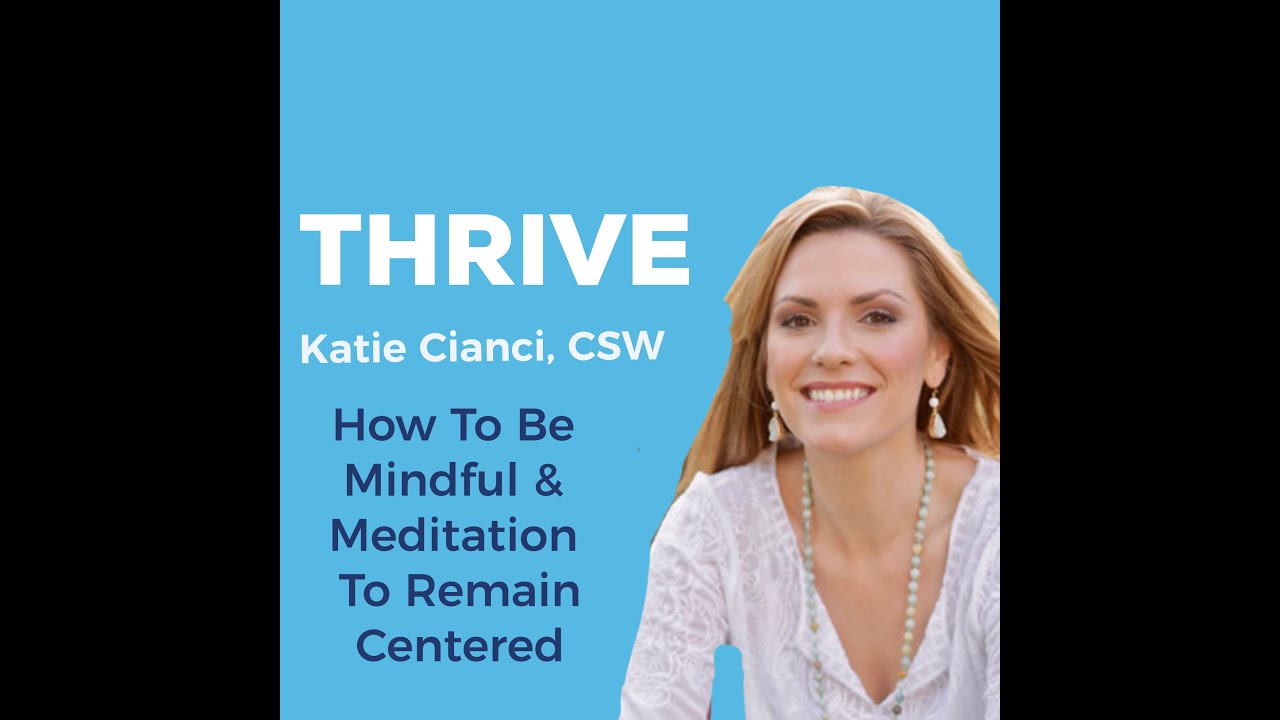
In this episode of the Thrive Show, host (Speaker A) interviews Katie Cianci, LCSW, psychotherapist and creator of A Love Seed. The conversation centers on the mental health challenges posed by the COVID‑19 pandemic, especially for parents, teens, and families juggling work, homeschooling, and uncertainty. Katie explains how the pandemic can trigger trauma responses—fight, flight, freeze, and hypo‑arousal—activating past adverse childhood experiences. She introduces the concept of a "resilience zone" where minor ups and downs are manageable, and offers concrete mind‑body tools to help families stay centered: brief breathing exercises, dancing, movement, nature walks, sensory mindfulness (hot tea, soups, essential oils), touch, art, and playful activities. Katie leads a short guided iRest Yoga Nidra meditation, describing its structure (setting intention, inner resource, body scan) and its benefits for stress reduction and sleep. She shares her community resources—the Love Seed Facebook page and Tribe, a 6‑week "Peace Zone Solution" course beginning April 6, and a free 20‑minute iRest recording. The episode concludes with a light‑hearted "squeegee breath" exercise and encouragement for listeners to connect with her for further support.
Chapters
Hey everybody, welcome to the Thrive Show where we are talking about creating a healthy lifestyle, a thriving business, and a life of intention among the COVID-19 virus. Today I have a special guest who is going to be talking to us about trauma, anxiety, stress, addiction, all the things, because nothing is off the table here. She is the creator of A Love Seed and she has a mission to build resilient communities So that every person has the tools to connect to their true nature, heartfelt purpose, and joy within. Today we have a clinical social worker. She is a psychotherapist. Her name is Katie Sianci, and welcome, Katie.
Hi, thank you so much for having me.
This is such a treat to have you here today. I know that offline, before we pressed record, we were talking about a whole slew of things. And, you know, what are you seeing coming up here in the midst of the virus? I know you've done a couple of webinars to serve people and you've been really showing up and serving the community. So what are you hearing?
Well, what I'm hearing from a lot of moms, especially moms, I mean, there's— everyone's affected by this. The moms that I've been talking to are really struggling because a lot of them are working. So they're still working and they have their kids at home, they're homeschooling. I know as a mom myself, you know, I'm, I'm doing my own thing too, you know, and I have my son here and it's like, you know, trying to figure out how to be teacher, how to be nurturer, how to be employee, having to be, you know, your business if you have your own business, how to be supportive and positive. Meanwhile, behind the scenes, your, your house is like chaotic. And so it's like, okay, we get to keep our, you know, keep ourselves calm and centered amongst the chaos, amongst the crisis that we're in. And so I notice I have, you know, some, some of my clients that I work with are teens. So I have teens that are talking to me about how they're struggling with keeping up with the schoolwork. They're scared about, you know, their friends, their family. I mean, everybody's really scared and fearful because there's so much unknown. And so that's what I see is happening and that's the reality. Some people are getting sick, some people are getting ill with the virus and how do you take care of yourselves? How do you protect your family? How do you treat your whole family? I mean, there's just so much, so many questions.
Mmm.
And with all those questions and uncertainty, it can create like a stress response in our body and I can talk more about that, about what's happening because we're having a normal reaction to an abnormal event. So I just want people to know that, like, if they're feeling like, why are my kids acting so clingy and upset and crying and, you know, not their usual self? And you might not be acting your usual self because you're having a normal reaction to an abnormal event.
Hmm.
So, you know, it's— give yourself some grace. You know, give yourself some love, some grace. And to know that this is, this is something that many of, most of us have never experienced. I don't think, I mean, I know there's been pandemics before in the history of, you know, life. But for us, this is something that is new. It's new and it's uncertain and our world is shifting and changing almost every day. Right.
Yeah, almost hour by hour.
Yeah.
Really. And it sounds like, you know, because we're all in this together. And I know you're in an area that was— has been hit pretty hard down in Southern California. And, you know, this was almost like this unexpected thing because we kind of heard about it, we saw on the news, but then it was just here and everything shut down, everything changed. And You're talking a lot about, you know, having teenagers. And I know there's a lot of people on here that have kids and they're wondering those things like, what do I do? I'm trying to play mom, I'm trying to play dad, I'm trying to be homeschool teacher, I'm trying to like, how do they interact and handle their kids during this time?
I think it's important to have some, some moments of connection with your children. throughout the day, 'cause I get it. If you're fortunate enough to have a job right now or have some sort of work or clients, then you're gonna wanna keep going with that, right? Because you wanna be able to provide and support your family. It is important though to take some time out of your day, even if it's for like 10, 15 minutes, to check in with them. So if you've got a call you're on, get on your call and then right after your call, check in with your kids. How are you doing? How can I support you? And allow yourself some time, just alone time with your kids. So one of the times that's really great with my son is at the end of the night, you know, like right before bed, you know, I really cushion that time, especially now, cushion that time to connect and say, you know, what's coming up for you? And because they're going to be thinking about this before they go to bed, right? What happens right before you go to bed? Everything that's happened during the day. Usually pops up. And so being present, asking questions like, you know, what's coming up for you, and really listening. And if there's fear that comes in, to validate it, to validate, yes, this is— yes, this is scary. Yes, this is uncertain. And right now we are safe. You know, right now, you know, and speak truth to what's happening. If For whatever reason, you're in a place where, you know, you're not— someone's sick in the home. Right now we're sick. However, right now we're taking care of ourselves. We're nurturing our bodies and our souls and our minds, and we're taking care of ourselves. So we're taking care of ourselves. So that keeps them from going to the what-if fearful mode that keeps everyone up at night, and we bring it back to the present moment. So the present moment is what's happening right now. We are safe. I'm supporting you. I love you. You know, just making those opportunities for connection. And you can do that during the day too. So for instance, if someone, you know, if your kids are screaming and yelling, it's like, okay, that means that they're probably out of what we call the resilience zone.
Mm-hmm.
A resilience zone is when your body gets activated, so your your reptilian brain— I'm gonna get a little scientific on you— is our fight, flight, or freeze response that gets kicked in, right? Whenever a distressing event happens. And since this is a crisis, I'm gonna call it what it is. It is— it's completely shifting everything that we've ever known. So it's the crisis. It's a distressing event. And whenever that happens, your fight, flight, or freeze response kicks in. So you have a hypoarousal, which means that you're gonna get jittery, anxious, angry, irritable. You might get super happy and call it mania.
Mm-hmm.
Maybe you're— even if you can't buy stuff on Amazon, you're buying stuff everywhere because you're just like, I don't know if tomorrow's gonna be here, so I'm gonna just live for the moment. And then the hypoarousal is no motivation, feeling like, you know, you don't feel like getting up in the morning. Or you feel tingly in your hands and your feet. Do you have— have you felt any of that? It's totally normal for all of us to feel this. I've felt it. So if you're a human being, you've felt this.
Have you?
Have you felt it?
I haven't, but I was talking to a woman yesterday on a— I'm in a women's networking group and she was saying that, those exact same things. She's like, I don't even want to get out of bed. I'm feeling like tingly and I'm feeling off. And so I'm like, yeah, that's normal, you know. She had had— I know she had some childhood trauma. So this is like that common, that thread that's leading back to that.
Yeah, so I'm glad you mentioned that. So if anyone's listening who's had any kind of childhood trauma, it's most likely going to be activated at this time because it's uncertain. So if you've had moments where you didn't feel safe, either in your home or just in general where you had moments of— they call it adverse childhood experiences, and they're traumatic distressing events that happened before the age of 18, then it's going to be activated. Now, if you've had a trauma after the age of 18, you're still going to get activated because during that time of trauma you didn't feel safe and you didn't feel secure. In this time, we're having that same experience coming up, right? So people aren't feeling safe and secure, so it's going to get activated. So you may have like this roller coaster, big highs and lows, or you may stay low, or you may stay high. But what we want to do is get you to a place where you're in the resilient zone, and that's where you have just minor ups and downs so that you feel pretty, you know, calm throughout the day. You're gonna have some moments of excitement, like when you're dancing or, or out, you know, in nature playing with your kids, but you're able to get yourself back into that zone. And it's helpful to teach your kids how to do that. And There's lots of tools that you can do to help your kids do that. Part of it's dancing, like you said, like doing, you know, we were talking earlier about, yeah, every morning I'm dancing, getting the energy moving, getting it flowing, because what we know is that when we're anxious, we usually stop breathing.
Mm-hmm.
So taking some deep breaths, like just 3 deep breaths and exhaling out. And just 3 of those can start to, to relax your nervous system so that you're not in the fight, flight, or freeze response. When you're dancing, what's happening? You're breathing, right? When you're dancing, you're getting your heart rate going, you're breathing. You can also do, you know, meditation, guided meditation. I have one that I offer, iRest Yoga Nidra, which is a guided It's a type of guided meditation. It's specifically for people with PTSD, depression, anxiety, chronic pain, sleep, you know, insomnia. So it's, it's something that does everything, and I love it. There's going out in nature. So if you— now everybody has something different. I know like states and counties, they all have different rules of what you can do. So if you can go for a walk in your neighborhood or go for a hike. Go for it.
If you—
if that's not accessible to you, then go outside. Go outside and take some deep breaths. Like, just getting the fresh air is going to shift your mood. It's going to remind you to breathe. And you're just going to— you'll feel a huge shift, a huge difference in how you feel. And there's lots of other things. So I could go on and on about what you can— I mean, 5 senses. If you've got tea, hot tea, you're supposed to actually— I did. Have you heard about that with this virus, that drinking hot liquids actually boosts your immunity against this virus?
Wow.
Yeah, I didn't hear that.
Yeah, there was something from Johns Hopkins University. There was some research that came out, but also the World Health Organization talked about that. So making some hot soups for your kids is going to help. Plus it helps them, you know, have them like experience, or hot tea, if you have flavored tea, you know, put a little honey in there and, you know, make it fun and like just smell the tea and like hold it, really like feel the warmth on your skin. That's a mindfulness practice. You're using your senses or when you're eating your food, like really, if you're eating oranges, like taste the orange, experience it, the flavor, letting it burst in your mouth. And like, these are fun things, like little things that you can do with your kids that are— they're so simple, but they're fun. Like, make it— make your experiences as enjoyable as possible because it brings more joy, not only into your life, but also to theirs.
Yeah, I love that. It sounds like a lot of what you're talking about is that intention. Like being intentional, being mindful, which is beautiful. And I'm thinking about the mom or the dad who's here today who's watching this and they're like, maybe their kid has just shut down. How do you, like, what do you suggest for that parent that is trying to check in with their kid or they're trying to reach out, yet the kid is just, maybe they're at the place where they're not receptive? Or maybe it's a spouse, maybe it's a co— you know. There's a lot of people respond so differently, but how do you suggest that they interact?
Yeah, so that's when someone shuts down, they're in the hypoarousal. And kids will do that too. They'll check out, like play their video games, watch YouTube, and they'll just go right into it, or TV, whatever it is. Or your spouse might do that, completely shut down and avoid. And usually they're in the freeze response, so they're not— they're avoiding, right? So it's, you know, it's good not to force them, but just to continue to like check in and say, you know, hey, what's going on? You know, and just really connect, try to do different things with that person. But, you know, some people do need a chance to just have their own space. However, it's not helpful for them to completely isolate. So it's like, hey, what's going on? you know, let's talk about this. And, or what can I, can I just lay next to them can sometimes be comforting.
Mm-hmm.
And just like holding them and just saying, hey, I'm scared too, or this is what's coming up for me, what's coming up for you? And people, I don't care if you love to isolate or whatever, but people love to connect. We just, we want to connect. But a lot of times people don't have words. especially children, they don't know. Like, I had a friend that I overheard her talking to her daughter, was like being really like firm, and she was talking back to her mom, you know. And she's like, hey, what, what's going on? Why are you acting like this? And the girl's like, I don't know. I'm like, yeah, they don't know why they're acting this way or why they're— they don't know because their body is just Is just doing all kinds of stuff inside that feels uncomfortable. And so that's why I say, like, sometimes say, hey, let's go for a walk. Even if they say, no, I don't want to, say, well, we're going. We're going for a walk, or we're going to dance. I'm going to put some music on and we're going to dance. And shift things up and put something on that you think your kids would like, you know, don't just, you know, put on your, you know, your kind of music. I mean, you can, but that will probably just annoy them. You know, do something that they want to do, or, hey, what do you want to do right now? And put the video games away, put the stuff, you know, TV away, and like connect. Because connection is really what helps us through this time. And because we can't go out and connect with people the way we usually do— I'm a hugger, I love hugging people. I would hug people like on, you know, on the street, you know, I mean, I just love it. Because I feel like hugs are powerful. They're healing.
Yes.
So, but we can't do that really, right, with people out. We can't really even be 6 feet. We can't even be close to people. So if you can do that in your home and just create like a hug circle or, you know, do massage, you know, for partners. If some of— if your partner likes massage, you know, do massage, give someone a massage, you know, just give, you know, therapeutic loving connection through touch. And there's just so many ways that you can make this work. I like essential oils. We were just talking about that. So I use, I use doTERRA. That's what I use. And I, you know, I put some on my hand and, you know, smell it, you know, and my kids do it. Or not my kid, my son. But I say my kids because I had my friend over here with her daughter. And we were doing that. We were playing with the oils and, you know, you can do like chalk exercises. That's another thing that people are doing. They're going outside on their front of their house, like in front of the house with— if you've got concrete or whatever, and they write positive messages or just doing fun activities with chalk.
Art, painting, you can do painting.
Create some like fun opportunities for your— you and your kids to do paint. Is this going to air over the weekend?
It'll be probably on Tuesday.
On Tuesday. Okay. So yeah, I mean, I get it. We're all working. Like, this sounds great, but I don't have time for this, Katie. But you, at the end of your workday or even during your workday, set up some projects for the kids to play. And that way They're busy. They're not just watching TV or, you know, on, you know, on the internet. Like, you know, after their schoolwork is done, give, you know, create some opportunities for them to play. Like setting up like PlayStations can be helpful.
It's beautiful. And I'm hearing so many ideas. Like, it's easy for us to focus on what we can't do. And really, you're shifting our energy into what we can do. There's so much. That we can still do to remain healthy, to stay present, to do all these things. I love that.
Mm-hmm.
Yeah. And there's also like workout videos on— I mean, I haven't done it yet. I need to. I've been doing my walk every morning, but I'm lucky that I have really nice paseos that are in my neighborhood so I can walk. And there's lots of trees, but not everyone has that. So, you know, there's so many like free online You know, on YouTube, like yoga, Zumba, dance. I mean, there's— I'm going to do it today because you told— you inspired me to dance. So I'm like, okay, I'm going to find something on there and just start moving. So I mean, there's— this is a great opportunity. I have to say, there's a lot of moms that I know and dads who said, oh, I just wish I could work from home.
Right.
There's someone say, I wish I could work from home. And now you have your wish, maybe not the way that you expected it. You probably didn't think your kids were going to be home with you while you're working from home. However, this is a great opportunity for not only your children to see how hard you work, like what you're doing for the family. And so they get to see you in action, so to speak. But they also— you have an opportunity to connect with them and also see how hard they work. Like at school, you know, I mean, I didn't realize how much stuff my son did at school and all the fractions and I was like, man, like, your teacher is amazing. I have so much great gratitude for her. Like, she really— it's, it's hard to sit down and be like, okay, let's do our fractions. And they do not want to do it. They just want to distract, distract, you know. So it's like, it's an opportunity for us to connect and also have gratitude and be grateful for each other and experience like kindness and compassion. and connection where we may not have been able to do that as much before.
I love it. That is, that's the shift I'm seeing in the world. It's beautiful. So I know that you said you would love to walk us through a meditation. I'd love to offer you that space now if you would like to, if everyone would like to walk with it, walk through it with us.
Yes, I'd love to. Okay, so I'm going to do an eye rest. Yoga nidra meditation. And so what this is, so iRest is talking about intention. So you start with an intention for your practice, and this intention can be anything, any kind of intention for like if you have an intention for the day, you can incorporate this into your practice. And then I also ask you, as I guide you through, I ask you about a heartfelt desire.
Hmm.
So this is something you want more than anything else And it can be what you want in the moment. It could be what you want in the future. So let's say you want to have a thriving business or you want to feel more connected to your spouse or your, your children. You know, I'm going to ask you to think about that. And then an inner resource. An inner resource is a person, place, thing, or experience that you— where you feel safe, Secure and at ease. And so, and don't worry about trying to think about all this at the time. Just know that it will pop up and whatever pops up during the guided meditation is exactly what it's supposed to be. So whatever image or thought comes up, it's perfect. You don't have to think, oh no, no, that's not the one I want. Like, just allow whatever to come up because what we're doing in this practice is, and it's only 10 minutes, the 35 minutes is a much deeper practice and more restorative. So 35 minutes of this practice is equivalent to 2.5 hours of quality sleep.
Hmm.
And it's that powerful. And so we tap into your subconscious so that you can release a lot of stress, anxiety, and limiting beliefs, and you get to tap into your joy, your purpose, your heartfelt desire, and you get to relax your nervous system. So that you feel calm and peaceful. So we'll get started. Okay?
Beautiful.
Settling in, and you can sit up or lie down. So this is a practice that if you fall asleep, it's okay. It's all good. You can snore, you can do whatever, and you're still going to get the benefits. So you can sit up or lie down, and I'm going to use my handy dandy— this is— I love to use this peaceful So I'm going to start with this. I remember that. Yes, I love it. So allow yourself to settle into a comfortable position, and with your eyes open or closed, whatever is most comfortable, welcome the environment and sounds around you.
The touch of air on your skin, sensations where your body touches the surface supporting it, your entire body and mind settling into feeling at rest and at ease. And recall your heart's deepest desire. Longing or mission, perhaps for health, healing, or awakening.
Affirm an intention that supports you in realizing your heartfelt desire during this practice or in your daily life.
Mm-hmm. And welcome in your inner resource, an inner felt sense of ease, security, and well-being in this and every moment. And welcome sensations in your jaw, mouth, ears, eyes, forehead, and scalp.
Head.
Neck and shoulders. Arms, palms, and fingers. Torso and pelvis. Hips, Legs and feet. Your entire body as a field of radiant sensation. Welcoming your experience just as it is while affirming to yourself, I am aware and at ease. Secure and grounded. Welcome your body breathing and the sensation of the abdomen rising, expanding, and relaxing with each breath. Allow the body to breathe itself with the natural rhythm of your breath. And as the body is breathing, allow your felt sense of your inner resource of peace, ease, and well-being To emerge with each breath. Notice and welcome emotions, thoughts, and images that are present in your body and mind. Without trying to change them, as your experience is perfect just as it is. If helpful, welcome opposites of these emotions and thoughts. And actions that help you feel in harmony with yourself and the world around you. Welcome feelings of ease and well-being throughout your entire body and the joy of simply being. Imagine going about your daily life, all the while awake and aware as the awareness in which of all of life is unfolding. Awareness awake and aware of itself. And the joy of simply being. And as you're ready, open and close your eyes several times, and welcoming your inner resource of feeling grounded and connected to yourself and the world around you. And feeling secure and at ease. And as you come back to your waking life, allowing yourself to feel well-being and, you know, experiencing this joy in your daily life.
So beautiful. Oh my goodness. So for people who are watching, where can they find you? Because I'm sure they're going to want to experience more of that.
Well, I have a, I have a page on Facebook. And so it's a Love Seed page. And then I have a Love Seed Tribe. And that particular group is for people who are leaders and heart-centered leaders and healers, and, you know, mothers are healers and heart-centered leaders, right? So anyone who, you know, the Lovesy Tribe is, you know, people who are, you know, are nurturers who like to give. And so I love to give in that group. It just started, so I'm going to be offering more meditations on that group. And then I'm also offering a program at request from many moms that I know and work with. is called A Peace Zone Solution. And so it's going to be a 6-week course where I'll be offering weekly iRest meditations, longer ones with recordings and activities that you can do with your family. And so that you can be more joyful, joyful, calm, and resilient during this time. And that's going to start on April 6th. So they can contact me. I think I can give you a link so they can access it and then also give a free gift. Of a 20-minute iRest Yoga Nidra session so they can have access to that as well.
Beautiful. That is so generous of you. Thank you so much. And any—
and you can contact me anytime. So, you know, I know sometimes people feel like, oh, I don't know if I can contact— just send me a message if you have a question. I want to be of service. This is something like I just— I have all these tools that I want to share with people and Do I have time for one more to share?
Oh yeah, absolutely.
Okay, I'm gonna just surprise you here because I just thought about this. This is a really fun one. It's called the squeegee breath. So I'm going to share this really quickly with you guys. So like stuff like this, I just like, I want to share. I just want to give. So reach out to me. Okay, so the squeegee breath is where you, you take a deep— this is fun to do with your kids. So you take a deep breath in. I'll show you how to do it. And then you smile at the top, really goofy and like silly. And then you squeegee all of your worries away on your out-breath. And so it's fun because it's gonna make you laugh.
Yeah.
You want to try it?
Yeah!
And on this fun note, okay, so we'll take a deep breath in and smile.
Hold it, hold it, hold it.
And then exhaling out, you let it all out. And shake it out.
That felt good.
That felt good?
Yes, I love it.
So stuff like that, you know, I'll be teaching a lot of that.
Awesome.
Well, thank you so much. It has been such a pleasure having you here. I know that people are going to want to be connected with you and learn more about how to, you know, stay resilient, stay calm, stay present during this moment because there's so much beauty right here.
Yes, there is.
If we, if we, if we focus on it, what we focus on is what becomes our reality.
Yes, absolutely. Well, thank you so much, Katie.
It's been a pleasure.
So exciting having you here.
Thank you.
Thanks, guys. We will see you tomorrow.
Bye.
More from Val

Kind of Chic to Treat Your Business Like An ACTUAL BUSINESS | ADHD & Business Creator Val Nichols

ADHD Creatives Make The Best CREATORS! I Can't Wait To Show You How! ADHD Content Creator Val

ADHD Creators Never Apologize For This! Be Too Much | Val Nichols ADHD Creator & Entrepreneur #adhd

Fidget Toys for ADHD! What do you think? What do you think is the BEST Fidget toys for an Adult?!



Social Media For Business | Content Pillars | Val Nichols ADHD Business Coach

Your 'TOO MUCH' energy is actually your highest paying brand ASSET In Your Business

