Vinny O Brien curates three data-driven reads for e-commerce operators: Stratably's Q1 2026 Amazon Strategy Workbook on ad spend and analytics gaps, The Robin Report on TikTok Shop's halo effect for beauty brands, and Acadia's guide to Amazon organic ranking in the AI era. He covers Amazon's Rufus detecting listing-review mismatches and why social commerce predicts retail sales.
Chapters
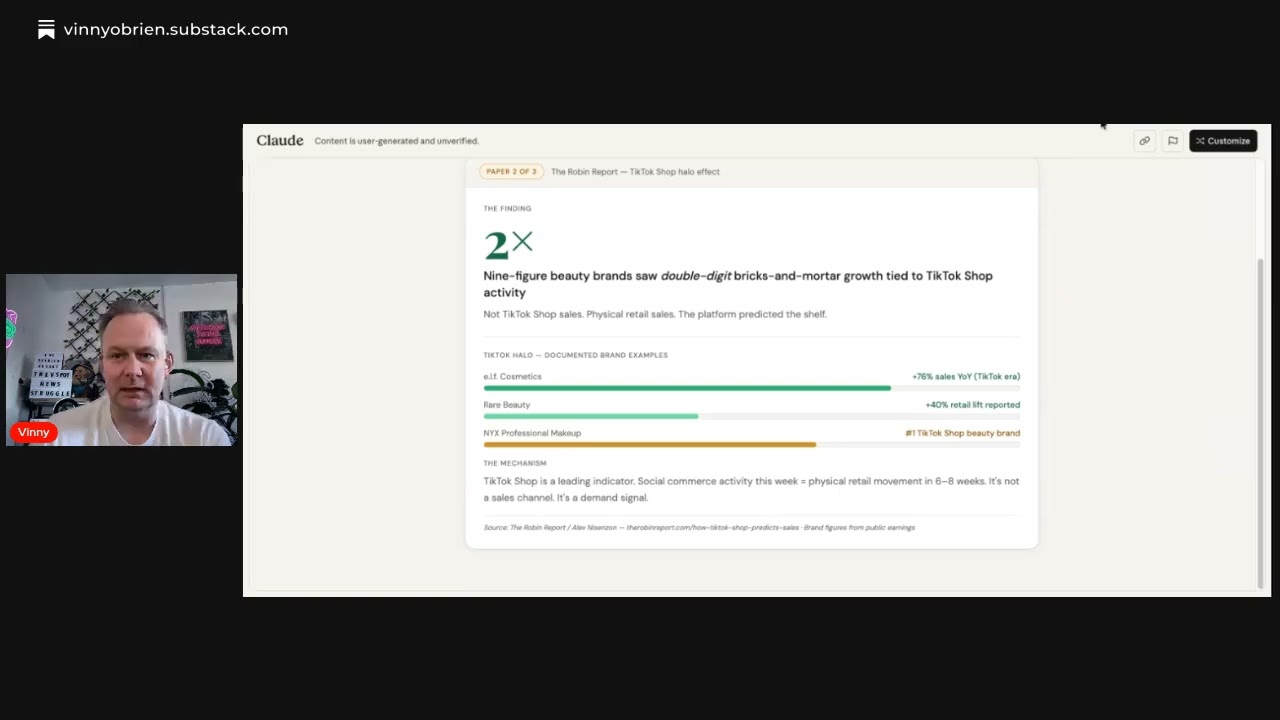
Okay, and welcome. This is the first of something new I am trying. It's Sunday— no, it's not, it's Friday. But I do love a Simpsons joke. Remember back where Homer said, 'I do love lazy Saturdays,' and Marge said, 'Homer, it's Wednesday.' Well, my wife just fell foul of that yesterday. Nice one. So it's Sunday, let's pretend it is. What am I doing right now? Well, you've got the weekend brain on. Maybe you're thinking about the weekend ahead. Maybe you're not, maybe you're not there yet. For those of you going to ShopTalk, you're probably fully focused on that. So I don't want to waste your evening. Every Sunday I'm going to do something that's really simple and I'm going to be joined by guests each week. I'm going to go through my inbox, find those 3 things that actually matter, a paper, a report, a case study, something with data in it. And I'm going to tell you why, as someone running a brand or an e-com business, why you should read it, not summarize it, not replace it, recommend it and give props to the people who've put it together. In most cases, there's going to be someone, a niche group somewhere, maybe that finds this interesting. I'm going to try and give you 3 ideas worth your time and then send you on your way. This is what I call the Le Sunday Supplement. I'm Vinny O Brien, an e-commerce consultant based in Kerry, Ireland. I work with brands across the US and Europe, and I've got roughly 20 years of watching this industry eat itself and grow back stronger, which means I have developed opinions, a decent newsletter— it's questionable— and an increasingly good radar for what's signal and what is noise. So let's do the 3 things this week that are worth your Sunday evening, uh, even though I'm going to send this out on a Friday, but there you go, it's going to be a Sunday show, as I said. So paper 1 is from Stratably. It's the Stratably Q1 2026 Amazon Strategy Workbook. It's titled then, "The data your Amazon lead needs Q2 before it eats them alive." So I'm going to share some of the data with you because this is a meaty one. So bear with me now while I share my screen with you. But the idea here is that I'm going to pick out some ideas from within these papers and case studies that people have carefully put together and start sharing some of these insights with you and why it is you should lead them. So what is it that Stratibeat tell us? They're telling us that 7% of 'First-party vendors say ad spend is tied directly towards AVN with Amazon.' And why is this interesting? Well, Stratably, if you haven't come across them, they're one of the most useful research houses covering Amazon from the brand operator side, not the Amazon side. They've just dropped their Q1 2026 strategy workbook. It's about 40+ pages, benchmarks, forecasts, editable worksheets. And what I like about it is it's not written by Amazon's PR machine. Which is probably a machine, literally. It's written for people who are running the day-to-day business, and that's really where I feel a lot of innovation happens. Now it's behind a membership wall, I've linked it below, but here's why I think that it earns that click. So concept 1, most brands are flying high, flying blind on ad spend, and they know it. So that 7% is a key number here. So Stratably have surveyed 155 brands on how they're changing Amazon ad spend as a percentage of sales in 2026. When you look at what comes back, the variance alone is quite striking. Some brands are pulling back, some are increasing, and nobody agrees on how to account for it in their P&L. Now, 20 years on from when I started, this is kind of alarming that we haven't solved these problems yet. Now, if you're a brand doing serious volume on Amazon, say 7 figures, and you're still treating ads as a cost line rather than a growth variable, you're probably leaving money on the table, or worse, you're spending money that you don't know is working. So that's 7%. There's also this piece in there that only 7% of first-party vendors say that their ad spend is tied directly to their annual vendor negotiations with Amazon. One for you, Martin. Martin Hoiberg, if you're not familiar with who that is. 7%, which means 93% are negotiating on one thing while spending another. That's not really what we call strategy. They're just two separate conversations that are happening that should be one. The second part to note here is that Amazon's AI is learning from you. What do I mean by that? Well, Rufus isn't just reading your product listing, it's cross-referencing it. It's connecting your claims against your reviews. And if you say something like, you know, you're ultra durable, really generic sounding comment there. But if you have that in your title and your reviews say it fell apart in 2 minutes or 2 weeks or whatever, The algorithm is starting to catch that gap. So what's real and what's reality? In eBay, we used to call that item as described or SNAD when we were back in the good old days, significantly not as described. So they're using AI to close the gaps in these sort of things, which is kind of interesting because it's going to start forcing us to be honest about the things that we do, which is not a bad thing. So it's going to clean up some of those listings as well. So if you are a D2C brand and you're selling on Amazon, it's going to be clear for your team putting together the brief for your content guys or girls to say, get this right, it's something we really need to focus in on. And one of the other things when you think about all the great things that LLMs can do, it's starting to pull in all this contextual data. You hear a lot about that over the months and years ahead. That means some of the data that you have out there that you may not know that you own. So conversations that you've had in public and in private,. They can all form part of the sort of contextual data that you're building into your listings. And then there's going to be a regulatory aspect as well. Regulatory, I'm speaking really, really quickly. So for my EU audience, this matters more than ever that if you're trying to scale into the US via Amazon, your localized content might be technically accurate but misaligned how US customers describe the problem that your product solves. So nuance is going to become even more interesting. And that's another gap that Rufus is going to find for us. The third part in this paper that I thought was interesting is the analytics gap. So if I go in here, this was the analytics gap here. Yeah, so we have basic reporting, some custom dashboards connected across many channels, and we've got predictive and advanced analytics. So most brands are not using the data that they already have access to. Stratably measured tracked analytics maturity across 103 consumer brands and their key takeaway? Well, most brands are not using that data that they already have access to, not because they're lazy, but because no one's connected the dots between sales, advertising, and operational data. The tail does wag the dog, as they might say. So if you're a brand operator and you don't have a single point of view in your Amazon business, one place where revenue, ad spend, margin, and content performance all sit together, this is your fire drill. This workbook has an actual worksheet for it, so you can go in and actually play around with it. You can manipulate it, make it work for your own business, or make it shine a mirror up into your face, and that's not a comfortable place to be. But the number is quite striking here. So most people are using basic reporting only, 41% of people, or at least the highest ranked on this one. Then we have some are using custom dashboards, This to me doesn't necessarily make sense because we had a lot of raw data already in Amazon, but with this being exposed into other attribution tools, maybe it's what they're using. And then we've got connected data across some channels. So we really have to start digging in and seeing why are we not using more data. And it's interesting, in all the years I've been using tools and reports, Amazon and eBay data and marketplace data has always been separate and has always been an additional charge rather than it being this one one place that you can gather all of the information that you need. You can gather your operational metrics, your customer support details, you can capture your Shopify revenue, whatever, wherever that's coming from. But if you go to those external platforms, and in many cases because they weren't always available, but they are now, it's more readily available, you should be able to get that cross-channel look at your business and then to start seeing where you can pull those levers, be they operational or otherwise. So there you go, that was the Stratobee Report. There's always something amazing in there. They do great interviews as well, they've great podcast channels, so it's really worth taking time. That was one of the ones that caught my eye, and Amazon Marketplace is being so important right now in terms of growth for businesses. I think it's a good one to have a look at. Up next, it is, um, up next it is the Robin Report, and they're talking about TikTok predicting sales. Now, the Robin Report is something I've been following for quite some time. It's one of those daily pods, those daily emails that I get every single day, and they always put in some really, really interesting information to try and get you to kind of tune in. And because it's daily, they're constantly sourcing news and bringing really interesting things. They always have good guests on to their podcast as well. So you can either read it or you can listen to it. And I think it's really, really helpful. So the Robin Report is a little bit shorter because it's that daily snapshot. So I want you to kind of get a full weight of what this report's actually saying. So they published a piece this week by Alex Nissenson about— it was titled "How TikTok Shop Predicts Sales." The headline finding is this: that 9-figure beauty brands, that's $100 million plus in annual revenues, saw double-digit growth in brick-and-mortar sales that was tied directly to their TikTok Shop activity. Now let that sink in for a minute. That's $100 million plus in annual revenues. So double-digit growth in brick and mortar that was directly linked to TikTok Shop activity. Really, really interesting. So this is not their TikTok Shop sales, physical retail sales. So that's what they are calling the halo effect. So you can see here some of the findings. I use Claude to pull all this together for me. Because I'm incredibly lazy. Doesn't mean I don't second-guess these things, but I thought for this it would be nice to have some sort of a visual sitting beside me so you can see the data that is there. So they found that the 9-figure beauty brands saw that double-digit growth. We can see 3 brands that are mentioned: e.l.f., Rare Beauty, and NYX Professional Makeup. You can see e.l.f. in particular, 76% increase in sales year on year. e.l.f. have been one of those brands that are really interesting to watch. Consistent growth quarter on quarter. They are early adopters in the channels that seem to make sense for them depending on where their customers are. They're not chest beaters, you know, they'll go and they'll make noise in the right areas and they seem to maneuver their way through channel adoption really, really well. And beauty is a category that more than most seems to understand its own space. And I've got this theory that I can't really articulate now, but I'll try to. I think that the best brand owners in beauty understand their space that they occupy so, so well that all of the things they do from a brand building perspective are really natural to them. So they know where their community are, they know how to talk to them, they know what they don't like, they know what they love, they know what's relevant to them and they know what's not. So they really get that brand building piece right. Whereas if you get someone who decides they think they see a gap in an apparel market and they're from an accounting background or someone that just feels like they're trying to fill this gap, and you don't get that same understanding of who that brand is or what it is they're trying to do. So I think there's this really interesting space that the best beauty brand operators occupy because of their inherent love of the thing that they do, or their inherent knowledge of those things that they do as well. I just think that they're really, really smart, um, in, in those areas too. So when it comes to, um, the rest of the report. So why else should you be thinking about this? The mechanism is the same when you're looking at other channels that you should be getting into. So if you're a brand that doesn't sell beauty products and you're not in this category, the mechanism is still the same for you. Social commerce activity on TikTok is now a leading indicator of growth. Everywhere you look, it's one of those places that people are getting to. Live shopping in the US is becoming something that we didn't think it would. Whatnot now accounts for, I think it's about $6 billion in annualized revenue. In the US market, which is not something we would have thought of last year. That's a whole marketplace by itself. It can stand on its own two feet. It's not growing. So if you're a D2C brand and you're in the home, fashion, fitness, or any of those space, anything but a kind of, how would you describe it, a visually demonstrable product, TikTok Shop is a canary for you. It's the canary in the mine. The thing, if it dies, you're not going to lose too much sleep over it, but you've tried it.. And maybe it's the way that you start thinking, how do I do TikTok content? Because it's not as hi-fi as we might think. Its pitch is more lo-fi, more natural. I've seen it work on eBay as well. I spent hours and hours and hours on eBay Live. It was the single best representation of what eBay is in a modern context. People in their warehouse showing their products, getting you to sell them. People were bidding on them in real time. There were sales happening. It was just remarkable. It was just the best representation of what eBay is today. So that's what TikTok is. That's why I think it's important to note that. And then one of the kind of key things to flag to you is this idea that geography matters. That's why I've got that screenshot up right now. The TikTok shop is live and mature in the US and the UK. It's also here in the Republic of Ireland where it's struggling a little bit more in terms of numbers. But I think that's to do with our market size and population size and we're importers by our nature.. So we see these brands everywhere else. We may be looking for something different when it comes to our TikTok shop. But if you're a European brand operator, watch this as well. Watch for the growth of it. They've tested in Spain and Belgium, I think, as well, are two of the other countries. So if you do have a window, go have a look. That halo effect is coming to your market. The brands that are building on TikTok, even the ones in the US and UK, are building this muscle. And that's the idea. I was chatting with the senior director of Nike this morning. He talked about this idea of muscle memory and building various muscles for your business. This is one of those things that I think— it's coming to mainland Europe, you're not too late, don't worry, you're going to be early. So don't waste this opportunity when it does come. Paper 3, and we're almost there. This Sunday Supplement won't just be me talking in the future, it's going to be other people too, which means you're going to bring different perspectives, different things that they notice. And I think, as I said, What I'm trying to do is get to that point where I'm telling you as category operators and owners where to talk about. Paper 3, the other thing I noticed this week was from Acadia. The piece that I focused on was Taming the Organic Wild Part 2: Your Amazon Product Page is Lying to an AI and the AI Has the Receipts. And I thought again, Acadia are one of those agencies that are producing incredible data for years and years now. They are such a big authority on the space that it's unwise not to listen and read to them on a more frequent basis. Now, this one from Arcadia, they're a performance marketing agency, as I said, out of Atlanta, and it's part 2 of a series on organic strategy on Amazon in the AI era, which we are now just embarking on. So they kind of publish an academic paper. It's more like a practitioner briefing, I guess. But the operational insight in here is really, really sharp, and it is better than most of the research reports that I see. So the frame that they're looking through is Amazon's organic ranking, the position your product shows up without you paying for it. Or, you know, it's a really important piece. It was where the early Amazon operators all earned their salt. It's where a lot of sweat went into as well. So it used to be driven by keyword optimization, stuff the title, stuff the bullets, rank high, job done. We've seen that the listings look awful, but they sell really, really well. That world thankfully has gone. So I want to have a look at click-through rate, conversion rate, and impression share. These are the 3 things that will determine your revenue and your ranking. You can't optimize one in isolation. That old keyword stuffing is done. So what drives each? CTR is one on mobile, CVR is one on trust. So again, go back to this idea of trust, and we heard about it a little bit earlier. That consistency between listing claims and customer service reviews. Rufus is reading those as well. So again, it's good to see the reciprocity of this kind of information appearing on multiple reports. And I heard that word being used on a new podcast this week, and they said, I bet you can't get the word reciprocity into your podcast. There you go. I've done it. Didn't take me long. Took me whatever, 15 minutes or so. But the framework says that organic success is now driven by these three interdependent metrics: CVR, CTR, and impression share. And these 3 together are returning or determining your revenue and your ranking. So I think it's something that we should be paying attention to. Now, how you get there, and another thing to consider is, you know, what's good or bad. So most of your customers are probably on mobile. So first image is always going to be your hook. If your product is on a white background shot of your product floating in space and your competitor has lifestyle image that shows you know, something that is a little bit more ethereal, let's say, that answers the buyer question in the first 3 seconds, you're probably losing. So that old packshot idea is something that is changing as well. And for small brands, especially Irish and European brands entering the US market, that is something that your creative director is going to need as part of that brief. And thankfully, some tools are now helping us do that. So it's not about beautiful photography, it's about answering the question before the customer sets out to ask you to do it. So you can see here, and we have the launch, we've got first 90 days, we've got 6 months. This is the time frame for building the systems you need to win on Amazon. So that second part of it, your reputation being a ranking signal to you, we've already talked a little bit about that, so I'm not going to harp on that too much. And then it's the things you think of, like, is this easy to assemble? Can I put it together? Does it need batteries? Is there 12 items in the or is there only one? So all of the things that you can think of, how you develop context into those questions. And a great place to look for this is in your pre-sales questions coming through in your customer service inbox. So have a look through that, and I think that you're going to get there and start building more contextually led imagery. Final part of all of this is, and I just kind of pulled up the image for you to look at there, the plan that The idea here that this is a kind of a one-and-done type task is fallacy. So what you've got to realize is that this is one continuous process and is ongoing. So when you finish it, it's not actually finished. You're back on the wagon for a while. You're going to determine the timing of when you need to go at this again and start changing it all over and saying, well, there's people ranking better than us, something has changed, or there's a market situation that has, or there is a seasonality effect that we need to think of. So all these things mean that you've got to constantly do these things. So the idea that we've got to get back on the bike every day and clock goes back to zero is something that we sometimes struggle with, but that is the job, folks. That is what we are here to do. Um, so that was it really. That is your first Sunday Supplement. This is a pilot episode that I wanted to put together to give you the idea of what it is that I am trying to create. So just to recap on the 3 that I called out this week, And I am grateful to them for constantly putting together great information. And if you want in on this, let me know, email me at vinny@vinnyandco.com, drop me a DM on LinkedIn, and I'll happily read the report that you've put together. But the first one we had, Stratably's Amazon Strategy Workbook, get your Amazon lead to read it before Q2 planning. Looking at the analytics gap alone is worth the membership to that. The Robin Report on TikTok Shop was the second one that I looked at. That was the TikTok Shop Halo Effect. So if you're still treating TikTok Shop like an optional extra, this may be the one that gets you to reconsider that. And then finally, Acadia on Amazon Organic Strategy. Read it, then go look after your product listing. And you know what? It's a great thing to think about in the context of your overall e-com business anyway. All 3 links are going to be in the show notes below. I'll be back next Sunday with a guest you'll be happy to know. And if you think you've got something, as I said, that I should be reading— a paper, a case study, something else with actual data in it or great imagery— send it in. Contact is in the bio, as I said. And this has been the Sunday Supplement. I am Vinny O Brien. Enjoy what is left of your weekend. Thanks for tuning in.
More from Vinny







Where is the consumer now? Reagan took to the field for the V Spot news .. #ecomm #ecommerce



Shopify's $4bn Loan Book and the Winter of Discounts | The Ostrich Report Live
